
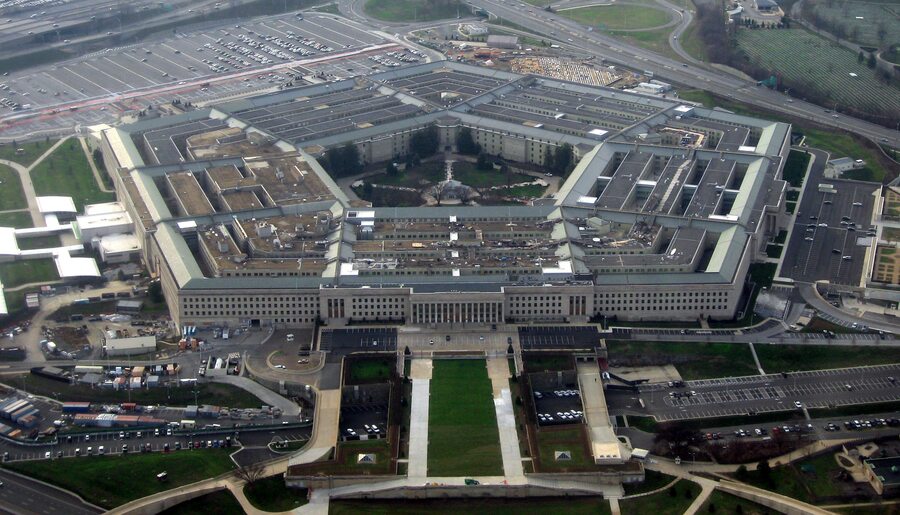
In December 2017, the New York Times published an investigation that forced the United States government to acknowledge what it had spent years concealing: the existence of a secret Pentagon programme dedicated to the study of Unidentified Aerial Phenomena. The programme had a name — the Advanced Aerospace Threat Identification Program — and a budget: 22 million dollars, quietly appropriated through the Senate by Nevada Senator Harry Reid and directed, in large part, to a Las Vegas aerospace company called Bigelow Aerospace Advanced Space Studies. The revelation produced immediate, worldwide headlines. It also raised more questions than it answered.
AATIP, as it became known, ran officially from 2007 to 2012. Its director was Luis Elizondo, a career intelligence officer whose decision to resign from the Pentagon in 2017 — and to speak publicly about what he had seen — helped break open the story the Times was investigating. Elizondo has consistently maintained that the programme did not truly end in 2012, that its work continued under different designations, and that what the government has publicly acknowledged represents a fraction of the actual enterprise.
Less publicly known than AATIP was its sister programme: the Advanced Aerospace Weapon System Applications Program, or AAWSAP. Where AATIP focused on the threat-assessment dimension of UAPs — studying what the objects might be and whether they represented a foreign adversary's technology — AAWSAP operated on a broader canvas. According to investigative journalists and former programme personnel who have spoken on the record, AAWSAP examined not only UAP encounters but the full range of anomalous phenomena reported by military personnel, including incidents at and around Skinwalker Ranch in Utah, a property purchased by Bigelow Aerospace specifically for this purpose.
The distinction matters because it reveals the scope of what the U.S. government was quietly investigating. The declassified AATIP materials, released primarily through the efforts of researcher Steven Aftergood and the Federation of American Scientists, describe encounters with objects exhibiting capabilities that no known aircraft possesses: instantaneous acceleration, hypersonic velocity without thermal signature, low observability, and the ability to transition between air and water environments without loss of performance. Elizondo has referred to these as the “five observables” — a checklist that, in his assessment, describes something that is not of human manufacture.
The 2017 disclosure prompted Congress to act. The Navy revised its UAP reporting guidelines. The UAP Task Force was established in 2020. The All-domain Anomaly Resolution Office followed in 2022. The unclassified reports that have been delivered to Congress since 2021 acknowledge hundreds of unresolved cases. In 2023, former intelligence officer David Grusch testified under oath before the House Oversight Committee that the United States government has, for decades, operated a programme to recover and reverse-engineer non-human craft. AATIP and AAWSAP, in this reading, were not aberrations. They were windows — briefly left open — into an enterprise that had been running in the dark for far longer.
