
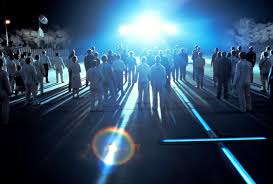
Long before the Pentagon acknowledged the existence of its UAP task force, long before decorated Navy pilots described impossible objects hovering over the Atlantic, Hollywood had already prepared the ground. For more than seven decades, the American film industry has returned, with remarkable persistence, to a single subject: the possibility that we are not alone, and the question of what governments might know about it. Whether that persistence reflects genuine cultural anxiety, deliberate conditioning, or simply the reliable box-office appeal of cosmic mystery is a question the industry itself has never been willing to answer cleanly.
The template was set early. Robert Wise's The Day the Earth Stood Still (1951) arrived not as pulp entertainment but as a Cold War parable dressed in the language of first contact — a visitor from space delivering a stark ultimatum to a militarized, self-destructive civilization. The film was taken seriously enough that the Air Force, then in the middle of Project Blue Book, monitored its reception. Audiences did not panic. They were moved. Hollywood had discovered that the extraterrestrial subject, handled with intelligence, could carry enormous emotional and ideological freight.
The decade that followed produced hundreds of alien-invasion pictures, most of them crude, but the genre's underlying logic was already bifurcating into the two poles that would define it ever after: the alien as existential threat, and the alien as emissary. It was Steven Spielberg who made that second pole culturally dominant. Close Encounters of the Third Kind (1977) was, by any measure, an unusual proposition for a major studio release — a film in which the arrival of extraterrestrial craft is greeted not with weapons but with music, and in which the U.S. government's principal role is concealment. Spielberg has said he drew heavily on the civilian UFO literature of the era, including the testimonies collected by J. Allen Hynek, the Air Force consultant who became the phenomenon's most credible academic champion. The government's cover-up was not incidental to the plot; it was the plot.
The timing of major UFO films and moments of political turbulence around the subject has never been entirely easy to dismiss. E.T. the Extra-Terrestrial appeared in 1982, the same year that a leaked document — later disputed but never conclusively debunked — appeared to describe a secret government group called Majestic-12, convened to manage crash-retrieval operations. Independence Day became the highest-grossing film of 1996, the year the Roswell incident reached its 50th anniversary and provoked a new wave of congressional and media scrutiny. Contact, based on Carl Sagan's novel, arrived in 1997 with an unusually sober portrait of institutional resistance to the possibility of intelligent extraterrestrial life. Denis Villeneuve's Arrival (2016) opened the same autumn that the Hillary Clinton campaign was publicly committing to declassify UFO files — a campaign promise that generated more genuine press coverage than most foreign-policy positions.
Researchers who study the relationship between entertainment and public opinion have long noted what scholars call the "cultural inoculation" effect: the repeated fictional exposure to an idea that is, at the time of exposure, officially denied. By the time a government acknowledges something — whether the existence of domestic surveillance programs, the scale of wartime casualties, or the reality of unidentified objects performing maneuvers that defy known aerodynamics — a significant portion of the public has already processed a version of it through narrative. Hollywood did not invent public belief in UFOs, but it has unquestionably managed and modulated it.
The more provocative version of this argument, advanced by researchers including Robbie Graham in his study Silver Screen Saucers, holds that the relationship between the entertainment industry and the national security state on this subject has not always been incidental. Documents released under the Freedom of Information Act have confirmed that the CIA maintained active relationships with Hollywood producers and writers throughout the 1950s and beyond. Whether that relationship extended to the management of UFO-themed content specifically remains, in the documentary record, unproven. But the circumstantial case is not easily dismissed by anyone who has looked at it seriously.
What is beyond dispute is that the texture of Hollywood's treatment of the subject has shifted in step with the political climate. The hostile-invasion films of the early Cold War gave way to the wonder and ambiguity of the Spielberg era, which gave way in turn to the ironic blockbuster excess of the 1990s, which has now yielded something more sober and less easily categorized. Arrival and Nope and Annihilation are not reassuring films. They do not resolve. They leave their audiences with the sensation of having encountered something genuinely beyond comprehension — which is, by most credible accounts, precisely what the pilots and radar operators and intelligence analysts who have come forward in recent years describe.
Whether Hollywood knows something the public does not, or whether it merely reflects and amplifies what the public already suspects, the convergence is now too sustained to be accidental. The films keep coming. The disclosures keep accumulating. The distance between the two grows smaller every year.
Watch
UFO Films That Predicted Disclosure
Recommended Reading