
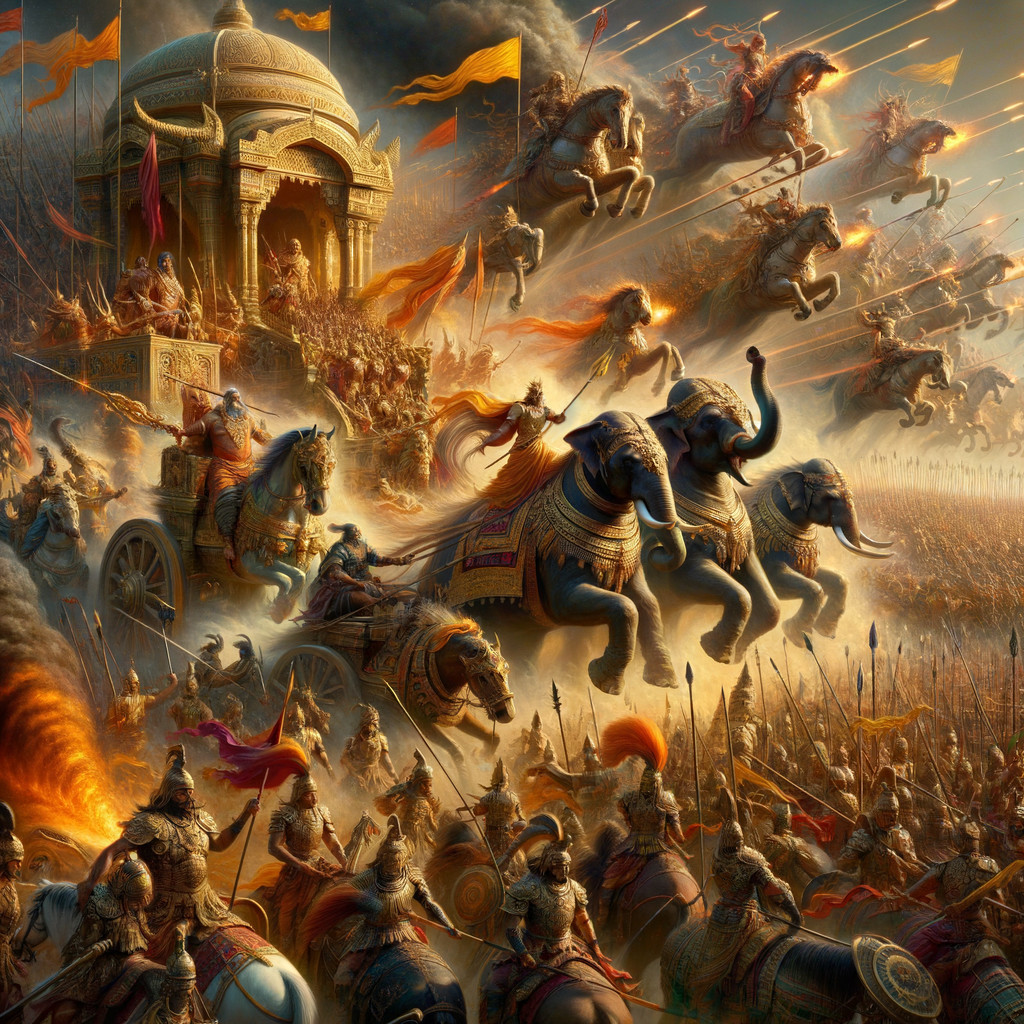
The Mahabharata is the longest epic poem ever written — roughly ten times the length of the Iliad and Odyssey combined. Composed over several centuries, with its oldest sections dating to around 400 BCE and its complete written form to the 4th century CE, it describes a cataclysmic war between two branches of a royal family, the Pandavas and Kauravas, that ends in the near-total destruction of both sides. It is usually treated as mythology. But within its 200,000 verses, it contains passages that have driven researchers to a disquieting question: what if these are not metaphors?
The Vimanas — described throughout the Mahabharata and the earlier Ramayana — are flying vehicles operated by the gods and great heroes. Their descriptions are not vague. The texts specify their shapes (some described as double-decked, circular, with portholes), their motive power (the Vaimanika Shastra, an ancient Sanskrit text, describes mercury vortex engines), their speeds and manoeuvring capabilities, and their weapons systems. The Pushpaka Vimana in the Ramayana moves “at the owner’s will”, travels through the air “like a cloud”, and can carry unlimited passengers. These descriptions predate any known tradition of human flight by thousands of years.
More disturbing still are the weapons. The Brahmastra, invoked by reciting sacred mantras and aimed at a target, is described in the Mahabharata as releasing “an incandescent column of smoke and fire as brilliant as ten thousand suns,” after which “the sky turned as if scorched by ten thousand suns,” and the dead were “so burned that they were unrecognisable.” The aftermath includes descriptions of survivors losing their hair and nails, food becoming poisonous, and water turning black — a catalogue that parallels, with striking specificity, the documented effects of nuclear fallout.
The archaeologist David Davenport, who spent twelve years studying the ancient city of Mohenjo-daro in modern Pakistan, published findings in 1979 suggesting that the city had experienced a sudden catastrophic event at roughly 2,000 BCE. He identified a site where the sand had vitrified — melted and fused into glass — at temperatures in excess of 1,500 degrees Celsius, with the pattern radiating outward from a central epicentre. Conventional explanations have been proposed; none are fully satisfying. The Mahabharata’s account of the Brahmastra includes the specific detail that anything caught in its blast is “reduced to ashes.”
None of this constitutes proof of an ancient advanced civilisation or extraterrestrial technology. But it constitutes, at minimum, evidence that needs a better explanation than the one academic consensus currently offers. The ancient Indian texts describe technologies in operational detail. The physical record contains anomalies consistent with the events those texts describe. The convergence is not comfortable to dismiss.
Watch: Vimanas: The Ancient Flying Machines of India — Documentary
Documentary and interview coverage available on YouTube.
Recommended Reading
Vimana Aircraft of Ancient India & Atlantis — David Hatcher Childress
View on Amazon →Technology of the Gods — David Hatcher Childress
View on Amazon →