
The McMinnville Photographs: America’s Most Credible UFO Photos
Two photographs taken by an Oregon farmer on May 11, 1950. Studied by the U.S. government, independent physicists, and photographic analysts for over seventy years. Never debunked.

“All the Skies That Are Fit to Print”
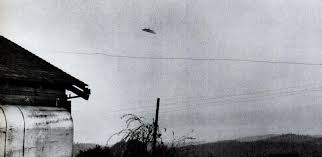
Two photographs taken by an Oregon farmer on May 11, 1950. Studied by the U.S. government, independent physicists, and photographic analysts for over seventy years. Never debunked.
On the evening of May 11, 1950, Evelyn Trent was feeding rabbits on the family farm outside McMinnville, Oregon, when she spotted an unusual object moving slowly across the sky to the northeast. She called to her husband Paul, who retrieved his camera — a Kodak Roamer — and took two photographs before the object accelerated and disappeared. The photographs were developed, shown to neighbours, and eventually published in the McMinnville Telephone-Register on June 8, 1950. Within weeks they had appeared in Life magazine, making them among the first widely circulated UFO photographs in American history.
What sets the Trent photographs apart from the vast majority of purported UFO images is not merely their visual clarity — though both show a distinct metallic disc with a superstructure visible on its upper surface — but the sustained and serious scientific scrutiny they have survived. The images were submitted to the University of Colorado UFO Project, known as the Condon Committee, which studied them in detail between 1966 and 1968. The committee’s photographic analyst, Dr. William Hartmann, concluded that “this is one of the few UFO reports in which all factors investigated, geometric, psychological, and physical, appear to be consistent with the assertion that an extraordinary flying object, silvery, metallic, disc-shaped, tens of metres in diameter, and evidently artificial, flew within sight of two witnesses.” That conclusion, from a government-commissioned scientific body, has never been overturned.
Subsequent analysis by the Jet Propulsion Laboratory and independent researchers using computer enhancement and densitometry — techniques that measure the density of the photographic negative to determine whether an object is at the stated distance or is a nearby small model — consistently supported the conclusion that the object in the photographs was large and distant rather than small and close. A 1975 analysis by Dr. Bruce Maccabee, an optical physicist and Navy researcher, found that the shadow patterns on the underside of the object were consistent with a large, distant, self-luminous or highly reflective metallic surface, and inconsistent with the model hoax hypothesis.
Attempts to explain the photographs as a hoax have been made repeatedly over the decades. The most common hypothesis is that Paul Trent suspended a small model from the overhead wires visible in the background of one image. However, analysis of the wire positions relative to the object’s position, combined with measurements of the negative grain structure, has consistently failed to support this theory. No wire or suspension mechanism has been detected in any analysis of the original negatives. The original negatives, held for decades by the Trent family and later by the McMinnville newspaper, were examined multiple times and found to show no evidence of manipulation.
The Trent photographs have also survived a simple but important biographical test: Paul and Evelyn Trent never sought publicity, never sold their story, and never repeated or capitalised on the incident. In subsequent interviews, both described the event matter-of-factly, without embellishment, and with a consistency that investigators found credible. Paul Trent, a pragmatic Oregon farmer with no evident interest in UFO culture, described the object as “a good-sized mirror” moving slowly and silently. He was not describing something out of science fiction. He was describing what he saw.
The photographs were reproduced in the 1966 paperback edition of Frank Edwards’ Flying Saucers — Serious Business and became a touchstone of the early civilian UFO research community. Today they are displayed annually at the McMinnville UFO Festival, held in the city each May — a community that has built a modest cultural identity around the event, not because Paul Trent sought fame, but because the photographs remain, after seventy-five years, the most thoroughly analysed and least successfully debunked UFO images in the American record.
The McMinnville Trent Photographs — scientific analysis and background
Related: Rendlesham Forest — Britain’s Roswell · The Nimitz Encounter · Betty and Barney Hill