The Tehran UFO Incident — 1976: When Iran’s Air Force Scrambled Jets and Lost
Two F-4 intercepts. Weapons systems failed. Secondary objects separated from the primary craft. The U.S. Defense Intelligence Agency called it outstanding.

“All the Skies That Are Fit to Print”
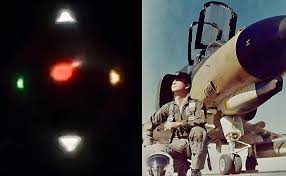
Two F-4 intercepts. Weapons systems failed. Secondary objects separated from the primary craft. The U.S. Defense Intelligence Agency called it outstanding.
The Tehran UFO incident of September 1976 is considered by many UAP researchers to be one of the most significant military encounter cases on record — not because of the number of witnesses or the duration of the event, but because of the quality of the documentation and the identity of the organisation that called it credible. That organisation was the United States Defense Intelligence Agency, which assessed the case in an internal report classified until its declassification decades later and described it as “an outstanding report” that met “all the necessary criteria” for a genuine UAP encounter: multiple witnesses, radar confirmation, electronic effects, and physical evidence.
At approximately 12:30 AM on 19 September 1976, the Imperial Iranian Air Force command in Tehran began receiving calls from civilians reporting a brilliant light in the sky over the city. The duty officer scrambled an F-4 Phantom II from Shahrokhi Air Force Base. As the jet approached the object — described as radiating light in multiple colours — at approximately 40 miles distance, its instrumentation and communications systems failed completely. The pilot turned back toward base. As he did, the systems immediately restored to normal function.
A second F-4 was scrambled. Its crew observed the object as approximately the size of a tanker aircraft, emitting intense white, red, green, and blue lights in a strobing pattern. On radar, it appeared as strong as a 707 airliner. As the second jet closed to within 25 nautical miles, a smaller object separated from the primary craft and accelerated toward the F-4 at high speed. The pilot attempted to fire an AIM-9 Sidewinder missile. His weapons control panel went offline and his communications failed simultaneously. He executed a hard dive manoeuvre to evade; the smaller object followed briefly, then returned to the primary craft.
A third smaller object then separated and descended toward the ground, illuminating the desert below it with a bright light before landing or appearing to land near a dry lake bed. A fourth object was observed near the ground in a separate direction. The primary craft and remaining objects eventually departed. On the ground the following morning, investigators found nothing at the apparent landing site. The crew of the second F-4 reported that the area lit by the descending object had shown a peculiar bright flash, and a civilian aircraft in the area at the time reported communications and instrumentation anomalies consistent with the military crews’ accounts.
The DIA report, written by Lieutenant Colonel Olin Mooy, noted the “classic components of a genuine UFO report” and the reliability of the witnesses. It was circulated to the White House, the CIA, the NSA, the Joint Chiefs of Staff, and multiple military commands. The Iranian Imperial Air Force General who oversaw the investigation stated in subsequent interviews that he had no doubt the craft was not of earthly origin. The Shah of Iran’s government fell in 1979; many records from the period were lost. What survived is enough.
The DIA report was not a routine field dispatch. It was evaluated at the highest level of the American intelligence community and circulated to the National Security Council. The evaluating officer’s conclusion — that the case met all criteria for a genuine UAP encounter — was not challenged or contradicted by any subsequent analysis. It simply went into the archive and stayed there. The Islamic Revolution of 1979 and the subsequent collapse of U.S.–Iranian relations ensured that follow-up investigation with Iranian witnesses became impossible. The case remains frozen at 1976.
The Tehran incident belongs to a category that UAP researchers call fighter intercept cases — encounters in which military aircraft are scrambled to intercept an unidentified object and their onboard systems are neutralised. The same pattern appears in the Nimitz encounter (weapons system unavailable during the intercept), the Belgium wave (F-16 radar lock broken repeatedly), and several declassified Cold War cases. The neutralisation of weapons and communications systems is a specific, documentable feature that is inconsistent with natural phenomena, conventional aircraft, or misidentification. It is consistent with a technology capable of actively interfering with electronic systems.
A reconstruction of the September 1976 encounter — the two F-4 intercepts, the weapons system failures, the secondary objects, and the DIA report that evaluated it as a genuine UAP case.
An examination of the declassified DIA assessment of the Tehran encounter — including the circulation list that reached the National Security Council and the evaluating officer’s conclusions.
UFOs and the National Security State (2002)
Richard Dolan’s history of U.S. government UAP engagement includes detailed coverage of the Tehran case and the pattern of military encounters that the intelligence community classified and retained.
View on Amazon →UFOs: Generals, Pilots and Government Officials Go on the Record (2010)
The Tehran incident is among the case studies in Leslie Kean’s investigation — with commentary from retired military officers who evaluated its significance.
View on Amazon →Above Top Secret (1987)
Timothy Good’s landmark compilation of government documents and military testimony — the book that first brought the Tehran case to wide public attention in the English-speaking world.
View on Amazon →