
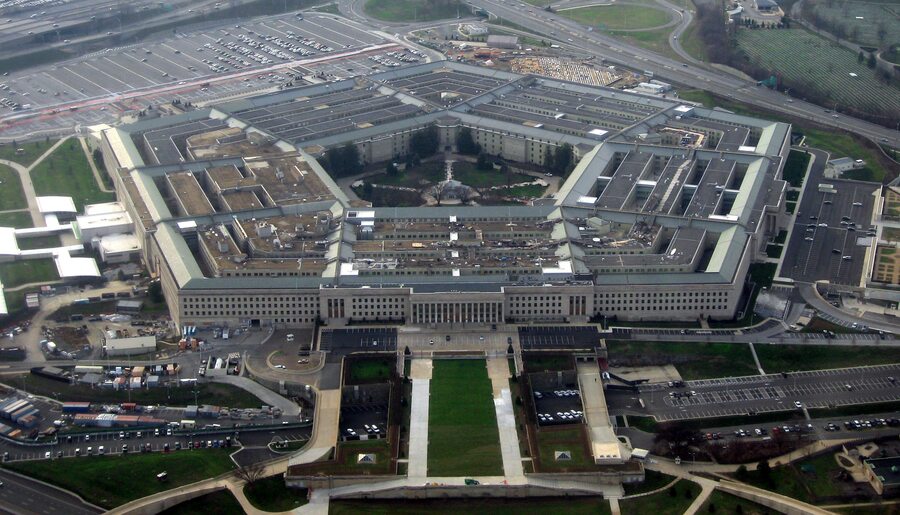
The United States Department of Defense's formal engagement with Unidentified Aerial Phenomena has, since 2017, undergone a transformation that would have seemed implausible to anyone familiar with the institution's prior seven decades of posture on the subject. An organisation that had officially closed its UAP investigation programme in 1969, and that had spent the subsequent fifty years treating public interest in the subject as a nuisance at best and a national security liability at worst, has — under sustained congressional pressure and in the face of a growing public record it could no longer credibly deny — constructed an entirely new institutional architecture for UAP investigation, acknowledgment, and reporting.
The sequence of events that produced this change began, publicly, with the Navy's 2019 confirmation that three widely circulated videos — the Tic-Tac, the Gimbal, and the Go Fast — were genuine recordings of “unidentified aerial phenomena.” The Navy's confirmation followed the New York Times investigation of December 2017, which had forced the existence of the Advanced Aerospace Threat Identification Program into the open. By 2020, the pressure was sufficient that the DoD established the UAP Task Force within the Office of Naval Intelligence — a body charged with standardising UAP reporting across the military services and analysing the resulting data.
The first unclassified report delivered by the UAP Task Force to Congress, in June 2021, covered 144 military UAP encounters and resolved exactly one. Its language was notably restrained: it described objects that had been observed to accelerate at rates no known aircraft could match, to operate without visible propulsion, and to transition between air and water environments, while carefully avoiding any conclusion about what those objects might be. The report acknowledged that the stigma attached to UAP reporting was suppressing disclosure. It recommended improved reporting infrastructure. It did not recommend, and the DoD did not implement, any new classification review that might have explained the gap between what was publicly acknowledged and what researchers believed the classified record contained.
The successor to the UAP Task Force, the All-domain Anomaly Resolution Office, was established in 2022 with a broader mandate. AARO is charged with coordinating across all military services and relevant intelligence agencies, and with providing annual reports to Congress. Its first director, Dr. Sean Kirkpatrick, oversaw the production of a historical record of UAP reports dating to 1945 — a record that, in its unclassified form, captured hundreds of unresolved cases while explicitly noting that the most sensitive relevant material remained classified.
The tension at the centre of the DoD's UAP engagement is this: the institution is simultaneously being directed by Congress to be transparent, and being accused by credible whistleblowers of maintaining highly classified programmes that contradict its public positions. David Grusch's 2023 Congressional testimony — that the DoD has been operating, outside normal oversight channels, a programme to retrieve and reverse-engineer non-human craft — remains unresolved. The DoD has neither confirmed the programme's existence nor, despite the specificity of the allegations, produced a documented investigation of their substance. The architecture of public accountability that has been constructed since 2017 is, in the view of the researchers and legislators who built it, a floor. The question is how far the ceiling is above it.