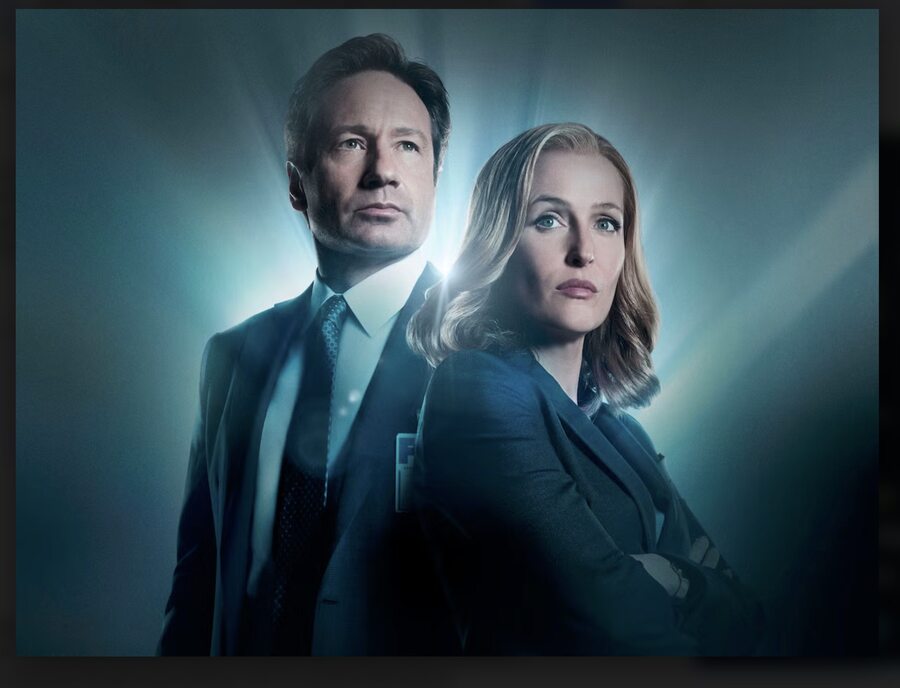
In popular culture, few television series have captured the tension between the unknown and the rational quite like The X-Files. Created by Chris Carter, the show ran for nine seasons from 1993 to 2002 — and then returned for two more — weaving together paranormal mysteries, government conspiracies, and the enduring question of extraterrestrial life. At its heart was a simple yet profound idea: truth exists, but it is often hidden behind secrecy, institutional denial, and manufactured doubt.
Almost everything The X-Files imagined has since found some echo in real disclosure events. The show depicted a secret government programme studying recovered craft and non-human materials. In 2017, the New York Times confirmed the existence of AATIP — a classified Pentagon programme doing exactly that. The show depicted military pilots encountering objects with capabilities far beyond known technology. In 2019, the U.S. Navy officially confirmed the authenticity of FLIR footage showing precisely such objects. The show depicted congressional officials pressing for answers that the intelligence community refused to provide. In 2023, former intelligence officer David Grusch testified under oath before Congress that the U.S. government had recovered non-human biologics and intact non-human craft.
The Mulder-Scully Dynamic as Epistemological Model
Agents Fox Mulder and Dana Scully embodied the eternal conflict between belief and scepticism. Mulder’s relentless conviction in UFOs and the paranormal clashed with Scully’s disciplined, scientific doubt. Their partnership challenged viewers to balance open-mindedness with critical thinking — and that tension was not incidental. Chris Carter has stated in interviews that the show was designed to hold both positions simultaneously, refusing to resolve the ambiguity. The result was a format that taught its audience to ask questions rather than accept easy answers, from either direction.
That epistemological posture — sceptical enough to demand evidence, open enough not to dismiss testimony — is the correct one for anyone approaching the UFO subject seriously. It is, not coincidentally, the approach that has produced the most credible research in the field.
Influences That Reached Further
For many viewers, The X-Files was the beginning of a longer journey. The researchers it gestured toward — often obliquely — turned out to be real: J. Allen Hynek, the Air Force’s own scientific consultant for Project Blue Book, who concluded publicly that the subject deserved serious investigation; Philip Corso, the Army colonel whose account of handling recovered Roswell materials became one of the most contested and scrutinised testimonies in the field; George Knapp, the Las Vegas investigative journalist who broke the Bob Lazar story and has spent three decades following threads that most outlets will not touch.
The show also created an on-ramp to the ancient mysteries field. Viewers who followed the threads outward eventually encountered Erich von Däniken’s Chariots of the Gods, Zecharia Sitchin’s Sumerian interpretations, and Graham Hancock’s geological evidence for a lost civilisation predating the known record. Whether or not one accepts those conclusions, the questions they raise about the official version of human prehistory are not easily dismissed.
What Fiction Understood Before the Institutions Did
The deeper question The X-Files raises is not whether specific plotlines were accurate. It is why a fictional television show in 1993 was mapping the contours of a reality that official institutions would not acknowledge for another twenty-five years. Either the writers were extraordinarily prescient, or they were drawing on sources — consultants, leaked information, the accumulated testimony of credible witnesses — that pointed toward something real. Carter has never fully answered this question, and the ambiguity is probably intentional.
The truth is out there. The evidence suggests it always was. The show’s achievement was to hold open the possibility at a time when every institutional force was working to close it.
Watch: CIA UFO Files — Declassified Documentary
The classified infrastructure that inspired The X-Files — now partially confirmed by official declassification.