
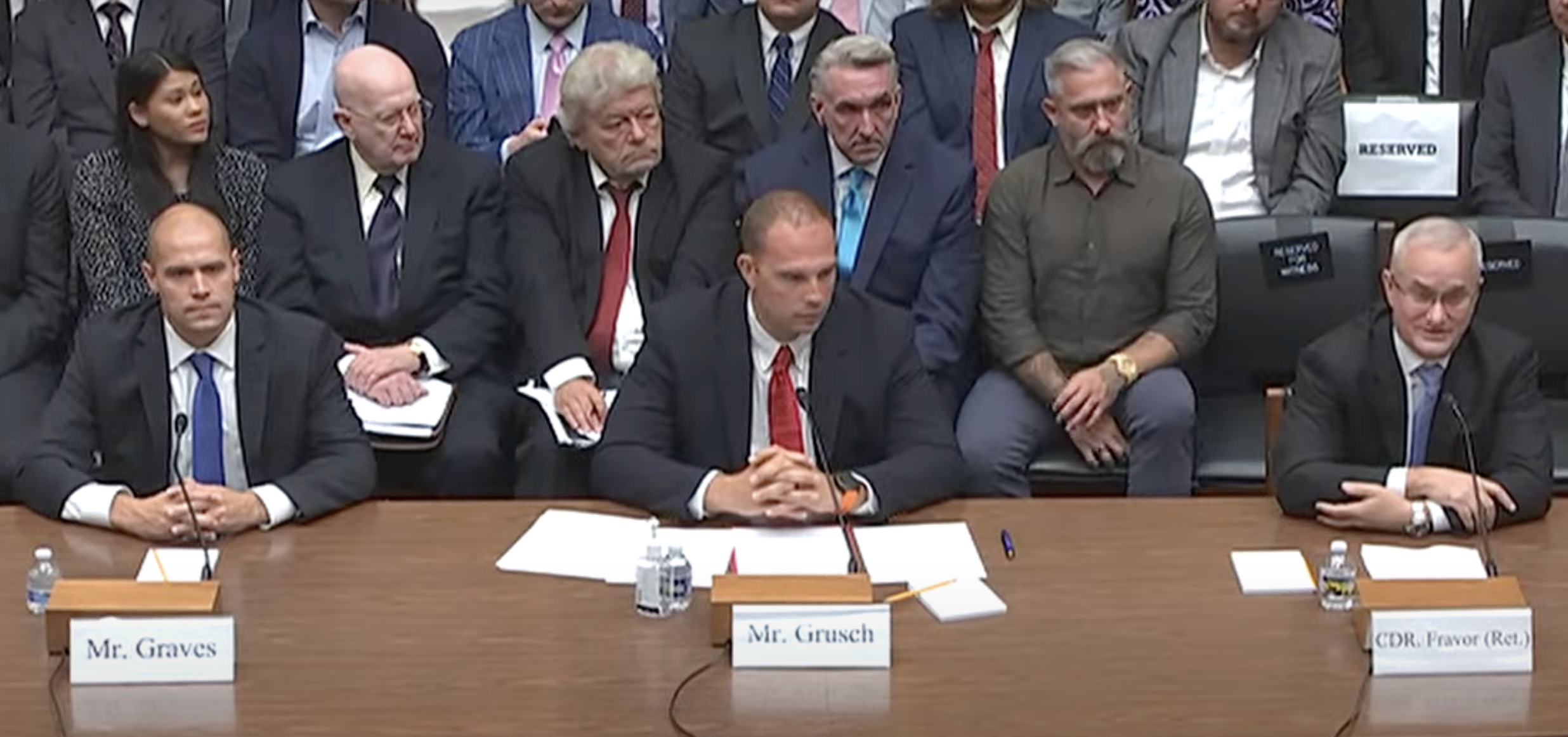
On July 26, 2023, three witnesses sat before the House Oversight Committee's national security subcommittee and said, under oath and in public, what no one had said in that setting before. Ryan Graves, a former F/A-18 Navy pilot, described near-daily encounters with objects his squadron had no name for during operations over the Atlantic. Commander David Fravor, retired, described the Tic-Tac encounter of 2004 — an account he had given many times, but never before to Congress under oath. And David Grusch, a former Air Force intelligence officer who had served as the UAP Task Force's representative to other intelligence community elements, said the United States government has been running a programme, for decades, to retrieve and reverse-engineer non-human craft — and that people with knowledge of that programme had faced retaliation for attempting to disclose it.
The hearing was the product of years of pressure from a bipartisan group of lawmakers who had concluded, through classified briefings and conversations with intelligence community insiders, that something of significance was being withheld from Congress. Senator Chuck Schumer and Senator Mike Rounds had co-sponsored the UAP Disclosure Act in 2023 — modelled explicitly on the JFK Records Act — which would have required the declassification and transfer to a new review board of all government UAP records. The act faced fierce resistance from the defence establishment and was significantly diluted before passage. Its sponsors described the resistance as itself revealing.
Grusch's testimony was the centrepiece of the hearing, and it was extraordinary. He stated that he had been told by multiple individuals with direct knowledge and appropriate security clearances that the U.S. government is in possession of non-human biological material and craft. He said he had been denied access to relevant programmes when he had attempted to investigate them through official channels. He said colleagues and whistleblowers had faced illegal retaliation. He said he had reported all of this to the Inspector General of the Intelligence Community, who had found his complaint “credible and urgent”. The Intelligence Community Inspector General does not use those words lightly.
The Department of Defense, asked about Grusch's specific claims in the days following the hearing, issued a statement saying it had found no verifiable evidence of possession of non-human craft. Grusch, speaking to reporters, noted that the absence of verifiable evidence in the possession of an office that had been denied access to the relevant programmes was not the same as evidence of absence. His attorney, Charles McCullough — who had previously served as the first Inspector General of the Intelligence Community — stated publicly that Grusch's disclosures had been reviewed by that office and found legitimate.
The July 2023 hearing changed the terms of the public debate. For decades, the implicit question had been whether the UAP subject deserved serious attention. After July 2023, the question that hung over Washington — asked quietly in corridors and openly in the press — was a different one: what, exactly, has the government been sitting on, and for how long?
