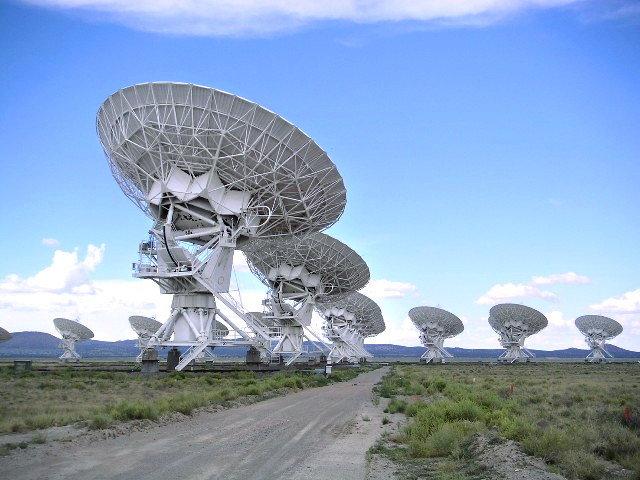
Radio telescope arrays have scanned the sky for seventy years. The silence has never been total — but it has never been clearly answered.
Science & Disclosure
The Fermi Paradox in the Age of Disclosure
Enrico Fermi asked “where is everybody?” over lunch in 1950. Seventy-six years later, governments have formally acknowledged objects in their airspace they cannot explain. The question has not been answered. But it has been changed.
The remark was casual. In the summer of 1950, physicist Enrico Fermi was walking to lunch at Los Alamos National Laboratory with colleagues Edward Teller, Herbert York, and Emil Konopinski. They had been discussing a New Yorker cartoon about flying saucers. The conversation moved on. Then, over the meal, Fermi suddenly asked: “But where is everybody?” His colleagues understood immediately what he meant. The universe is roughly 13.8 billion years old. The Milky Way contains somewhere between 100 and 400 billion stars. The probability that Earth is the only planet in this galaxy to have produced intelligent life is, by any reasonable statistical calculation, vanishingly small. If other civilisations exist — and the numbers strongly suggest they should — why have we found no evidence of them?
That question, which became known as the Fermi Paradox, has occupied scientists, philosophers, and researchers for seven decades. The proposed solutions are numerous and range from the sobering to the alarming. The Great Filter hypothesis, developed by economist Robin Hanson in 1998, proposes that somewhere along the path from simple chemistry to spacefaring civilisation there is a barrier that almost nothing survives. The question that keeps physicists awake at night: is the Great Filter behind us, or ahead? If it lies behind us — if the emergence of complex multicellular life, or consciousness, or technological civilisation is the filter — then we are among the rare survivors, and the silence of the cosmos reflects how extraordinarily unlikely we were. If the filter lies ahead, it means that civilisations routinely develop technology and then destroy themselves. The silence, in that case, is a warning.
Other proposed solutions carry their own unease. The Zoo Hypothesis, proposed by MIT radio astronomer John Ball in 1973, suggests that advanced civilisations are aware of us but have chosen not to make contact — observing without interfering, as we observe wildlife preserves. The Dark Forest theory, articulated by Chinese science fiction author Liu Cixin and now taken seriously by a number of physicists, proposes that the universe is silent because silence is survival strategy: any civilisation that announces its existence invites destruction by others who cannot afford to take the risk that a stranger is benign. The Simulation Hypothesis takes a different route entirely, suggesting that the apparent emptiness of the cosmos is a consequence of our being inside a constructed reality rather than a natural one.
What none of these theories fully accounted for — until recently — was the possibility that the paradox had already been partially resolved, and that the resolution was being actively suppressed. In December 2017, the New York Times published a story confirming that the U.S. Pentagon had been operating a secret programme to study Unidentified Aerial Phenomena. In the years that followed, the U.S. Navy confirmed the authenticity of multiple videos showing objects with performance characteristics no known human technology can replicate. In 2023, former intelligence officer David Grusch testified under oath before Congress that the U.S. government has retrieved craft of non-human origin. The Fermi Paradox, framed as an argument from silence, suddenly had to contend with evidence that the silence may not be as complete as assumed.
The Harvard astrophysicist Avi Loeb has been among the most prominent scientists to take this seriously. When the interstellar object ‘Oumuamua passed through our solar system in 2017 and accelerated in a way that no natural explanation has satisfactorily accounted for, Loeb proposed in a peer-reviewed paper that an artificial origin could not be ruled out. He subsequently founded the Galileo Project at Harvard — a systematic scientific effort to search for evidence of extraterrestrial technological objects using instruments the project controls itself, rather than relying on military sensor data. His argument is not that aliens are definitely here. It is that the scientific community’s refusal to seriously investigate the possibility reflects institutional conformism rather than rigorous scepticism.
The Fermi Paradox in 2026 looks different from the Fermi Paradox in 1950. The original framing assumed that the silence of the cosmos was total — no signals, no artefacts, no evidence of any kind. That assumption is harder to maintain when governments have formally acknowledged unidentified objects operating in restricted airspace with capabilities that exceed anything in the known technological inventory of any nation on Earth. The paradox has not been resolved. But its terms have shifted. The question is no longer only “where is everybody?” It may now be “what are we not being told about who is already here?”
SETI — the Search for Extraterrestrial Intelligence — has been scanning radio frequencies since 1960, when Frank Drake pointed the 85-foot telescope at Green Bank at Tau Ceti and Epsilon Eridani and heard nothing definitive. The Wow! Signal of 1977, detected at the Big Ear observatory in Ohio, remains the most compelling candidate for an extraterrestrial radio signal ever recorded: a narrowband transmission at 1420 MHz, the theoretically optimal frequency for interstellar communication, lasting 72 seconds and never repeated. It has never been explained. SETI’s radio telescope approach rests on the assumption that other civilisations would communicate via radio frequencies. UAP researchers increasingly point out that this assumption may be wrong — and that civilisations advanced enough to cross interstellar distances are unlikely to be communicating via technology we invented a century ago.
What the Fermi Paradox ultimately forces is a confrontation with scale. The universe is not merely large in the way that a continent is large. It is large in a way that makes analogies almost meaningless. The nearest star is four light-years away; a civilisation that developed interstellar travel ten million years ago — which is less than a quarter of one percent of the age of the universe — would have had time to visit every star in the Milky Way multiple times over. The silence, if it is silence, is not the silence of an empty neighbourhood. It is the silence of an ocean in which we have only just learned to listen, using tools we have had for less than a century, looking for signals we have decided in advance must resemble our own.
Watch: The Fermi Paradox — All Proposed Solutions
A comprehensive overview of every major proposed solution to the Fermi Paradox — from the Great Filter to the Zoo Hypothesis — and what each implies about our place in the universe.
Essential Reading
Extraterrestrial: The First Sign of Intelligent Life Beyond Earth — Avi Loeb (2021)
Harvard’s most decorated astrophysicist makes the case that ‘Oumuamua may have been an artificial object — and argues that science’s refusal to seriously investigate the possibility reflects institutional failure, not rigorous scepticism.
The science fiction trilogy that introduced the Dark Forest theory — the proposition that cosmic silence is a survival strategy, not evidence of emptiness. Now taken seriously by physicists as a genuine solution to the Fermi Paradox.
The physicist and SETI researcher examines why fifty years of scanning the cosmos have returned silence — and what that silence actually means for our understanding of life, intelligence, and our place in the universe.