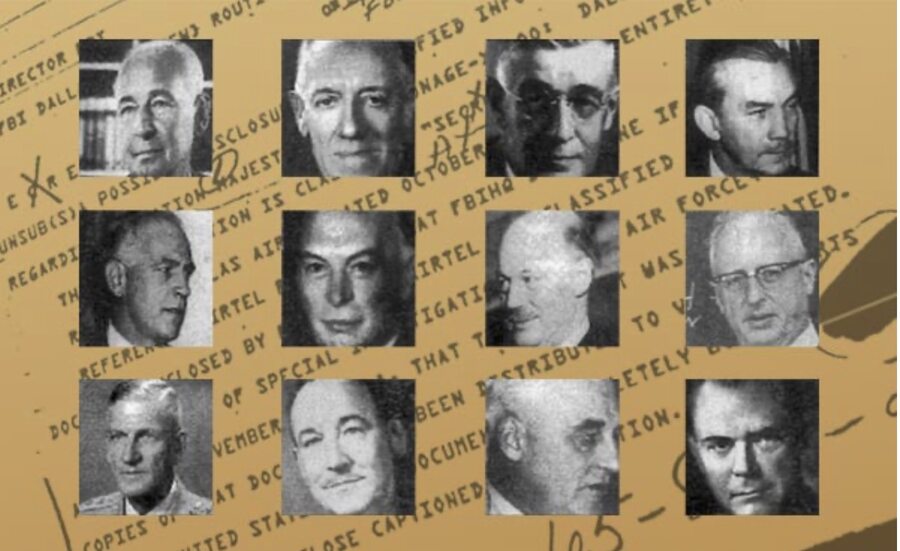
The alleged Majestic-12 briefing document, purportedly prepared for President-elect Eisenhower in November 1952. The FBI investigated and closed its file without a definitive conclusion.
Government Files
Majestic 12: The Documents That Could Not Be Proved Real — or Fake
An anonymous package. Undeveloped film. Documents naming twelve of America’s most powerful post-war figures as managers of a UFO recovery programme. The FBI spent years trying to prove them forged. It couldn’t.
In December 1984, UFO researcher Jaime Shandera received an anonymous package at his home in North Hollywood. Inside was an undeveloped roll of 35mm film. When developed, the film showed what appeared to be eight pages of a classified government briefing document — a report prepared, according to its own header, for President-elect Dwight D. Eisenhower, dated November 18, 1952. The document described a twelve-member special committee, designated Majestic-12 or MJ-12, established by President Harry Truman in September 1947 by classified executive order. Its stated purpose: to oversee the investigation and recovery of crashed extraterrestrial craft, and to manage all information about them.
The document named the committee’s members. They were not fringe figures. They were the architects of post-war American power: Rear Admiral Roscoe Hillenkoetter, the first Director of the CIA. Dr. Vannevar Bush, who had coordinated the entire American scientific war effort. Secretary of Defense James Forrestal, who would die under disputed circumstances in 1949. General Hoyt Vandenberg, Air Force Chief of Staff. General Nathan Twining, who had written the 1947 Air Materiel Command memo describing flying saucers as “real and not visionary or fictitious.” And seven others of comparable stature. If the document was genuine, it described the most significant secret in the history of the United States government. If it was forged, it was one of the most sophisticated and audacious forgeries ever attempted.
Stanton Friedman, the nuclear physicist who became the most rigorous investigator of the Roswell incident, spent eight years examining the Majestic-12 documents. His conclusion was that they were authentic — not because he could verify their provenance, but because the specific details they contained were consistent with declassified documents he had found through independent FOIA research. The formatting of dates in the Eisenhower Briefing Document matched the personal style used in other documented Eisenhower-era communications in ways that would have required access to obscure archival material to reproduce. The named members’ known security clearances, positions, and institutional relationships were all consistent with the roles described. A forger, Friedman argued, would have had to know things they could not reasonably have known in 1984.
A second document surfaced in 1985. While working in the National Archives, researchers William Moore and Shandera discovered what became known as the Cutler-Twining memo — a note from Robert Cutler, Eisenhower’s Special Assistant for National Security Affairs, to General Twining, referencing an “MJ-12 SSP” briefing and requesting a scheduling change. Unlike the original film documents, this one was found in a physical government archive. The National Archives confirmed the document was physically present where Moore and Shandera claimed to have found it. What the Archives could not confirm was how it got there — it had not been deposited through normal channels and carried no record of its origin. It remains in the Archives today, unexplained.
The FBI investigation ran for several years. Agents examined the alleged Truman signature on the executive order establishing the committee and compared it with authenticated Truman signatures from the period. One internal FBI document, released through FOIA, contains a handwritten annotation describing the documents as “bogus.” But the bureau never issued a formal public determination. It could not demonstrate how the forgery was accomplished, who had accomplished it, or what source material a forger would have needed to produce the level of period-accurate detail the documents contained. The investigation closed without a definitive finding. The documents were neither authenticated nor conclusively debunked.
Critics have identified specific anomalies worth noting. The date formatting on the Eisenhower Briefing Document — “18 November, 1952” — uses a comma style some researchers argue was inconsistent with classified document conventions of the period, though this point remains contested. Dr. Donald Menzel, one of the named MJ-12 members, was a prominent public sceptic of UFOs, which critics call an unlikely choice for a recovery programme’s oversight committee. Friedman countered that Menzel’s public scepticism was exactly the kind of cover a programme managing this secret would want — and that Menzel had in fact held numerous high-level security clearances throughout his academic career at Harvard, a fact verified through independent research.
The question that the modern disclosure era has made considerably harder to dismiss is this: the existence of forged documents does not disprove the existence of the programme they describe. David Grusch, in his July 2023 congressional testimony under oath before the House Oversight Committee, described a multi-generational programme within the U.S. government involving the recovery and reverse-engineering of non-human craft — hidden from congressional oversight through the misuse of special access programme classifications and unacknowledged budgets. That is, in its essential architecture, precisely what the Majestic-12 documents describe. Grusch did not reference MJ-12 by name. The structural correspondence between his account and the programme the documents claim existed is nevertheless exact: a small, compartmentalised committee; access denied to elected officials; physical materials from crash recoveries; a chain of secrecy maintained across administrations for decades.
The Majestic-12 case has not been closed. The documents remain in circulation. The Cutler-Twining memo remains in the National Archives, unaccounted for. The FBI file remains partially redacted. The institutional response to the documents — the years of FBI investigation, the Air Force inquiries, the sustained official effort to discredit them — was not the response of agencies dealing with an obvious hoax. Governments do not spend years investigating things they are certain are false. The most honest assessment of the Majestic-12 documents after forty years is this: we do not know if they are real. We also do not know, with certainty, that they are not.
Stanton Friedman presents his eight-year investigation of the MJ-12 documents — the evidence for authenticity, the FBI response, the Cutler-Twining memo, and why the case remains open.
Essential Reading
TOP SECRET/MAJIC — Stanton Friedman (1996)
The nuclear physicist’s definitive eight-year investigation of the Majestic-12 documents — examining provenance, typography, historical context, the FBI investigation, and the case for authenticity.
Crash at Corona — Stanton Friedman & Don Berliner (1992)
The companion investigation to the MJ-12 research — examining the Roswell crash the Majestic-12 documents claim was the founding event for the committee, and the witnesses whose testimony supports the recovery story.
Imminent: Inside the Pentagon’s Hunt for UFOs — Luis Elizondo (2024)
The former head of AATIP describes the classified UAP programmes he ran — and what he discovered about the depth and age of the secrecy infrastructure that MJ-12, if genuine, helped establish.