
On September 18, 2026, the U.S. Department of War released a short segment of military infrared footage under the designation DOW-UAP-PR135. The accompanying mission report, DOW-UAP-D108, described six unresolved objects and estimated their speed at approximately 480 miles per hour. The release was made through DVIDS, under PURSUE release 6 — the government’s ongoing programme of declassified UAP disclosure.
Within three weeks, a team of researchers from Blue Marble Space, NASA Goddard Space Flight Center, Harvard University’s Galileo Project, and The Skeptics Society posted a preprint analyzing the footage frame by frame. Their conclusion: the brightness patterns of the six objects are consistent with the wingbeat signatures of birds. This article examines what the analysis measured, where it is strongest, and why it cannot be treated as a definitive identification.
What the Footage and the Mission Report Establish
The public record on DOW-UAP-PR135 is limited but verifiable. The video is genuine military infrared footage released through official channels. The mission report, DOW-UAP-D108, describes the objects as unresolved — meaning that AARO, the All-domain Anomaly Resolution Office, has not made a formal identification. The estimated speed of approximately 480 mph appears in the mission report’s description; it is not a figure derived independently in this analysis or by this publication.
Two caveats apply. First, 480 mph is an estimate from the mission report, not a precision measurement; speed figures from infrared tracking depend on assumptions about the objects’ distance and altitude. Second, the DVIDS listing shows two date fields: “Date Taken: January 1, 2025” and “Date Posted: September 18, 2026.” The preprint gives the mission-report encounter date as July 29, 2025. Why the DVIDS “Date Taken” field shows January 1 rather than July 29 is not explained in the publicly released materials. The mission report filename’s reference to “2025” is consistent with the July 29 encounter date and is not itself a discrepancy.
What the Researchers Measured
The preprint — arXiv:2610.08692, by Jacob Haqq-Misra (Blue Marble Space), Ravi Kopparapu (NASA Goddard Space Flight Center), Adrian Cloete, Yaniv Eldadi, and Avi Loeb (Galileo Project, Harvard), and Michael Shermer (The Skeptics Society) — was posted in early October 2026 and updated to version 4 on October 16. It has been submitted to Scientific Reports for peer review; submission is not acceptance, and the paper has not completed that process. Institutional affiliations identify the authors; they do not imply endorsement by NASA, Harvard, or any other named organisation.
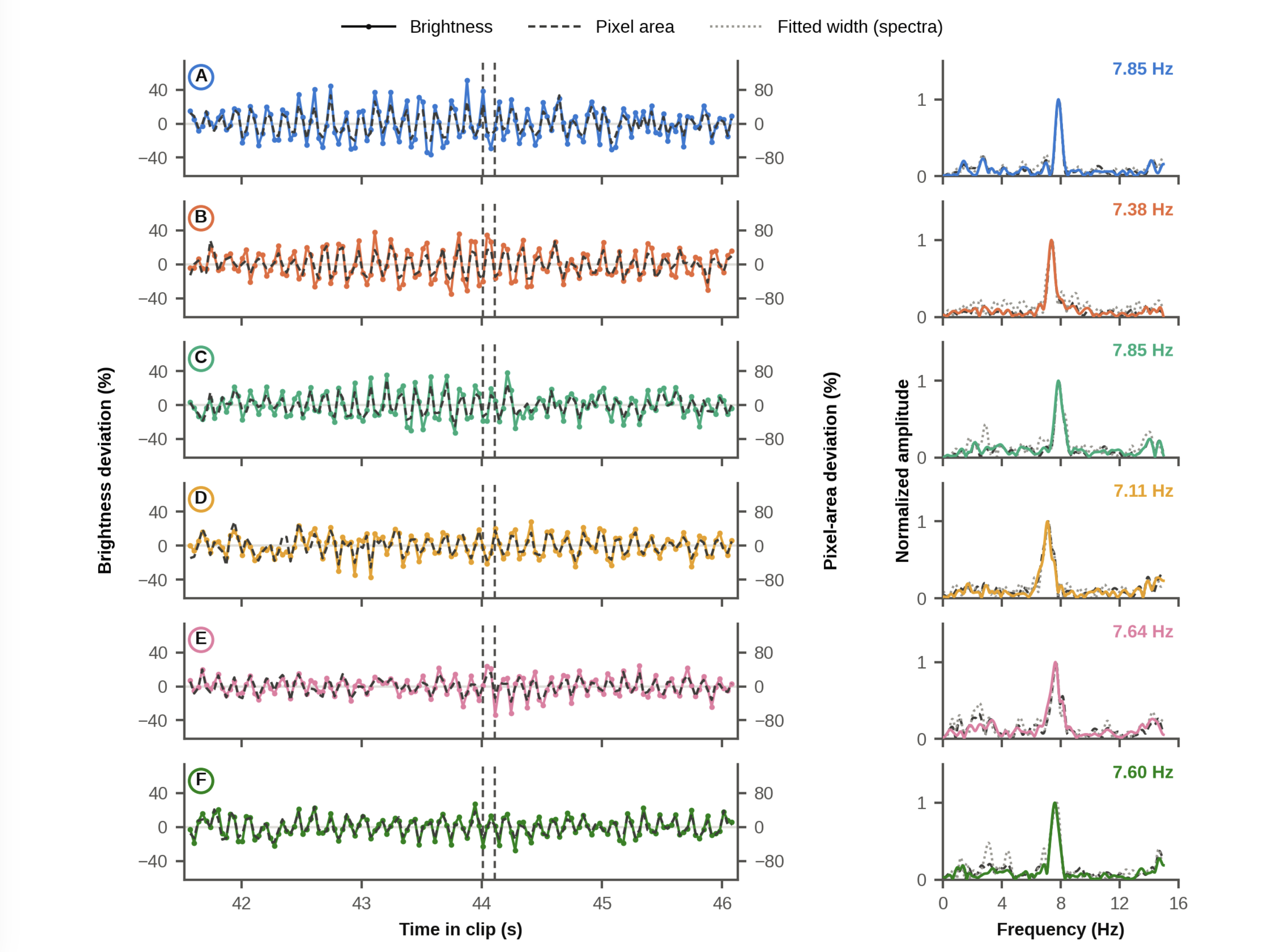
The core of the analysis is a frame-by-frame brightness measurement of each object across the full video. All six exhibit periodic oscillation of 7.1 to 7.9 cycles per second (Hz), and each object’s oscillation is independent of the others — not synchronised — which argues against a single artificial source or a camera artifact affecting all objects simultaneously.
The 7.1 – 7.9 Hz range falls within the wingbeat rates of medium-to-large birds in flapping flight. The Galileo Project’s own ground-based infrared cameras recorded 3.4 to 10.0 Hz for flying animals — birds, bats, and insects — in a separate sky survey. Before drawing that comparison, the researchers planted constant-brightness control objects into their pipeline; those controls showed no flicker, confirming that the PR135 oscillations are a real signal and not a compression or sensor artifact.
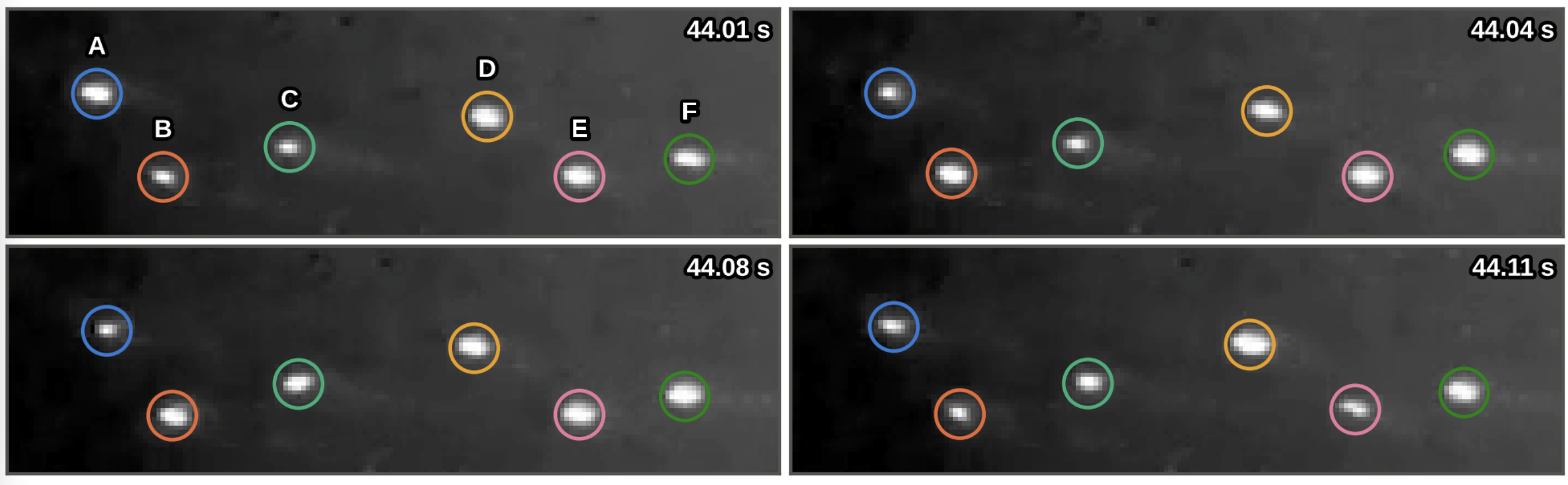
The same analysis applied to four other previously released military UAP videos found seven additional objects with periodic oscillations of 3.0 to 11.0 Hz — again within the biological range. A full reproduction package — analysis scripts, brightness data, and figures — is archived at Zenodo 23021686 under open licences. Anyone can run the same code on the same video. This is public reproduction; independent replication by a separate team using different tools has not yet been published.
How an Apparent Speed of 480 mph Can Mislead
The 480 mph figure is the most striking number in the mission report, and it deserves careful handling. To understand why it does not rule out birds — or, more precisely, why it cannot be used as independent evidence against a biological explanation — requires understanding a phenomenon called parallax.
Apparent speed from infrared tracking is typically derived by measuring how quickly objects’ angular positions shift across the sensor’s field of view, then projecting that motion to a ground-referenced speed using the aircraft’s altitude — assuming the objects are near the ground. If they are not, the derived speed is inflated by parallax. The Haqq-Misra team calculated that an object at 60 to 80 per cent of the aircraft’s altitude, moving at the modest speed of a soaring bird, would produce an apparent ground speed close to 480 mph when projected in the conventional way.
The parallax argument collapses the apparent anomaly of the speed estimate. It does not replace it with a confirmed identity.
Why Altitude Is the Key Unresolved Problem
The parallax explanation depends on the relative altitudes of the objects and the observing aircraft. The mission report gives the objects at an estimated FL220 — Flight Level 220, approximately 22,000 feet above sea level. The observing aircraft’s altitude is not given in the publicly released materials. Without it, the full parallax geometry cannot be independently verified: whether a bird-speed object at FL220 would produce an apparent 480 mph depends on how much higher the aircraft was flying.
There is a further difficulty. The FL220 object altitude may itself be inconsistent with typical nocturnal bird flight at the inferred location — the preprint infers from mission report details that the incident occurred over or near Kuwait, though neither the location nor the aircraft type has been confirmed from publicly released materials. The preprint’s authors acknowledge this tension and flag it as unresolved. Brightness oscillation measurements and the parallax argument can point toward birds; they cannot confirm it if the altitude is inconsistent with where birds actually fly at night. Resolving it requires either an unredacted mission report or corroborating data — radar returns, additional sensor logs — not currently available in the public domain.
What Would Test the Competing Explanations
The bird hypothesis rests on convergence: the Hz range matches wingbeat rates, the oscillations are independent across all six objects, artifact tests are negative, and the speed anomaly dissolves under parallax. That is a coherent case. It is not a closed one.
The aircraft’s altitude — not given in the publicly released materials — is the single most useful missing piece. It would allow a direct test of whether the objects’ FL220 altitude is compatible with documented nocturnal bird flight at the inferred location. Periodic brightness oscillation is also not unique to wingbeats: a tumbling object, a pulsing artificial light, or certain atmospheric effects could produce similar infrared variation. The researchers argue that the Hz range and signal independence point toward birds, but those alternatives are not ruled out by brightness data alone.
This paper has not been assessed by AARO. DOW-UAP-PR135 remains “unresolved.” The preprint is a scientific hypothesis that the available evidence supports but does not conclusively establish. It is not a government identification, and it is not a debunking.
■ The UFO Times Evidence Scale
How we rate the claims in this article.
DOW-UAP-PR135 was released September 18, 2026, via DVIDS (PURSUE release 6). Mission report DOW-UAP-D108 describes six unresolved objects with an estimated speed of approximately 480 mph; “unresolved” means AARO has not made a formal identification. The preprint (arXiv:2610.08692, Haqq-Misra et al. 2026) measured brightness oscillations of 7.1 – 7.9 Hz for all six objects, with each independent of the others. Artifact tests (compression and sensor controls) were negative. The Galileo Project’s ground cameras recorded 3.4 – 10.0 Hz for flying animals in infrared. Parallax geometry shows that an object at 60 – 80% of the aircraft’s altitude, moving at bird speeds, would produce an apparent ground speed close to 480 mph; the objects are reported at FL220 in the mission report, and the aircraft altitude is not given in the publicly released materials. A full reproduction package (scripts, data, figures) is publicly archived at Zenodo 23021686 under open licences.
The six objects are most consistent with birds, based on the convergence of Hz range, signal independence, negative artifact tests, and the parallax speed argument. The mission report’s incident location is inferred to be near Kuwait; the aircraft type is also an inference. These conclusions come from a preprint submitted to Scientific Reports; the paper has not completed peer review. The findings have not been independently replicated by a separate team.
The mission report gives the objects at an estimated FL220 (approximately 22,000 feet). The observing aircraft’s altitude is not given in the publicly released materials; without it, the full parallax geometry cannot be verified. The FL220 object altitude may itself be inconsistent with typical nocturnal bird flight at the inferred location; the authors flag this as unresolved. The DVIDS “Date Taken” field shows January 1, 2025, while the mission report gives July 29, 2025; why these differ is not explained in the public record. Periodic brightness oscillation is not unique to wingbeats; alternative explanations have not been ruled out. No independent replication has been published.
The claim that 480 mph is a confirmed measured speed of the objects (it is a mission report estimate, subject to altitude assumptions). The claim that the preprint constitutes an AARO identification or official determination. The claim that submission to Scientific Reports means the paper has been accepted or peer-reviewed.
Primary Sources
- Haqq-Misra, J., Kopparapu, R., Cloete, A., Eldadi, Y., Shermer, M., & Loeb, A. (2026). Brightness-rhythm analysis of military infrared UAP video DOW-UAP-PR135. arXiv:2610.08692v4. arxiv.org/abs/2610.08692
- Zenodo archive (data, code, figures, CC BY 4.0 / MIT): zenodo.org/records/23021686
- DOW-UAP-PR135 video (AARO via DVIDS, public domain): DVIDS video 1023397
- Galileo Project flying-animal comparison dataset: Loeb et al. (2026) and Dominé et al. (2025), Sensors 25, 783.
Related Articles
Further Reading
The scientists, investigators, and former officials who have spent careers examining UAP evidence — their books, arguments, and findings.
Browse the UFO Times Bookstore →