
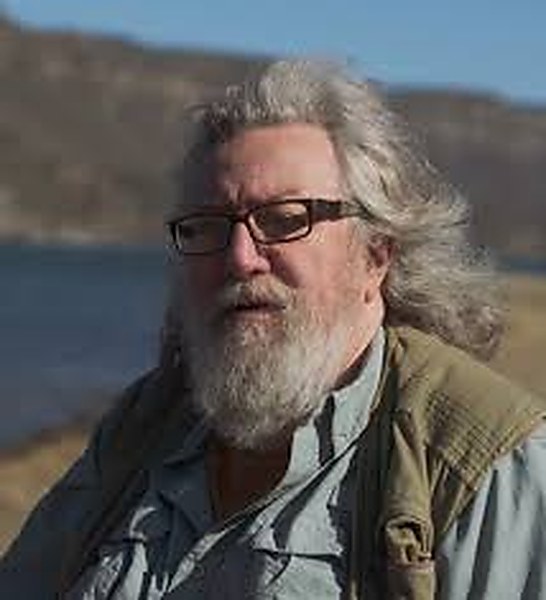
Randall Carlson does not argue from texts. He argues from rock. His method is to take the physical landscape of the American Northwest — the channelled scablands of eastern Washington, the hanging valleys of the Columbia River system, the enormous erratic boulders that sit in the middle of the Montana plains hundreds of miles from the nearest source geology — and read it as a record of events whose scale and violence mainstream geology spent much of the 20th century trying to minimise. What the landscape tells him, in unambiguous geological language, is that the end of the last ice age was not a gradual warming. It was punctuated by catastrophic floods of almost incomprehensible scale, triggered by events whose ultimate cause remains contested but whose effects are written permanently into the earth.
The foundational work here belongs to J Harlen Bretz, a geologist who in the 1920s proposed that the channelled scablands of Washington had been carved by a single catastrophic flood — what he called the Spokane Flood — of a scale that standard geological thinking had no framework for accommodating. The geological establishment dismissed him for decades. By the 1970s, the evidence had become undeniable: a flood had occurred, it had been catastrophic, and it had been triggered by the collapse of an ice dam holding back a lake containing roughly half the volume of Lake Michigan. Bretz was vindicated and eventually awarded the Penrose Medal, geology’s highest honour. Carlson’s contribution has been to extend Bretz’s insights, connect them to other evidence for end-of-ice-age catastrophism, and argue that the events in question were far more widespread and severe than even Bretz appreciated.
The Younger Dryas Impact Hypothesis
The central claim of Carlson’s recent work — developed in collaboration with Graham Hancock, whose “Magicians of the Gods” draws heavily on Carlson’s fieldwork — is that the Younger Dryas cooling event of approximately 12,900 years ago was triggered by a cosmic impact or airblast. The Younger Dryas was a sudden return to near-glacial conditions lasting approximately 1,200 years, following a period of warming at the end of the last ice age. Mainstream geology has not settled on a cause. The Younger Dryas Impact Hypothesis, first published in a peer-reviewed paper in 2007, proposes that a fragmented comet struck or airburst over the North American ice sheet, triggering catastrophic melting, enormous floods, and a global climate disruption whose effects are recorded in the geological and biological record of every continent.
The evidence Carlson marshals for this hypothesis includes the presence of shocked quartz, nano-diamonds, and iridium — materials associated with cosmic impacts — in a black mat layer that appears at the Younger Dryas boundary at archaeological sites across North America and Europe. It includes the extinction of the North American megafauna — mammoths, mastodons, giant ground sloths, American horses — which disappears from the fossil record at precisely this horizon. And it includes the flood mythologies of virtually every ancient culture on earth, which Carlson interprets not as independent invention but as the preserved memory of an actual event experienced by actual human populations and transmitted through the cultural record for twelve thousand years.
Sacred Geometry and the Inherited Knowledge
Carlson’s work is not limited to catastrophism. He has spent decades examining the sacred geometry encoded in ancient monuments — the Great Pyramid, Stonehenge, the Chartres Cathedral — and arguing that these structures preserve a mathematical and cosmological knowledge that was not independently developed by their builders but inherited from a predecessor civilisation destroyed in the Younger Dryas catastrophe. The argument is that the survivors of that civilisation — the “magicians of the gods” that Hancock describes — encoded what they knew in durable architectural form, embedding the mathematics of the cosmos in structures whose builders could follow the proportions without necessarily understanding the full cosmological framework they embodied.
What makes Carlson’s contribution distinctive within alternative research is his insistence on physical evidence. His catastrophism arguments are not based on mythology alone but on fieldwork, laboratory analysis, and published geological literature. His Joe Rogan appearances, where he has spent hours walking through the physical evidence with maps and photographs, have introduced millions of people to a body of scientific work that mainstream popular science has been slow to take seriously. The Younger Dryas Impact Hypothesis remains controversial but increasingly well-supported. And the ancient civilisation hypothesis — the idea that a sophisticated culture preceded ours and was destroyed by cosmic events that our mythology still remembers — looks rather less exotic now than it did before Carlson started reading the landscape.
Watch
Randall Carlson — Cosmic Catastrophe and the Lost Civilisation
Watch
Randall Carlson and Graham Hancock — The Younger Dryas Impact and the Flood Myths
Recommended Reading
Magicians of the Gods — Graham Hancock (2015)
The book that introduced Carlson’s catastrophism research to a mass audience — Hancock’s examination of the geological and astronomical evidence for a cosmic impact that ended an advanced predecessor civilisation around 12,900 years ago.
View on Amazon →Fingerprints of the Gods — Graham Hancock (1995)
The foundational work in the lost civilisation genre — the geological and architectural evidence that a sophisticated culture preceded ancient Egypt and Mesopotamia, destroyed in a global catastrophe.
View on Amazon →Forgotten Civilization — Robert Schoch (2012)
Schoch’s complementary analysis of the solar plasma event that may have triggered the Younger Dryas — the geological and astronomical case that sits alongside Carlson’s impact hypothesis as part of the same catastrophist picture.
View on Amazon →