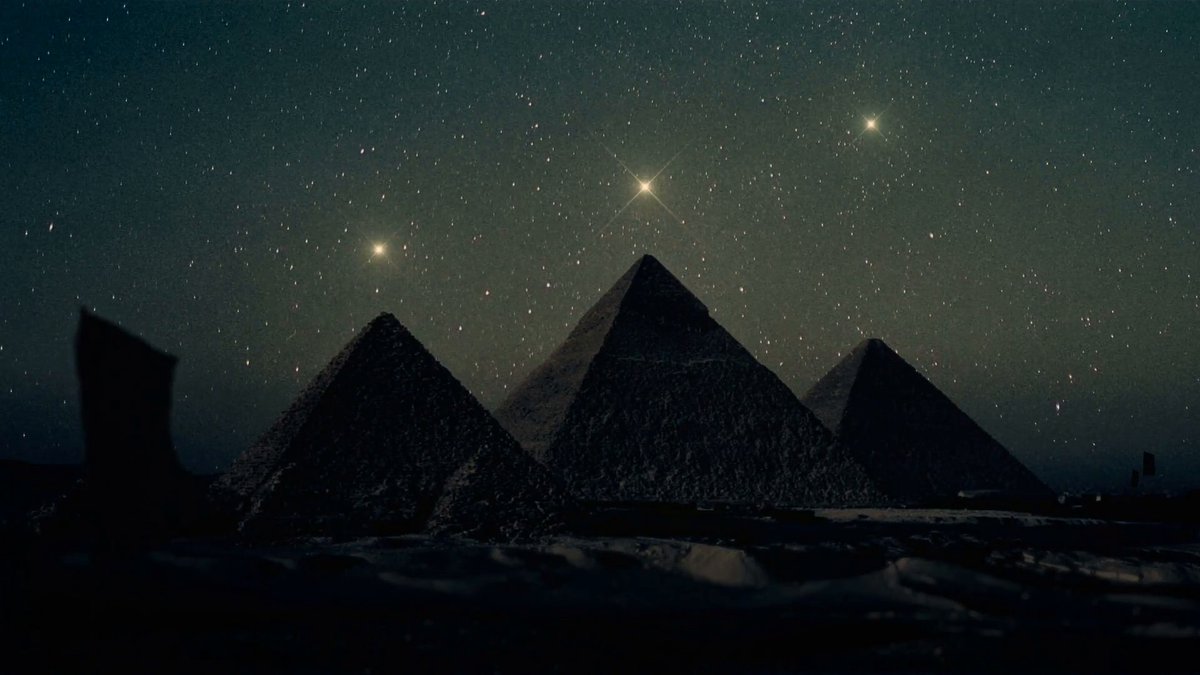
The three pyramids of Giza beneath the night sky. Bauval’s Orion Correlation Theory argues that their layout mirrors Orion’s Belt precisely — and that the alignment was exact in 10,500 BCE, eight thousand years before the pharaohs.
Ancient Aliens
Robert Bauval and the Orion Correlation: The Pyramids Were Never Just Tombs
A Belgian engineer looked up at Orion’s Belt one night in the Saudi desert and realised he was looking at the Giza plateau. His discovery rewrote the purpose of the pyramids — and the implied date of Egyptian civilisation.
In 1983, Robert Bauval was working as a construction engineer in Saudi Arabia. He was lying on his back in the desert one clear night, looking up at Orion, when something clicked that no Egyptologist had articulated in print: the three stars of Orion’s Belt — Alnitak, Alnilam, and Mintaka — are not in a straight line. One of them is slightly offset to the left. And the three pyramids of Giza — Khufu, Khafre, and Menkaure — are not in a straight line either. One of them is slightly offset to the left. The proportions match. The offset is in the same direction. Bauval had not yet checked the mathematics. He did not need to. He was looking at a map.
What followed was a decade of research that culminated in The Orion Mystery, published in 1994 with co-author Adrian Gilbert. The book presented the Orion Correlation Theory in full: the argument that the three Giza pyramids were deliberately positioned to mirror the three stars of Orion’s Belt, and that the Nile itself corresponds to the Milky Way in the same sky map. Using astronomical software to calculate the precession of the equinoxes — the slow wobble of Earth’s axis that shifts the apparent position of stars over millennia — Bauval established that the alignment of the pyramids to Orion’s Belt as it appeared on the ground would have been precise and intentional at approximately 10,500 BCE. Not 2,500 BCE, when the pyramids are conventionally dated. Ten thousand five hundred years before the common era.
This date is not arbitrary. It recurs independently in Bauval’s collaboration with Graham Hancock, published as The Message of the Sphinx in 1996. Robert Schoch, the Boston University geologist who re-dated the Sphinx to at least 7,000 BCE on the basis of water erosion patterns on its enclosure walls, identifies the same general epoch as the likely period of the Sphinx’s original construction. John Anthony West, the independent Egyptologist who brought Schoch’s geological work to public attention, argued that the Sphinx was originally a monument to Leo — a reading supported by the astronomical position of the Sphinx on the Giza plateau, which faces due east and would have gazed directly at the rising constellation of Leo at the spring equinox in approximately 10,500 BCE. Three independent lines of inquiry — architectural, geological, astronomical — converge on the same date.
The conventional Egyptological response to the Orion Correlation Theory has been dismissive but not always rigorous. The most common objection — raised by astronomer Ed Krupp — holds that to make the correlation work, you have to view the sky map south-up, which is not how ancient Egyptians viewed the sky. Bauval has contested this interpretation at length. Crucially, the ancient Egyptian concept of the Duat — the celestial realm of the dead — was explicitly identified with Orion in the Pyramid Texts, the oldest religious writings in the world, carved on the walls of the pyramids at Saqqara. The Pyramid Texts state that the soul of the pharaoh ascends to become a star in Orion. Bauval’s correlation does not impose an external astronomical framework on the Egyptians. It reads the one they wrote down themselves.
The practical geometry is equally striking. The three Giza pyramids are not positioned to maximise visibility from any particular vantage point on the ground. They are not arranged to follow the Nile, or the local topography, or any administrative logic visible in the archaeological record. They are positioned in a specific, irregular configuration that has no architectural precedent and no obvious functional explanation — unless the function was celestial mapping. In that case, the configuration is exact.
In subsequent work, including Black Genesis (2011, with Thomas Brophy), Bauval extended his research into the pre-dynastic period and the African origins of Egyptian civilisation, presenting evidence that the astronomical tradition encoded at Giza predated the Old Kingdom dynasties by thousands of years. The roots of Egyptian astronomical knowledge, Bauval and Brophy argue, lie in the Saharan cultures of the Nabta Playa in what is now southern Egypt — cultures that were sophisticated, organised, and cosmologically literate long before the first pharaoh.
The Orion Correlation Theory has not been formally accepted by mainstream Egyptology. It has also not been definitively refuted. What it has done is force a re-examination of what the pyramids were for — and who the Egyptians believed themselves to be. Not tomb-builders marking the graves of megalomaniac kings, but a civilisation engaged in a multi-generational project to map the heavens on the ground, preserve the memory of a sky that would not look the same again for twenty-six thousand years, and enshrine in stone a message for whoever came next. Whether that message was intended for us remains, for now, an open question.
Watch: Robert Bauval — The Orion Mystery Explained
Bauval presents the core Orion Correlation Theory — the geometry, the astronomy, and the Pyramid Texts — in one of his clearest recorded lectures.
Watch: The Sphinx — Geological Evidence for a Much Earlier Date
Robert Schoch on the water erosion evidence that places the Sphinx thousands of years before the accepted date — and its connection to Bauval’s 10,500 BCE alignment.
The Robert Bauval Library
The Orion Mystery (1994)
The book that introduced the Orion Correlation Theory to the world. The mathematics, the astronomical data, and the case that the Giza pyramids are a star map.
The Message of the Sphinx (1996) — with Graham Hancock
Bauval and Hancock combine the Orion Correlation with Schoch’s geological re-dating of the Sphinx to build the complete case for a pre-dynastic civilisation at Giza.
The African origins of Egyptian civilisation. Bauval and Brophy trace the astronomical tradition behind the Giza complex back to the Saharan cultures of 6,000 BCE and earlier.