
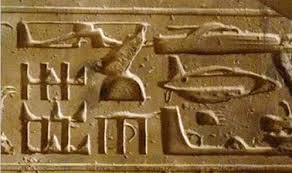
The Temple of Seti I at Abydos, Egypt, was built approximately 3,000 years ago and is one of the finest examples of New Kingdom temple architecture in existence. Its walls and ceilings are covered with hieroglyphic inscriptions and relief carvings of exceptional quality. Most of them are unremarkable to anyone except Egyptologists. One panel is not. On the ceiling of a corridor in the temple’s main hall, a section of overlapping and partially erased hieroglyphs produces images that have been interpreted, by thousands of observers over several decades, as a helicopter, a submarine, a tank, and what appears to be a fixed-wing aircraft or flying saucer. The controversy they have generated is disproportionate to their size but not, arguably, to their implications.
The mainstream Egyptological explanation is a phenomenon called palimpsest — essentially, carving over a previous carving. The argument is that Seti I’s cartouche and titulary were originally carved in the space, and that Ramesses II, Seti’s successor, had the original text partially plastered over and replaced with his own. Over time, the plaster fell away, leaving a composite of the two texts whose overlapping characters produce the appearance of modern vehicles. This is a credible explanation. Palimpsest is a documented phenomenon in Egyptian epigraphy, and the specific characters involved can be identified in the overlapping texts.
What the palimpsest explanation does not entirely resolve is the quality of the resemblance. The helicopter profile, in particular — with a rotor structure, a cockpit bulge, and a tail boom — is not a vague approximation. It is specific enough that multiple aerospace engineers, shown the image without context, have independently identified it as a helicopter. The submarine profile has a ballast tank structure consistent with an actual submarine design. If these images are the product of random character overlap, the randomness has been extraordinarily cooperative.
The Abydos carvings do not stand alone in the Egyptian record. The Saqqara Bird, a wooden artefact discovered in 1898 and now held in the Cairo Museum, has an aerodynamic profile that matches a modern glider almost exactly — horizontal stabiliser, tapered fuselage, centre of gravity in the correct position for stable flight. Dr. Khalil Messiha, who studied it in the 1970s, concluded that it was a scale model of a glider. The Cairo Museum labels it a ceremonial object in the shape of a bird.
The correct interpretation of the Abydos carvings is not established. The palimpsest explanation is serious and should not be dismissed. But neither should the images themselves be dismissed — particularly given the broader context of a civilisation that built structures of impossible precision, maintained astronomical knowledge of extraordinary depth, and produced texts whose content predates the knowledge they supposedly encode by centuries. The Abydos carvings are a detail in a much larger picture. The picture does not add up.
Watch: The Abydos Hieroglyphs: Ancient Egyptian Flying Machines — Analysis
Documentary and interview coverage available on YouTube.
Recommended Reading
The Sign and the Seal — Graham Hancock
View on Amazon →Serpent in the Sky — John Anthony West
View on Amazon →