
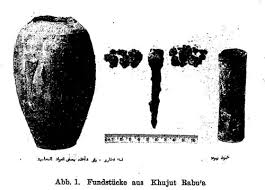
In 1936, German archaeologist Wilhelm König was cataloguing artefacts in the Iraq Museum in Baghdad when he encountered a clay pot that made no sense. The Parthian-era jar, dating to roughly 250 BCE, contained a copper cylinder, an iron rod, and traces of an acidic substance — either vinegar or wine. König recognised the structure immediately: it was an electrochemical cell. A battery. When a group of American engineers recreated the device in 1940 and filled it with grape juice, it generated approximately 1.1 volts of electricity for 18 days. In 2005, television presenter Adam Hart-Davis independently replicated it and confirmed the electrical output. The Baghdad Battery — or Parthian Battery — is not a theory. It is a functioning electrochemical device built 2,000 years ago.
The mainstream explanation — that the vessel was used for storing sacred scrolls, and that the metal components are coincidental — does not survive contact with the engineering. The copper cylinder is precisely sized to fit the jar. The iron rod is precisely sized to fit the cylinder without touching it. The bitumen seal at the top is exactly the kind of insulation an electrochemical cell requires to prevent contact between the rod and the cylinder at the jar’s opening. The probability of this configuration arising by coincidence is not serious. A similar artefact has been found at Seleucia, a nearby archaeological site.
In Egypt, the Temple of Dendera contains a series of relief carvings in its lower crypt that have been interpreted by researchers, including the Austrian engineer Walter Garn, as depicting electric lamps. The carvings show a large lotus flower from which a serpent emerges and extends to fill a bulb-like vessel on a pillar — a configuration that resembles, with considerable precision, a Crookes tube or cathode ray tube, with the serpent as the electron beam filament. The carvings are accompanied by what appear to be electrical insulators and cables. Garn built a working model based on the carving dimensions and concluded that the device would function as a light source if powered by a Baghdad Battery.
The Sanskrit texts add another layer. The Vaimanika Shastra, a technical text purportedly channelled in the early 20th century from ancient sources, contains detailed descriptions of aircraft propulsion systems involving mercury vortex engines — sealed chambers in which mercury is rotated at high speed to produce electromagnetic thrust. Aerospace engineers at the Indian Institute of Science in Bangalore studied the designs in 1974 and concluded that, while the specific aircraft described would not fly as drawn, the underlying concept — rotating mercury as an electromagnetic propulsion element — was technically coherent.
None of these artefacts and texts constitute proof of an ancient electrical civilisation. What they constitute, taken together, is a pattern: evidence of technological knowledge — electrochemistry, optics, electromagnetic propulsion — appearing in ancient contexts where conventional history says it should not exist. The pattern demands a better explanation than accident or coincidence, and the scientific community’s refusal to systematically investigate it is itself a phenomenon that deserves scrutiny.
Watch: The Baghdad Battery and Ancient Electricity — Documentary Investigation
Documentary and interview coverage available on YouTube.
Recommended Reading
Technology of the Gods — David Hatcher Childress
View on Amazon →The Giza Power Plant — Christopher Dunn
View on Amazon →