
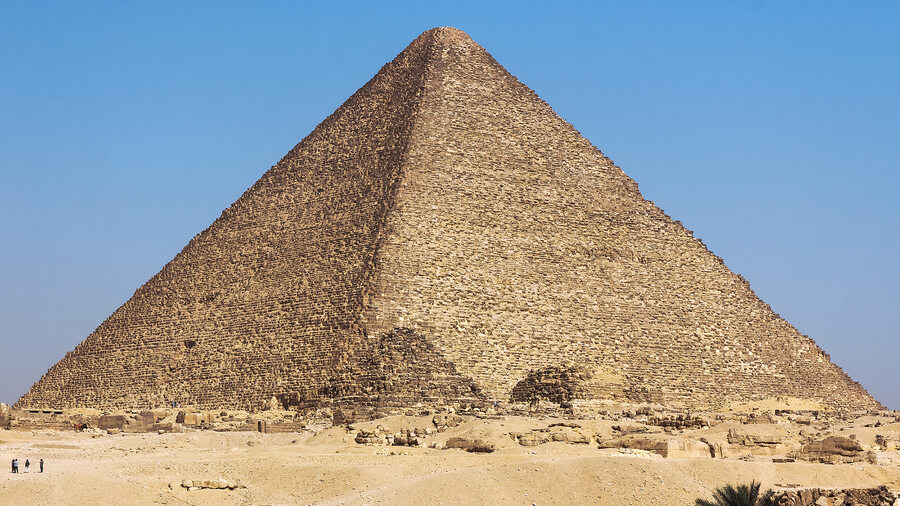
The Great Pyramid of Giza contains an estimated 2.3 million stone blocks, weighing between 2.5 and 80 tonnes each. Its four base sides are aligned to the cardinal directions with an accuracy of 0.067 degrees—more precise than the compass rose on most modern maps. The Great Pyramid's original height of 146.5 metres was, for nearly four thousand years, the greatest height ever achieved by human construction. Its internal chambers are connected by passages whose geometry has been the subject of intense scholarly and speculative interest for centuries. The structure was built, according to mainstream Egyptology, by a workforce of tens of thousands of labourers over approximately twenty years, in service of a Fourth Dynasty pharaoh named Khufu, using tools of copper and stone.
The question of how it was built—not whether it was possible for ancient humans, but precisely how the logistics of quarrying, transporting, and positioning millions of tons of stone with the observed degree of accuracy were managed—has never been satisfactorily resolved. Competing theories range from internal ramps to external ramps, from water lubrication of sledge paths to organised levee systems exploiting the Nile's flood plains. No single hypothesis accounts for all the available archaeological evidence. The quarrying sites at Aswan, where the granite used in the burial chamber was cut, are more than 800 kilometres from Giza. The limestone used for the outer casing—much of it now stripped—was sourced from a quarry directly across the river. Yet the precision of fit, both within individual blocks and between chambers, suggests a level of planning and execution that exceeds what ramps and ropes can account for.
The ancient astronaut hypothesis, popularised by Erich von Däniken in the late 1960s and subsequently expanded by researchers including Graham Hancock, Robert Bauval, and Robert Schoch, proposes that the Giza complex preserves evidence of a lost civilisation or an extraterrestrial intervention that conventional archaeology has been unable or unwilling to account for. The Orion Correlation Theory, developed by Bauval, argues that the three pyramids of the Giza plateau are positioned to mirror the three stars of Orion's Belt as they appeared in the sky around 10,500 BCE—a date far earlier than the accepted age of the pyramids and one that would place their conception in the context of a civilisation that has left no other trace in the archaeological record.
The King's Chamber presents its own mysteries. The chamber is tuned to resonate at specific frequencies—the measured acoustic properties of the granite walls create vibrations at frequencies near the frequency of the Earth's Schumann resonance. The empty red granite sarcophagus found in the chamber predates Khufu by analysis—the stone cutting and style are inconsistent with Fourth Dynasty techniques. The air shafts that connect the chamber to the external surfaces of the pyramid point not toward cardinal directions but toward specific stars as they appeared in the sky circa 2500 BCE: Orion for one shaft, Thuban (the pole star) for another. This astronomical encoding was not accidental. It was intentional. Yet mainstream Egyptology refuses to integrate these astronomical alignments into any coherent theory of purpose.
Bauval's Orion Correlation Theory proposes that the pyramid complex was designed as a terrestrial mirror of Orion's Belt, aligned to the sky as it appeared at the moment of a civilisational threshold or knowledge transfer. If the three Giza pyramids encode the positions of the three stars as they appeared 12,000 years ago (a date that would align with the Younger Dryas catastrophe and the destruction of any pre-flood civilisation), then the pyramid complex is not a pharaonic tomb but a celestial map—a message left for a future era that would have the technology to understand it. This interpretation transforms the question from "how did they build it?" to "why did they build it?" And that question has no answer within the conventional framework.
What remains unknown cuts to the heart of the problem. No mummy has ever been found inside the Great Pyramid. No treasure, no dedicatory inscription, no evidence of burial has ever been discovered inside. The conventional "tomb" interpretation rests entirely on architectural inference—the presence of a chamber suggests burial, even though no burial evidence exists. In 2017, muon tomography (a technique using cosmic ray particles to image dense structures) revealed a 30-metre void above the Grand Gallery—a chamber the size of a cathedral whose purpose is entirely unknown. The discovery proved that the Great Pyramid still contains secrets, that it has never been fully understood, and that the questions archaeology has asked are not the questions that matter. What was that void for? Why was it hidden? What knowledge was intended to be preserved there? These questions remain unanswered and, more troublingly, largely unasked by institutional Egyptology.