
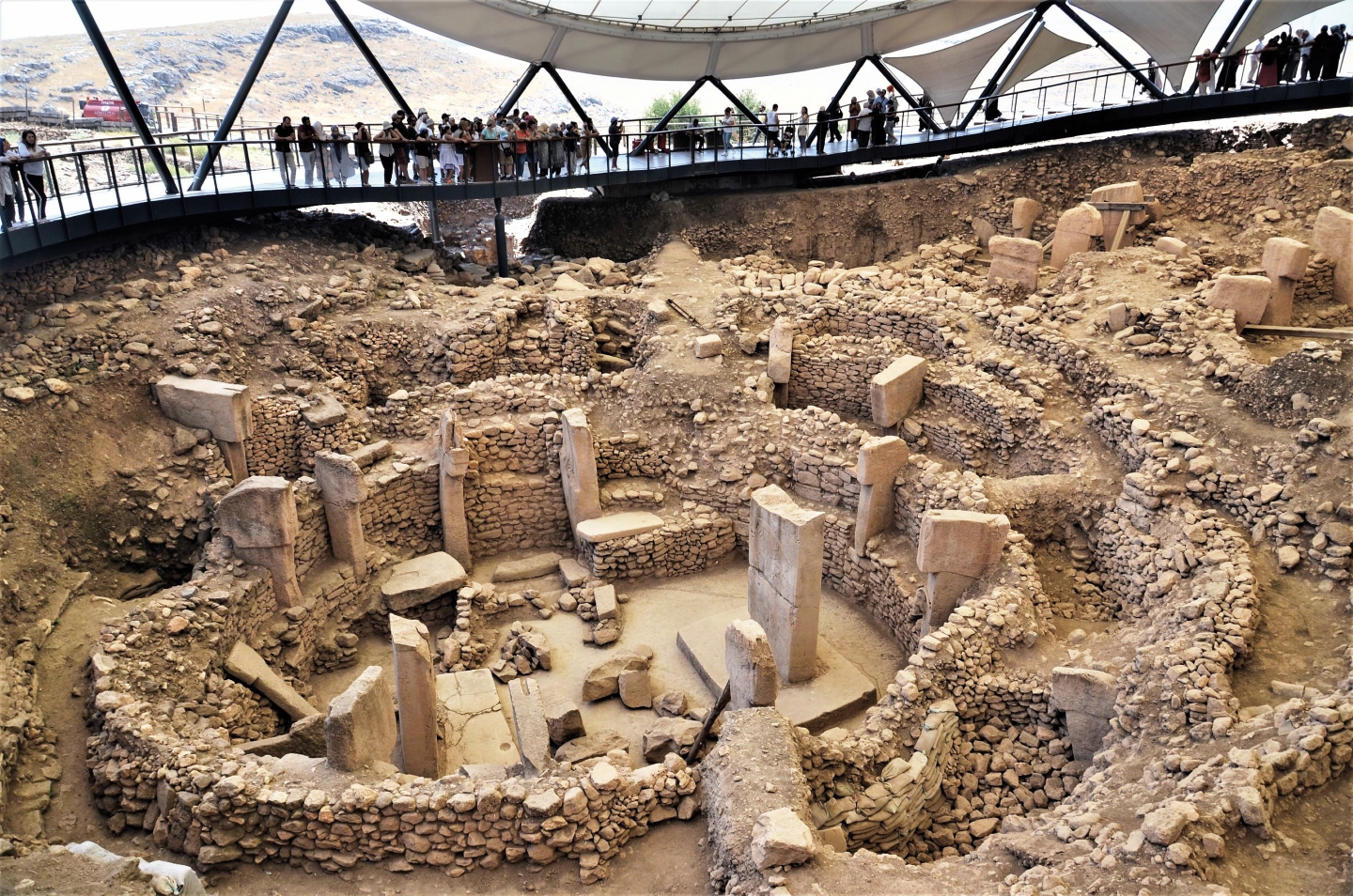
Gobekli Tepe, southeastern Turkey. At least 20 circular enclosures, each containing T-shaped limestone pillars up to 6 metres tall and 20 tons, covered in detailed bas-relief carvings. Built 12,000 years ago — before agriculture, before writing, before any civilization previously recognized. Only about 5% has been excavated.
In 1994, a Kurdish shepherd in southeastern Turkey noticed something unusual protruding from the ground on a hilltop called Gobekli Tepe — "Potbelly Hill" in Turkish. German archaeologist Klaus Schmidt visited, understood immediately what he was looking at, and spent the rest of his life excavating it.
What Schmidt found changed archaeology permanently. Gobekli Tepe is the oldest known monumental structure on Earth. Its earliest enclosures date to approximately 10,000 BCE — roughly 12,000 years ago. That is 6,000 years before Stonehenge, 7,000 years before the Great Pyramid, and predates agriculture, the wheel, writing, and every city civilization previously known to have existed.
According to the standard model of human prehistory, it should not exist.
What Is There
The site consists of at least 20 circular enclosures, each containing massive T-shaped limestone pillars arranged in rings. The pillars range up to 6 metres in height and weigh up to 20 tons. They were quarried from limestone approximately 100 metres away — using flint tools, since metal had not yet been invented.
The pillars are covered in extraordinarily detailed bas-relief carvings: foxes, boars, snakes, vultures, scorpions, aurochs, and abstract symbols. Many pillars also feature arm-like protrusions — making them resemble stylized, faceless human or humanoid figures. Whatever these represent, the artistic execution is striking for any period of human history, let alone for 10,000 BCE.
Excavations have found massive stone basins suggesting fermentation, and the bones of hundreds of thousands of animals — evidence of large communal gatherings. But there are no houses, no granaries, no evidence of permanent habitation. People came from considerable distances, gathered, and left. It was built and used by hunter-gatherers: people with no agriculture, no permanent settlements, and no political organization previously thought capable of anything at this scale.
The Problem It Creates for Standard Prehistory
The conventional narrative of human civilization runs: hunter-gatherers develop agriculture, surplus creates cities, cities create writing, writing creates history. Agriculture first, civilization after.
Gobekli Tepe inverts this entirely. Monumental architecture came first. Klaus Schmidt himself proposed — before his death in 2014 — that the need to feed the labor force gathered to build the site may have been one of the pressures that drove the invention of agriculture in the Fertile Crescent. Religion — or organized communal ritual — may be older than farming. The symbolic capacity to build a temple may have preceded and caused the agricultural revolution.
This is not a minor revision. It is a fundamental inversion of the standard model.
"In 10 or 15 years, Gobekli Tepe will be recognized as one of the greatest archaeological discoveries of the 20th century. It will change everything we thought we knew about the origins of civilization." — Klaus Schmidt, archaeologist, 2006
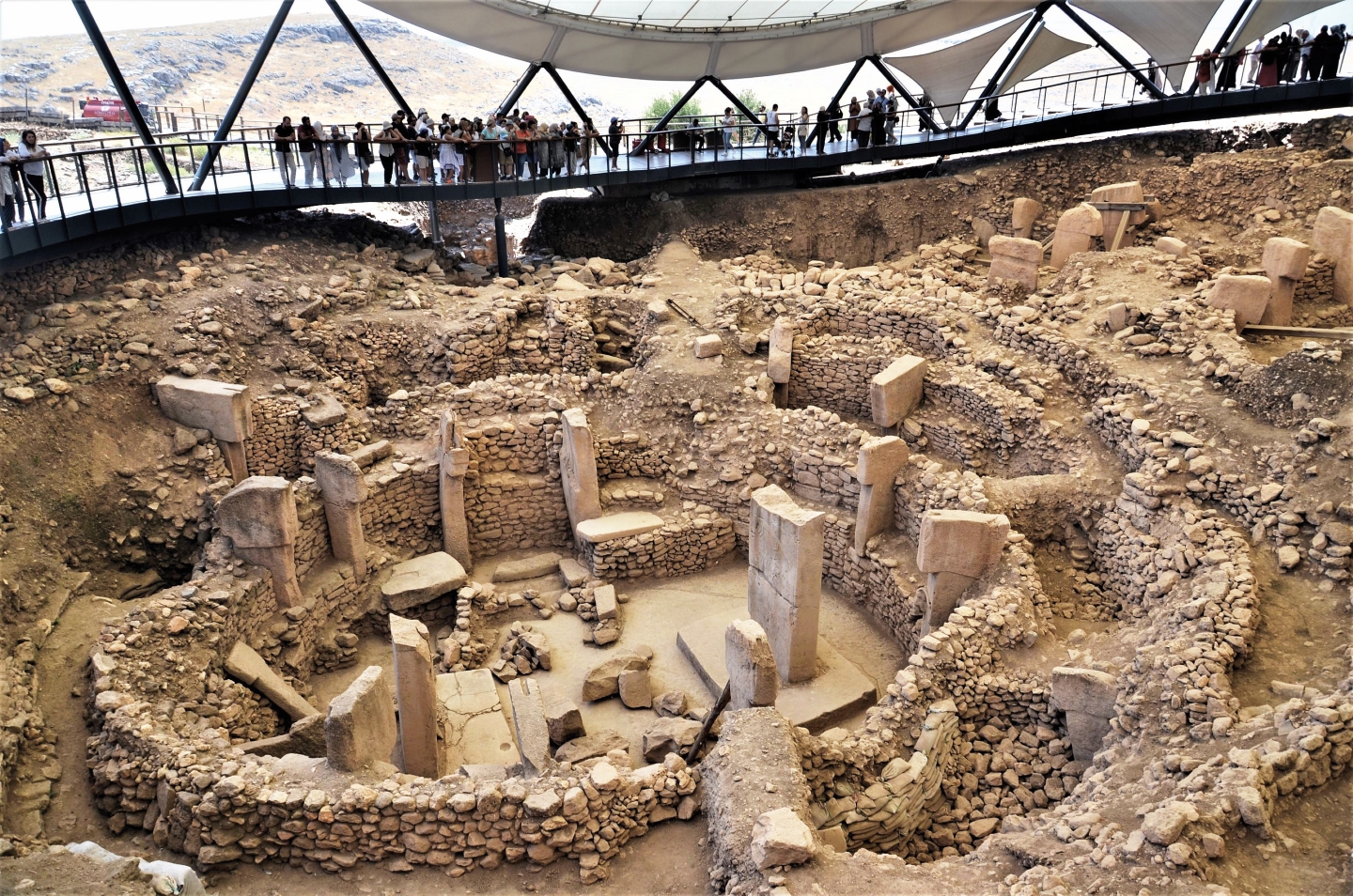
The T-shaped limestone pillars of Gobekli Tepe. Many are carved with animals, insects, and abstract symbols in fine bas-relief. Some feature arm-like protrusions suggesting humanoid figures. Their identity — gods, ancestors, extraterrestrial visitors — remains unknown and genuinely contested.
The Deliberate Burial: The Most Puzzling Fact
Around 8,000 BCE — after approximately 2,000 years of use — Gobekli Tepe was deliberately buried. Not abandoned. Buried. Systematically, under thousands of tons of rubble hauled to the site specifically to cover it. The enclosures were filled to the brim. The pillars were concealed. The entire complex was entombed beneath a man-made hill.
Why? There is no archaeological parallel. No other monumental complex we know of was deliberately buried by the civilization that built it. The theories range from ritual "killing" of a sacred space, to preservation against arriving enemies, to climate-driven abandonment with deliberate sealing. None is fully satisfying. The people who could answer the question left no writing — writing would not be invented for another 6,500 years.
The Comet Impact Theory
A 2017 paper in Mediterranean Archaeology and Archaeometry proposed that the symbols on Pillar 43 — the "Vulture Stone" — encode a specific date: approximately 10,950 BCE, the beginning of the Younger Dryas cold period. Many researchers now believe the Younger Dryas was triggered by a comet or asteroid impact over the North American ice sheet — a catastrophic event that would have been visible across the Northern Hemisphere and devastating to any civilization existing at the time.
If accurate, the builders of Gobekli Tepe were recording a specific cosmic catastrophe — they had the astronomical knowledge to track and date celestial events, and the institutional capacity to memorialize what they observed in durable stone. This connects to Graham Hancock's argument in America Before that a sophisticated pre-Flood civilization was destroyed by the Younger Dryas impact, and that Gobekli Tepe was built by survivors attempting to preserve their knowledge.
The interpretation remains contested. But it cannot be dismissed — the astronomical analysis has been peer-reviewed and the Younger Dryas impact theory has growing geological support.
The Ancient Astronaut Interpretation
The ancient astronaut reading holds that a site of this sophistication, built 12,000 years ago by a supposedly primitive culture, requires outside explanation. The T-shaped humanoid pillars represent non-human visitors. The site was a place of contact. The deliberate burial was protective concealment. The astronomical encoding represents knowledge transmitted from beings with advanced science.
The weakness of this reading at Gobekli Tepe is the same as elsewhere: it invokes outside assistance instead of asking what humans were genuinely capable of. The emerging mainstream consensus — that hunter-gatherers were far more organizationally sophisticated than previously believed — is arguably more radical. It requires revising upward our entire understanding of what our species was doing 12,000 years ago. No aliens required.
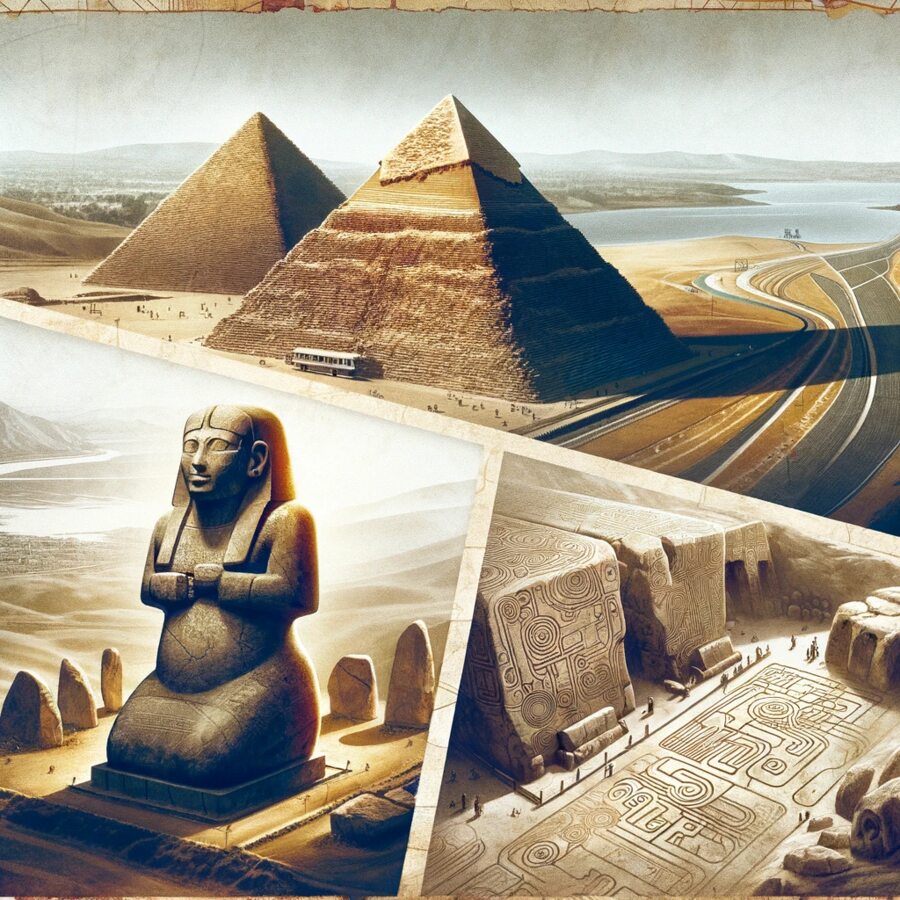
Gobekli Tepe sits at the very beginning of the human tradition of monumental architecture. What came after — Jericho, the Sumerian city-states, the pyramids — now looks less like the origin of civilization and more like the continuation of something already long under way.
The Honest Assessment
Gobekli Tepe does not require exotic explanations to be extraordinary. Human beings built this 12,000 years ago with stone tools — and that fact, by itself, is one of the most astonishing things we know about our species.
The questions it raises are real and unresolved: Who exactly built it, and what kind of society produced that knowledge? What was its function? Why was it buried? What does the 95% of the site still underground contain?
These questions do not need ancient astronauts to be compelling. They are compelling because human history is stranger, deeper, and more surprising than we thought. Gobekli Tepe is the proof.
UFO Times Evidence Assessment
- ESTABLISHED Gobekli Tepe is ~12,000 years old — the oldest known monumental structure. Built before agriculture. Deliberately buried around 8,000 BCE. The reason is officially unknown.
- ESTABLISHED Only ~5% of the site has been excavated. It fundamentally challenges the standard sequence of civilization development.
- CREDIBLE The Vulture Stone may encode an astronomical date corresponding to the Younger Dryas impact event. The interpretation is peer-reviewed and contested, not dismissed.
- SPECULATIVE That Gobekli Tepe was built by survivors of a pre-Flood advanced civilization, or that its figures represent non-human visitors. Possible interpretations not yet supported by physical evidence.
- UNSUPPORTED Any specific claim about extraterrestrial involvement in the site's construction or design.
Related Investigations
Recommended Reading
Fingerprints of the Gods — Graham Hancock (1995)
Published before Göbekli Tepe’s full excavation, Hancock’s argument for a lost advanced civilisation is now corroborated by the site — making this the essential intellectual context for understanding what was built 12,000 years ago.
View on Amazon →America Before: The Key to Earth’s Lost Civilization — Graham Hancock (2019)
Hancock’s follow-up integrates Göbekli Tepe into his global thesis about pre-Ice Age civilisation — using the site’s astronomical alignments and iconography to argue for a sophisticated lost culture.
View on Amazon →Forbidden Archaeology — Michael A. Cremo & Richard L. Thompson (1993)
The definitive catalogue of archaeological evidence suppressed or ignored by mainstream science — Göbekli Tepe forced a revision of human prehistory exactly as Cremo and Thompson predicted it would.
View on Amazon →Go Deeper
Essential Reading on Gobekli Tepe
Graham Hancock's America Before covers the Younger Dryas impact theory and its connection to Gobekli Tepe. Andrew Collins's Gobekli Tepe: Genesis of the Gods is the definitive ancient astronaut treatment. Both are in our bookstore.
Browse the Bookstore →