
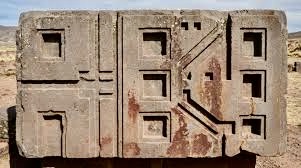
The scattered H-shaped andesite blocks of Puma Punku, Bolivia. Each block was cut with a precision that has not been replicated experimentally using Bronze Age tools.
At an altitude of nearly 3,900 meters on the Bolivian Altiplano, in the shadow of the Andes and beside the shores of Lake Titicaca, lie the ruins of a place called Puma Punku. Most visitors arrive expecting ancient stones. What they find is something far stranger.
The blocks at Puma Punku are not simply large — they are machined. H-shaped stones cut with right angles so precise that engineers measuring them with modern instruments register tolerances of less than a millimeter. Holes drilled at identical depths in multiple separate blocks, as if produced by the same tool with the same calibration. Interlocking joints — slots and flanges — that fit together with the precision of manufactured components. Surfaces so flat that light does not pass beneath a straight edge placed across them.
The question this raises is not simply "who built this?" The question is: what were they using?
What Puma Punku Actually Is
Puma Punku — which means "Gate of the Puma" in Aymara — is a temple complex located within the larger archaeological site of Tiwanaku, in western Bolivia. Tiwanaku itself is one of the oldest urban centers in the Americas, with continuous occupation dating back approximately 1,500 years, and it served as the spiritual and political capital of an empire that at its height stretched across parts of modern Bolivia, Peru, Chile, and Argentina.
Mainstream archaeology dates Puma Punku's construction to approximately 536–600 CE, placing it within the Tiwanaku IV period. The site functioned as a ceremonial platform — a sacred precinct of monumental architecture built to impress, intimidate, and connect worshippers to the divine.
That conventional account is where agreement ends.
The stone used at Puma Punku is primarily red sandstone and gray andesite. The sandstone is local and manageable. The andesite is not. It is an extremely hard volcanic stone whose nearest known source is approximately 90 kilometers away — across Lake Titicaca or through high mountain passes — and the largest andesite blocks at the site weigh between 130 and 800 metric tons. How they were transported remains officially unresolved.
The Precision Problem
The transportation mystery is significant. But it is the stonework itself that has made Puma Punku so difficult to categorize.
The H-shaped blocks — named for the profile they present when viewed from the end — are perhaps the most studied stones in the ancient world. Each H-block is identical in its dimensions to the others. The recesses, indentations, and channels cut into them are geometrically regular in ways that would require either a template, a pattern, or a machine capable of reproducing exact measurements across multiple separate stones. Archaeologists examining the blocks with modern measuring equipment have documented tolerances so fine that they challenge any explanation based on simple hand tools.
The precision at Puma Punku is not decorative. It is functional. These blocks were designed to interlock — like components in a machine, not like stones in a wall.
The drill holes are equally puzzling. Multiple blocks contain holes bored to identical depths — some sources report tolerances within a fraction of a millimeter — in andesite, one of the hardest stones used in construction anywhere in the ancient world. Modern diamond-tipped drill bits struggle with andesite. The Tiwanaku culture, per the archaeological consensus, had no metal tools harder than bronze.
The straight-cut channels — long, narrow grooves running along the surfaces of some blocks — have been examined by mechanical engineers who note they appear consistent with the output of a saw rather than a chisel. No ancient saw capable of cutting andesite has been found at the site or described in any known account of Tiwanaku culture.
What Mainstream Archaeology Says
It is important to represent the mainstream position accurately, because it is not as dismissive as it is sometimes portrayed.
Archaeological consensus holds that the Tiwanaku people were sophisticated builders whose achievements have been consistently underestimated by later observers. Experimental archaeology — attempts to replicate ancient construction techniques using period-accurate tools — has demonstrated that hard stone can be worked with stone tools, abrasion, and patient labor to a level of precision that surprises modern observers. The argument, in essence, is that given enough skilled workers, enough time, and enough accumulated expertise, the stonework at Puma Punku falls within the range of human capability.
Archaeologist Alexei Vranich, who led excavations at Tiwanaku in the early 2000s, has argued that Puma Punku's blocks were cut using a combination of stone tools, sand abrasion, and an organizational capacity for skilled labor that the Tiwanaku empire clearly possessed. He notes that what looks like machine precision to a modern eye may simply be the result of generations of accumulated craft knowledge applied systematically.
The dating of the site to 536–600 CE is based on radiocarbon dating of organic material found at the site and is considered reliable by the relevant scientific community. Claims that Puma Punku is 17,000 years old — a figure that circulates widely in ancient astronaut literature — are not supported by the physical evidence and have been specifically addressed and rejected by the archaeologists who have studied the site most closely.
What Mainstream Archaeology Does Not Explain
Acknowledging the mainstream position honestly makes the remaining questions more, not less, significant.
If the Tiwanaku builders used stone-on-stone abrasion to achieve sub-millimeter tolerances across multiple identical blocks, that process would have required not just skill but a system of measurement and quality control more sophisticated than anything documented in Tiwanaku culture. Archaeology has found no rulers, no measurement standards, no template systems, no manufacturing documentation of any kind from Puma Punku. The precision exists. The explanation for how it was achieved does not.
The identical dimensions across multiple H-blocks remain genuinely difficult to explain through hand tools alone. Hand-tool work, however skilled, produces variation. The variation at Puma Punku is negligible in ways that suggest either a template or a mechanical guide of some kind — neither of which has been found.
The andesite sourcing question has not been resolved. Moving 800-ton blocks of volcanic stone 90 kilometers at 3,900 meters altitude with a Bronze Age toolkit is not impossible in principle, but no specific mechanism has been demonstrated experimentally for stones of this weight. The ramp-and-sled systems proposed for the pyramids of Giza face even greater challenges at Puma Punku's altitude and terrain.
And the purpose of the precision is unclear. Ceremonial architecture does not require sub-millimeter tolerances — it requires grandeur and symbolism. The functional precision at Puma Punku suggests the blocks were designed to be assembled in a specific way, under load, where fit mattered mechanically. What that assembly was, and what it was designed to do, remains unknown.
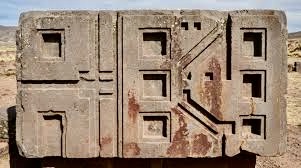
Close-up of the interlocking stonework at Puma Punku. The geometric regularity of the cuts and joints has led engineers and researchers to question conventional explanations.
The Ancient Astronaut Interpretation
Puma Punku is one of the central exhibits in the ancient astronaut argument, and it is worth examining why — and where that argument is strongest and weakest.
The case made by researchers like Erich von Däniken and the television series Ancient Aliens is that the precision and scale of Puma Punku cannot be explained by Bronze Age human capability, and that the most plausible explanation for the stonework is the involvement of a technologically advanced civilization — whether extraterrestrial, a lost human civilization, or some combination. The H-blocks in particular are cited as evidence of machine manufacturing, and the drill holes as evidence of powered tools.
The strongest version of this argument is not that aliens built Puma Punku. It is that the explanation archaeology currently offers — skilled labor with stone tools — does not adequately account for the specific features observed, and that until a better explanation is demonstrated experimentally, the question of how Puma Punku was built remains genuinely open.
The weakest version of the argument makes claims that do not hold up: the 17,000-year dating, assertions that the Tiwanaku people had no knowledge of how to work stone, claims that the precision is literally impossible by human means. These overstatements undermine the legitimate questions the site raises.
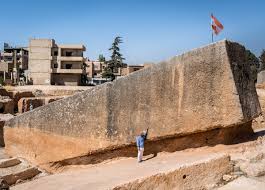
The Baalbek megaliths in Lebanon — another ancient site where stones of extraordinary size and precision challenge conventional explanations. Puma Punku is not alone: the ancient world is full of construction anomalies that archaeology has not fully resolved.
What We Actually Know — and Don't
Puma Punku was built by the Tiwanaku civilization, almost certainly between the 5th and 7th centuries CE. That is supported by radiocarbon evidence and is not seriously contested by serious researchers on either side of the debate.
The Tiwanaku people were sophisticated, organized, and capable of extraordinary architectural achievement. Their empire was one of the most significant in pre-Columbian South America and their engineering accomplishments extended well beyond Puma Punku.
The stonework at Puma Punku exhibits precision that is difficult — though not demonstrably impossible — to explain with Bronze Age tools. No experimental archaeology project has yet replicated the specific features of the H-blocks, the andesite drill holes, or the straight-cut channels using only tools the Tiwanaku would have possessed.
The transportation of the heaviest andesite blocks has not been explained by a specifically demonstrated mechanism. It is assumed to have been accomplished by organized human labor — an assumption that may be correct but has not been proven for stones of this mass at this altitude.
The purpose and original configuration of Puma Punku remains partly unknown. The site was badly damaged — possibly by an earthquake, possibly by deliberate dismantling — and the blocks were scattered across the site. What the completed structure looked like, and what function the precision of its components served, is not fully understood.
Why Puma Punku Matters
Whether or not one accepts any version of the ancient astronaut hypothesis, Puma Punku presents a genuine archaeological puzzle. A civilization working with Bronze Age technology produced stonework whose precision has not been replicated experimentally. Heavy stones were moved from distant sources by a mechanism not yet specifically demonstrated. A complex of machinery-like precision was built at one of the highest inhabited altitudes on Earth — and then, at some point, destroyed or fell, and the knowledge of how it was built went with it.
The honest position — held by very few people on either side of this debate — is that we do not yet have a complete explanation for Puma Punku. The mainstream account is plausible but incomplete. The ancient astronaut account is imaginative but unproven.
What Puma Punku demands is not a conclusion. It demands better archaeology, better experimental replication, and a willingness to sit with uncertainty rather than forcing the evidence into a predetermined answer.
The stones have been there for fifteen centuries. They can wait a little longer for an honest reckoning.
■ The UFO Times Evidence Scale
How we rate the claims in this article.
Puma Punku is a real archaeological site within the Tiwanaku complex in Bolivia. The site dates to approximately 536–600 CE based on radiocarbon evidence. The andesite used comes from sources approximately 90 kilometers away. The largest blocks weigh up to 800 metric tons. The stonework exhibits high geometric precision documented by surveys.
The specific sub-millimeter precision tolerances cited vary across accounts and have not been uniformly documented in peer-reviewed literature. The claim that no experimental archaeology has replicated the stonework is accurate as of this writing but absence of evidence is not evidence of impossibility.
The ancient astronaut interpretation — that the precision stonework implies non-human or advanced technological involvement. This is a possible explanation for the observed anomalies but is not supported by direct physical evidence of any specific advanced technology.
Claims that Puma Punku is 17,000 years old. Claims that precision is literally impossible by human means. Claims that the Tiwanaku had no stoneworking knowledge. These are not supported by the archaeological evidence.
Recommended Reading
Chariots of the Gods — Erich von Däniken (1968)
The foundational treatment of Puma Punku as evidence for extraterrestrial contact — von Däniken’s analysis of the H-blocks’ impossible precision remains the starting point for any serious investigation of the site.
View on Amazon →Fingerprints of the Gods — Graham Hancock (1995)
Hancock’s investigation into the Tiwanaku culture places Puma Punku within a global pattern of anomalous ancient engineering — proposing a pre-Ice Age civilisation with technological capabilities that conventional archaeology cannot account for.
View on Amazon →Forbidden Archaeology — Michael A. Cremo & Richard L. Thompson (1993)
The most comprehensive catalogue of suppressed archaeological evidence — essential for understanding how mainstream science has handled anomalous sites like Puma Punku and why the evidence is systematically excluded from academic discourse.
View on Amazon →Related Articles
Further Reading
The researchers, archaeologists, and independent investigators who have spent careers at sites like Puma Punku — their books, their arguments, and their evidence.
Browse the UFO Times Bookstore →