
Across the ancient world, in locations separated by thousands of kilometres and supposedly unrelated by any contact or trade, there exists a class of structures that archaeology has never satisfactorily explained. Not merely impressive—Angkor Wat and the great cathedrals of Europe are impressive. But these sites are impossible by the standards of conventional archaeology. They require a level of engineering sophistication, tool capability, organisational complexity, and physical strength that should not have existed at the times these structures were allegedly built. The pattern they form is what matters most—not individual sites, but the global consistency of the anomaly.
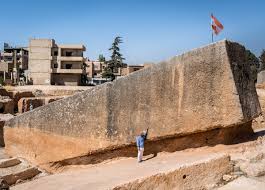
Baalbek in Lebanon contains the trilithon: three limestone blocks, each weighing approximately 800 tonnes. These are positioned within a larger platform whose construction and purpose remain unexplained. The Baalbek complex shows signs of multiple construction phases—some visible stones and structures rest on a pre-Roman foundation platform of cyclopean blocks that mainstream archaeology has never adequately dated or explained. The precision of the fit, the scale of the individual stones, and the evidence of intentional destruction and reconstruction suggest a history far more complex than the conventional narrative accounts for.
Sacsayhuamán in Peru consists of 360-tonne limestone blocks fitted together with sub-millimetre precision, without mortar. The stones are so tightly fitted that a knife blade cannot be inserted between them. The site sits at 3,700 metres altitude, overlooking Cusco. Spanish conquistadors, when they arrived, found it partially ruined and attributed its construction to the Inca civilisation, though the Inca provided no detailed account of how it was built and no one has satisfactorily explained the logistics of moving and positioning stones of this scale with hand tools.
Easter Island's 887 Moai figures, each weighing up to 86 tonnes, are distributed across an island with a pre-contact population that conventional estimates place at 3,000–15,000 people. The logistics of carving, moving, and erecting figures of this scale with the tools available to Easter Island peoples—stone implements and wooden poles—remain unresolved. The island had no large trees that could have been used for construction or transportation. Yet the figures were made, transported sometimes over a kilometre across the island, and positioned on ahu (ceremonial platforms). The labour investment was immense. The purpose was cosmological, not utilitarian. And the question of how remains essentially unanswered by conventional archaeology.
What unites these sites—Baalbek, Sacsayhuamán, Easter Island—is not geography or culture. It is a pattern: scale beyond what pure necessity would dictate, precision that exceeds the capabilities of the tools that archaeology claims were available, locations that defy logistical sense (high altitude, remote islands, sites of no particular resource value), and the consistent feature of later cultures building upon, reusing, or living alongside these structures without fully explaining them. The conventional explanation for each site treats it as an isolated anomaly. But the global pattern suggests something else: that these sites are expressions of a shared knowledge base or a shared technological tradition that spans the ancient world.
The Yonaguni underwater structure off the coast of Japan adds another dimension to the mystery. The submerged platform shows right angles, terracing, and evidence of intentional construction. It is dated, through sea-level analysis, to exist before the last ice age sea level rise approximately 10,000 years ago—placing it in a period of human prehistory that conventional archaeology describes as pre-civilisational, lacking settled habitation, writing, or monumental architecture. If Yonaguni is indeed constructed (which mainstream geology still contests), it implies a sophisticated maritime civilisation predating the official archaeological record by millennia.
Gunung Padang in Indonesia represents a more recent discovery with profound implications. Ground-penetrating radar has revealed constructed chambers beneath the surface, and geological analysis suggests layers of construction dating potentially to 20,000 BCE or earlier—an age that would place the site in the pre-agricultural epoch, when mainstream archaeology insists no civilisation could have existed. The discovery has sparked intense debate about whether the subsurface structures are natural geomorphological formations or constructed platforms. What matters is that the possibility—that monumental architecture might predate the accepted timeline by 20,000 years—has forced archaeology to confront the limits of its certainty. These sites do not fit the narrative. And once you acknowledge the pattern of sites that don't fit, the narrative itself becomes the problem.