
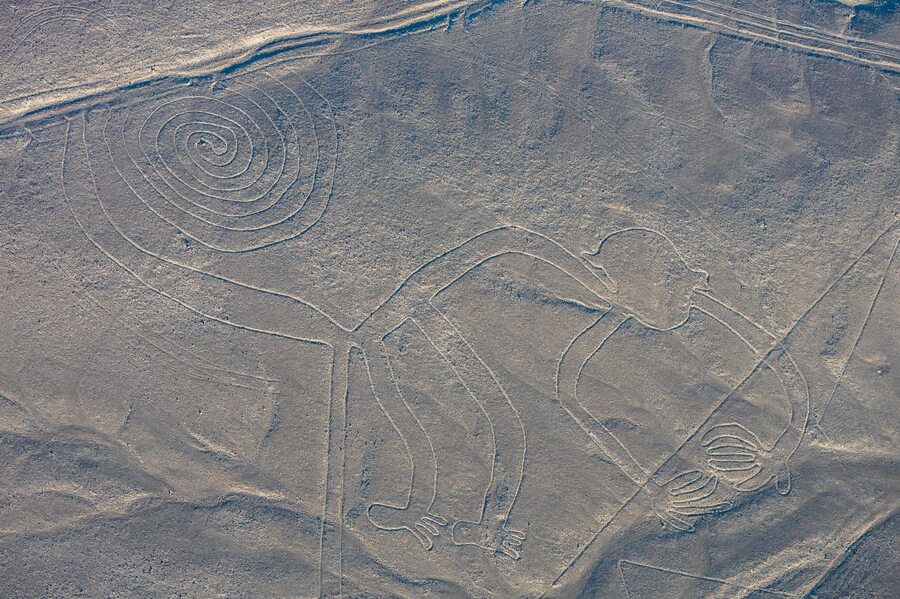
How the Nazca Lines were made is straightforward: remove the reddish-brown iron oxide-coated pebbles that cover the surface of the Peruvian coastal plateau and pile them to the sides of the cleared paths, revealing the pale yellow-grey earth beneath. The technique requires no advanced technology. The scale at which it was applied is what has never been fully explained. Spread across approximately 450 square kilometres of the Nazca Desert in southern Peru, the geoglyphs include more than 800 straight lines, 300 geometric figures, and 70 animal and plant designs. The largest figures extend for over 370 metres. The geometric lines are so straight that when Europeans first spotted them from the air in the 1920s, they assumed they were ancient landing strips.
The Nazca civilisation that created the figures flourished between roughly 100 BCE and 800 CE. They left no written records. Their architecture was modest by the standards of contemporary civilisations. Yet the lines they drew in the desert have lasted two thousand years without significant weathering, preserved by the remarkable stability of the Nazca microclimate—one of the driest places on Earth, where rain is rare and wind speeds are low enough to leave the surface essentially undisturbed. Whatever the Nazca people were trying to communicate or commemorate, they built it to last.
The scholarly consensus holds that the geoglyphs were ceremonial in nature—offerings or messages directed toward mountain gods associated with water and fertility, rendered on a scale that would make them visible from the surrounding hills or, in the cosmological logic of the culture, from the sky above. Archaeologist Johan Reinhard's research, which connected the geoglyphs to the Nazca's water cult and to sightlines toward sacred peaks, remains the most rigorously supported academic interpretation. The anthropologist María Reiche, who devoted her life to mapping and preserving the figures, believed the largest lines functioned as an astronomical calendar. But none of these explanations fully accounts for why the figures would need to be visible from the air, or for the sheer labour investment in creating designs whose full extent could never be appreciated from the ground.
Von Däniken's 1968 interpretation—that the figures were landing strips for extraterrestrial aircraft—has proven durable not because the evidence overwhelmingly supports it, but because it is one of the few frameworks that actually takes the mystery seriously. The other explanations have a problem: they assume the Nazca people knew why they were building on a scale that required aerial perspective to view. But there is no evidence the Nazca had any technology for viewing their own creations from above. Yet the scale and sophistication of the geoglyphs suggest they were deliberately designed for aerial observation. This contradiction remains at the heart of the Nazca mystery.
The 2019–2022 AI discoveries have fundamentally changed the Nazca conversation. Yamagata University and IBM Watson AI analysis revealed 143+ new geoglyphs invisible to ground-level observers, including a 37-metre humanoid figure that had remained undetected for two millennia. What the AI analysis demonstrates is that the visible Nazca Lines—the ones archaeology has studied—represent only a fraction of the total project. The scale of the full undertaking, once you account for the hidden and invisible designs, is far larger than previously understood. This suggests a civilisation with both the resources and the motivation to build on a scale that archaeology has underestimated.
Recent research by Michel Van Etten and Phillis Pitluga has identified acoustic and hydraulic properties of the Nazca Lines. Some lines may have been designed to funnel water or to create specific acoustic effects when wind passed through them. The spider glyph aligns precisely with the only Amazonian spider species capable of predicting rainfall—a species unknown to the Nazca region. What these competing theories share is a recognition that the Nazca Lines encode knowledge—astronomical, hydrological, biological—that suggests a level of sophistication far beyond what conventional archaeology attributes to the period. The question is no longer whether the Nazca Lines mean something. The question is what framework of human capability allows us to account for a civilisation that could build on this scale, with this precision, encoding this much knowledge, and leaving behind no written explanation of their purpose.