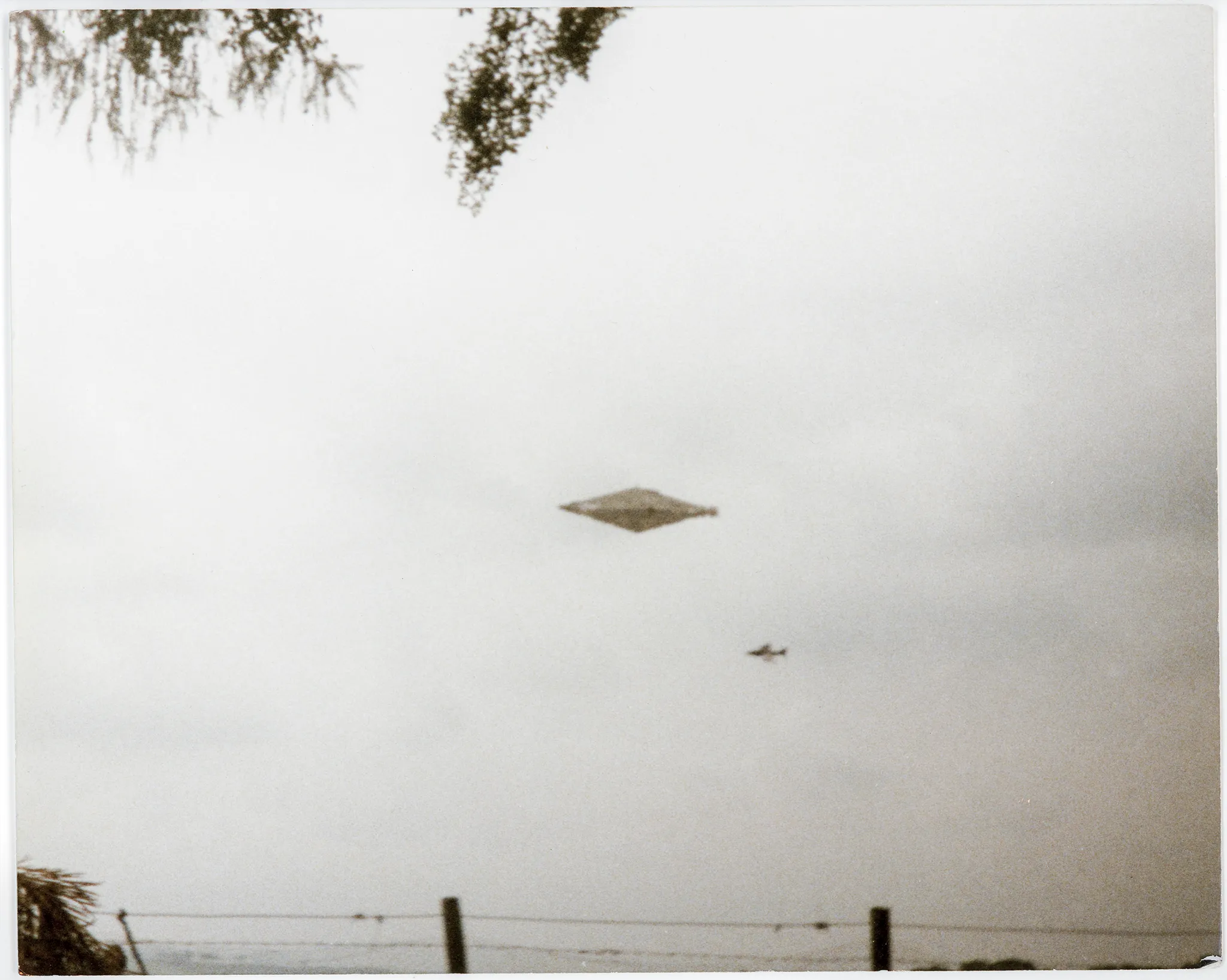
with permission of Craig Lindsay / Sheffield Hallam University
Unforgettable Cases
The Calvine Photograph: What the Surviving Image Proves—and What It Cannot
On the evening of 4 August 1990, two men above the hamlet of Calvine in Perthshire photographed a large diamond-shaped object hovering in the Scottish sky. The photographs were passed to the government and largely vanished. Thirty-two years later, a single surviving original print was found, archived, and subjected to expert analysis. The object has not been definitively identified.
The Calvine case has, over three decades of research, accumulated an unusually thorough public record for a British UFO sighting. What distinguishes it from comparable cases is not simply the quality of the surviving image but the depth of the paper trail: Ministry of Defence investigation records, parliamentary questions, Freedom of Information releases, CIA-related correspondence, and an expert photographic analysis of the surviving print — all of it now partly in the public domain.
What the original MoD record says
The earliest documented account is a handwritten summary prepared by Sec(AS)2A desk officer Owen Hartop in September 1990 and released at the National Archives in 2009. The sighting took place at approximately 9pm on Saturday, 4 August 1990, near the village of Calvine, close to the A9 in Perthshire. A large diamond-shaped object appeared in the sky and hovered before ascending vertically at high speed — for ten minutes, according to David Clarke’s account of Hartop’s summary (National Archives, DEFE 24/1940/1, pp. 113–116). During the sighting, a jet identified by the MoD as a Harrier made several low-level passes in the area. One of the two witnesses photographed the object, taking a total of six colour photographs.
Hartop’s handwritten summary makes no reference to any sound associated with the object’s appearance. A description of a “low humming sound” before the witnesses noticed the craft appears in accounts given much later by Nick Pope, based on his recollection of having reviewed the case in the early 1990s.
The identities of the two witnesses have never been established. A name written in chinagraph pencil on the back of the surviving print — “Kevin Russell c/o the Daily Record, Glasgow” — led researchers to contact more than four hundred people of that name worldwide; the search did not produce a confirmed match. No witness has come forward. Andrew Robinson’s photographic analysis notes that a restricted MoD report that may contain the witnesses’ names is sealed under the Data Protection Act until 1 January 2076. Public evidence does not establish that the witnesses’ identities are definitively contained in that document.
The photographs and the evidence chain
After the sighting, the witnesses passed their prints and negatives to the Scottish Daily Record. The newspaper’s picture desk forwarded the materials to Craig Lindsay, the RAF press officer based at RAF Pitreavie near Edinburgh, who relayed them to the MoD in London. The original negatives and prints then disappeared. The MoD has stated the negatives were returned to the Daily Record; the newspaper has stated it never received them back. The Daily Record never published any story about the photographs in 1990, or at any point afterwards. The full set of six photographs and their negatives remains unaccounted for.
Before forwarding the materials, Lindsay retained one print along with its original envelope. He kept these for more than thirty years.
Some researchers have speculated that the newspaper may have been discouraged from publishing by a government advisory notice. The DSMA (formerly D-Notice) committee secretary has stated that no records of such a notice in connection with this case have been found, though he acknowledged one could not be ruled out.
The government’s investigation
MoD documents released under the Freedom of Information Act establish that the photographs were the subject of at least two rounds of formal analysis. In September 1990, the DI55 branch of the Directorate of Scientific and Technical Intelligence examined the images. Their analysis identified a Harrier jet alongside the unidentified object, and noted a “barely visible second aircraft, again probably a Harrier.” Departmental experts reached no “definite conclusions” about the nature of the object. A written answer given by Nicholas Soames, Minister of State for the Armed Forces, on 24 July 1996 stated that the MoD had examined the associated negatives, judged them to contain nothing of defence significance, had not retained them, and had no record of photographs having been taken from them.
That position is complicated by the released record. In January 1992 — sixteen months after the initial examination — DI55 initiated a second analysis. Acetate copies of five images were sent to the RAF’s Joint Air Reconnaissance Intelligence Centre (JARIC) at RAF Brampton for detailed scrutiny, asking for calculations of height, distance, diameter, and size. The tasking document describes “the sensitivity of the material” and requires “very special handling.” It also notes that the task had already been “discussed with Ops 4 Squadron.” The released files contain no record of what this second analysis concluded. The paper trail ends in early 1992.
A separate stream of MoD correspondence from late 1992 to early 1993 shows that British intelligence had informally shared imagery with the United States, and that enquiries were made through the Defence Attaché in Washington as to whether the Americans had a classified diamond- or triangular-shaped hypersonic aircraft. No confirmation was received. A ministerial briefing later released under FOI acknowledged that “no one on the Air Staff or at desk level in [defence intelligence] knows for sure that such a project exists.”
Watch
An in-depth examination of the evidence, the chain of custody of the photographs, and the British government’s internal response over three decades
Nick Pope’s account
Nick Pope served as a desk officer in Sec(AS)2A from 1991 to 1994. The Calvine sighting took place in August 1990, a year before Pope’s posting began; the original investigation was conducted by his predecessor, Owen Hartop. When Pope arrived in 1991, he found an enlarged print already on the office wall.
In a 2001 interview with researcher David Clarke, Pope described the image as appearing to show “a solid structured craft” at least the size of a Harrier, and said the MoD’s internal assessment had been that “this was for real, that it was a good one.” At some point during his tenure, Pope’s head of division, JRG Clark, removed the enlarged print from the wall and locked it away. Pope attributed this to Clark’s belief that the photograph might relate to a classified American aircraft.
Pope wrote briefly about the Calvine case in his 1996 book Open Skies, Closed Minds, describing it as “one of the most intriguing in the Ministry of Defence’s files.” He died in April 2026 at the age of sixty.
David Clarke and the 2022 publication
Dr David Clarke is an investigative journalist and academic who served as consultant for the National Archives UFO file releases between 2008 and 2013. He subsequently spent years attempting to locate the missing photographs and identify the witnesses.
In 2021 Clarke tracked down Craig Lindsay, the retired RAF press officer who had handled the photographs in 1990. Lindsay said he had been waiting for someone to call about this for thirty years. In May 2022 Clarke visited him at RAF Pitreavie Castle, where Lindsay produced the original print, its envelope, and the fax copies he had sent to the MoD. On 27 June 2022, Lindsay donated the materials to Sheffield Hallam University. Clarke published the image on 12 August 2022; it appeared in the Daily Mail the following morning.
Clarke has said he does not believe the object in the photograph is an alien spacecraft. He has described it as “by far the best UFO photograph I have ever seen” in the sense of the best photographic record of a genuinely unidentified aerial object, not as evidence of an extraterrestrial origin.
What the photographic analysis found
Andrew Robinson, a senior lecturer in photography at Sheffield Hallam University, conducted a detailed analysis of the original print donated by Lindsay, publishing initial findings in August 2022 and an extended report in 2024. His conclusions were that the photograph is genuine: “as far as can be determined the image itself is a genuine photograph of a scene before the camera.” He found no evidence of post-production manipulation — no signs of alteration, compositing, or fabrication. The surviving print is consistent with the MoD photocopies released in 2009.
Robinson does not rule out the possibility that staging occurred in front of the camera — that a physical object was placed in the scene before the photograph was taken. He found no direct evidence for this, but his analysis does not eliminate it as a possibility. His analysis is the only independent expert examination of the original print in the public record.
A different interpretation has been offered by Sean Kirkpatrick, former director of the US Department of Defense’s All-domain Anomaly Resolution Office (AARO). He has stated publicly that in his view the image shows a reflection, and that “the top and bottom are reflections of each other.” This assessment has been contested by Robinson and by Clarke’s team. The question has not been formally settled.
Competing explanations
Three main explanations have been advanced for what the photograph shows. None has been established with documentary evidence.
The first is a classified American aircraft — most often linked to the rumoured Aurora programme or a related black project, possibly flown from RAF Machrihanish. A Defence Intelligence officer told Clarke’s team this was the explanation he had been given internally. But the MoD’s own contemporaneous records show that formal British enquiries with the Americans produced no confirmation. The MoD also found no record of any Harriers operating in mainland Scotland at the date and time of the sighting, leaving the origin of the accompanying jet unresolved alongside that of the main object.
The second is a fabricated photograph. Air Commodore Simon Baldwin, the UK’s Air Attaché in Washington, told Clarke he and a senior American officer concluded the photograph was “a spoof” — that someone had “taken a picture of a Harrier and drawn a large object alongside it.” Andrew Robinson’s analysis found no evidence of post-production manipulation but does not exclude staging in front of the camera. The witnesses’ silence over thirty-six years has been noted by several researchers as relevant context.
The third explanation is that the photographs show a genuinely unidentified object. The MoD’s own formal finding was “object unexplained, case closed, no further action.” The geometry of the craft — a diamond shape with no visible propulsion or wings — did not match any aircraft in the British or American inventories. Whether this reflects the limits of 1990s intelligence access, a reluctance to share classified information, or something genuinely outside the known inventory has not been answered.
Evidence Assessment
Established — supported by MoD documents or analysed primary sources
A sighting was reported near Calvine, Perthshire on the evening of 4 August 1990
Six colour photographs were taken by one of two witnesses
The photographs passed through the Scottish Daily Record to an RAF press officer and then to the MoD
DI55 conducted at least two formal analyses; neither produced a definitive identification
A Harrier (and possibly a second aircraft) was visible in the photographs alongside the unidentified object
The original prints and negatives cannot be accounted for
Craig Lindsay retained one surviving print, donated to Sheffield Hallam University in June 2022
Andrew Robinson’s photographic analysis found no evidence of post-production manipulation
Reported but unconfirmed — sourced from individual accounts or secondary reporting
A “low humming sound” preceded the sighting (Pope’s account; absent from the original MoD handwritten record)
The object hovered for six minutes (some sources); the MoD’s September 1990 handwritten summary, as described in Clarke’s account (DEFE 24/1940/1, pp. 113–116), says ten minutes
A government advisory notice discouraged the Daily Record from publishing (speculated; no confirmed records found)
The object was a classified US experimental aircraft (asserted by one Defence Intelligence source; never officially confirmed or denied)
Not established
The identity of either witness
The current whereabouts of the original negatives and five of the six prints
What the January 1992 JARIC analysis concluded
The true nature of the object photographed
Go Deeper
Dr David Clarke’s detailed five-part account of the Calvine case — drawing on FOI documents, original interviews, and his own archival research — is the most comprehensive published investigation of the evidence.
After thirty-six years, the Calvine incident remains formally unresolved. The surviving print is in a university archive. The original negatives and five of the six photographs cannot be accounted for. The witnesses have not been identified and show no sign of coming forward. The second MoD analysis commissioned in 1992 left no trace of its conclusions in the released files.
The Calvine case does not prove the existence of an extraterrestrial craft, a classified aircraft, or a fabricated photograph. What it provides is an unusually detailed paper trail showing that a British government agency treated a reported sighting seriously enough to examine it twice, share imagery with an allied intelligence service, and decline to explain its findings publicly. That is the record. The explanations — classified aircraft, staged photograph, or genuinely unidentified object — remain competing hypotheses, none of which has been established by the evidence available.
Recommended Reading
Open Skies, Closed Minds
Nick Pope — 1996
The former MoD desk officer’s account of his years in Sec(AS)2A includes the first public description of the Calvine case — a rare insider account of how the British government handled the phenomenon in the early 1990s.
UFOs: Generals, Pilots and Government Officials Go on the Record
Leslie Kean — 2010
Investigative journalist Leslie Kean assembles testimony from senior military and government officials worldwide — including British sources — making the case that the phenomenon is real and demands serious investigation.
A Covert Agenda: The British Government’s UFO Top Secrets Exposed
Nick Redfern — 1997
Redfern’s FOIA-based investigation into British government UFO files reveals a consistent pattern of suppression and classification spanning decades — the institutional context within which the Calvine photographs disappeared.