
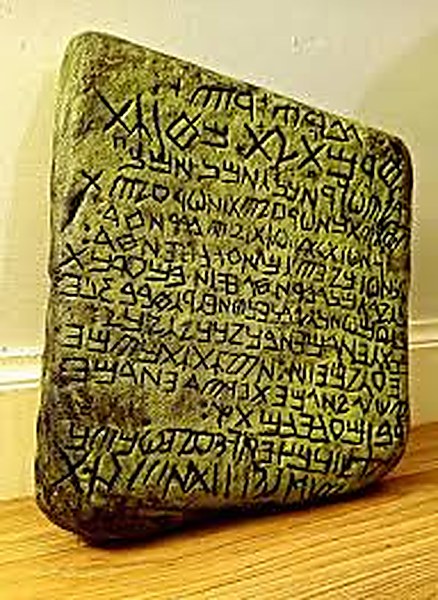
The Emerald Tablets of Thoth the Atlantean occupy an unusual position in the literature of ancient wisdom. They are either one of the most important surviving transmissions of pre-flood knowledge — preserved by a priest-king of Atlantis who escaped the destruction of his civilisation and encoded the fundamental principles of the cosmos in imperishable text — or they are a 20th-century composition presented as ancient in order to lend it authority it would not otherwise possess. The evidence for the second interpretation is substantial. The evidence for the first interpretation is philosophical and experiential rather than archaeological. And yet the tablets refuse to be dismissed, because their content — whatever its actual origin — is of extraordinary sophistication and internal consistency.
The text as it is widely known derives from a translation attributed to Dr. Doreal, published in the 1930s, which claims to be a rendering of Emerald Tablets discovered beneath the pyramid of the Sun at Teotihuacán in Mexico. Doreal — whose real name was Maurice Doreal — founded the Brotherhood of the White Temple in Colorado and was not a figure whose credentials invited uncritical trust. The tablets he claimed to have translated are not publicly accessible. No independent scholar has examined them. The chain of custody for the original artifacts, if they exist, is entirely unverified. By the standards of academic textual scholarship, the Doreal tablets cannot be authenticated.
The Hermetic Connection
The complication is that the philosophical content of the Emerald Tablets does not read like the production of a 1930s occultist. The most famous passage — “As above, so below; as within, so without; as the universe, so the soul” — is the core principle of Hermeticism, the philosophical and spiritual tradition attributed to Hermes Trismegistus, himself a synthesis of the Greek god Hermes and the Egyptian god Thoth. This principle appears in the Corpus Hermeticum, a body of texts that scholars date to the 2nd and 3rd centuries CE but which many Hermetic scholars argue preserve genuinely ancient Egyptian wisdom. The conceptual framework of the Emerald Tablets — the correspondence between cosmic and personal scales, the alchemical transformation of consciousness, the cyclical nature of time — is consistent with Egyptian and Neoplatonic thought at a depth that a fraudulent composition would be unlikely to achieve accidentally.
The pre-Doreal history of the Emerald Tablets is more tractable. A Latin text known as the Tabula Smaragdina circulated in medieval Europe from at least the 8th century CE and was attributed to Hermes Trismegistus. This text contains the core Hermetic principles in compressed form and was influential on the development of alchemy across the Islamic and European worlds. Isaac Newton, whose alchemical manuscripts have only recently been fully examined, produced his own translation of the Tabula Smaragdina. The medieval Latin text is thus real, historically documented, and philosophically significant. What it does not do is establish the existence of the more expansive Doreal tablets or their claimed Atlantean origin.
What the Tablets Preserve
Whatever their ultimate origin, the Emerald Tablets as transmitted through the Hermetic and Doreal traditions preserve a set of cosmological principles that have proven extraordinarily fertile. The idea that the macrocosm and microcosm are structurally identical — that the same patterns repeat at all scales of existence — is not only the foundation of Hermeticism but anticipates, in a qualitative way, the mathematical concept of self-similarity that underlies modern fractal theory. The alchemical framework of the tablets — the transformation of base matter into gold as a metaphor for the transformation of the human soul — prefigures Jung’s reading of alchemy as the projection of psychological processes onto material substances.
Within the ancient astronaut tradition, the Emerald Tablets are read more literally: as a genuine transmission from a pre-flood civilisation that possessed a cosmological understanding far in advance of what the conventional timeline of human intellectual development admits. Thoth the Atlantean, on this reading, is not a mythological figure but a historical one — a survivor who preserved in text what his civilisation had encoded in the geometry of its monuments. Whether that reading is correct cannot currently be established. What can be established is that the philosophical content of the tablets — wherever it came from — has influenced esoteric, scientific, and spiritual thought for centuries and shows no sign of exhausting its productive life.
Watch
The Emerald Tablets of Thoth — Ancient Wisdom and the Hermetic Tradition
Watch
Thoth and the Lost Knowledge of Atlantis — Ancient Aliens
Recommended Reading
The Emerald Tablets of Thoth-The-Atlantean — Dr. Doreal, trans. (1939)
The primary text — Doreal’s English translation of the alleged ancient tablets, with commentary. Essential reading for anyone approaching the subject, regardless of where one stands on questions of authenticity.
View on Amazon →The Kybalion — Three Initiates (1908)
The foundational modern text of Hermetic philosophy, which systematises the “as above, so below” principle of the Emerald Tablets. Provides the conceptual framework for understanding the tablets’ cosmological claims.
View on Amazon →Fingerprints of the Gods — Graham Hancock (1995)
Hancock’s investigation into the lost civilisation from which texts like the Emerald Tablets may have descended — the Atlantean hypothesis examined through the lens of geological and archaeological evidence.
View on Amazon →