
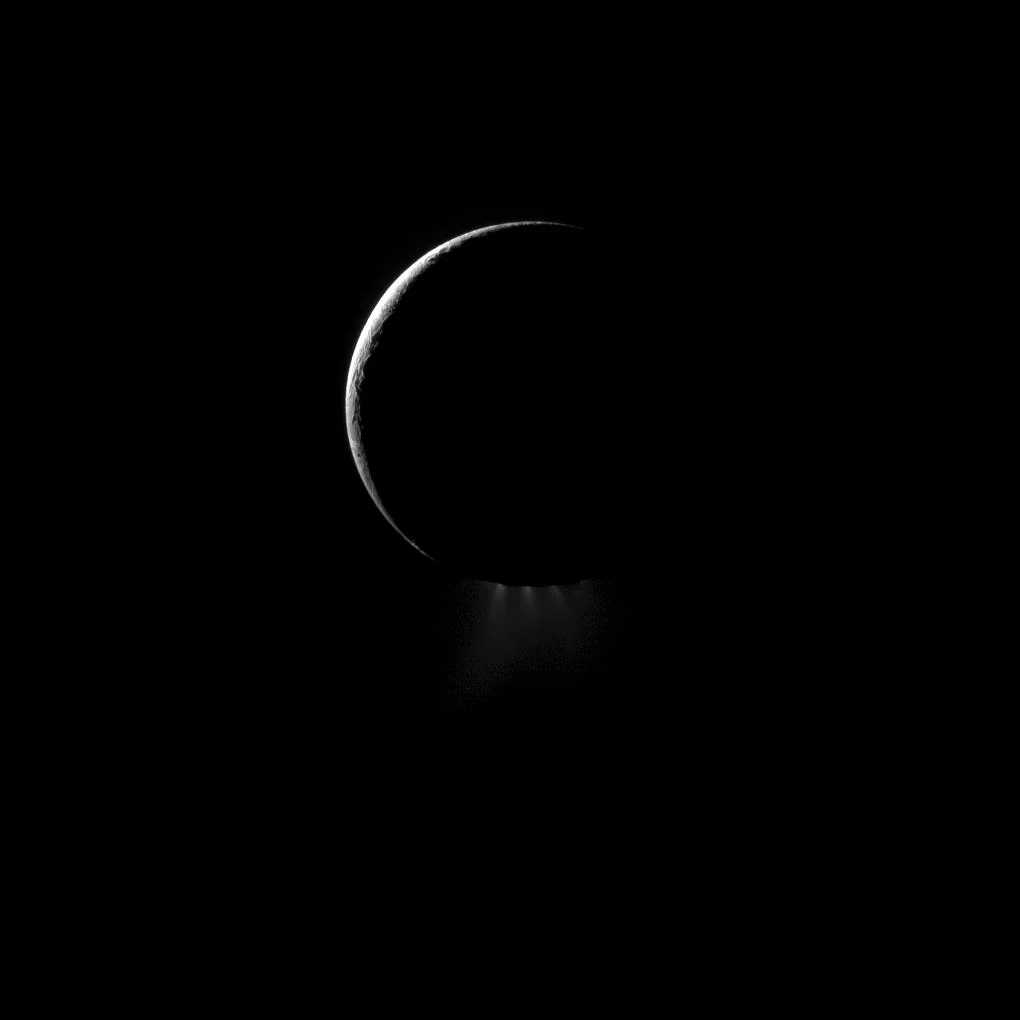
No life has been detected on Enceladus. But two new peer-reviewed studies show that a known microbial metabolism can function in simulated Enceladus-ocean chemistry — and that material erupting from the moon may naturally concentrate chemicals into individual ice grains that future spacecraft could examine. Both papers were published September 25, 2026 in Science Advances. Neither is evidence of life. Together they make the search for life on Enceladus more scientifically focused than it was before.
What the Two Studies Reported
Two research teams, with overlapping membership, published their findings in Science Advances on the same day. The first study, led by researchers at Ludwig-Maximilians-Universität München (LMU), tested whether a specific methane-producing Earth microorganism could survive under laboratory conditions designed to approximate the chemistry of Enceladus’s ocean. The second, led by Professor Frank Postberg at Freie Universität Berlin, reanalyzed measurements from NASA’s Cassini spacecraft to explain how ocean-derived material gets packaged into the individual ice grains that shoot out of the moon’s plumes.
The two studies are stronger together than separately. The first asks whether a known metabolism could operate under Enceladus-like conditions. The second describes how the products of any such metabolism — or any other ocean chemistry — might be distributed across the plume particles that a future spacecraft would actually collect. Together they connect the question of potential habitability beneath the ice with a practical approach to investigating that question from space.
Why Enceladus Attracts Astrobiologists
Enceladus is one of Saturn’s moons — a small, bright world about 500 kilometres across, covered in ice. Data from NASA’s Cassini spacecraft, which orbited Saturn from 2004 to 2017, confirmed that Enceladus has a global liquid water ocean beneath its frozen outer shell. Near the south pole, fractures in the ice — nicknamed the “tiger stripes” — allow material from the ocean below to erupt into space as plumes of water vapour and tiny ice particles.
Cassini flew through these plumes multiple times and analyzed their composition directly. What it found: water, various salts, molecular hydrogen, carbon dioxide, and complex organic compounds. Molecular hydrogen was particularly significant because it is consistent with hydrothermal reactions between water and rock on the seafloor — a source of chemical energy that certain microorganisms on Earth exploit. Liquid water, chemical energy and organic chemistry are three of the conditions scientists consider important for life. That combination is why Enceladus has moved to the top of astrobiology target lists. But none of those ingredients alone constitutes evidence that life is there. Habitability and habitation are different things.
Study One: An Earth Methanogen in Simulated Enceladus Chemistry
The first study, “Enceladus-like geochemistry fuels methanogenesis under extreme CO₂ limitation,” was published by a team from LMU Munich, the Woods Hole Oceanographic Institution, the University of Regensburg and Freie Universität Berlin. The lead author is Dr. Vanessa Helmbrecht; the senior author is Professor William Orsi of LMU.
The researchers created what they call an “Enceladus simulant”: a laboratory environment approximating some of the chemical conditions estimated to exist on the seafloor of Enceladus’s ocean. Oxygen levels were roughly 10,000 times lower than Earth’s atmosphere; carbonate salts reproduced the moon’s highly alkaline, soda-ocean chemistry; and mineral-water reactions generated hydrogen the way hydrothermal processes on a rocky seafloor would. Into this environment, the team introduced Methanothermococcus okinawensis, a single-celled archaeon that lives near deep-sea hydrothermal vents on Earth and uses only hydrogen and carbon dioxide to produce methane — one of the most ancient metabolisms on Earth.
The results surprised the team. The organism did not grow in a standard laboratory medium at pH 10 or 11, where extreme alkalinity limits available carbon dioxide. But in the Enceladus simulant — where hydrogen was generated by mineral-water reactions — the organism grew and produced methane. The chemistry of the simulant appeared to allow the microbe to access the tiny amounts of dissolved inorganic carbon available, overcoming the scarcity that would otherwise have halted its growth.
“Our findings suggest that the chemistry of Enceladus itself can help overcome this major barrier to life,” Professor Orsi said. “The interaction between the rock and water not only produces hydrogen as a source of energy, but also creates conditions that allow microbes to keep accessing carbon, even though CO₂ is extremely scarce.”
The essential qualification: This experiment demonstrates that one terrestrial organism can function under a laboratory approximation of certain predicted Enceladus conditions. It does not establish that Enceladus contains life, that the ocean of Enceladus precisely matches the simulant, or that any methane detected in the plumes has a biological origin. The organism studied came from Earth’s deep sea, not from Enceladus.
Study Two: Enceladus’s Plume Grains Are Chemically Sorted
The second study, “Cassini CDA observes compositional segregation of Enceladus’ ice grains from slow freezing and fragmentation of oceanic spray,” was led by Professor Frank Postberg at Freie Universität Berlin, with contributions including Postberg’s colleague Dr. Nozair Khawaja.
The team revisited data from Cassini’s Cosmic Dust Analyzer (CDA) — the instrument that sampled ice particles in the plume — and combined those measurements with long-term laboratory experiments and physical models to reconstruct what happens to ocean droplets as they travel from the surface of the ocean through the moon’s icy crust and out into space.
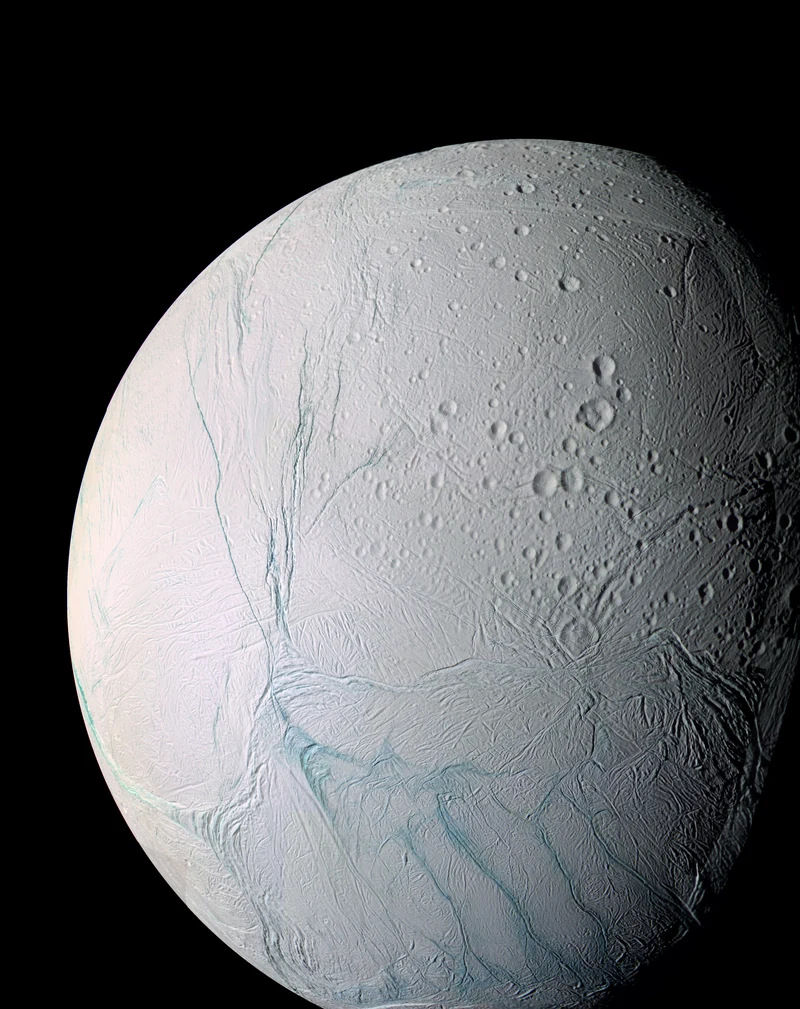
The process the team reconstructed begins at the ocean surface. Gas-filled bubbles burst, throwing tiny ocean droplets upward. Water vapour carries those droplets through the fractures in the ice toward space. The key finding is that the droplets do not freeze instantly — they freeze slowly. That slow freezing allows the chemical constituents dissolved in each droplet to separate: different salts migrate to different locations, sodium chloride partitioning away from sodium carbonate, organic compounds separating from mineral ions. As the partially frozen droplets collide with the walls of the icy channels at speeds approaching 1,000 kilometres per hour, they shatter into fragments only a few micrometres across. By that point, the sorting is already complete. Individual ice grains in the plume therefore often carry a concentrated, relatively pure sample of one type of substance rather than a diluted mixture of the entire ocean.
Professor Postberg describes the implication plainly: “Enceladus actually does a lot of the work for us in preparing samples for analysis that usually take a lot of effort in chemical labs on Earth. The oceanic constituents are separated from each other and simultaneously concentrated into individual ice particles.”
This finding matters for how scientists interpret Cassini’s plume measurements, and it matters for future missions. A single ice grain does not represent a well-mixed sample of the entire ocean; it may instead carry a concentrated signature of whatever chemical process produced it. That cuts both ways: a grain carrying unusual organic chemistry might stand out clearly, but researchers must also be careful not to treat any one grain as fully representative of the ocean as a whole.
Important clarification: The second study did not find cells in the plume data, and it did not confirm biological organic material. It describes a physical and chemical sorting process that operates on whatever is in the ocean, regardless of whether that ocean contains life.
How the Studies Fit Together
The two papers address different but connected questions. The methanogen study concerns whether a known metabolism could function under estimated ocean chemistry. The ice-grain study concerns how ocean-derived material gets packaged into particles that spacecraft can actually intercept and analyze. Together they trace a path from what might be happening on the seafloor to what a future instrument might detect in space.
If a methanogenic organism — or any other organism — were producing organic compounds in the Enceladus ocean, the ice-grain sorting process described in the second study would influence how those compounds appear in the plume. They might be concentrated into specific grain types rather than spread evenly across all particles. That means a future spacecraft would not necessarily need to average across hundreds of grains to see a signal; it might need instead to analyze individual grains carefully and look for unusual compositions.
“Future spacecrafts will have to analyze many individual ice particles in the plume,” Professor Postberg says. “But if they come across one with microbial material in it, they could identify biosignatures in the particle relatively easily with already available technology.”
That is a significant practical point. Neither study claims life exists. But together they shift the question of how future missions should be designed — toward instruments capable of resolving individual grain compositions at high sensitivity.
Why Methane Would Not Prove Life
Cassini detected methane in the Enceladus plumes. The methanogen study shows that an Earth organism could produce methane under simulated Enceladus conditions. These two facts do not add up to a detection of biology.
Methane can be produced through both biological and nonbiological processes. It can be produced by geological processes entirely unrelated to life: water interacting with certain iron- and magnesium-bearing rocks can generate methane through a process called serpentinization. High-temperature and high-pressure reactions between simple carbon compounds and hydrogen can also produce methane abiotically. What Cassini detected in the Enceladus plume is consistent with hydrothermal chemistry — with or without any biological contribution.
Confirming a biological origin for methane on another world would require substantially more than detecting its presence. Scientists generally look for a convergence of independent lines of evidence before making a credible case for life. Those might include complex organic patterns that are difficult to replicate through nonbiological chemistry alone; isotopic relationships in carbon and hydrogen that are consistent with biological processing; repeated and independently verified measurements ruling out contamination and instrument artifacts; chemical disequilibrium that geological models cannot adequately explain; and, ideally, structural or physical evidence of cellular material. No single indicator suffices. This list is not an officially adopted detection standard, but it reflects the scientific community’s general consensus on the burden of evidence required before a credible life claim can be evaluated.
The Enceladus studies do not meet any of those thresholds for life detection. What they do is narrow the search — ruling out some conditions as too hostile and pointing to the type of evidence that a future mission should look for.
How Future Missions Could Test the Possibility
Enceladus has a practical advantage over other ocean worlds: its ocean exports itself. A future spacecraft could fly through the plumes and analyze individual ice grains at much higher mass-spectrometric resolution than Cassini, searching for complex organic chemistry and multiple mutually supporting biosignatures rather than relying on any single compound. The chemical sorting described in the second study would guide interpretation: grains with unusual compositions could stand out against the background of more ordinary salt-rich particles, reducing the need to drill through kilometres of ice.
The two September 2026 studies give mission planners clearer scientific requirements: instruments capable of resolving individual grain compositions at sensitivity sufficient to detect the kinds of organic signatures that biological or unusual abiotic chemistry might produce.
Evidence Assessment
The studies make Enceladus a more testable target — not an inhabited world. The question of whether life exists there remains open and unanswered. What these papers add is a clearer sense of what to look for and how to look for it.
Sources and Further Reading
- Helmbrecht, Postberg, Khawaja et al., “Enceladus-like geochemistry fuels methanogenesis under extreme CO₂ limitation,” Science Advances, September 25, 2026 — primary source (peer-reviewed study). First study discussed in this article; establishes methanogen growth in Enceladus simulant. science.org/doi/10.1126/sciadv.aei0167 →
- Postberg et al., “Cassini CDA observes compositional segregation of Enceladus’ ice grains from slow freezing and fragmentation of oceanic spray,” Science Advances, September 25, 2026 — primary source (peer-reviewed study). Second study discussed in this article; explains chemical sorting of ice grains in the plume. science.org/doi/10.1126/sciadv.aee7256 →
- LMU Munich, “Life on Saturn’s moon would be possible,” September 28, 2026 — institutional explanation. Official press release from lead institution for the methanogen study; source for researcher quotes. lmu.de →
- Freie Universität Berlin, “Great News from Saturn’s Moon Enceladus in the Search for Life in Space,” September 25, 2026 — institutional explanation. Official press release from Postberg’s institution; source for ice-grain study explanation and quotes. fu-berlin.de →
- NASA, Enceladus overview — background reference. NASA’s current scientific summary of Enceladus, covering Cassini findings and ongoing research. science.nasa.gov/saturn/moons/enceladus/ →
- NASA, Cassini at Enceladus — background reference. NASA mission page covering Cassini’s plume flybys and instrument findings. science.nasa.gov/mission/cassini/science/enceladus/ →
- NASA, Enceladus hydrothermal activity explanation — background reference. NASA’s explanation of the hydrothermal evidence detected by Cassini. science.nasa.gov/resource/enceladus-hydrothermal-activity/ →