
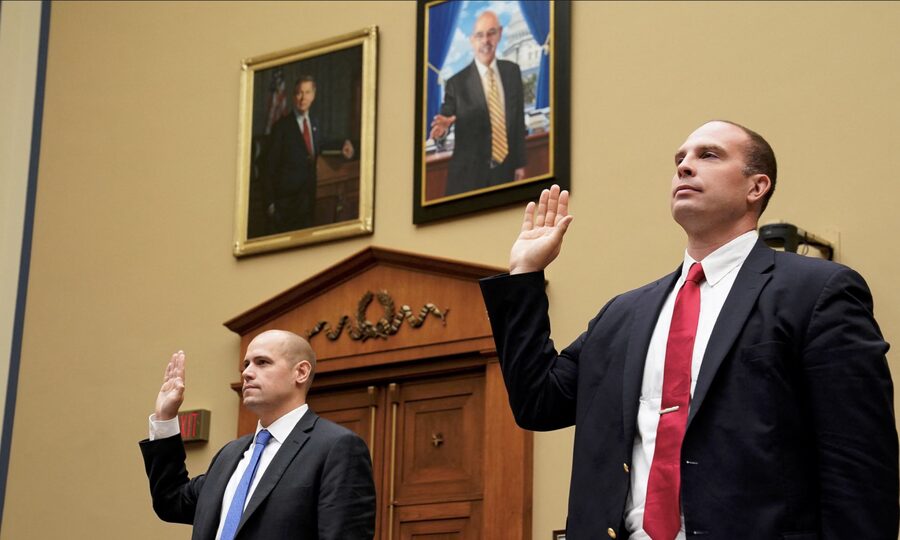
The institutional shift is the story. Congress, the Pentagon, intelligence agencies, and the scientific community are no longer asking whether to investigate UAP. They are asking how. That change in the question is more significant than any individual sighting.
Every few weeks, another video appears.
A glowing orb. An unusual radar contact. A military witness. An anonymous source claiming inside knowledge.
Within hours, the internet divides into its familiar camps. Some declare the mystery solved before the investigation has begun. Others dismiss it just as quickly, insisting there is nothing worth examining. The debate generates enormous heat and very little light.
Neither reaction advances our understanding. Neither is journalism. Neither is science. Both are something older and less useful: the human reflex to resolve uncertainty as quickly as possible, regardless of what the evidence actually supports.
The most important development in the study of Unidentified Anomalous Phenomena is not another video. It is not another witness, another anonymous source, or another leaked document.
It is something quieter, less dramatic, and ultimately far more significant.
For the first time in decades, governments, scientists, military organizations, and journalists are beginning to ask the same question: how should we investigate the unknown?
That question matters because methods outlast headlines.
The Search for Better Answers
Throughout history, humanity has faced mysteries that challenged existing knowledge — and the pattern of how those mysteries were resolved is remarkably consistent.
Lightning was once attributed to divine forces. Then science revealed atmospheric electricity, and the mystery dissolved not because people stopped wondering but because they developed instruments capable of measuring what they could not previously see. Meteorites were dismissed as impossible for centuries — educated Europeans insisted that rocks could not fall from the sky — until the evidence literally became too frequent and too well-documented to deny. The existence of exoplanets remained speculative until improved telescopes transformed speculation into observation. Today we have confirmed more than five thousand of them.
In each case, the breakthrough came not because people believed more strongly.
It came because they developed better methods of investigation.
The lesson is not complicated. Reliable answers emerge from better evidence, not louder opinions. The history of science is not a history of people who were more certain than everyone else. It is a history of people who were more careful.
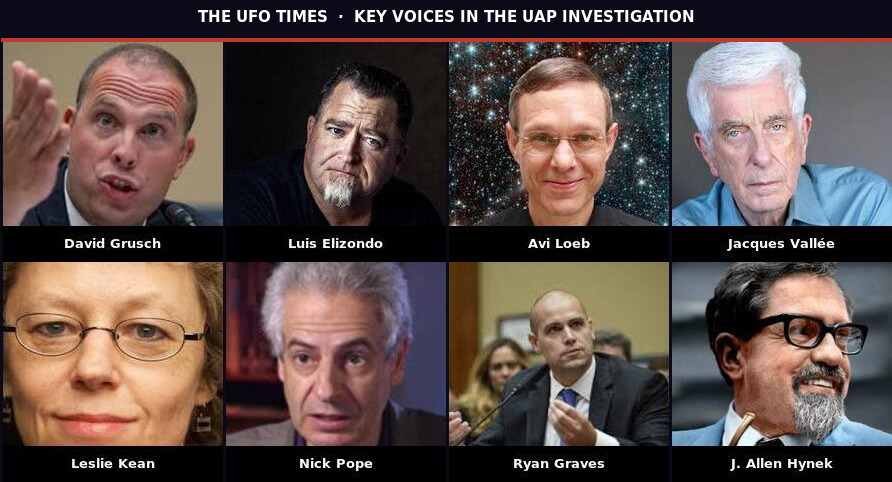
Eight of the most consequential voices in serious UAP investigation: David Grusch, Luis Elizondo, Avi Loeb, Jacques Vallée, Leslie Kean, Nick Pope, Ryan Graves, and J. Allen Hynek. Different backgrounds, different eras, different methods — united by a single commitment to taking the evidence seriously rather than dismissing it or sensationalising it.
A New Standard Is Emerging
The recent institutional shift in how governments approach UAP is significant precisely because it is methodological rather than conclusive. No government has confirmed extraterrestrial visitors. What has changed is something less dramatic and more durable: the process itself.
Military pilots are encouraged to report unusual encounters through formal channels. Government agencies have established investigative offices with defined mandates. Scientists are developing instruments capable of collecting higher-quality data. Congress has demanded transparency and passed legislation creating new oversight mechanisms. International cooperation on UAP reporting is growing quietly.
Whether these efforts ultimately explain every case through conventional means, or reveal something entirely new, they share one foundational principle:
Evidence comes before conclusions.
That principle should guide journalism as well as science. It is, in fact, the same principle — applied to a different set of questions with a different set of tools.
The Problem With Certainty
The study of UAP suffers from a peculiar problem that is worth naming directly.
Confidence is routinely mistaken for credibility. The person making the boldest claim frequently receives the greatest attention, regardless of whether the supporting evidence is equally strong. Certainty is rewarded. Uncertainty is treated as weakness. The result is a conversation that generates enormous volume and very little insight.
There are two opposing forms of this certainty, and both are equally unhelpful.
The first insists that every unexplained object must represent non-human intelligence. Any alternative explanation is dismissed as denial, cover-up, or naivety. The mystery is solved before the investigation begins — it is just that the conclusion requires no evidence to arrive at.
The second insists that every unexplained object must have an ordinary explanation, even when the available evidence remains genuinely incomplete. This position, sometimes mistaken for scientific skepticism, is in practice just as dogmatic as the one it opposes. It also begins with a conclusion and works backward.
Neither position is investigation. Both are the avoidance of it.
"The person making the boldest claim frequently receives the greatest attention, regardless of whether the supporting evidence is equally strong. Certainty is rewarded. Uncertainty is treated as weakness."
The Value of Honest Uncertainty
There are three words that rarely generate headlines: we don't know.
They represent intellectual honesty rather than weakness. They are, in fact, the beginning of every serious investigation — because you cannot find the truth if you have already decided what it is.
An unresolved case is not proof of extraterrestrial technology. Neither is it proof that nothing unusual occurred. It is an acknowledgment that the available evidence does not yet justify a definitive conclusion — and that acknowledgment is the most honest thing a journalist or a scientist can offer when the evidence is incomplete.
Science advances by reducing uncertainty, not by pretending it has already disappeared. Journalism should aspire to the same standard. When we say we don't know, we are not failing the reader. We are respecting them enough to tell the truth about what the evidence actually says.

CIA Headquarters, Langley, Virginia. The intelligence community sits at the centre of the UAP classification debate — holding records that Congressional oversight bodies have repeatedly struggled to access. What governments hold matters. How those files are investigated — by whom, under what standards, with what oversight — matters equally.
The Questions Worth Asking
The questions that defined this subject a decade ago have largely been superseded. "Are UFOs real?" has been answered — something is real, something is unidentified, and serious institutions are taking it seriously. "Are extraterrestrials visiting Earth?" remains unanswered, and may remain so for some time.
The questions worth asking now are different. They are less dramatic and more answerable:
Are governments collecting better data than ever before?
Are scientific institutions taking unidentified phenomena more seriously?
Are reporting standards improving?
Are investigations becoming more transparent?
Are journalists distinguishing evidence from speculation?
Are the people studying this subject being held to higher standards than before?
Those questions are measurable. More importantly, they can be answered through careful reporting — without requiring access to classified programs, without relying on anonymous sources, and without pretending to certainty that the evidence does not support.
Why Journalism Matters Here
A journalist's responsibility is not to confirm what readers hope is true. Nor is it to dismiss extraordinary claims because they appear unlikely. Good journalism asks different questions — the same questions in every story, on every subject, regardless of what the answer turns out to be.
Who made the claim? What evidence supports it? Can the information be independently verified? What alternative explanations have been considered? What remains unknown? What would it take to find out?
These questions are less exciting than dramatic headlines. They produce slower, more careful stories. They sometimes conclude with uncertainty rather than resolution.
They are also far more useful — because they build the one thing that no single story can manufacture on its own: trust.
Looking Beyond the Headlines
Years from now, historians may look back at this period not as the moment when humanity solved the mystery of UAP — but as the moment we finally began investigating it with the seriousness it deserved.
If that happens, the greatest discovery will not be found in a single photograph, a classified document, or a sensational headline. It will not be a craft in a hangar or a confirmation at a podium.
It will be found in the standards we chose to adopt.
Because mysteries come and go. The headlines fade. The viral videos are replaced by newer viral videos. But the methods we develop — the standards we hold ourselves to, the questions we insist on asking, the uncertainty we refuse to paper over with premature conclusions — those endure.
In the pursuit of truth, the quality of our questions will always determine the quality of our answers.
■ The UFO Times Editorial Principles
— The UFO Times Editorial Board · theufotimes.com · Est. 2010