
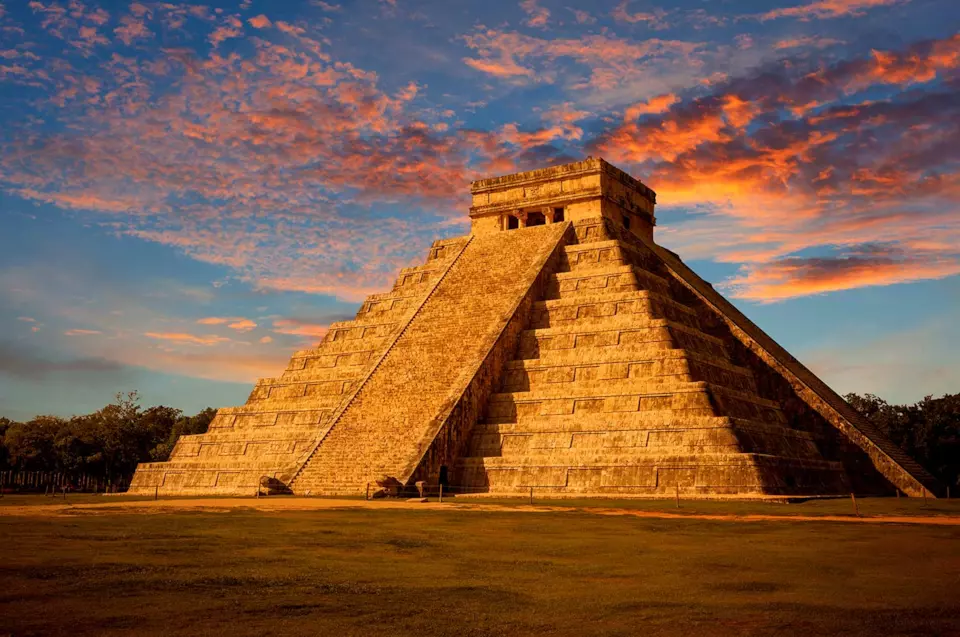
The pyramid is not a natural architectural solution to a universal problem. It is not the inevitable answer to the question "how do we build something tall and stable?" The pyramid is a very specific architectural form—a geometric solution that requires intentional design, considerable planning, and sustained commitment. Yet this specific form appears independently across multiple continents, spanning thousands of years of human history, in cultures that mainstream archaeology claims had no contact with one another. Egypt's pyramid tradition runs from the Step Pyramid of Djoser (circa 2650 BCE) through the Giza complex. Mesoamerica's pyramid tradition appears in Teotihuacan, Chichén Itzá, and Monte Albán. Cambodia's Angkor Wat encodes pyramid geometry in its temple architecture. China contains dozens of earthen pyramids near Xi'an that date back centuries and whose original purpose and builders remain disputed. The pattern of convergence is global and undeniable.
What unites these pyramid traditions is not merely the triangular form, but something deeper: specific astronomical alignments, mathematical constants encoded in proportions, and evidence of intentional cosmological design. Multiple pyramid complexes orient not to local landmarks or practical necessities, but to specific astronomical positions. The Giza pyramids align to Orion's Belt. Teotihuacan's pyramids align to Venus and the Pleiades. Angkor Wat's temple geometry encodes the precession of the equinoxes—a phenomenon that requires 26,000 years to complete and could not have been observed by a single civilisation. Yet it appears encoded in structures built thousands of years apart by supposedly unconnected peoples. This level of astronomical knowledge and intentional mathematical encoding suggests either an extraordinary coincidence across multiple continents or a shared knowledge source.
The conventional explanation—independent invention—suffers from a fatal problem. The pyramid is not an obvious architectural form. It is not easy to build. It is not the most efficient use of labour for creating monumental height (columns would be easier). It is not the most efficient use of materials (domes would be stronger). It is not aligned to local stars in most cases. Yet it was chosen, repeatedly and intentionally, by cultures across the globe. The assumption of independent invention requires that humans, scattered across continents with no contact, all arrived at the same very specific answer to the same unasked question. This strains credulity.
The mathematical constants are where the pattern becomes undeniable. The ratio of the Great Pyramid's perimeter to its height encodes pi (3.14159...) with remarkable precision. This same pi ratio appears encoded in the proportions of Teotihuacan's pyramids. Pi is not a number that humans arrive at intuitively. It requires mathematics to calculate. It requires an understanding of circles and their relationship to straight lines. It is not a constant that would appear in multiple, supposedly independent pyramid traditions unless it was deliberately placed there. The presence of pi in Egyptian and Mesoamerican pyramid geometry is not explained by conventional archaeology—it is simply not mentioned, as though the mathematical constant's presence is an embarrassment to the narrative of independent development.
Gunung Padang in Indonesia complicates the timeline further. Ground-penetrating radar has revealed constructed megalithic chambers beneath the surface, potentially dating to 20,000 BCE or earlier—placing the site in an era that conventional archaeology identifies as pre-civilisation, when no pyramids or monumental architecture should have existed anywhere on Earth. If the subsurface structures at Gunung Padang are indeed constructed (and the evidence for this remains contested), then the global pattern of pyramid building extends back far further than the accepted timeline allows. The pyramid tradition would not begin in Egypt or Mesoamerica. It would begin in prehistory, at a time that conventional archaeology has designated as culturally invisible.
The diffusion argument—the idea that pyramid knowledge spread from a single source—requires asking what that source was and when. If all pyramid traditions derive from a single origin, that origin must predate the Egyptian pyramids. It must predate Mesoamerican pyramids. It must be old enough and widespread enough to leave traces across five continents. Conventional archaeology offers no such origin. The alternative is to argue that every civilisation independently invented the pyramid, arrived at compatible astronomical alignments without contact, and encoded the same mathematical constants without knowledge sharing. This position is not science. It is faith in a narrative that the evidence no longer supports. Until archaeology is willing to confront the global pattern of pyramid building as a single phenomenon rather than isolated regional developments, the real questions will remain unasked and the real answers will remain undiscovered.