
■ Case File
■ Timeline of Key Events
January 1996
Reports of unusual aerial activity circulate in and around Varginha.
20 January 1996
Liliane Silva, Valquíria Silva and Kátia Xavier report encountering a strange figure in Jardim André. Military and emergency-service activity in the surrounding area begins generating additional reports.
Early–mid 1996
Allegations of firefighter and military recovery operations spread publicly. Marco Eli Chereze becomes ill and dies. Brazilian media coverage intensifies.
1997
Brazilian Military Police open Inquérito Policial Militar No. 18/1997 following publication of Incidente em Varginha, which names Army personnel. Inquiry concludes: conventional explanation, extraterrestrial interpretation rejected.
2022
James Fox releases Moment of Contact, bringing the case to international attention and preserving new witness testimony. The film renews worldwide investigative interest.
Varginha, Minas Gerais, Brazil — a functioning commercial city that became the centre of the country’s most famous alleged encounter with a nonhuman intelligence.
On the afternoon of January 20, 1996, three young women were walking through the Jardim André neighbourhood of Varginha, a commercial city in the hills of southern Minas Gerais.
Their journey was ordinary. What they later said they encountered was not.
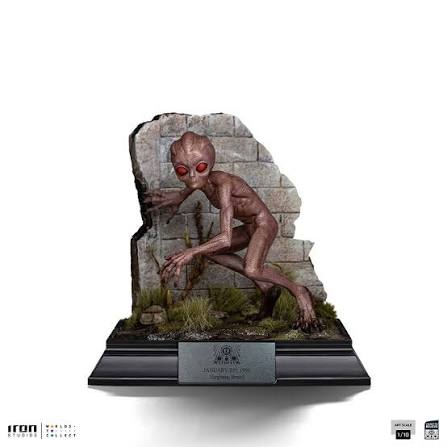
Near a vacant lot and a concrete wall, the women noticed a small figure crouched close to the ground. It appeared physically weakened or frightened. Its body was thin, its skin dark brown and strangely reflective, and its head seemed disproportionately large. The witnesses described prominent red eyes and several protrusions on the upper part of its head.
For a moment, the figure looked back at them.
The women ran.
Within hours, their story began moving through the city. Within weeks, reports of military vehicles, firefighters, hospitals and alleged captured beings were being assembled into a far larger narrative. By the end of the year, Varginha had become the centre of Brazil’s most famous alleged encounter with a nonhuman intelligence.
Three decades later, the central question remains deceptively simple: What did the women see?
The answer has become entangled with rumour, official denials, military records, anonymous testimony, documentary films and claims of a government recovery operation. Some investigators maintain that Varginha was the site of an extraordinary biological event concealed by Brazilian authorities. Sceptics argue that an ordinary person was misidentified during a storm and that unrelated activity was later woven into an alien legend.
Between those positions lies a more complicated record.
There were identifiable witnesses. There was an official military inquiry. There were military and emergency-service movements that became part of the controversy. But there is still no publicly verified body, biological sample, medical record or authenticated chain of custody demonstrating that a nonhuman organism was recovered.
The Varginha incident cannot be responsibly understood as a single event. It is a layered case: a civilian encounter at its centre, surrounded by increasingly dramatic claims whose evidentiary strength varies considerably.
The comparison to Roswell — which spread through international media and gave the case its shorthand identity — is an evocative media parallel, not an evidentiary equivalence. Both cases involve alleged recoveries, military involvement and official denials. But the resemblance ends there. The Varginha case must be assessed on its own record.
The City Before the Story
Varginha lies in the state of Minas Gerais, between Brazil’s major metropolitan centres of São Paulo, Rio de Janeiro and Belo Horizonte. Long before the alleged encounter made the city internationally famous, Varginha was known principally as a regional centre of commerce and coffee production.
It was not an isolated settlement on the edge of an unexplored wilderness. It was a functioning Brazilian city with schools, hospitals, military facilities, busy neighbourhoods and regular traffic moving through the surrounding region.
That setting matters. The principal witness encounter did not occur in a remote desert or inaccessible forest. It was reported in an urban neighbourhood, close enough to homes and streets that the location could be revisited, photographed and discussed by residents almost immediately.
The city’s ordinary character also helps explain why the story spread so quickly. Reports of a strange figure, emergency vehicles and unusual military activity were not easily absorbed into daily life. People talked. Journalists arrived. UFO investigators began collecting testimony.
Soon, separate observations were being connected to one another.
January 1996: Reconstructing the Earliest Reports
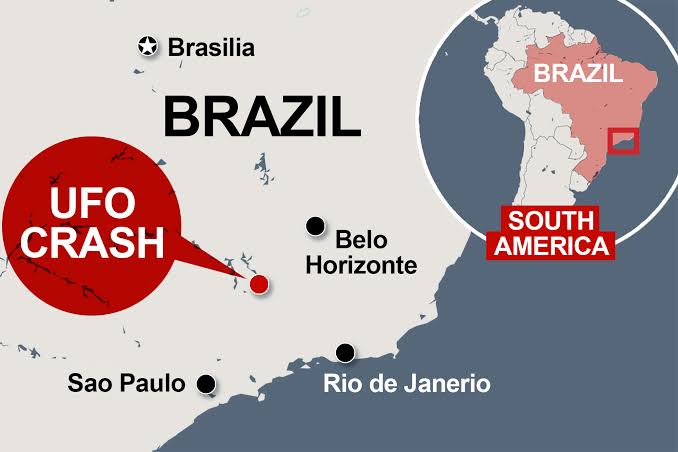
Varginha and the surrounding area of Minas Gerais. The map identifies locations associated with reported events. Unverified locations — including any alleged “crash site” — are not marked as confirmed.
The most widely repeated version of the Varginha story begins before the encounter involving the three women. Some later accounts describe unusual aerial activity over the region in the days or hours preceding January 20. One frequently cited claim involves a couple who reportedly observed a damaged or unstable object moving low in the sky. Other narratives place a descending object, smoke or debris somewhere outside the city.
These reports are important because they became the foundation for the later “crash” interpretation. But they must be treated cautiously. The public record does not contain a verified crash site, authenticated debris, contemporaneous radar record or documented recovery of an aircraft. The alleged aerial observations are therefore best understood as witness reports — not proof that a vehicle came down near Varginha.
The strongest and most identifiable part of the case began on January 20. That afternoon, sisters Liliane and Valquíria Silva were walking with their friend Kátia de Andrade Xavier through Jardim André. Contemporary and later accounts differ on some peripheral details, including their exact destination and the precise time, but the central description has remained broadly recognisable.
The women said they encountered a strange figure crouching beside a wall in or near a vacant lot. They did not initially describe seeing a spacecraft. They described a being.
The Three Principal Witnesses
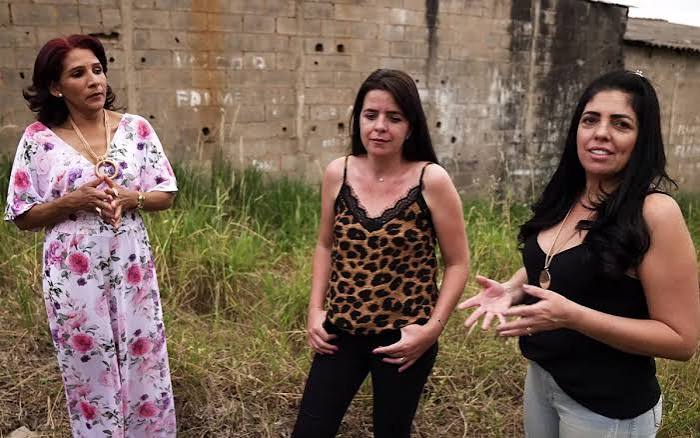
Principal witnesses associated with the reported January 20, 1996 encounter. Their testimony has remained broadly consistent on the central description over three decades.
The principal civilian witnesses were Liliane Silva, Valquíria Silva and Kátia de Andrade Xavier. They were young at the time, with published accounts generally placing them in their middle to late teenage years and early adulthood. Their encounter became the emotional centre of the Varginha case because they were identifiable, interviewed publicly and consistent about the central elements of what frightened them.
According to their account, the figure was small and humanoid but visibly abnormal. Its skin appeared brown, oily or unusually shiny. Its body was thin. Its head was large in relation to its frame. The eyes were red or intensely coloured. Several protrusions, ridges or horn-like structures appeared on the upper portion of its head.
The figure was crouched. The witnesses did not report that it advanced toward them or attempted to communicate. Instead, they perceived it as distressed, weakened or fearful. One of the women later recalled feeling that the being was suffering.
“One of the women later recalled feeling that the being was suffering.”
Principal witness testimony — Varginha, January 1996
That detail is significant because it differs from the aggressive imagery that later became associated with some retellings. The women’s core narrative was not initially one of attack, abduction or pursuit. It was an unexpected encounter with something they could not identify.
Their reaction, however, was immediate fear. They ran from the area and returned home, where family members initially struggled to understand what they were describing. At least one early formulation reportedly compared the figure with a demon or something evil — not necessarily because the witnesses believed they had encountered a supernatural entity, but because they lacked an ordinary category for what they had seen. Only later did UFO investigators and the media place the encounter within an extraterrestrial framework.
What Did the Witnesses Describe?
Descriptions of the alleged figure have changed slightly across interviews, translations and retellings. The most defensible summary is therefore a composite, not a biological profile.
Witness reconstruction of the reported figure, based on descriptions given after the January 20, 1996 encounter. This illustration is not a photograph of a verified organism and should not be read as a biological profile of a confirmed creature.
Composite of Witness Descriptions
- Short humanoid body
- Thin or fragile physical appearance
- Disproportionately large head
- Large or prominent red eyes
- Brown, dark or oily-looking skin
- Several protrusions or ridge-like structures on the head
- Crouched or weakened posture
- Unusual or unpleasant odour (in some accounts)
This is a composite drawn from witness statements — not a biological profile of a confirmed creature. Height estimates and the number of protrusions vary across accounts.
The number and form of the protrusions have not always been described identically. Some accounts refer to three horn-like bumps. Others describe ridges or raised structures rather than conventional horns. Similarly, the exact height is uncertain. Later summaries frequently state that the figure was approximately four feet tall, but estimates made during a frightening and brief encounter should not be treated as precise measurements.
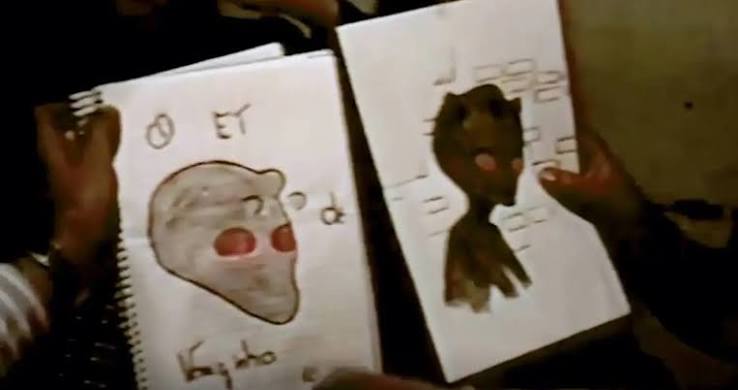
The widely circulated sketches associated with the case are reconstructions based on testimony. They are not photographs, medical illustrations or independently verified depictions of an organism. That distinction should be made explicit whenever such images are displayed.
The Importance — and Limits — of Their Testimony
The three women are important because they are named firsthand witnesses. Their account cannot simply be dismissed as an anonymous rumour. But testimony, even sincere testimony, is not self-validating.
Human perception is influenced by lighting, distance, expectation, stress and the brevity of an encounter. Memory can also evolve as a witness is repeatedly interviewed, exposed to media coverage or asked to revisit the same event over many years. None of that demonstrates that the women fabricated their experience. It means only that their testimony must be evaluated as testimony.
The question is not whether they were frightened. Their reaction appears genuine. The more difficult question is whether the figure they saw was a person viewed under unusual conditions, an animal, a known person whom they failed to recognise, a visual misinterpretation amplified by fear, an unknown biological entity, or something for which the surviving record provides no confident explanation.
The official military inquiry would later argue that the women had encountered a local resident known by the nickname “Mudinho,” who was said to move in a crouched posture and who may have been dirty or wet during severe weather. The witnesses rejected that explanation. They said they already knew him by sight and would not have mistaken him for the figure they encountered.
This disagreement remains central to the case. The official explanation is not absurd merely because the witnesses dispute it. Nor does the witnesses’ rejection automatically prove that they saw a nonhuman being. The issue turns on how closely the proposed individual matched the observed figure, how good the viewing conditions were, and whether the inquiry reconstructed the encounter independently or selected a convenient explanation after the case had become controversial.
A City Already on Edge
By the time the women’s story became public, other unusual reports were circulating in Varginha. Residents spoke of strange animals, unusual odours, emergency vehicles and military movements. Firefighters were said to have been summoned to capture an unidentified creature. Army trucks were reportedly observed in areas later associated with the case. Hospitals and medical personnel were drawn into the developing narrative.
Some of these claims came from named witnesses. Others emerged anonymously. Still others were recorded only after UFO investigators began actively searching for evidence of a recovery operation. This distinction is crucial.
When an extraordinary story begins spreading through a community, real but unrelated events can acquire new meaning. An ordinary military truck may become evidence of a secret transport. A hospital closure may be interpreted as proof of a concealed patient. A firefighter responding to an animal report may later be connected to an alleged creature capture. It is also possible that witnesses to genuinely unusual activity become more willing to speak only after learning that others observed something strange.
Both processes can occur simultaneously. The task is therefore not to assume that every report belongs to one coherent incident. It is to determine which reports arose independently, which were contemporaneous, and which appeared only after the extraterrestrial narrative had taken shape.
The Story Expands
The case changed dramatically after investigators began connecting the women’s encounter with allegations involving firefighters and military personnel. According to the developing recovery narrative, one or more unusual beings were located in or near Varginha, captured by emergency or military personnel and transported through a chain of facilities.
Different versions of this allegation identified the Varginha fire department, the Brazilian Military Police, the Brazilian Army, a regional hospital, the Escola de Sargentos das Armas in nearby Três Corações, a university or laboratory in Campinas, and — in later claims — American personnel who allegedly removed material from Brazil.
No publicly authenticated document establishes that this chain of events occurred. Yet the allegations became detailed enough — and named Army personnel directly enough — that the Brazilian military eventually opened a formal inquiry.
That inquiry is not evidence that an extraterrestrial being was captured. It is evidence that the accusations became serious enough to require an official response.
The archive of Brazil’s Superior Military Court identifies the proceeding as Inquérito Policial Militar No. 18/1997, produced between February and June 1997. The archive states that the inquiry arose after military personnel were named in the book Incidente em Varginha as participants in the alleged capture and transport of an extraterrestrial being on January 20, 1996. The surviving file contains two volumes and hundreds of pages.
The investigation would become one of the most important — and most disputed — documents in the entire case.
■ Editorial Note: A Necessary Pause Before the Most Serious Claims
At this point, the evidence changes character. The women’s encounter is based on direct testimony. The military inquiry is an authenticated official record. The claims involving captured beings, secret medical examinations and biological contamination are more difficult — many depend upon anonymous sources, later interviews and interpretations made after the case became internationally famous.
That does not make them false. It makes source discipline essential. The investigation continues below.
The Recovery Narrative
The Varginha case did not become internationally famous because three women reported seeing a strange figure. It became famous because investigators later argued that the figure was only one part of a much larger operation — one involving firefighters, police officers, military vehicles, hospitals and the alleged recovery of more than one unidentified being.
That larger narrative is also where the evidentiary problems become most serious. Some elements are documented: military vehicles were operating in the region, military personnel were named publicly, an official inquiry was opened, and identifiable witnesses reported unusual activity. Other elements rest primarily on anonymous testimony, secondhand accounts or interviews conducted years after the event. The distinction between those categories is essential.
The existence of military movement does not establish the transportation of a nonhuman body. The existence of a hospital does not establish that a creature was examined there. The death of a police officer after the reported incident does not, by itself, establish biological contamination. The recovery hypothesis must therefore be reconstructed claim by claim.
Firefighters and the Alleged First Capture
One of the earliest and most persistent allegations holds that the Varginha fire department was called to locate or capture an unusual creature. In the most widely circulated version, firefighters entered an area of vegetation or open ground after receiving reports of a strange animal. They allegedly found a small humanoid being and captured it with a net or other animal-control equipment.
Some accounts place this operation during the morning of January 20, before the three women reported their encounter later that day. Other versions shift the time or location, creating uncertainty about whether they describe the same alleged being.
No publicly authenticated fire-department report has established that personnel captured an unidentified humanoid organism. The strongest versions of the claim come from investigators who said they interviewed individuals connected to emergency services or local authorities. In several instances, however, the alleged witnesses were not publicly identified, or their testimony was presented indirectly through an investigator.
That does not prove that the accounts were invented. It does weaken the ability of independent researchers to verify them. A named firefighter giving an attributable statement constitutes firsthand testimony. An investigator reporting what an unnamed firefighter allegedly said is a secondhand claim. The two should not be treated as evidentially equivalent.
The official position was that firefighters had responded to ordinary incidents and animal-related calls, not to an extraterrestrial recovery. Supporters of the case argue that the unusual number of reported vehicles, the secrecy attributed to personnel and the consistency of later testimony suggest something beyond routine work. The surviving public record does not resolve that conflict.
Military Vehicles in and Around Varginha
Reports of military trucks became one of the most visible components of the case. Witnesses described Army vehicles travelling through Varginha and toward facilities in nearby Três Corações, where the Brazilian Army operates the Escola de Sargentos das Armas — the School of Sergeants of Arms. To UFO investigators, the vehicles represented a transportation chain. In their reconstruction, military personnel moved one or more beings from Varginha to a secure military or medical facility.
The Army offered conventional explanations. Personnel questioned during the official inquiry said that vehicles were in the area for routine reasons, including scheduled activity, maintenance, transportation duties and visits to authorised facilities. The inquiry treated the military presence as ordinary and rejected the conclusion that Army vehicles had carried extraterrestrial material.
A photograph of an Army truck proves only that the vehicle existed or was present at a particular location. Unless an image can be dated, authenticated and connected to a specific movement, it does not demonstrate what was inside. Similarly, witness observations of covered cargo or unusual driving behaviour cannot establish the nature of that cargo.
The key unanswered question is not whether military vehicles were present. It is whether their movements can be reconstructed with sufficient precision to determine whether the official explanations account for them. No publicly available manifest, transport order or authenticated photograph has established that an unknown organism was carried by the Brazilian Army.
The Escola de Sargentos das Armas
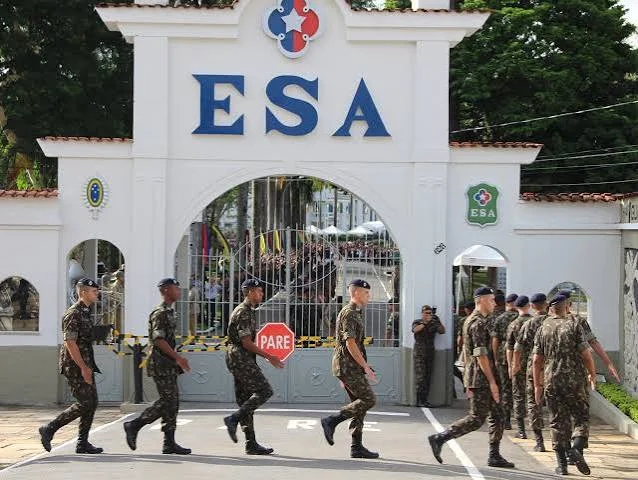
The military school at Três Corações became central to the alleged recovery route. According to Brazilian UFO investigators Vitório Pacaccini and Maxs Portes, Army personnel connected to the school participated in the capture or transportation of an extraterrestrial being. Those allegations were published in their book Incidente em Varginha and directly named military personnel. The accusations eventually helped trigger an official military police inquiry.
The Superior Military Court archive identifies that proceeding as Inquérito Policial Militar No. 18/1997, and confirms that it concerned allegations that military personnel were responsible for the supposed capture and transport of an extraterrestrial being in Varginha on January 20, 1996. That description is important: it confirms that the Army formally investigated accusations involving its personnel. It does not say that the Army confirmed a capture.
The inquiry was produced between February and June 1997 and originated through the Escola de Sargentos das Armas. The surviving material runs to hundreds of pages across two volumes. The central military conclusion was conventional: no extraterrestrial being had been captured or transported, and the military movements cited by investigators had ordinary explanations.
For supporters of the case, the inquiry demonstrates that the allegations had become too detailed to ignore. For sceptics, it demonstrates that the allegations were examined and rejected. Both observations are reasonable. Neither, by itself, settles the matter.
Marco Eli Chereze
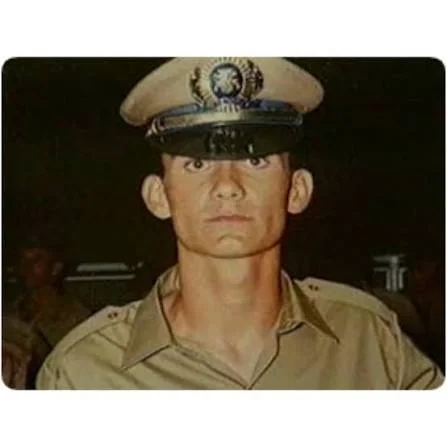
No part of the Varginha story is more sensitive than the death of Military Police officer Marco Eli Chereze. He has been described by UFO investigators as one of the officers who allegedly participated in the capture of a being. According to this narrative, he came into direct physical contact with the organism, developed an infection and died several weeks later. The allegation transformed his death into one of the case’s most dramatic claims. But the available evidence requires considerable caution.
Chereze was a real police officer. He did become seriously ill. He died in 1996, not long after the events associated with Varginha. The critical question is whether reliable records connect his illness to an encounter with an unidentified organism.
Public accounts generally describe his condition as involving a severe infection that progressed despite medical treatment. Later investigators and documentary filmmakers have argued that the illness was unusual, rapid or resistant to treatment. His family has expressed suspicion about the circumstances surrounding his death and has participated in later investigations of the case.
None of that establishes biological contact with a nonhuman being. For the extraterrestrial-contamination hypothesis to be demonstrated, several evidentiary links would be required: proof that Chereze participated in a recovery operation; proof that he physically contacted the reported being; medical documentation establishing the nature of his illness; evidence connecting the infection to that contact; exclusion of known medical causes; and a verifiable chain of evidence preserved independently of later testimony. The public record does not currently satisfy that chain.
Chronology can create a powerful impression. If an officer allegedly handled an unknown creature and then died from infection, the sequence appears meaningful. But chronology alone is not causation. Without authenticated operational records and complete medical documentation, Chereze’s death must be treated as an unresolved and tragic medical event that later became incorporated into the Varginha recovery narrative.
Medical claims surrounding Chereze also vary significantly across retellings. Some describe an unexplained systemic infection; others describe a surgical procedure followed by complications; still others imply that physicians could not identify the responsible pathogen. These versions should not be blended together. The article must distinguish between statements from treating physicians, hospital or death records, statements from family members, claims made by UFO investigators and interpretations advanced in documentaries. A fatal infection can occur through recognised medical pathways, including complications from surgery, bacterial infection, sepsis or delayed treatment. Establishing that a case was medically unusual is not equivalent to establishing that it had an extraterrestrial origin.
Marco Eli Chereze’s death is documented. His alleged participation in the recovery of a being is not publicly established, and a causal connection between the Varginha incident and his illness has not been demonstrated by publicly available evidence.
The Hospital Allegations
The recovery narrative next moves into Varginha’s medical facilities. Investigators have alleged that one or more beings were taken to a hospital, examined by physicians and later transferred under military supervision. Different versions identify different facilities: some refer to the Hospital Regional de Varginha, others involve another local hospital or military medical setting, and later accounts extend the transport route to Campinas, where a university or laboratory was allegedly capable of examining biological material.
The number of alleged beings also changes across accounts. Some narratives describe one creature; others describe two — one alive and one dead; still others imply that an injured being was treated before being transported elsewhere.
No publicly authenticated hospital admission record, pathology report, laboratory analysis, photograph or biological sample has verified these claims. That absence is significant. A medical examination of an unknown organism would ordinarily generate documentation: admission logs, staff records, laboratory requests, biological samples, waste-disposal records, imaging, medication orders or security directives. Supporters argue that such records could have been seized, altered or classified. That is possible in principle, but it cannot substitute for evidence. A claim cannot be validated solely by asserting that confirming records were hidden.
Witness quality in this section varies considerably. A named physician who states that he personally saw or examined an unusual organism provides stronger testimony than an anonymous hospital employee quoted through an investigator. A person who saw military vehicles outside a hospital provides evidence of vehicles — not of what was being treated inside.
A staff member who heard rumours from colleagues provides evidence that rumours circulated — not that the underlying event occurred. Several later witnesses have claimed knowledge of unusual medical activity; some have provided on-camera interviews, while others have remained anonymous, reportedly because of professional concerns or fear of repercussions. Anonymity does not automatically invalidate testimony, but it makes corroboration difficult.
One version of the case holds that biological remains or a surviving being were transported from Varginha to Campinas, and some later narratives add an American role, suggesting that United States personnel or aircraft eventually removed evidence from Brazil. Because it dramatically expands the case from a local Brazilian incident into an international recovery operation, this allegation requires independent evidence of a correspondingly high quality. No verified transport manifest, aircraft record, diplomatic communication, customs documentation or university record has established such a transfer. It belongs to the case’s history, but it should not be framed as an established extension of the recovery chain.
A Story Constructed from Separate Events?
The sceptical interpretation does not necessarily require that every witness lied. Instead, it proposes that several unrelated or misunderstood events were gradually combined: three women encountered a known local resident or another ordinary figure; firefighters responded to a conventional animal report; military vehicles conducted routine operations; hospital activity was unrelated; Chereze died from a recognised medical condition; local rumours connected these events; and investigators then assembled them into one recovery narrative.
This is a plausible mechanism. Human beings naturally look for connections, particularly when unusual events occur close together in time and place. Once a powerful explanatory story emerges, later observations may be interpreted through it. However, the rumour-amplification explanation also faces a challenge: several witnesses have continued to insist that the official accounts do not match what they observed, some reports emerged relatively early, and military personnel were named specifically enough to provoke an inquiry. The story did not arise solely from one anonymous source decades later.
The question is therefore not whether rumour played a role — it almost certainly did. The harder question is whether rumour explains the entire case or merely accumulated around a genuinely anomalous core.
The Official Military Inquiry
The Brazilian military inquiry remains the most important authenticated document associated with Varginha. The Superior Military Court archive confirms that military personnel were accused in a published book of participating in the supposed capture and transport of an extraterrestrial being, and that the inquiry was opened to examine those accusations. The archive’s existence refutes one common misconception: the Varginha case was not entirely ignored by authorities. It was investigated.
But the inquiry’s scope must be understood correctly. It was a military police inquiry into allegations involving military personnel — not a broad scientific investigation designed to determine whether extraterrestrial life had visited Brazil. Its primary institutional question was whether Army personnel had engaged in the actions attributed to them. Witnesses and military personnel were questioned, vehicle movements were reviewed, conventional explanations were presented, and the allegations published by UFO investigators were examined. The inquiry did not validate the capture of an extraterrestrial being. Its conclusions rejected the extraordinary interpretation.
The “Mudinho” Explanation
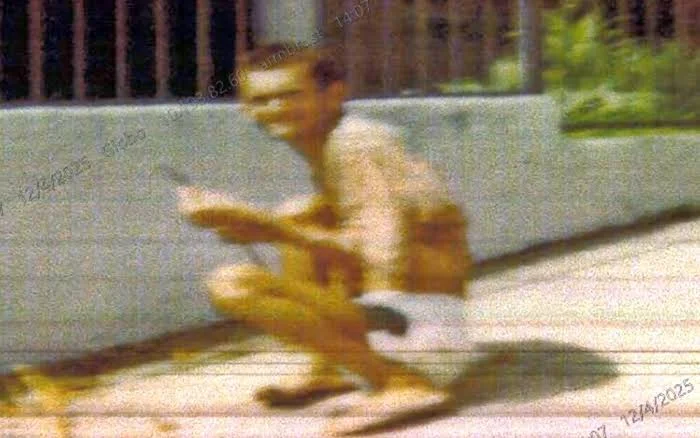
The most controversial conventional explanation concerns the figure seen by the three women. The inquiry suggested that they may have encountered a local resident named Luíz Antônio de Paula, known by the nickname “Mudinho.” He was reportedly familiar to people in the neighbourhood and was sometimes seen crouching near walls. According to the official reconstruction, he may have been wet, muddy or dirty during poor weather, creating an unusual appearance when seen unexpectedly.
The explanation attempted to account for a crouched posture, dark or dirty skin and clothing, a location near the reported encounter, a frightened interpretation by the witnesses, and the absence of physical evidence showing that a nonhuman organism had been present.
The women rejected the identification. They maintained that they knew the local man and would not have mistaken him for the figure they saw. They also argued that his appearance did not account for the red eyes, large head or protrusions they described. The official explanation therefore depends on a classic conflict between witness confidence and reconstructive plausibility. Witnesses can be sincerely certain and still mistaken. Authorities can provide a plausible conventional explanation without proving that it is correct.
“They maintained that they knew the local man and would not have mistaken him for the figure they saw.”
The principal witnesses — on the official “Mudinho” explanation
The question is whether the inquiry demonstrated that Luíz Antônio de Paula was at the precise location and time of the encounter, or whether it merely identified a person who could resemble aspects of the description. A possible source of misidentification is not the same as a demonstrated identification. The official inquiry treated the explanation as sufficient. Many investigators and the witnesses themselves did not.
Military Explanations for the Vehicles
The inquiry also addressed the reported Army traffic. Military personnel stated that the vehicles were engaged in legitimate activities: routine transportation, scheduled movement and the delivery or collection of equipment. To establish a secret recovery operation, investigators would need to show that the vehicles were present at the relevant times, that their stated assignments were false or inconsistent, that personnel accounts conflicted materially, that the vehicles carried unusual cargo, and that the transport route connected verified recovery and examination locations. The public evidence has not established that complete chain. The official explanations may leave some witnesses unconvinced, but they cannot be dismissed merely because they are conventional.
■ What the Inquiry Does — and Does Not — Establish
The inquiry proves
- Military personnel were publicly accused
- Accusations were serious enough to trigger an official investigation
- Army personnel and activities were examined
- Authorities offered conventional explanations
- The military rejected the extraterrestrial-recovery narrative
The inquiry does not prove
- Every witness was mistaken
- No unidentified event occurred
- Every military movement has been independently reconstructed
- The three women definitely encountered Luíz Antônio de Paula
- All hospital testimony was fabricated
- A captured creature, nonhuman body or secret autopsy
- Biological contamination or American removal of evidence
The Evidentiary Divide
By this stage, the case can be divided into three clearly defined levels. The distinctions do not tell readers what to believe. They tell readers what kind of evidence supports each claim.
Three identifiable women reported encountering an unusual figure. The story became a major local and national controversy. Military and emergency-service activity was discussed by witnesses. Named Army personnel were accused publicly. A military inquiry was opened and the inquiry rejected the extraterrestrial interpretation. Marco Eli Chereze became ill and died.
Firefighters captured an unidentified being. Military Police officers recovered another being. Chereze physically handled the organism. Hospitals received one or more creatures. Physicians examined a nonhuman body. Material was transported to Campinas. American personnel later removed evidence. These claims rest primarily on witness testimony, secondhand accounts or later investigation, not independently verified physical evidence.
A crashed extraterrestrial craft. A verified nonhuman organism. Biological samples. Authenticated photographs of recovery operations. Medical records identifying a nonhuman patient. A secure and authenticated chain of custody. A confirmed causal link between Chereze’s death and the incident. None of these have been publicly demonstrated.
A Case Strongest at Its Centre
The deeper one moves into the Varginha recovery narrative, the more dramatic the claims become — and the weaker the publicly verifiable evidence tends to be. At the centre are three witnesses who say they saw something extraordinary. Around them are reports of emergency and military activity. Beyond that are allegations of capture, hospitalisation, biological danger and international removal.
The central encounter is identifiable and direct. The outer layers increasingly depend on secondhand testimony, anonymity and later reconstruction. This pattern does not automatically disprove the larger story. But it means the article’s conclusions must be weighted accordingly.
The next question is how later investigators and filmmakers reshaped public understanding of the case — and whether new testimony has strengthened the evidence or merely expanded the mythology.
The Case Returns to the International Stage
For many years, the Varginha incident remained largely known within Brazil and among dedicated UFO researchers. While books, magazine articles and television documentaries kept the story alive, it never achieved the same international recognition as Roswell, the Rendlesham Forest incident or the Phoenix Lights. That changed in 2022.
American filmmaker James Fox, already known for documentaries such as The Phenomenon, released Moment of Contact, a feature-length investigation devoted entirely to the events in Varginha. Rather than reconstructing the incident through dramatic re-enactments alone, Fox returned to the city itself, interviewed many of the principal witnesses, revisited the reported locations and sought testimony from individuals who had never previously spoken publicly. For many viewers outside Brazil, Moment of Contact was their first detailed introduction to what had become known as “Brazil’s Roswell.”
■ Documentary — Moment of Contact (2022)

Promotional artwork from James Fox’s documentary Moment of Contact (2022), which renewed international interest in the Varginha case.
Directed by James Fox · Released 2022
The documentary renewed worldwide interest in the case and introduced a new generation of researchers to its witnesses, military allegations and official investigation. It is a valuable source of preserved testimony. It is not an independent verification of the extraordinary claims made by some of its interview subjects, and should be considered alongside official records and firsthand documentation.
Documentary material preserves important testimony and advances additional allegations, but should be evaluated as a secondary investigation rather than independent physical proof.
Official trailer for Moment of Contact (2022). If the embed does not load, watch on YouTube →
A Case That Grew Beyond Its Origins
One of the most instructive aspects of the Varginha incident is the way it evolved over time. The earliest reports centred on a frightening encounter experienced by three young women. Soon afterwards came reports of firefighters, military trucks and unusual activity. Then came allegations involving hospitals. Later still, stories emerged concerning additional witnesses, multiple creatures, transport operations, biological contamination and even alleged American involvement.
This evolution is not unique. Many famous historical mysteries develop in layers. As new witnesses come forward — or believe they remember previously unimportant details — the narrative expands. Sometimes those new accounts strengthen the original case. Sometimes they introduce contradictions that make reconstruction more difficult. The challenge for historians is not simply to collect every story. It is to determine when each claim first appeared, who made it, whether it can be independently corroborated and how it relates to the original documented events.
That discipline is particularly important in Varginha, where later retellings often present the entire recovery narrative as though every component had been established from the beginning. The surviving historical record suggests a far more gradual process.
Why Sceptics Remain Unconvinced
The Varginha incident has never persuaded the scientific community at large. Several reasons are frequently cited. First, no publicly verified physical evidence has emerged: no authenticated biological specimen, no confirmed crash debris, no laboratory report identifying an unknown organism, and no verified chain of custody demonstrating that a recovered body existed.
Second, the most extraordinary elements of the case depend heavily on testimony gathered months or years after the alleged events. Testimony is valuable — it is also inherently difficult to verify when unsupported by physical evidence. Third, many of the recovery claims involve anonymous witnesses or individuals whose statements cannot be independently examined. Finally, the Brazilian military inquiry rejected the extraterrestrial interpretation and offered conventional explanations for the principal allegations.
None of these points proves that the witnesses were mistaken. Together, however, they explain why many historians, scientists and sceptical investigators conclude that the evidence falls short of demonstrating the recovery of a nonhuman being.
Why Investigators Continue to Study the Case
Despite those weaknesses, Varginha continues to attract serious attention. Unlike many legendary UFO stories, it possesses several characteristics that researchers consider significant: the principal civilian witnesses are identifiable and their core description has remained broadly consistent; the alleged encounter occurred in a populated urban environment rather than an isolated location; military personnel were publicly named; an official inquiry exists; and the case generated lasting national attention rather than disappearing after a few days.
Supporters argue that these features distinguish Varginha from stories based solely on anonymous claims or folklore. They also note that the official explanation — identifying the reported figure as a local resident — has never satisfied the principal witnesses themselves. For investigators, the unresolved tension between witness confidence and official explanation remains one of the case’s defining features.
■ The UFO Times Evidence Ledger
How we rate the claims in this investigation.
Three named civilian witnesses reported encountering an unusual figure. The encounter became a matter of public attention in January 1996. Military and emergency-service activity formed part of the developing controversy. Military personnel were publicly accused of participating in a recovery. A formal Brazilian military inquiry was opened. The inquiry rejected the extraterrestrial interpretation. Marco Eli Chereze became ill and died following the period associated with the incident.
Firefighters captured an unidentified being. Military Police recovered another creature. Hospitals received one or more nonhuman organisms. Chereze handled the alleged being. Witnesses observed unusual military transport operations. Additional military personnel privately confirmed the recovery. These claims rest primarily on witness accounts, secondhand testimony or later investigation — not independently verified physical evidence.
A crashed extraterrestrial spacecraft. Verified biological remains. Authenticated medical examinations of a nonhuman organism. Laboratory analysis demonstrating unknown biology. A documented chain of custody. American removal of recovered material. Official confirmation of extraterrestrial involvement. None of these have been publicly demonstrated.
The Legacy of Varginha
Visitors arriving in Varginha today quickly discover that the incident has become inseparable from the city’s identity. Alien-themed monuments, public artwork and tourism all acknowledge the story’s enduring place in local culture. Whether one accepts the extraterrestrial interpretation or not, January 1996 left a lasting historical imprint: it influenced Brazilian UFO research, generated books, documentaries and conferences, and remains one of the country’s most widely discussed unexplained events.
Very few cases continue to inspire serious investigation nearly three decades after the original reports. Varginha is one of them. That longevity is itself a form of evidence — not of extraterrestrial contact, but of a case whose central questions have not been satisfactorily answered by either side.
■ Key Takeaways
- Three named civilian witnesses reported an extraordinary encounter in January 1996. Their core description has remained broadly consistent for nearly thirty years and has never been retracted.
- A formal Brazilian military inquiry (IPM No. 18/1997) examined the allegations and questioned personnel. It rejected the extraterrestrial interpretation and offered conventional explanations for the principal claims.
- Emergency and military activity was observed by multiple witnesses, but has not been independently verified as connected to the recovery of a nonhuman organism.
- No authenticated physical evidence — biological samples, crash debris, medical records or photographs of recovery operations — has been made publicly available.
- The case is strongest at its documented centre. The outer claims grow progressively less well evidenced the further they extend from the original encounter.
- The case remains open. Future documentary discoveries, declassified records or authenticated physical material could alter the balance of evidence in either direction.
Editorial Assessment
Almost thirty years after the reported events, the Varginha incident remains one of the most intriguing — and most misunderstood — cases in modern UFO history.
Its strength lies in its documented core. Named civilian witnesses described an extraordinary encounter that they have never retracted. Military personnel became part of the controversy. Official authorities considered the allegations serious enough to conduct a formal inquiry.
Beyond that core, however, the evidentiary landscape changes. The claims that transformed Varginha into a symbol of alleged extraterrestrial contact — captured beings, hospital examinations, biological contamination and international recovery operations — depend largely upon testimony, retrospective investigation and interpretations that have not been independently confirmed by publicly available physical evidence.
That does not make those claims false. Neither does it allow them to be presented as established historical fact. Responsible investigation requires resisting two equal temptations: the first is to dismiss every witness because some claims remain unverified; the second is to treat sincere testimony as proof of extraordinary conclusions. Neither approach serves the historical record.
Something unusual was reported in Varginha during January 1996. Exactly what that event was remains open to debate. Whether the most extraordinary claims accurately describe what happened has yet to be demonstrated by evidence capable of independent verification.
■ Editorial Classification
Unresolved — Significant Witness Testimony, Physical Evidence Not Publicly Verified
This classification does not close the case. It reflects the current balance of publicly available evidence. Future documentary discoveries, official records or authenticated physical material could strengthen — or weaken — the competing interpretations. Until then, Varginha deserves to be remembered not because it proves the existence of extraterrestrial visitors, but because it reminds investigators of the importance of careful documentation, disciplined analysis and intellectual humility when confronting extraordinary claims.
Sources & Further Reading
Official Records
- Brazilian Superior Military Court (Superior Tribunal Militar) — archive of Inquérito Policial Militar No. 18/1997
- Brazilian National Archives (Arquivo Nacional) — UFO document collection
Contemporary & Retrospective Reporting
- Major Brazilian newspaper and television coverage, January–February 1996
- El País Brasil retrospective, January 2026 — witness identification and official explanation summary
Books & Investigations
- Incidente em Varginha — Vitório Pacaccini & Maxs Portes (the publication that triggered the military inquiry; claims are those of the authors)
Documentary
- Moment of Contact (2022), directed by James Fox — investigative documentary preserving witness testimony; a secondary investigation, not independent physical proof. Official trailer →
Related Cases & Investigation
Further Reading
The investigators, journalists and researchers who have spent years examining the Varginha case — their books, their arguments, and their primary sources.
Browse the UFO Times Bookstore →