
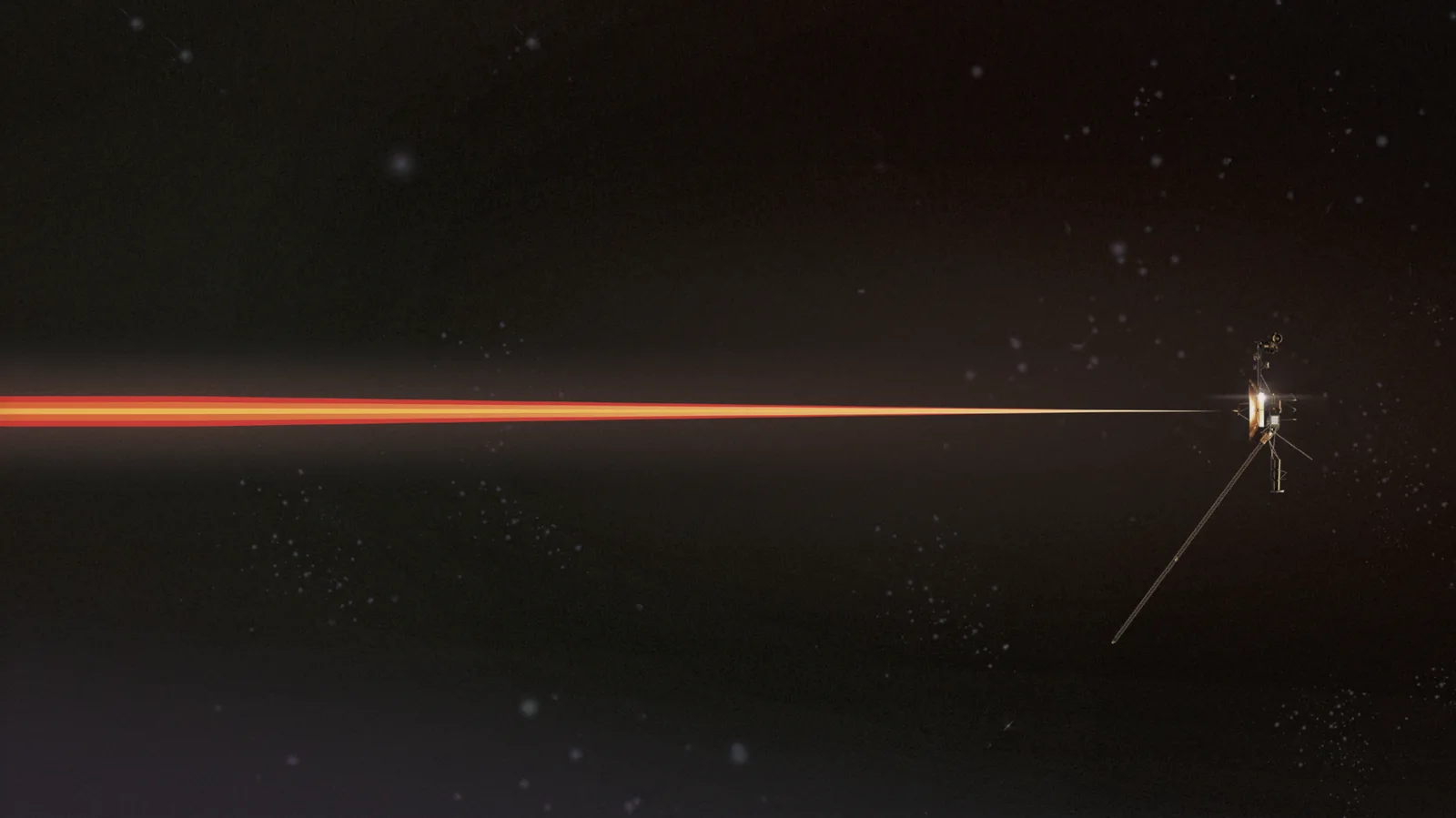
On November 18, 2026, Voyager 1 became the first spacecraft to reach one light-day from Earth. NASA confirmed the milestone the following day: the probe was approximately 25.9 billion kilometres away, so distant that its radio signal needed 24 hours to reach us.
The achievement invites admiration for the engineers who have kept the spacecraft operating for more than 49 years. But aboard Voyager is something that raises a different question.
If another civilisation encountered something we had made, what would we want it to know about us?
A day away — even at the speed of light
A light-day measures distance. It does not mean Voyager travelled for a day, or that it moves at the speed of light. It means light itself takes an entire day to cross the distance separating the spacecraft from Earth.
Voyager 1 launched on September 5, 1977, to explore Jupiter and Saturn. Its journey continued beyond those planetary encounters, and in August 2012 it entered interstellar space. NASA’s Voyager mission overview provides the full record of what the spacecraft encountered along the way.
For readers imagining a nearby destination, that phrase needs perspective. Entering interstellar space did not bring Voyager close to another inhabited world. It crossed a boundary in the environment surrounding our Sun. The mission’s distance makes the scale of space more tangible — and the difficulty of travelling between stars harder to overlook.
A small record of an enormous world
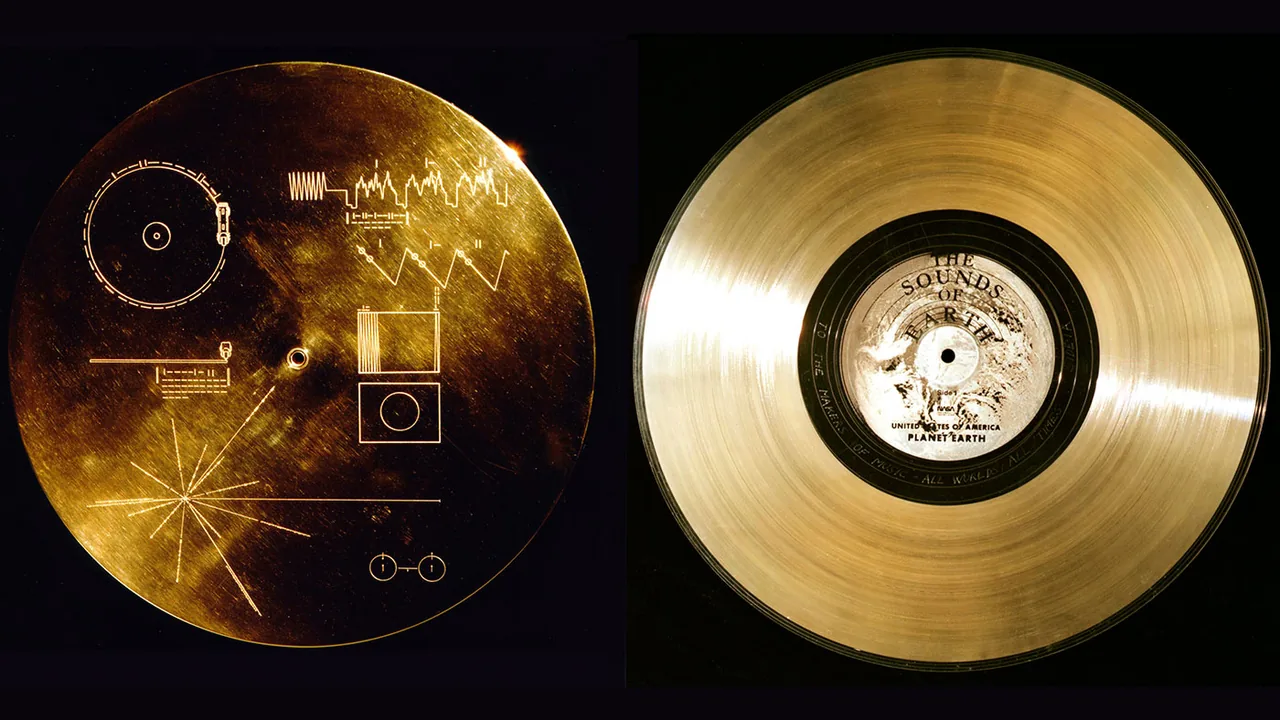
Each Voyager spacecraft carries a Golden Record: a 12-inch, gold-plated copper disc containing sounds and images selected to represent life and culture on Earth. NASA’s Golden Record overview describes the full scope of the project.
Its contents include natural sounds, music from different cultures and eras, and spoken greetings in 55 languages. Its protective cover carries symbolic instructions intended to explain how to play it, locate Earth and determine how long the record has been travelling.
The record is a physical time capsule. Whether anyone will ever discover and understand it remains unknown.
A committee chaired by astronomer Carl Sagan selected its contents. Among them were 115 images, the sounds of wind and thunder, birds and whales, and music expressing different human traditions. The full contents of the Golden Record are documented by NASA.
That selection poses questions of its own. How could any committee adequately represent a planet? Which voices would it include? Which experiences would remain absent? A message assembled in 1977 inevitably reflects decisions made by particular people at a particular moment.
It is a portrait of humanity, rather than a complete account of humanity.
Hope is not evidence of a recipient
The Golden Record does not establish that extraterrestrial civilisations exist. Sending a message cannot demonstrate that someone is available to receive it.
Its significance lies in the decision to prepare for that possibility.
We can investigate the universe while remaining uncertain about what we may find. We can build instruments, examine evidence and ask difficult questions without turning our hopes into conclusions.
For The UFO Times, that distinction matters. Curiosity gives an investigation its direction. Evidence determines how far its conclusions can go.
A milestone, with an engineering challenge
The anniversary announcement also contained a reminder of Voyager’s vulnerability. NASA reported on November 19 that engineers had not received science or engineering data since November 14, although a carrier signal remained detectable. The team used that signal and trajectory calculations to confirm the distance milestone.
That was the situation described in the announcement; subsequent engineering developments should be checked separately at NASA’s Voyager mission pages. The milestone itself should not be mistaken for confirmation that every spacecraft system was functioning normally.
What would we send today?
Voyager’s record gives our imagination something concrete to consider: a human-made object carrying an account of Earth into interstellar space.
What would we choose differently if we assembled that account today? Would we describe our achievements, our failures, our disagreements — or our capacity to question ourselves?
There is no evidence here of a conversation with another civilisation. There is, however, a remarkable expression of our willingness to imagine one.
What if someone, somewhere, could understand?
Sources & References
- NASA. “NASA’s Voyager 1 Makes History Reaching One Light-Day From Earth.” News release RELEASE26-098, November 19, 2026. nasa.gov.
- NASA Science. Voyager 1 mission overview. science.nasa.gov/mission/voyager/voyager-1. Background reference; not a November 2026 publication.
- NASA Science. Voyager Golden Record overview. science.nasa.gov — Golden Record overview. Background reference.
- NASA Science. Golden Record contents. science.nasa.gov — Golden Record contents. Background reference.
Facts First. Mystery Second. Speculation Last.