
One Hundred Objects off Virginia: What AARO’s New UAP Report Actually Reveals
A U.S. Navy report describes approximately 100 airborne objects and two likely uncrewed surface systems off the Virginia coast. The incident is real enough to be under investigation — but the public evidence remains strikingly incomplete.
By The UFO Times Editorial Desk · July 27, 2026
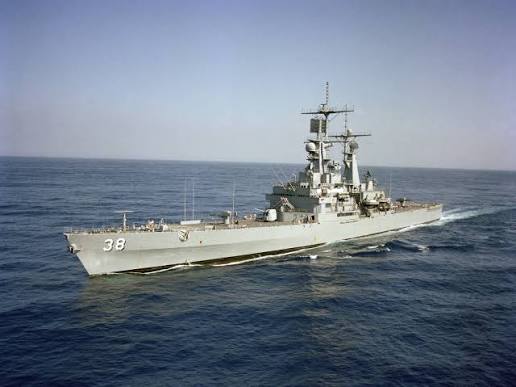
A U.S. Navy vessel operates in the Atlantic. AARO has not identified the specific Navy assets involved in the reported Virginia UAP incident, and has not disclosed the date, location, or sensor data underlying the report. This image is provided for regional context only — it does not depict the incident or the units involved. Image: U.S. Navy / public domain.
The most arresting passage in the Pentagon’s latest annual report on unidentified anomalous phenomena occupies only three sentences.
According to the All-domain Anomaly Resolution Office, or AARO, U.S. Navy assets operating off the coast of Virginia reported approximately 100 unidentified airborne objects and two “likely uncrewed” systems on the surface of the water. AARO says it is actively investigating the event in coordination with the unit that submitted the report.
That is the full public account.
No date is given. No video, radar data or infrared imagery accompanies the passage. The report does not describe the objects’ appearance, size, altitude, speed, formation, duration or behavior. It does not say whether the airborne objects interacted with the surface systems. It does not identify the Navy platforms involved or explain why the objects remained unidentified.
“The number is extraordinary. The publicly available evidence is not.”
The UFO Times Editorial Desk
That distinction is essential. A report from military personnel deserves investigation, particularly when it concerns a large concentration of unidentified objects in a strategically important maritime area. But an unresolved military report is not, by itself, evidence of extraterrestrial technology. It is evidence of an unresolved event.
■ What the Official Report Confirms
AARO’s Fiscal Year 2025 Consolidated Annual Report on Unidentified Anomalous Phenomena covers reports received for events occurring primarily between June 2, 2024, and May 30, 2025. The office received 319 UAP reports. The single maritime case was the Virginia incident. The official text states:
“The single maritime domain UAP case AARO received involved a report from U.S. Navy assets operating off the coast of Virginia. The report described approximately 100 airborne UAP and two, likely uncrewed, surface systems. AARO is actively investigating this event in coordination with the reporting unit.”
— AARO, Fiscal Year 2025 Consolidated Annual Report on UAP, p. 5
The language confirms five facts:
- The report came from U.S. Navy assets — not an anonymous account.
- The reported location was off the Virginia coast.
- Approximately 100 airborne objects were involved.
- Two objects on the water were assessed as likely uncrewed surface systems.
- AARO had not resolved the event when it published the report.
Primary Source: Download the AARO FY2025 Annual Report (PDF) →

Official seal of the All-domain Anomaly Resolution Office (AARO), established July 2022 under the Office of the Secretary of Defense. AARO serves as the U.S. government’s central body for UAP detection, identification, and attribution across air, maritime, and space domains. Source: U.S. Department of Defense.
What We Know — and What We Do Not
| ✓ Confirmed by AARO | ■ Not Publicly Disclosed | ✗ Not Established |
|---|---|---|
| U.S. Navy assets submitted the report | Date and duration of the event | Extraterrestrial origin |
| Location was off Virginia | Precise location | Extraordinary speed or maneuvering |
| Approximately 100 airborne UAP were described | Sensor platforms and raw data | Transmedium travel |
| Two likely uncrewed surface systems were described | Size, shape and formation of objects | Connection between airborne and surface objects |
| Investigation remains active | Whether objects were tracked or recovered afterward | Foreign, domestic or nonhuman control |
This table shows why the case is both important and easy to exaggerate.
The presence of approximately 100 objects sounds unprecedented. Yet quantity alone does not establish anomalous capability. Large numbers can point toward coordinated drones, balloons, birds, airborne debris, sensor tracks, misidentification or more than one phenomenon grouped into a single report. Without the underlying data, it is impossible to rank those possibilities confidently.
The two surface systems add an unusual dimension. They could suggest a coordinated maritime drone operation in which surface vessels supported airborne systems. They could also have been unrelated objects observed in the same operating area. AARO’s brief wording does not establish that the surface and airborne objects communicated, maneuvered together or belonged to the same operator.
Even the word “approximately” matters. It may represent a visual estimate, a count assembled from multiple sensor detections or the total number of observations recorded over time. The report does not tell us.
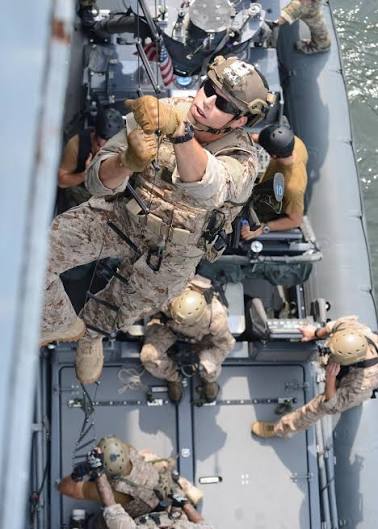
U.S. Navy and Marine Corps personnel during a training exercise in the Virginia coastal region. The waters off Virginia encompass Naval Station Norfolk — the world’s largest naval station — multiple restricted operating areas, and active Atlantic training zones. AARO did not disclose the precise location of the reported UAP incident. This image depicts routine naval training and does not represent the incident. Image: U.S. Navy / DVIDS.
Why the Virginia Location Matters
The waters and airspace around coastal Virginia are among the most sensitive military environments in the United States. The region includes Naval Station Norfolk — the world’s largest naval station — major training areas, active aviation corridors and direct access to the Chesapeake Bay and the Atlantic Ocean.
That makes an unidentified mass incursion a legitimate national-security concern regardless of its ultimate explanation. If the objects were drones, the central questions would be: who operated them, how they entered the area, what they were collecting, and why U.S. forces could not immediately identify or stop them. Those questions are serious without invoking visitors from another world.

A U.S. Navy destroyer underway in the Atlantic. The waters off Virginia are among the most monitored military environments in the world — which makes a mass unidentified incursion a legitimate security concern regardless of its eventual explanation. If the objects were drones, the question of how they entered the area and why they could not be immediately identified is as serious as any exotic hypothesis. Image: U.S. Navy / DVIDS.
The location also invites comparison with previously reported drone incursions in the Virginia region, including repeated activity over Langley Air Force Base in December 2023. Public reporting described unidentified drones entering restricted airspace over a period of more than two weeks. However, AARO’s new report does not connect the offshore Navy case to the Langley events. Any connection is therefore a hypothesis, not a fact.
The incidents may reflect a broader vulnerability to small, relatively inexpensive systems operating around high-value military sites. They may also involve different technologies, different operators and different circumstances. Until the government provides dates and technical details for the maritime case, the two stories should not be merged.
The Drone Explanation Must Be Taken Seriously
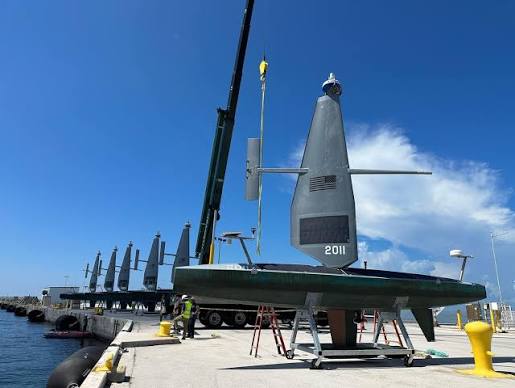
A U.S. Navy unmanned surface vessel. This illustrates the category of uncrewed maritime technology described in the AARO report — not the objects from the Virginia incident. The Navy operates multiple classes of unmanned surface vessels for patrol, surveillance and as potential launch platforms for airborne systems. Source: U.S. Navy / DVIDS.
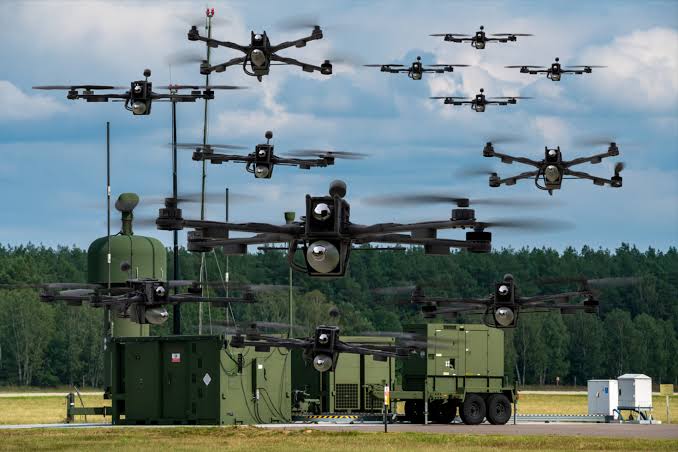
U.S. Navy drone swarm test. Modern unmanned aerial systems can operate in coordinated groups of dozens or hundreds of units, launched from land or sea. This image illustrates existing technology relevant to the Virginia case — it does not depict the reported objects. Source: U.S. Navy / DVIDS.
“Drone” is sometimes treated as a dismissive answer in UAP discussions. It should not be. Modern unmanned systems can operate in coordinated groups, carry sophisticated sensors, launch from land or sea, and create difficult identification problems — especially at night or when viewed through specialized military sensors.
The two likely uncrewed surface systems make a drone-centered explanation particularly relevant. Surface vessels can potentially function as launch platforms, relay stations, navigation aids or recovery systems for airborne drones. That does not prove such an operation occurred off Virginia, but it provides a plausible technological framework requiring investigation.
Several possibilities remain open:
- A domestic military exercise or classified test not immediately recognized by the reporting unit.
- A foreign intelligence or surveillance operation.
- Commercial or civilian systems entering a military operating area.
- Multiple conventional objects or sensor returns incorrectly interpreted as a coordinated event.
- A genuinely anomalous incident whose characteristics cannot be reproduced by known systems.
The fifth possibility cannot be excluded merely because the first four are more familiar. But it should not be elevated above them without evidence of performance that conventional systems cannot achieve. AARO does not report such performance in this case.
What the Wider Annual Report Shows
The Virginia event appears inside a report that is far more cautious than many online summaries suggest.
Of the 319 reports received, AARO resolved 114 as ordinary objects or phenomena. Those explanations included balloons, birds, satellites, aircraft, unmanned aerial systems, a commercial rocket launch and even one manned jet pack. The office also resolved 256 cases inherited from an earlier reporting period, bringing the total number of cases resolved during the period to 370.
AARO identified nine of the 319 new reports as deserving further analysis by intelligence, scientific and technical specialists. It placed 191 in what it calls the “active archive” because insufficient information prevented a reliable assessment. Those archived reports may be revisited if corroborating data or improved analytical methods become available.
That category must be interpreted carefully. “Insufficient data” does not mean that AARO detected impossible flight characteristics. It means the office could not determine whether the underlying events were ordinary or exceeded known technology. The report also states that none of the cases AARO resolved indicated advanced foreign capabilities or breakthrough technology. This conclusion applies to resolved cases. It does not explain every unresolved case, and it does not validate extraordinary interpretations of them.
The Growing Satellite Problem
One of the report’s most useful findings concerns satellite flares. Sunlight reflecting from a satellite can appear as a bright orb that emerges, moves or fades under particular viewing conditions. As satellite constellations multiply, pilots and observers are seeing more lights whose apparent behavior can be difficult to interpret without precise location, time and viewing-angle data.
AARO says a new three-dimensional modeling capability enabled analysts to attribute 238 reports to satellite flaring. Forty-four of the 319 reports covered in the current reporting period were resolved this way.
This is exactly why rigorous analysis matters. An observation can be sincere, accurately reported and genuinely unidentified to the witness while still having an ordinary astronomical or technological explanation. The military personnel who file UAP reports are trained observers — but even trained observers cannot calculate satellite trajectories from a cockpit.
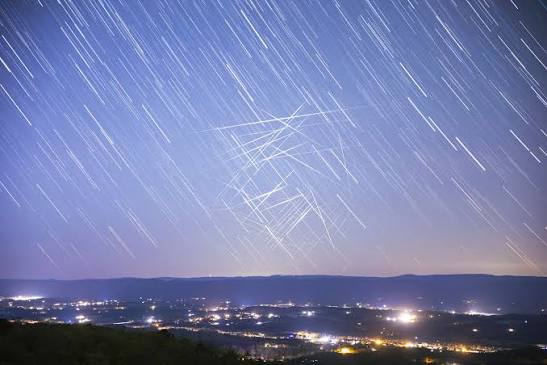
A satellite flare captured from the ground. As commercial satellite constellations expand, sunlight reflecting off spacecraft produces bright, moving lights that trained observers cannot immediately identify without precise time, location and trajectory data. AARO resolved 44 of its 319 current reports — and 238 cases total — using new 3D modeling that attributed them to this phenomenon. Source: Creative Commons.
Reports Near Sensitive Sites
AARO also analyzed reports near national-security sites and critical infrastructure. Some narrative accounts described apparent performance beyond known technology, but the office said those reports arrived without technical data capable of validating the claims.
The annual report records two cases in which witnesses attributed electronic or avionics interference near operational aircraft to UAP. AARO has not determined whether the unidentified objects caused those effects.
Separately, government agencies reported 50 unmanned-aircraft incidents near U.S. nuclear infrastructure, weapons or launch sites — up from 18 in the previous annual report. AARO explicitly says those 50 incidents were not reported as UAP. Most involved recognizable unmanned aircraft, commonly quadcopters.
That separation matters. Drone incursions and UAP cases can overlap as security problems, but they are not interchangeable labels. The government should not use “drone” to prematurely close an unidentified case, and UAP advocates should not rebrand identified drone incidents as evidence of exotic technology. Ryan Graves — the former Navy pilot who has testified before Congress about UAP reporting stigma and sensor limitations — has made precisely this point: the failure mode runs in both directions.
The Central Weakness: Missing Data
AARO identifies the same obstacle that has followed official UFO investigations for decades: a lack of timely, actionable sensor data.
Witness testimony can establish that someone observed something unusual. It can help reconstruct direction, duration, color, shape and behavior. But testimony alone rarely provides the measurements needed to calculate distance, size, acceleration or energy output.
For the Virginia case, a meaningful public assessment would require at least some of the following:
Information Needed for a Public Assessment
- The date, time and duration of the event
- Navy units and sensor platforms involved
- Radar tracks and possible clutter or interference data
- Infrared or electro-optical imagery
- Estimated altitude, speed and object dimensions
- Weather, visibility and astronomical conditions
- RF or signals-intelligence data, if collected
- Whether objects flew in formation or responded to each other
- Evidence connecting airborne objects to surface systems
- Records of interception, tracking or recovery attempts
Without those materials, the public has a dramatic sentence but not a testable case. Classification may legitimately protect sensor capabilities, tactics and military operations. Nevertheless, the government could release a carefully redacted case summary explaining how the observations were collected and which hypotheses remain under consideration. Transparency does not require revealing every technical specification. As Congressman Tim Burchett and others on the House Oversight Committee have repeatedly argued, the current level of disclosure is insufficient for congressional oversight, let alone informed public understanding.
■ Editor’s Assessment
The Virginia incident deserves sustained attention. A coordinated intrusion involving approximately 100 airborne objects and two surface systems — if that description is supported by multiple sensors — would represent a significant failure of domain awareness and possibly a major intelligence event.
But the conditional phrase is essential: if that description is supported by multiple sensors.
At present, the public does not know whether the count came from radar, infrared imagery, visual observation or a combination of sources. We do not know whether the objects displayed unusual speed, acceleration or transmedium capability. We do not know whether they were close to military assets or many miles away.
The responsible conclusion is therefore limited: A U.S. Navy unit reported a large and unusual offshore event. AARO considered it sufficiently unresolved to keep the investigation active. The released information is not sufficient to determine what occurred.
That is less sensational than declaring a swarm of alien craft. It is also more consequential than dismissing the event as “probably drones” without seeing the evidence.
— The UFO Times Editorial Desk, July 27, 2026
What Should Happen Next
AARO should publish an unclassified update addressing the basic architecture of the incident. The questions requiring answers are not extraordinary — they are the minimum information necessary for serious public understanding:
- When did the event occur, and over what period were the objects observed?
- Which sensor categories detected them?
- Was the approximate count simultaneous or cumulative over time?
- Did the objects enter restricted airspace or approach Navy vessels?
- What made the surface systems “likely uncrewed”?
- Is there evidence that the airborne and surface systems were coordinated?
- Which conventional explanations remain viable, and which have been tested and ruled out?
- What specific information prevents resolution of the case?
These questions do not presume an extraterrestrial answer. They demand the minimum information necessary for serious public understanding. The Virginia case may eventually be explained as a drone exercise, a surveillance operation, a collection of unrelated conventional objects or a sensor interpretation problem. It may retain genuinely anomalous features after those possibilities are tested.
We do not yet know. That uncertainty is not a license for speculation. It is a reason to keep investigating — and a reason for government to be clearer about what it has already learned.
Sources
Primary Source
All-domain Anomaly Resolution Office. Fiscal Year 2025 Consolidated Annual Report on Unidentified Anomalous Phenomena. U.S. Department of Defense, 2026. Download PDF →
- Brandi Vincent, DefenseScoop. “Pentagon investigating mysterious UAP event reported by the Navy near Virginia’s coast.” July 21, 2026.
- All-domain Anomaly Resolution Office. Congressional and Press Products. aaro.mil.
Related Coverage