
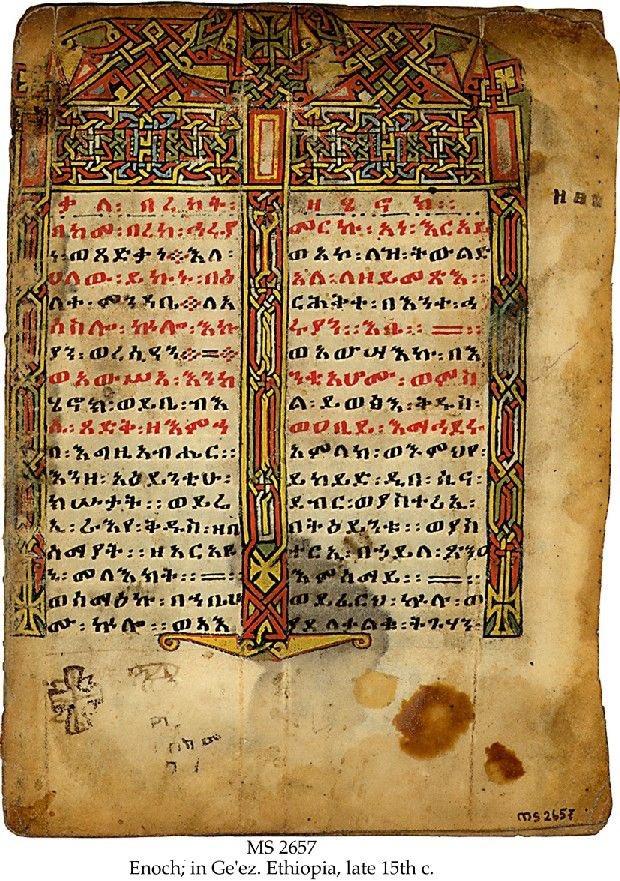
MS 2657 — an illuminated manuscript of the Book of Enoch written in Ge’ez, Ethiopia, late 15th century. The Ethiopian Orthodox Tewahedo Church preserved the complete text of 1 Enoch for centuries as part of its biblical canon, long after the work had disappeared from most other traditions. The discovery of Aramaic fragments at Qumran in 1947 confirmed the manuscript tradition’s antiquity.
“And it came to pass when the children of men had multiplied that in those days were born unto them beautiful and comely daughters. And the angels, the children of the heaven, saw and lusted after them, and said to one another: ‘Come, let us choose us wives from among the children of men and beget us children.’”
— 1 Enoch 6:1–2 (R. H. Charles translation, 1917)
Few ancient writings have generated as much curiosity as the Book of Enoch.
To some readers, it is a forgotten scripture that reveals hidden truths about angels and the origins of evil. To historians, it is one of the most significant surviving works of Jewish apocalyptic literature. To modern proponents of Ancient Astronaut Theory, it has become a source of speculation about possible encounters between humanity and non-human intelligences.
Yet before examining these interpretations, one question deserves to be answered: What is the Book of Enoch?
Although absent from most modern Bibles, the text profoundly influenced Jewish thought during the Second Temple period, shaped early Christian ideas about angels and divine judgment, and continues to be studied by historians, theologians, and archaeologists alike.
At The UFO Times, our objective is straightforward: to separate the ancient text from the many interpretations that have followed it. This article examines the historical record, the manuscript evidence, and the scholarly consensus — so that readers can understand what the Book of Enoch actually says before encountering what others have claimed about it.
A Timeline: From Genesis to the Modern Era
c. 6th Century BC
Genesis 5:24 written. Eight words — “God took him” — inspire centuries of theological speculation about who Enoch was and what he witnessed.
c. 300–100 BC
Composition of 1 Enoch. Multiple authors over approximately two centuries produce the texts later assembled into the Book of Enoch. The work circulates widely in Jewish communities during the Second Temple period.
c. 65 AD
The Epistle of Jude directly quotes 1 Enoch 1:9 in the New Testament. Early Church Fathers — Tertullian, Justin Martyr, Irenaeus — engage seriously with the text.
4th–5th Century AD
Excluded from most canons. As Jewish and Christian communities finalize their scriptural boundaries, 1 Enoch is not included. The Ethiopian Orthodox Tewahedo Church remains a major exception, retaining it as canonical scripture.
1773
James Bruce returns to Europe from Abyssinia with Ethiopian manuscripts of 1 Enoch, reintroducing the text to Western scholarship after centuries of near-obscurity.
1947–1956
Dead Sea Scrolls discovered at Qumran. Aramaic fragments of 1 Enoch are among the manuscripts, confirming the text was actively read and copied more than two thousand years ago.
1968 — Present
Ancient Astronaut interpretations emerge. Erich von Däniken’s Chariots of the Gods? and Zecharia Sitchin’s subsequent works reframe the Watchers and Nephilim as potential evidence of extraterrestrial contact, generating a popular debate that continues today.
Who Was Enoch?
Enoch appears only briefly in the Hebrew Bible. In Genesis 5, he is introduced as the seventh generation from Adam and the great-grandfather of Noah. The entire account of his life occupies a single verse — and it is unlike any other verse in the genealogy.
■ Primary Source
“Enoch walked faithfully with God; then he was no more, because God took him.”
— Genesis 5:24
Because Genesis never describes Enoch’s death, later Jewish traditions came to portray him as someone granted extraordinary access to heavenly knowledge. Where other patriarchs in the genealogy simply “died,” Enoch was “taken.” That distinction, brief as it was, proved sufficient to inspire centuries of imaginative religious writing.
The Book of Enoch transforms this otherwise unremarkable figure into a visionary who journeys through the heavens, witnesses divine judgment, encounters angels and celestial beings, and records revelations intended for future generations. It is one of antiquity’s most striking examples of what happens when scripture leaves a gap and imagination moves in to fill it.
What Is the Book of Enoch?
Despite its traditional title, the Book of Enoch was not written by the biblical Enoch. Modern scholarship concludes that 1 Enoch is a collection of several works composed between approximately the third century BC and the first century BC by different Jewish authors. These writings were eventually assembled into a single work that explores heavenly visions, divine justice, the fall of rebellious angels, the coming judgment, and the ultimate restoration of creation.
The work as we have it today is divided into five major sections, each with its own distinct focus and probable origin. Scholars generally believe these were composed independently before being brought together into the collection now known as 1 Enoch.
| Section | Also Known As | Main Theme |
|---|---|---|
| Chapters 1–36 | Book of the Watchers | The descent of the Watchers, the Nephilim, forbidden knowledge, and Enoch’s heavenly journeys. The section most cited in modern discussion. |
| Chapters 37–71 | Book of Parables (Similitudes) | Visions of divine judgment and the mysterious “Son of Man” — a figure of great importance to scholars of early Jewish and Christian messianic thought. |
| Chapters 72–82 | Astronomical Book (Book of Luminaries) | Ancient cosmology, the movements of the sun and moon, and a solar calendar — evidence that the text engaged deeply with the scientific questions of its era. |
| Chapters 83–90 | Book of Dream Visions | A sweeping symbolic vision of human history from the Flood to the coming of a messianic age, using animals to represent nations and individuals in a distinctive allegorical style. |
| Chapters 91–108 | Epistle of Enoch | Ethical teachings, woes against the wicked, and apocalyptic prophecy. Includes the “Apocalypse of Weeks,” which divides history into ten symbolic periods. |
The complete text survives in Ge’ez, the classical language of Ethiopia, while significant portions were discovered in Aramaic among the Dead Sea Scrolls. Together, these sources provide historians with a manuscript tradition of extraordinary richness for a work of such antiquity.
“Rather than being a medieval Ethiopian composition, the Qumran manuscripts demonstrated that the Book of Enoch was already widely known during the Second Temple period and held in high regard by at least some Jewish communities.”
Discovery Among the Dead Sea Scrolls
For many centuries, Western scholars knew the Book of Enoch primarily through Ethiopian manuscripts brought to Europe by the Scottish explorer James Bruce in 1773. The first English translation appeared in 1821, and the text attracted significant scholarly and popular interest — but its precise origins and age remained uncertain.
That changed dramatically after the discovery of the Dead Sea Scrolls near Qumran in 1947.

The caves at Qumran, Judean Desert — where fragments of 1 Enoch in Aramaic were discovered between 1947 and 1956.
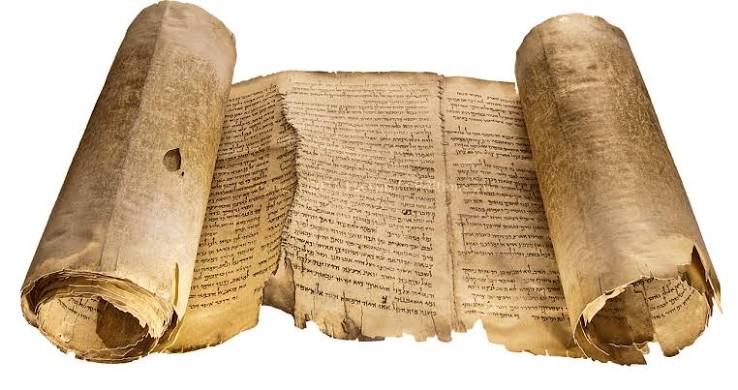
A Dead Sea Scroll. The Qumran library contained more Enoch manuscripts than some canonical biblical books — evidence of how widely the text was read.
Among the thousands of manuscript fragments recovered from the Judean Desert were portions of the Book of Enoch written in Aramaic. This discovery transformed scholarly understanding of the text in two important ways.
First, it confirmed the antiquity of the work. The Qumran fragments date to the second and first centuries BC, establishing that the Book of Enoch was not a late composition but an ancient one, read and copied by Jewish communities more than two thousand years ago.
Second, the presence of multiple Enoch manuscripts at Qumran — more copies than of some canonical biblical books — suggested that the text was not marginal but actively valued by at least some members of the Second Temple Jewish world. Related texts discovered at the same site, including The Book of Giants, indicated that Enoch traditions were part of a living literary culture rather than an isolated curiosity.
The Dead Sea Scrolls remain one of the strongest pieces of historical evidence for the antiquity and significance of the Book of Enoch.
The Watchers: Descent and Transgression
Perhaps the Book of Enoch’s best-known narrative concerns a group of heavenly beings known as the Watchers. According to the text, two hundred angels descended to Earth on Mount Hermon — a mountain in the northern Levant that the text identifies by name as the place where they swore their oath together, binding themselves to their decision regardless of the consequences.
Led by figures whose names include Semjaza and Azazel, the Watchers took human wives and transmitted knowledge that humanity was not intended to possess.
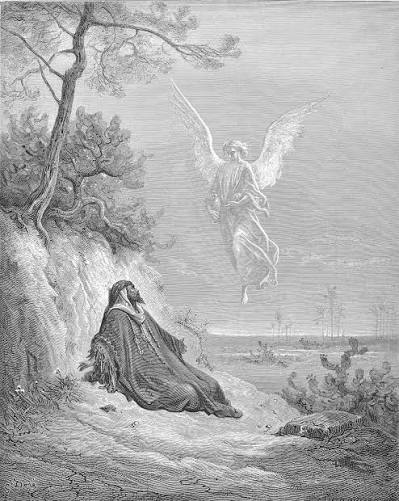
A classical engraving in the tradition of Gustave Doré depicting a heavenly being appearing to a human figure — imagery that has long accompanied artistic interpretations of the Watchers narrative in 1 Enoch.
■ Primary Source
“And Azazel taught men to make swords, and knives, and shields, and breastplates, and made known to them the metals of the earth and the art of working them, and bracelets, and ornaments, and the use of antimony, and the beautifying of the eyelids, and all kinds of costly stones, and all colouring tinctures.”
— 1 Enoch 8:1–2 (R. H. Charles translation, 1917)
The forbidden knowledge transmitted by the Watchers, as the text describes it, included metalworking and weapon-making, astrology and the reading of celestial signs, enchantments and sorcery, and the arts of cosmetics and adornment. In each case, the Book of Enoch frames these gifts not as progress but as corruption — technologies and arts that enabled violence, vanity, and moral disorder.
As punishment for their transgression, God commands the archangels Michael, Raphael, Gabriel, and Uriel to bind the Watchers until the day of final judgment. The Watchers narrative thus functions within the text as an origin story — an explanation for the presence of evil in the created order and for the moral catastrophe that preceded the biblical Flood.
The specificity of Mount Hermon as the site of descent is notable. The mountain, located on the border of modern Lebanon and Syria and rising to approximately 2,814 metres, held deep religious significance in the ancient Near East. Its mention by name in 1 Enoch suggests the narrative was anchored to real geography, whatever the intended meaning of the account.
The Nephilim
The offspring of the Watchers and human women are identified with the Nephilim — a term that appears only briefly in the Hebrew Bible and has generated interpretive debate for centuries.
■ Primary Source
“The Nephilim were on the earth in those days — and also afterward — when the sons of God went to the daughters of humans and had children by them. They were the heroes of old, men of renown.”
— Genesis 6:4
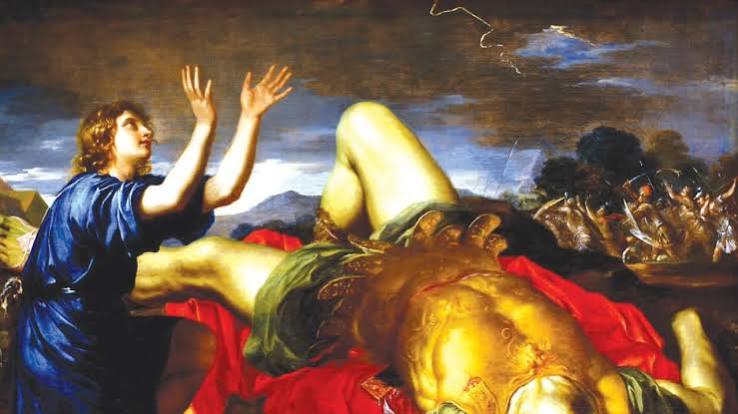
A detail from a classical painting depicting the encounter between a human figure and a fallen giant — imagery long associated with biblical and extra-biblical accounts of the Nephilim. The Book of Enoch greatly expanded upon the four verses of Genesis 6, transforming a brief mention into a complete narrative of origins, violence, and divine judgment.
In the Book of Enoch, the Nephilim become violent giants whose actions contribute to widespread destruction and injustice before the Flood. The text expands the four verses of Genesis 6:1–4 into a much fuller account of their origin, behaviour, and ultimate fate.
Interpretations have varied considerably across religious traditions and historical periods. Some have understood the account literally — physical giants born of supernatural unions. Others interpret the narrative symbolically, reading the “sons of God” as mortal rulers and the Nephilim as a metaphor for political tyranny, moral corruption, or the breakdown of divine order rather than a literal biological event.
Because the biblical references are so brief and the Book of Enoch’s account so vivid, 1 Enoch became one of the principal texts shaping subsequent theological traditions about the Nephilim. Its influence on the subject is difficult to overstate: most of what popular culture associates with the Nephilim comes not from the four verses of Genesis but from the much more detailed narrative of 1 Enoch.
Enoch Across Religious Traditions
Although the Book of Enoch is most closely associated with ancient Jewish literature, the figure of Enoch appears in several major religious traditions. Each preserves his memory differently, reflecting distinct theological perspectives while recognizing him as an individual of exceptional righteousness — a man singled out from the rest of humanity for a relationship with God that transcended ordinary life and death.
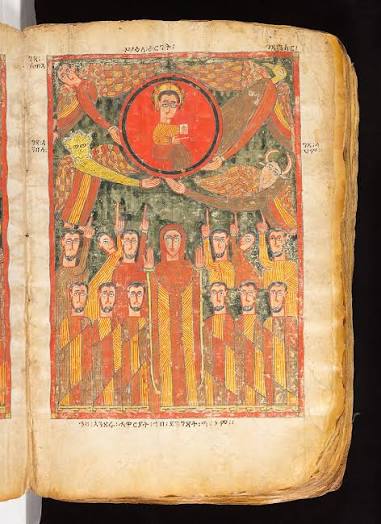
An Ethiopian illuminated manuscript depicting a heavenly scene, produced within the tradition of the Ethiopian Orthodox Tewahedo Church. This is the same tradition that preserved the complete text of the Book of Enoch in Ge’ez for more than fifteen centuries — the reason the work survived at all.
Judaism. In the Hebrew Bible, Enoch appears briefly in Genesis as the seventh generation from Adam. His extraordinary description — “God took him” — became the foundation for centuries of later Jewish writing. During the Second Temple period, Jewish authors greatly expanded his story, presenting him as a visionary who received revelations about heaven, angels, divine judgment, and the future of humanity. These traditions eventually became the Book of Enoch.
Christianity. Christianity inherited Enoch from the Hebrew Scriptures and continued to regard him as a remarkable figure of faith. The Epistle to the Hebrews praises Enoch for his faithfulness, while the Epistle of Jude directly quotes the Book of Enoch — demonstrating that the text was known and respected by at least some early Christian communities. Although 1 Enoch was ultimately excluded from most Christian biblical canons, its influence remained visible in discussions of angels, divine judgment, and the Nephilim.
Ethiopian Orthodox Christianity. The Ethiopian Orthodox Tewahedo Church occupies a unique place in the history of the Book of Enoch. Unlike most Christian traditions, it recognizes 1 Enoch as canonical scripture and has always done so. For centuries, complete manuscripts survived only in Ge’ez, preserving a work that had largely disappeared elsewhere. The discovery of Aramaic fragments among the Dead Sea Scrolls later confirmed that the Ethiopian tradition had faithfully preserved an authentic ancient Jewish text — not a later composition.
Islam. The Book of Enoch is not part of the Islamic scriptural tradition and is not mentioned in the Qur’an. However, many Islamic scholars identify the Qur’anic prophet Idris (إدریس) with the biblical Enoch. Idris appears in two Qur’anic passages as a truthful prophet raised to a high station by God. Later Islamic literature sometimes attributes wisdom, knowledge, and heavenly ascent to Idris, but these traditions developed independently and are distinct from the Book of Enoch itself.
| Tradition | Figure | Role | Status of 1 Enoch |
|---|---|---|---|
| Judaism | Enoch | Patriarch whose story was greatly expanded in Second Temple literature | Non-canonical; important historical and religious document |
| Christianity | Enoch | Model of faith; referenced in Hebrews and directly quoted in Jude | Non-canonical in most denominations; influential on early theology |
| Ethiopian Orthodox Church | Enoch | Holy patriarch; the complete text preserved in Ge’ez for fifteen centuries | Canonical scripture |
| Islam | Idris (traditionally identified with Enoch) | Prophet raised to a high station by God; mentioned twice in the Qur’an | Not part of Islamic scripture; traditions developed independently |
■ Editor’s Note
The appearance of Enoch across multiple religious traditions illustrates his enduring significance in the ancient world. While the details of his life differ considerably between traditions, the consistent portrayal — a righteous individual chosen for a unique relationship with God — highlights the remarkable influence of a man whose entire biblical biography was compressed into a single verse.
Influence on Judaism and Christianity
The Book of Enoch exercised considerable influence during the Second Temple period. Its themes appear throughout other Jewish writings of the era, and they resonate across early Christian literature in ways that suggest the text was widely read and taken seriously.
Most significantly, the Epistle of Jude quotes directly from 1 Enoch 1:9 — making it one of the only works outside the established canon to be directly cited within the New Testament.
■ Primary Source
“Enoch, the seventh from Adam, prophesied about them: ‘See, the Lord is coming with thousands upon thousands of his holy ones to judge everyone, and to convict all of them of all the ungodly acts they have committed in their ungodliness.’”
— Jude 1:14–15, quoting 1 Enoch 1:9
Church Fathers including Justin Martyr, Irenaeus, Tertullian, and Athenagoras all engaged with the text. Tertullian went furthest, arguing that the Book of Enoch ought to be considered scripture. Others were more cautious about its authority while still drawing on its ideas about fallen angels, divine judgment, and the cosmic struggle between good and evil.
The theological ideas found in 1 Enoch — its developed angelology, its framework for understanding the origin of evil, its apocalyptic vision of divine judgment — demonstrably influenced the world in which the New Testament was written. The Book of Enoch was not a marginal text. It was part of the living intellectual and spiritual environment in which both Judaism and Christianity took shape.
Why Is It Not in Most Bibles?
The exclusion of the Book of Enoch from most Jewish and Christian Bibles was not the result of a single council decision, a deliberate suppression, or a historical conspiracy. It reflected the gradual and varied process by which different religious communities over several centuries determined which texts best represented their core traditions and were appropriate for public worship and authoritative teaching.
Jewish religious authorities did not include the text within the Hebrew Bible. The reasons were multiple: the work was clearly composite, of uncertain authorship across multiple generations, and its elaborate angelology and apocalyptic framework were not universally accepted as central to Jewish faith. Most Christian traditions followed the boundaries of the Hebrew canon in this regard.
It is worth noting that the process of canon formation was neither quick nor uniform. Different Christian communities in different regions held different views about which texts were authoritative for centuries. The Book of Enoch was not singled out for suppression; it was simply one of many texts that did not achieve universal acceptance as the boundaries of scripture gradually solidified.
The principal exception — and it is an important one — remains the Ethiopian Orthodox Tewahedo Church, one of the oldest Christian communities in the world. For millions of Ethiopian Christians, 1 Enoch is not a non-canonical curiosity but part of the Bible itself.
The Book of Enoch and Ancient Astronaut Theory
During the twentieth century, the Book of Enoch acquired a new audience and a new interpretive framework. Writers associated with Ancient Astronaut Theory proposed that the Watchers descending from the sky, the transmission of advanced technological knowledge, and Enoch’s guided heavenly journeys could all be read as descriptions of encounters with technologically sophisticated non-human beings — interpreted in religious language by ancient authors who lacked the conceptual vocabulary for what they were actually experiencing.
Erich von Däniken, whose Chariots of the Gods? (1968) introduced millions of readers to this framework, argued that the Watchers were extraterrestrial visitors and that the “forbidden knowledge” they transmitted represented advanced technology. Zecharia Sitchin extended this reading considerably, connecting the Watchers and Nephilim to his broader argument about the Anunnaki — Sumerian beings he identified as extraterrestrials who had intervened in human development.
Understanding how these interpretations relate to the original text — and where they depart from it — requires looking at the three main ways the Book of Enoch has been understood across history:
| Interpretive Framework | View of the Watchers | View of the Nephilim | Basis |
|---|---|---|---|
| Traditional Jewish & Christian | Fallen angels who violated divine law by entering the human realm | Literal giants, or symbolic figures of moral corruption and social disorder | Theology & Scripture |
| Mainstream Scholarship | Mythological figures within Jewish apocalyptic literature; theological explanation for the origin of evil | Narrative device representing social or moral disorder; possibly reflecting cultural memory of change in early human history | Historical Analysis |
| Ancient Astronaut Theory | Extraterrestrial beings who physically descended to Earth and transmitted advanced knowledge to early humans | Hybrid beings with non-human genetic ancestry; potential evidence of directed intervention in human evolution | Speculative Interpretation |
The distinction between what the text says and what later interpreters have read into it remains essential. Mainstream biblical scholars locate the Watchers narrative firmly within the well-understood conventions of ancient Jewish apocalyptic literature — a genre that routinely employed heavenly beings, divine councils, and cosmic conflicts as narrative devices for exploring theological ideas about justice, evil, and divine sovereignty.
No archaeological evidence has been produced to demonstrate that the Book of Enoch describes literal contact with extraterrestrial civilizations. Like the story of Atlantis, the Book of Enoch is a text whose enduring power lies partly in its capacity to sustain multiple readings — but the ancient text itself, read in its historical context, yields a meaning quite different from what its modern interpreters have proposed.
Current Scholarly Consensus
Modern scholarship regards the Book of Enoch as one of the most significant surviving works of the Second Temple period — important not because of its canonical status but because of what it reveals about the Jewish religious imagination in the centuries immediately before and during the emergence of Christianity.
The text provides scholars with insight into how ancient Jewish communities conceptualized the nature of angels and heavenly beings; how they understood the origin and nature of evil; how apocalyptic literature functioned as a form of theological and political commentary; and what the religious world looked like in which the New Testament was written and early Christianity developed.
The Dead Sea Scrolls fragments are particularly significant. Before their discovery, the Book of Enoch was known primarily through the Ethiopian manuscript tradition. The Qumran texts confirmed that the work had deep roots in the ancient Hebrew-speaking world — roots that predate Christianity by at least two centuries.
Today, major academic institutions devote serious scholarly attention to the Book of Enoch and related Second Temple texts. The journal Dead Sea Discoveries, along with works by scholars such as George W. E. Nickelsburg and James C. VanderKam, represent the current state of rigorous academic engagement with this material. The field has advanced considerably since R. H. Charles published his landmark translation in 1917.
Regardless of one’s personal beliefs about the text’s theological claims, historians agree that the Book of Enoch offers an irreplaceable window into the ancient world.
The UFO Times Assessment
| Category | Rating | Editorial Note |
|---|---|---|
| Historical Importance | ★★★★★ | One of the most significant surviving works of the Second Temple period. Its influence on early Judaism, Christianity, and later religious tradition is thoroughly documented. |
| Religious Influence | ★★★★★ | Directly quoted in the New Testament. Cited by major early Church Fathers. Canonical in the Ethiopian Orthodox Church. Its theology shaped centuries of religious thought. |
| Manuscript Evidence | ★★★★★ | Complete text in Ge’ez; Aramaic fragments confirmed at Qumran (2nd–1st century BC). The manuscript tradition is among the best-documented for a non-canonical ancient text. |
| Archaeological Context | ★★★★☆ | The Qumran discoveries firmly anchor the text in the Second Temple world. No physical evidence supports the literal reality of the Watchers or the Nephilim as biological entities. |
| Scientific Evidence for Supernatural Claims | ★☆☆☆☆ | No archaeological or scientific evidence supports extraterrestrial involvement or the literal reality of the events described. The text’s theological claims are not subject to scientific verification. |
| Cultural Influence | ★★★★★ | From early Christian theology to Milton’s Paradise Lost, from the Dead Sea Scrolls to modern television, the Book of Enoch has shaped Western religious and cultural imagination across more than two thousand years. |
UFO Times Evidence Assessment
- ESTABLISHED The Book of Enoch (1 Enoch) is a real ancient Jewish text, composed between approximately 300 and 100 BC. It is preserved in complete form in Ge’ez and confirmed by Aramaic fragments among the Dead Sea Scrolls.
- ESTABLISHED The text was widely circulated in the Second Temple period, directly quoted in the Epistle of Jude, and discussed by major early Church Fathers. It remains canonical scripture in the Ethiopian Orthodox Church.
- ESTABLISHED The Book of Enoch significantly influenced the development of angelology, demonology, and apocalyptic thought in both Judaism and early Christianity. This is well-documented in academic scholarship.
- CREDIBLE The Watchers narrative functions within a well-understood Jewish literary tradition as a theological explanation for the origin of evil and the conditions preceding the Flood.
- SPECULATIVE That the Book of Enoch preserves historical memory of actual events beyond the literary and theological conventions of its era.
- UNSUPPORTED That the Watchers were extraterrestrial visitors, the Nephilim biological human-alien hybrids, or the forbidden knowledge literal advanced technology from a non-human intelligence. No archaeological evidence supports these claims.
Editorial Perspective
The Book of Enoch occupies a remarkable position at the crossroads of history, religion, and cultural imagination. Its influence on Jewish thought, early Christianity, and later traditions is well documented. At the same time, its vivid descriptions of heavenly beings, cosmic events, and forbidden knowledge have encouraged interpretations that extend far beyond what its ancient authors intended or could have anticipated.
This article is not about proving or disproving supernatural claims. It is about understanding what the text actually says, why historians consider it important, and how it came to be read so differently across two thousand years of religious and cultural history. Those are questions that can be answered through scholarship — and the answers are genuinely fascinating without requiring us to choose between sensationalism and dismissal.
When in doubt, choose credibility over drama. A mystery remains fascinating even when we admit that not all of the answers are known.
— The UFO Times Editorial Desk
Frequently Asked Questions
What is the Book of Enoch?
The Book of Enoch (1 Enoch) is an ancient Jewish religious text composed between approximately 300 and 100 BC by multiple authors. It expands upon the brief biblical account of Enoch and contains descriptions of heavenly journeys, fallen angels known as the Watchers, their offspring the Nephilim, and visions of divine judgment. It survives completely in Ge’ez (Ethiopian) and partially in Aramaic fragments found among the Dead Sea Scrolls at Qumran.
Why was the Book of Enoch removed from the Bible?
It was never formally removed — it was simply not included when most Jewish and Christian communities finalized their biblical canons in the 4th and 5th centuries AD. The Ethiopian Orthodox Tewahedo Church has always considered it canonical scripture. The exclusion was not a conspiracy but a gradual process that differed across religious communities over several centuries.
Who were the Watchers?
According to the Book of Enoch, the Watchers were two hundred heavenly angels who descended to Earth at Mount Hermon, took human wives, and transmitted forbidden knowledge to humanity. Their actions and the violence of their offspring the Nephilim contributed to the moral catastrophe preceding the Flood. Mainstream scholarship understands them as mythological figures within Jewish apocalyptic literature.
What are the Nephilim?
The Nephilim appear briefly in Genesis 6:1–4 and are greatly expanded in the Book of Enoch, where they are described as the violent offspring of the Watchers and human women. Interpretations range from literal giants to symbolic representations of moral disorder. Ancient Astronaut theorists sometimes describe them as human-extraterrestrial hybrid beings, but no physical evidence supports this reading.
How was the Book of Enoch rediscovered?
The complete text was brought to Europe by Scottish explorer James Bruce in 1773, having survived in Ethiopia. The first English translation was published in 1821 by Richard Laurence. A major second discovery came in 1947 when Aramaic fragments were found among the Dead Sea Scrolls at Qumran, confirming the text’s ancient Jewish origins and its widespread use during the Second Temple period.
Is the Book of Enoch in the Bible?
Not in most Bibles. It is non-canonical in Judaism, Roman Catholicism, Eastern Orthodoxy, and most Protestant denominations. It is, however, canonical in the Ethiopian Orthodox Tewahedo Church and the Eritrean Orthodox Tewahedo Church, which together represent millions of Christians. The Epistle of Jude in the New Testament directly quotes from it, which is one reason the text retained its influence even after exclusion from most canons.
Were the Watchers extraterrestrials?
This is the central claim of the Ancient Astronaut interpretation, associated with writers including Erich von Däniken and Zecharia Sitchin. Mainstream historians and theologians do not accept this reading. The Watchers belong to a well-documented tradition of Jewish apocalyptic literature in which heavenly beings, divine councils, and cosmic conflicts serve as narrative and theological devices. No physical or archaeological evidence has been produced to support an extraterrestrial interpretation specifically.
Related Investigations
Recommended Reading
The Book of Enoch — Translated by R. H. Charles (Dover edition)
The standard English translation, used in academic work for more than a century. Charles’s edition includes extensive textual notes comparing the Ethiopic, Aramaic, and Greek versions. Read the text itself before reading what others say about it.
View on Amazon →1 Enoch: A Commentary — George W. E. Nickelsburg (Hermeneia Series)
The definitive academic commentary in English — rigorous analysis of manuscripts, composition, theology, and historical context. Essential for readers who want to understand what historians actually conclude about the text.
View on Amazon →Enoch and the Growth of an Apocalyptic Tradition — James C. VanderKam
VanderKam is one of the foremost authorities on the Dead Sea Scrolls and Second Temple Judaism. This work traces how the figure of Enoch evolved from a single verse in Genesis into an entire literary tradition — providing essential historical context for understanding why the text matters beyond its specific contents.
View on Amazon →Ancient Mysteries — Coming Next
Ezekiel’s Vision: Divine Encounter or Ancient Technology?
The next article in the Sacred Texts series examines the prophet Ezekiel’s extraordinary vision of four-faced beings and a wheel within a wheel — one of the Hebrew Bible’s most debated passages. What did Ezekiel actually describe, what do historians understand about the vision’s literary context, and how has it been interpreted across three thousand years?
Explore Ancient Mysteries →