
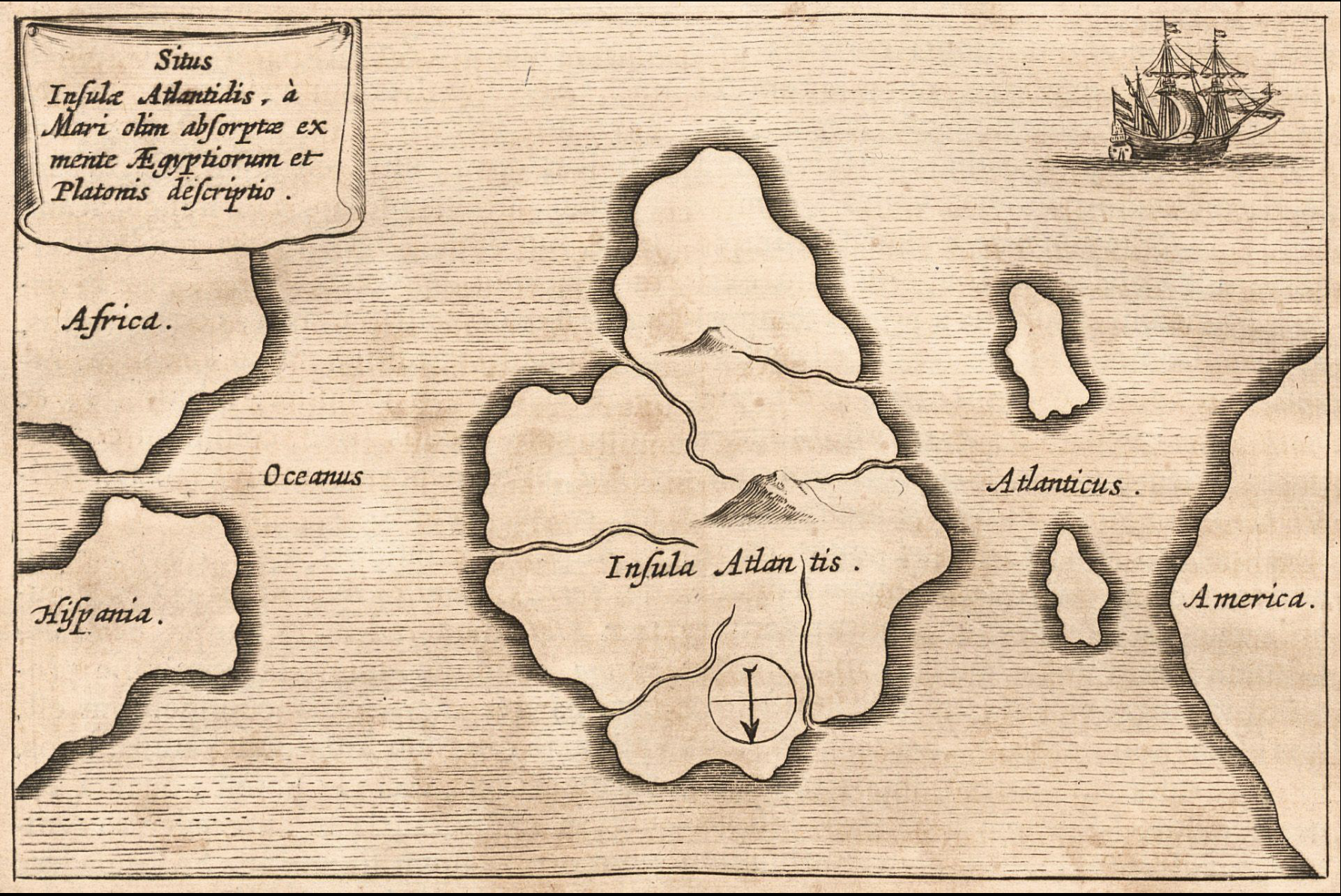
Situs Insulæ Atlantidis, à Mari olim absorptæ ex mente Ægytiorum et Platonis descriptio — "The location of the island of Atlantis, swallowed by the sea, from the account of the Egyptians and Plato." Map by Athanasius Kircher, published in Mundus Subterraneus, 1665. Note that Kircher placed south at the top — Africa is upper left, the Americas upper right, and Hispania lower left. The island of Atlantis sits in the center of the Atlantic Ocean, consistent with Plato's original description.
"There occurred violent earthquakes and floods; and in a single day and night of misfortune... the island of Atlantis disappeared in the depths of the sea."
— Plato, Timaeus, c. 360 BC
Some questions refuse to disappear. For more than two thousand years, Atlantis has been the most debated geographical mystery in Western intellectual history. Philosophers, archaeologists, geologists, oceanographers, historians, and independent researchers have all attempted to resolve it — reaching conclusions as varied as the disciplines they represent.
The story originates with a single ancient writer: Plato. In two philosophical dialogues written around 360 BC, he described a powerful island civilization that had existed beyond the Strait of Gibraltar before being destroyed in a single catastrophic day and night. No earlier Greek source mentions it. No independent ancient document confirms it.
Yet Atlantis has endured as few stories in human history have. It has inspired scientific expeditions, parliamentary debates, archaeological investigations, bestselling books, Hollywood films, and centuries of serious scholarly inquiry. More than 5,000 books about Atlantis were published in the twentieth century alone.
The central question has remained constant: Was it real?
Was Atlantis a genuine civilization preserved through ancient tradition? A philosophical allegory invented by Plato to illustrate the dangers of moral decline? A distorted memory of real historical catastrophes? Or has a literary device been transformed, across centuries of retelling, into something Plato never intended?
At The UFO Times, our role is not to provide certainty where the historical record offers none. Instead, this article examines what Plato actually wrote, how historians and archaeologists have interpreted it, what alternative researchers have proposed, and what — if anything — archaeology can tell us about the world's most famous lost civilization.
Plato's Account: The Only Ancient Source
The Atlantis story begins and ends with Plato (c. 428–348 BC). No earlier Greek writer mentions it. Everything known about Atlantis — its location, its civilization, its fate — derives from two of his philosophical dialogues: Timaeus and Critias, composed around 360 BC.
In Timaeus, the story is introduced as an aside. A character named Critias recalls that his grandfather had heard the account from the Athenian statesman Solon (c. 638–558 BC), who himself had received it from Egyptian priests in the city of Sais during a visit to Egypt around 590 BC. According to Critias, the priests told Solon that Greek memory extended back only a few generations, while Egyptian records preserved knowledge of civilizations far older than anything the Greeks knew.
One such civilization was Atlantis.
Critias — a more detailed but unfinished dialogue that breaks off abruptly mid-sentence — provides the full description of the lost island. By the time Plato presents the story, it has passed through at least five generations of transmission: Egyptian priests → Solon → Dropides → Critias the Elder → Critias the Younger → Plato. Each link in this chain introduces the possibility of elaboration, distortion, or creative reshaping.
What Plato Described
Location. Atlantis lay "beyond the Pillars of Heracles" — the ancient Greek name for the Strait of Gibraltar — in a great ocean. The island was described as larger than Libya and Asia combined (by ancient Greek geographical understanding, this likely meant larger than North Africa and the Middle East together). From this base, its rulers controlled a maritime empire extending across the western Mediterranean and parts of Africa and Europe.
Origins. According to Plato, the god Poseidon fell in love with a mortal woman named Cleito and fathered five sets of twin boys with her. The eldest, Atlas, became the first king — giving both the civilization and the surrounding ocean their names. The ten kings who descended from Poseidon and Cleito ruled Atlantis jointly under an elaborate legal code inscribed on a column of orichalcum — a mysterious metal described as gleaming with red light, second in value only to gold, and no longer found in Plato's era.
The Capital City. Plato describes the Atlantean capital in architectural detail. The city was built on concentric rings of alternating land and water, connected by canals wide enough to admit large ships. The innermost island held the royal palace and a great temple dedicated to Poseidon, clad in silver, with pinnacles of gold. The outer walls were coated in bronze, tin, and orichalcum. The city was fed by an elaborate system of irrigation channels. Hot and cold springs served both private and public baths.
Military Power. The Atlantean army included 10,000 war chariots and a standing navy of 1,200 warships. The empire controlled the western Mediterranean and had extended its reach toward Egypt and the Tyrrhene Sea. It was this imperial ambition — the attempted conquest of prehistoric Athens and Egypt — that precipitated the final conflict.
Moral Decline and Catastrophe. Over generations, the divine element in the Atlanteans diminished. As they became more fully mortal, virtue gave way to greed and arrogance. Zeus, observing their corruption, gathered the gods to decide their fate. At this point, Critias breaks off — the text ends mid-sentence, and the council of the gods is never recorded. Timaeus, however, provides the conclusion: before Athens could receive its honor, the island was swallowed by the sea in a great convulsion — "in a single day and night of misfortune."
"There occurred violent earthquakes and floods; and in a single day and night of misfortune all your warlike men in a body sank into the earth, and the island of Atlantis in like manner disappeared in the depths of the sea." — Plato, Timaeus, c. 360 BC
The chronology Plato assigns is striking: Atlantis existed and was destroyed 9,000 years before Solon's visit to Egypt — placing it at approximately 9,600 BC, deep in the prehistoric period when modern archaeology places humanity in hunter-gatherer societies with no known writing, architecture, or maritime empires.
Historical Interpretations: Was Plato Writing History or Philosophy?
The scholarly debate about Atlantis is as old as the tradition itself. Plato's own student, Aristotle, reportedly concluded that his teacher invented the island to serve his philosophical argument — and destroyed it when the argument was complete. Most classical historians have reached similar conclusions.
The Allegory Argument
Within the architecture of Plato's philosophy, Atlantis serves a transparent rhetorical function. His dialogues — including the Republic — explore themes of justice, ideal governance, moral decline, and the consequences of imperial overreach. Atlantis, in this reading, is the anti-Athens: a wealthy, powerful, technologically advanced civilization brought down by its own hubris.
The absence of any earlier Greek source that mentions Atlantis is the strongest evidence for this interpretation. Herodotus wrote extensively about Egypt and its historical records. Thucydides documented early Greek history in rigorous detail. Neither mentions a civilization called Atlantis. If Egyptian priests had been preserving records of a 9,600 BC maritime empire for millennia, it is difficult to explain why Solon appears to be the only Greek to have encountered those records.
The narrative structure of the Atlantis story also fits Plato's recurring themes too neatly. A virtuous, simple Athens defeats a corrupt, wealthy empire. Divine justice punishes excess. The pattern mirrors arguments Plato makes throughout his work. To many scholars, the story reads less like received history and more like philosophical illustration.
The Real Events Argument
A competing interpretation acknowledges Plato's philosophical purposes while proposing that a historical reality underlies the story — transmitted, distorted, and eventually filtered through Plato's literary sensibility.
The most compelling candidate is the Minoan civilization.
By the second millennium BC, Minoan Crete was the dominant maritime power of the eastern Mediterranean. Minoan merchants maintained trade networks across the Aegean and into the western Mediterranean. Their palace complexes — most famously Knossos — reflected a wealthy, sophisticated, and highly organized society. They controlled important sea lanes and exerted cultural influence over neighboring civilizations for centuries.
Around 1620 BC (with some estimates ranging slightly earlier or later), the volcanic island of Thera — modern Santorini, approximately 200 kilometers north of Crete — erupted in one of the largest volcanic events of the past 10,000 years. The eruption generated massive tsunamis, deposited volcanic ash across a vast area of the eastern Mediterranean, and likely disrupted agriculture and climate across the region. The Minoan settlement at Akrotiri, preserved beneath the ash with extraordinary completeness, testifies to the civilization's sophistication at the time of the event.
The Minoans did not immediately collapse — they survived the eruption for at least 150 years. But by approximately 1450 BC, Mycenaean Greeks from the mainland had taken control of Crete. The great island civilization that had dominated the Aegean was gone.
Researchers who favor the Minoan connection argue that the memory of this catastrophe — a powerful island civilization, destroyed by geological disaster and associated with divine punishment — survived in Egyptian records and eventually reached Plato through Solon's account. In this reading, Plato may have dramatically magnified the details: moving the location outside the Pillars of Heracles, inflating the civilization's size and antiquity, and reshaping the story to serve his philosophical purposes.
The chronological discrepancy remains a significant obstacle. Plato places Atlantis at 9,600 BC; the Minoan collapse occurred around 1450 BC. Some researchers propose a scribal error — that an Egyptian hieroglyphic number was misread, and the actual timeframe should be 900 years before Solon rather than 9,000. The suggestion is plausible but unverified.
Others point to the Bronze Age Collapse (c. 1200–1150 BC) — the still-mysterious, widespread disintegration of several major eastern Mediterranean civilizations within a span of decades — as another possible source of inspiration. The cause of this collapse, which brought down the Mycenaean Greeks, the Hittites, and a dozen other cultures almost simultaneously, remains one of history's genuinely open questions.
Alternative Theories: Where Was Atlantis?
If Atlantis had a geographical reality, where was it? Over the past two centuries, researchers have proposed dozens of locations. The following represent the most seriously discussed candidates — along with the current state of evidence for each.
Santorini (Thera), Greece
The island of Santorini is, by most assessments, the strongest geographical candidate. Its volcanic caldera — a vast, circular bay formed by the collapse of the volcanic summit during the great eruption — matches a civilization that literally sank beneath the sea. The Minoan site of Akrotiri, buried and preserved under the ash, demonstrates that an advanced Bronze Age culture occupied the island before the catastrophe. The site has been called the "Pompeii of the Aegean."
The primary weakness of the Santorini theory is the same as the Minoan theory generally: the chronological gap between the Thera eruption (c. 1620 BC) and Plato's date for Atlantis (c. 9,600 BC) is approximately 8,000 years. The geographical location — inside the Pillars of Heracles, in the Aegean — also contradicts Plato's placement of Atlantis in the Atlantic Ocean.
The Azores, Portugal
The Azores archipelago, located roughly 1,500 kilometers west of Portugal in the Atlantic, has been proposed since the nineteenth century as a remnant of the sunken Atlantean continent. The logic: the islands are geologically elevated, surrounded by the mid-Atlantic Ridge, and situated in the approximate area where Plato placed Atlantis.
Modern oceanography and geology provide little support for this hypothesis. The mid-Atlantic Ridge is a divergent tectonic boundary where plates are moving apart, not the remains of a sunken landmass. No geological mechanism consistent with the known history of the region could account for a continent-sized island disappearing in a single day.
The Richat Structure, Mauritania
Also known as the "Eye of the Sahara," the Richat Structure is a circular geological formation in western Mauritania approximately 50 kilometers in diameter. Its striking concentric ring appearance — visible from space — has attracted intense popular interest, particularly since it gained viral attention online after 2018. Some researchers argue that its circular structure mirrors Plato's description of Atlantis's concentric rings of land and water, and that its Saharan location could be explained by post-glacial sea level changes.
Mainstream geology identifies the Richat Structure as a natural formation created by geological uplift and differential erosion over hundreds of millions of years. There is no evidence of impact, flooding, or artificial construction. The structure sits more than 400 meters above sea level, and no evidence of a former coastline at this location has been established. The visual resemblance to Plato's description is striking — but resemblance is not evidence.
The Bimini Road, Bahamas
In 1968, divers discovered a formation of large, flat limestone blocks arranged in a curved line off the coast of North Bimini in the Bahamas. The "Bimini Road" — also called the "Bimini Wall" — immediately attracted attention from Atlantis researchers, partly because the psychic Edgar Cayce had predicted decades earlier that evidence of Atlantis would be discovered near Bimini around 1968 or 1969.
Geological investigation has consistently concluded that the Bimini Road is beachrock — naturally occurring limestone that consolidates in layers and fractures along regular lines, creating the appearance of worked stone. Multiple independent geological surveys have supported this conclusion. No artifacts, inscriptions, or evidence of construction have been found at the site.
Antarctica
In 1958, American geographer Charles Hapgood proposed in Earth's Shifting Crust that the Earth's outer crust periodically shifts as a whole, displacing continents relative to the poles. In a subsequent book, Maps of the Ancient Sea Kings (1966), he argued that certain ancient maps — including the Piri Reis Map of 1513 — depicted Antarctica before it was covered in ice, suggesting that an advanced civilization had mapped it during a warmer period.
Hapgood's crustal displacement theory has not gained acceptance in mainstream geology, which finds no physical mechanism capable of the rapid continental shifts he described. The Piri Reis Map interpretation is contested by cartographic historians who offer more conventional explanations for its unusual features. No archaeological evidence of any kind has been found beneath the Antarctic ice sheet.
Other Proposed Locations
Dozens of additional sites have been proposed over the years, including the Caribbean, the North Sea (where a landmass called Doggerland was indeed submerged by rising seas after the last Ice Age), Indonesia (the "Sundaland" hypothesis), Ireland, Spain, Cyprus, and the Black Sea. None has produced archaeological evidence sufficient to establish a credible connection to Plato's account.
| Location Theory | Proposed By | Strengths | Problems | Status |
|---|---|---|---|---|
| Minoan Crete / Santorini | K. T. Frost (1913), A. Galanopoulos (1960s) | Real maritime civilization; volcanic catastrophe; Egyptian records | 8,000-year chronological gap; location inside the Pillars of Heracles | CREDIBLE |
| Azores / Mid-Atlantic | Ignatius Donnelly (1882) | Atlantic location matches Plato; mid-ocean elevation | No geological mechanism for continental sinking; no evidence found | SPECULATIVE |
| Richat Structure | Various online researchers (2018–present) | Circular ring appearance; West African Atlantic coast | 400m above sea level; geological formation over millions of years; no artifacts | UNSUPPORTED |
| Bimini Road | J. Manson Valentine (1968) | Caribbean location; Edgar Cayce connection; underwater formation | Geological surveys confirm natural beachrock; no artifacts or inscriptions | UNSUPPORTED |
| Antarctica | Charles Hapgood (1958), various | Southern location outside known world; geological speculation about warmer periods | Crustal displacement theory rejected by geology; no archaeological evidence | UNSUPPORTED |
Theories of Atlantis at a Glance
| Theory | Main Idea | Evidence | Current Academic View |
|---|---|---|---|
| Plato's Allegory | A moral and political lesson about hubris and divine justice, not a historical record | Plato's dialogues; no earlier source; structural parallels to his other philosophical works | Most widely accepted |
| Minoan Civilization | Memory of the Thera eruption and Minoan collapse, transmitted through Egyptian records to Plato | Confirmed Bronze Age maritime civilization; real volcanic catastrophe; Egyptian historical records | Plausible historical influence |
| Literal Atlantic Empire | Plato's account is essentially accurate — a real civilization in the Atlantic, now sunk | Plato's geographic description; various proposed sites (Azores, Bimini, Richat Structure) | Not accepted; no confirmed site |
| Pre-Ice Age Lost Civilization | Atlantis preserves memory of an advanced human civilization destroyed in the Younger Dryas impact event (c. 10,900 BC) | Chronological match with Plato's date; growing support for Younger Dryas impact hypothesis; Göbekli Tepe | Speculative; actively debated |
| Ancient Astronaut Theory | Atlantis preserved advanced technology from extraterrestrial contact; its destruction scattered this knowledge across ancient cultures | Interpretive arguments; cultural parallels between separated civilizations; von Däniken, Cayce | Not accepted; no physical evidence |
Atlantis and the Ancient Astronaut Theory
The modern popular conception of Atlantis owes more to nineteenth- and twentieth-century writers than to Plato himself. Understanding how Atlantis was transformed from a philosophical dialogue into a cornerstone of alternative history requires tracing that evolution.
Ignatius Donnelly and the Birth of Modern Atlantology
The pivotal figure is Ignatius Donnelly (1831–1901), a Minnesota congressman and amateur scholar whose 1882 book Atlantis: The Antediluvian World launched the modern Atlantis industry. Donnelly argued that Atlantis had been a literal civilization in the Atlantic Ocean, the common origin of all ancient cultures on both sides of the Atlantic, and the source of myths about a global flood preserved across the world's religions. His book was a bestseller and was reprinted more than fifty times.
Donnelly's Atlantis was not extraterrestrial — it was a superior human civilization — but he established the template that later writers would use: Atlantis as a lost cradle of advanced knowledge, explaining the similarities between ancient cultures that mainstream archaeology cannot otherwise account for.
Edgar Cayce and Psychic Archaeology
American psychic Edgar Cayce (1877–1945) delivered hundreds of "life readings" in which he described Atlantis in detail — claiming it had been a highly advanced civilization possessing crystal-based energy technology, culminating in three catastrophic destructions over thousands of years. Cayce predicted that evidence of Atlantis would emerge near Bimini around 1968 or 1969. The discovery of the Bimini Road in 1968 was taken by many followers as confirmation.
No verifiable archaeological evidence has supported Cayce's Atlantean claims. His readings are not subject to historical or scientific verification and belong to a different category of evidence than documentary or archaeological sources.
Erich von Däniken and the Extraterrestrial Reading
In Chariots of the Gods? (1968), Swiss author Erich von Däniken connected Atlantis to his broader argument that advanced extraterrestrial beings had visited and assisted ancient humans — the core claim of the ancient astronaut theory. In his framework, Atlantis may have preserved technological knowledge originally transmitted by extraterrestrial contact — and its destruction scattered that knowledge across ancient civilizations, explaining the cultural parallels between Egypt, Mesoamerica, and other separated civilizations.
Von Däniken's arguments are interpretation, not evidence. No physical artifact, text, or geological data has been produced to support the extraterrestrial connection specifically. His work remains important as cultural history — it shaped how millions of people think about ancient civilizations — but it does not constitute historical or archaeological evidence.
Graham Hancock and the Lost Civilization Thesis
British journalist Graham Hancock has offered a more carefully argued version of the lost civilization thesis. In Fingerprints of the Gods (1995) and Magicians of the Gods (2015), Hancock argues that a sophisticated human civilization existed during the last Ice Age and was destroyed by the cosmic catastrophe known as the Younger Dryas impact event (c. 10,900 BC) — a period of abrupt cooling associated by some researchers with a comet or asteroid impact over the North American ice sheet.
Hancock does not claim extraterrestrial involvement. His "lost civilization" is human — an advanced culture whose knowledge was preserved and transmitted to later civilizations by survivors. He connects Atlantis to this thesis, arguing that Plato's chronology (9,600 BC) is broadly consistent with the Younger Dryas event.
Mainstream archaeology does not accept this framework as established. However, the Younger Dryas impact hypothesis has gained increasing geological support, and the existence of pre-12,000 BC cultural sophistication — most dramatically demonstrated by Göbekli Tepe in Turkey — has required mainstream archaeologists to revise upward their understanding of human capabilities in the deep prehistoric period.
Hancock's work occupies a different intellectual category from von Däniken's: it engages with peer-reviewed science and is responsive to new archaeological discoveries. Readers interested in this approach should understand that it remains disputed and has not been adopted by mainstream archaeology — but it is not scientifically illiterate.
What Does Archaeology Say Today?
No site has been confirmed as Plato's Atlantis. This is the most important sentence in this article. After 2,400 years of investigation — by scholars, explorers, archaeologists, oceanographers, and independent researchers — no physical evidence of the civilization Plato described has been identified.
The mainstream archaeological consensus holds that Atlantis is either a philosophical allegory or a narrative inspired by real historical events. Most classical scholars incline toward the former; some historians of the ancient world find the latter more plausible. Both positions are intellectually defensible.
What archaeology has definitively established is that the ancient world was more sophisticated than previously believed. Göbekli Tepe in Turkey — built approximately 12,000 years ago by hunter-gatherers — demonstrates organized monumental construction thousands of years before any previously recognized civilization. The Bronze Age Mediterranean world that Plato may have drawn upon includes the Minoans, the Mycenaean Greeks, the Egyptians, and a dozen other cultures whose complexity and interconnection continues to be revealed by ongoing excavation.
The argument that Atlantis must have existed because ancient civilizations built similar things — pyramids in Egypt and Mesoamerica, for example — rests on an increasingly outdated premise. Modern archaeology has documented the independent development of similar architectural solutions in separate cultures, driven by the practical challenges of monumental construction and the similar materials available. Cultural diffusion from a common source is not required to explain architectural parallels.
The absence of confirmed evidence does not make the mystery uninteresting. It makes the genuine questions more visible: What did Plato know, and from what sources? What events in Bronze Age history might have given rise to the account he received? What does it tell us about how oral tradition and cultural memory function across generations?
These are real historical questions. They do not require Atlantis to have been a literal civilization in order to be worth investigating.
Although no archaeological discovery has conclusively identified Atlantis, the legend continues to inspire legitimate historical inquiry alongside speculative interpretations, ensuring its place as one of history's most enduring mysteries.
The UFO Times Assessment
| Category | Rating | Editorial Note |
|---|---|---|
| Historical Evidence | ★★☆☆☆ | A single ancient source — Plato's dialogues — with no independent ancient corroboration. The transmission chain spans five generations before reaching Plato. |
| Archaeological Support | ★☆☆☆☆ | No confirmed site. The Minoan-Santorini connection is the most plausible historical candidate, but it does not match Plato's chronology or geography. |
| Scientific Consensus | ★☆☆☆☆ | Mainstream archaeology and classical scholarship regard Atlantis as allegory or mythology. No geological evidence supports a continent-sized landmass sinking in the Atlantic. |
| Cultural Influence | ★★★★★ | Unrivaled. Atlantis has shaped Western literature, philosophy, archaeology, and popular culture for more than two millennia. Its influence is independent of its historicity. |
| Historical Significance | ★★★★★ | As a cultural artifact and philosophical text, Plato's Atlantis dialogues are among the most consequential works in Western intellectual history — regardless of whether the island existed. |
Editorial Perspective
Whether Atlantis was a real civilization, a philosophical allegory, or a distorted echo of Bronze Age catastrophe, its influence on human imagination is beyond dispute. More than two millennia after Plato first described the lost island, Atlantis continues to inspire scientific investigation, historical debate, and serious inquiry across multiple disciplines.
The UFO Times does not advocate for any particular theory of Atlantis. We observe that the evidence for a literal sunken continent remains absent; that the allegorical interpretation is the most academically defensible; and that the Minoan connection represents the most historically grounded alternative. We also observe that the ancient world continues to surprise archaeologists — that Göbekli Tepe exists at all is a reminder that the limits of human knowledge about the prehistoric past are not where we assumed they were.
Our role is not to determine what readers should believe. It is to separate established history from evolving hypotheses, and to present the evidence — such as it is — honestly. In the case of Atlantis, the honest answer remains: we do not know. And that, in itself, is worth knowing.
— The UFO Times Editorial Desk
UFO Times Evidence Assessment
- ESTABLISHED Plato described Atlantis in Timaeus and Critias around 360 BC. These are the only surviving ancient sources. No earlier Greek or Egyptian text independently confirms the account.
- ESTABLISHED No site has been confirmed as Plato's Atlantis after 2,400 years of investigation. The absence of evidence, in this case, is a relevant data point.
- CREDIBLE The Minoan civilization and the Thera eruption represent a real historical catastrophe that may have inspired elements of the Atlantis story, preserved through Egyptian records and transmitted to Plato via Solon.
- CREDIBLE The allegorical interpretation — that Plato constructed Atlantis to serve a philosophical argument — is the most widely accepted scholarly position and is internally consistent with his other work.
- SPECULATIVE That Atlantis represents a pre-Ice Age civilization destroyed in the Younger Dryas impact event. Chronologically consistent with Plato's dates, and the Younger Dryas impact hypothesis has growing geological support — but no Atlantean artifacts or sites have been linked to this period.
- UNSUPPORTED Any claim connecting Atlantis to extraterrestrial contact or advanced non-human technology. No physical evidence supports this interpretation.
- UNSUPPORTED The Richat Structure, Bimini Road, Azores, or Antarctica as confirmed Atlantis locations. Each has been investigated; none has produced evidence consistent with Plato's description.
Frequently Asked Questions
Was Atlantis real?
No confirmed physical evidence of Atlantis has ever been found. The mainstream scholarly consensus is that Atlantis was either a philosophical allegory invented by Plato or a narrative inspired by real historical events — most plausibly the Minoan civilization and the Thera volcanic eruption. Whether Plato intended the story as fact or philosophy cannot be determined with certainty from the surviving texts.
Who first wrote about Atlantis?
Plato is the only ancient source. The story appears in two of his dialogues — Timaeus and the unfinished Critias — written around 360 BC. No earlier Greek, Egyptian, or other ancient text independently mentions Atlantis.
Where was Atlantis located?
According to Plato, Atlantis lay "beyond the Pillars of Heracles" — the Strait of Gibraltar — in the Atlantic Ocean. Over the centuries, dozens of specific locations have been proposed, including the Azores, the Bahamas, the Canary Islands, Santorini, Mauritania, Antarctica, and many others. None has been confirmed. The Minoan civilization on Crete and the island of Santorini represent the most historically grounded candidates, though they are located inside the Mediterranean — not outside it as Plato specified.
When was Atlantis destroyed?
Plato places the destruction of Atlantis 9,000 years before the visit of the Athenian statesman Solon to Egypt — approximately 9,600 BC. This date falls in the prehistoric period, long before any civilization previously recognized by archaeology. Some researchers propose this number resulted from a scribal error, and the original figure may have been 900 years rather than 9,000.
Is the Richat Structure (Eye of the Sahara) really Atlantis?
No. The Richat Structure in Mauritania is a well-studied geological formation created by uplift and erosion over hundreds of millions of years. It sits more than 400 meters above sea level. Mainstream geology finds no evidence of a former coastline, flooding, or artificial construction at the site. Its visual resemblance to Plato's description of concentric rings is noted — but visual resemblance is not archaeological evidence.
What is the Minoan theory of Atlantis?
The Minoan theory proposes that the Atlantis story was inspired by the real Bronze Age collapse of the Minoan civilization — a sophisticated maritime power based on Crete — following the catastrophic eruption of the volcanic island of Thera (modern Santorini) around 1620 BC. The theory was first formally proposed by archaeologist K. T. Frost in 1913 and remains the most historically credible alternative to the pure allegory interpretation. The primary weakness is the chronological discrepancy: Plato dates Atlantis to 9,600 BC, not 1620 BC.
Did Aristotle believe Atlantis was real?
According to later sources, Plato's student Aristotle did not believe Atlantis was a real place. He reportedly observed that Plato invented the island to serve his philosophical argument and destroyed it when the argument was finished. The original text of Aristotle's comment has not survived; it is known only through later references. Aristotle's view has historically been the dominant one among classical scholars.
Related Investigations
Recommended Reading
Timaeus and Critias — Plato (c. 360 BC, Penguin Classics edition)
The only surviving ancient source on Atlantis. Every theory, every interpretation, every claim about the lost civilization traces back to these two dialogues. Essential reading before any secondary source — the text is shorter and more nuanced than most accounts of it suggest.
View on Amazon →Atlantis: The Antediluvian World — Ignatius Donnelly (1882)
The 1882 bestseller that created the modern conception of Atlantis as a literal lost civilization. Written by a U.S. Congressman, this book launched a century of serious investigation and far more speculation. Scientifically outdated, but essential for understanding how Atlantis became what it is in popular culture. A historical document as much as an argument.
View on Amazon →Frauds, Myths, and Mysteries: Science and Pseudoscience in Archaeology — Kenneth Feder
The most rigorous and readable academic assessment of Atlantis and comparable archaeological mysteries. Feder applies consistent scientific method to distinguish verifiable historical claims from speculation. Essential for any reader who wants to understand how archaeologists actually evaluate the evidence — and why the evidence for Atlantis fails to meet the standard.
View on Amazon →Ancient Mysteries — Coming Next
The Ancient Mysteries Section
Atlantis is the first of a planned series of deep investigations into history's most enduring mysteries. Coming next: the Book of Enoch, Ezekiel's Vision, Father Carlo Crespi and the Golden Plates, the Vedas, and the Epic of Atrahasis. All available in the Ancient Mysteries section.
Explore Ancient Mysteries →