
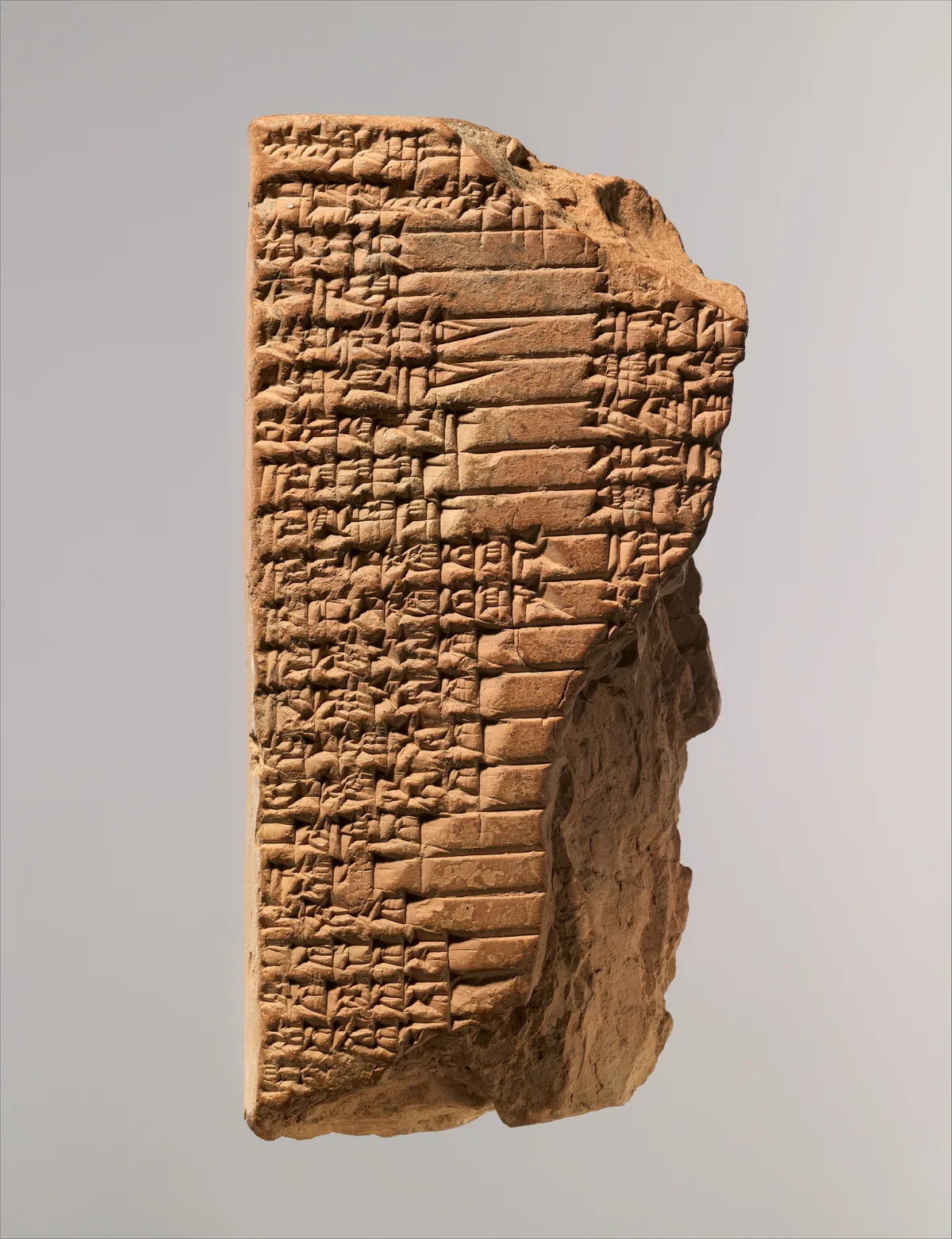
Old Babylonian cuneiform tablet containing a hymn to the mother goddess Aruru — the deity who shapes human beings from clay in Mesopotamian creation narratives closely related to the Atrahasis tradition. Metropolitan Museum of Art Open Access. CC0 Public Domain.
■ Evidence Status
Confirmed
The Atrahasis Epic is an Old Babylonian Akkadian composition. The best-preserved version dates to approximately 1700 BCE. Tablets in the British Museum are well-documented.
Confirmed
The flood episode from Atrahasis was incorporated, in adapted form, into Tablet XI of the Standard Babylonian Gilgamesh Epic.
Disputed
Whether the Genesis flood account derives directly from Atrahasis, or whether both draw on a shared earlier tradition. Scholars continue to debate the precise literary relationship.
Not Established
That Atrahasis is definitively the oldest flood story. Earlier Sumerian compositions referencing a flood (the Eridu Genesis) exist, and oral traditions may predate all written records.
Not Established
That the creation episode describes genetic engineering, extraterrestrial intervention, or any biological process recognizable by modern science. The Akkadian vocabulary does not support this reading.
“Wall, listen to me! Reed fence, pay attention to all my words! Tear down the house, build a boat — abandon riches, seek survival. Spurn property, save life. Take on board the boat the seed of all living things.”
— Atrahasis III.i.20–27 (Stephanie Dalley translation, Myths from Mesopotamia, 1989)
A god speaks to a wall. The wall — or rather the man on the other side of it — listens. He tears down his house, builds a boat, takes aboard the seed of all living creatures, and survives the flood that his god's rivals have sent to silence a noisy world.
This is the core of the Epic of Atrahasis, an Old Babylonian Akkadian composition that scholars date, in its best-preserved form, to approximately 1700 BCE. It is one of the most significant surviving texts from ancient Mesopotamia: not because it is supernatural, but because it is old, complete enough to read, and structurally parallel to one of the world’s most recognized narratives — the biblical flood.
The Atrahasis Epic is frequently described in popular writing as the “original” version of Noah’s Ark, a Sumerian text, or proof that the Bible copied Mesopotamian mythology. All three of these framings require correction. The best-preserved version of Atrahasis is Akkadian, not Sumerian. Whether Genesis drew directly from it or both derive from a common tradition is a matter of ongoing scholarly debate. And the question of what the text says versus what it has been claimed to say is, as with most ancient documents, more interesting than the headlines suggest.
At The UFO Times, the standard is clear: Facts First. Mystery Second. Speculation Last. This article examines what the Atrahasis Epic actually says, what the scholarship concludes, where genuine uncertainty remains, and — at the appropriate moment — what speculative interpreters have claimed about it.
What Is the Epic of Atrahasis?
The Atrahasis Epic is a narrative poem composed in the Akkadian language — a Semitic language spoken in ancient Babylonia and Assyria, distinct from Sumerian, the earlier language of southern Mesopotamia. The name of the epic derives from its flood hero: Atrahasis, an Akkadian epithet meaning “exceedingly wise” or “surpassingly wise.”
The text survives across three main tablets, each addressing a distinct phase of the narrative. The best-preserved version, housed primarily in the British Museum, was written by a scribe named Nur-Aya in the reign of King Ammi-saduqa of Babylon — the tenth ruler of the First Babylonian Dynasty, who ruled approximately 1646–1626 BCE. This gives the surviving text a firm terminus post quem, though the composition itself is believed to be older, drawing on earlier oral and written traditions that may reach back to the third millennium BCE.
The definitive critical edition of the Atrahasis text was published in 1969 by Assyriologists W. G. Lambert and A. R. Millard, whose work remains foundational. Stephanie Dalley’s translation in Myths from Mesopotamia (1989, Oxford University Press) brought the text to a broader English-speaking readership and remains one of the most accessible scholarly translations available.
■ Atrahasis Narrative Sequence — Summary
Step 1
Divine Labor
The Igigi dig canals and perform all agricultural work for the greater gods
Step 2
Igigi Rebellion
After generations of labor the lesser gods burn their tools and revolt
Step 3
Human Creation
Enki and Mami create humans from clay and a slain god’s blood to assume the labor
Step 4
Population & Noise
Humanity multiplies; their clamor prevents Enlil from sleeping
Step 5
Plague, Drought & Famine
Enlil sends successive catastrophes; Enki covertly helps Atrahasis deflect each one
Step 6
The Flood
Enlil decrees a flood; Enki warns Atrahasis via a reed wall; Atrahasis builds a boat and survives
Step 7
Post-Flood Controls
The gods institute permanent population limits: barrenness, infant mortality, priestess celibacy
Narrative summary of the Epic of Atrahasis — Tablets I, II, and III. Original graphic by The UFO Times.
| Tablet | Primary Subject | Preservation |
|---|---|---|
| Tablet I | The rebellion of the lesser gods (Igigi) and the creation of humanity to relieve their labor | Substantial portions preserved; some gaps |
| Tablet II | Human overpopulation; Enlil’s successive plagues (epidemic, drought, famine) to reduce human numbers | Significantly damaged; reconstructed with difficulty |
| Tablet III | The flood decision; Enki’s warning to Atrahasis; the building of the boat; the flood; its aftermath | Best preserved of the three tablets |
Additional Atrahasis fragments have been identified in libraries at Nippur, Sippar, and Ugarit, and a shorter version was found at the Hittite capital of Hattusa — indicating that the narrative circulated widely across the ancient Near East in both Akkadian and translated forms.
■ Geographic Reference
Schematic geographic reference — ancient Mesopotamia, 2nd millennium BCE. Cities in orange are named in the surviving Atrahasis tablets or in directly related textual sources. Rivers, coastline, and positions are approximate. Original map by The UFO Times.
Timeline: The Atrahasis Tradition Through History
c. 2600–2100 BCE
Earlier Sumerian flood traditions. Flood narratives, including references to a survivor named Ziusudra, circulate in Sumerian-language texts from cities including Nippur and Shuruppak. The extent to which these constitute direct precursors to the Akkadian Atrahasis remains a subject of scholarly discussion.
c. 1700 BCE
Best-preserved Atrahasis version composed. The Old Babylonian Akkadian text, copied by the scribe Nur-Aya, records the three-tablet epic in its most complete surviving form. This is the primary text used by modern scholarship.
c. 1300–700 BCE
Atrahasis flood episode integrated into Gilgamesh. The Standard Babylonian version of the Gilgamesh Epic adapts the Atrahasis flood narrative for Tablet XI, placing it in the mouth of Utnapishtim — the Babylonian version of the flood hero. This is one of the best-documented cases of literary borrowing in the ancient world.
c. 10th–5th Century BCE
Hebrew Bible flood narrative written down. The Genesis account, drawing on sources including the Yahwist (J) and Priestly (P) traditions, reaches a form close to what is read today. The degree to which Israelite scribes had access to Mesopotamian literary traditions remains debated among biblical scholars.
1872
George Smith publishes the Gilgamesh flood tablet. The British Museum scholar presents his translation of the flood episode from the Gilgamesh Epic to the Society of Biblical Archaeology in London, causing an international sensation — the first public recognition that a flood narrative predating Genesis had survived on cuneiform tablets.
1969
Lambert and Millard publish the definitive critical edition. W. G. Lambert and A. R. Millard’s Atra-hasis: The Babylonian Story of the Flood (Oxford University Press) establishes the scholarly foundation for all subsequent study of the text.
1989 — Present
Dalley translation and continued scholarship. Stephanie Dalley’s Myths from Mesopotamia makes the text widely accessible. Subsequent decades see continued fragment identification, reassessment of the text’s relationship to Genesis, and — in parallel — increasing speculative reinterpretation in ancient-alien and fringe literature.
The Deity Guide: Eight Key Figures
The Atrahasis Epic moves across a large divine cast. Understanding who the gods are and what they represent clarifies a narrative that can otherwise seem confusing on first reading.
Anu
Sky God — King of the Gods
The supreme deity of the Babylonian pantheon, associated with the heavens. In the Atrahasis Epic, Anu holds authority over the divine assembly but is often characterized as somewhat remote from the narrative’s central conflict. His name is the first word of the epic: “When the gods were man…” (the Akkadian word for “god” is il, and Anu is the prototype of divine authority).
Enlil
Lord of Wind and Earth — The Antagonist
Enlil is the functional antagonist of the Atrahasis narrative. He is the one who cannot sleep because of the noise humans make, who orders the successive plagues, and who ultimately demands the flood. He is not a villain in the text’s own terms — he is a god with legitimate authority who finds the situation intolerable — but his role drives the catastrophic action of the story.
Enki / Ea
God of Wisdom and Water — The Protector
Enki (Sumerian) or Ea (Akkadian) is the god of wisdom, subterranean waters, and magic. He co-creates humanity with Mami and is the deity who covertly warns Atrahasis of the coming flood. His method — speaking to a reed wall rather than directly to Atrahasis — allows him to maintain technical compliance with the divine oath not to warn humans, while still ensuring his favorite’s survival. Enki is the most complex figure in the epic.
Mami / Nintu / Belet-ili
Mother Goddess — Creator of Humanity
The mother goddess appears under several names in the epic and in related traditions: Mami, Nintu (“Lady of Birth”), and Belet-ili (“Lady of the Gods”). She is the divine midwife who pinches off fourteen pieces of clay and, working together with Enki, produces the first fourteen humans — seven male and seven female. Her role in the creation narrative is central and her later anguish over the flood is one of the text’s most emotionally resonant passages.
The Igigi
Lesser Gods — The Laborers Who Rebelled
The Igigi are the lesser class of gods who, before the creation of humans, were required to dig the great irrigation canals of Mesopotamia — back-breaking divine labor in service of the greater gods. After forty years (or, in some readings, 3,600 years — the Akkadian text uses a large round number whose exact meaning is uncertain), they revolt. It is this rebellion that prompts the creation of humanity as a labor substitute.
The Anunnaki
Greater Gods — The Divine Assembly
The Anunnaki are the greater gods of the Babylonian pantheon, the senior divine council whose decisions shape cosmic events. In the Atrahasis Epic, they hold the assembly that decides to create humanity and later the assembly that decides upon the flood. The term is often misused in popular writing as if the Anunnaki were a distinct alien species; within the text, they are simply the upper tier of the divine hierarchy.
We-ila / Geshtu-e
The Sacrificed God — Divine Ingredient
We-ila (sometimes identified with Geshtu-e in parallel texts) is the god chosen by divine lot and slain so that his blood and flesh can be mixed into the clay from which humans are formed. The Akkadian text specifies that the god’s temu (spirit, understanding) is transmitted through this blood, which is the mechanism by which humans share in divine intelligence. This is a theological statement about human nature, not a description of biology.
Atrahasis
The Flood Hero — “Exceedingly Wise”
The human protagonist of the epic, whose name functions as an epithet: atra-hasis, “exceedingly wise.” He is a devotee of Enki and is selected to survive the flood because of his wisdom and his pious relationship with that deity. He appears in Sumerian tradition as Ziusudra and in the later Babylonian Gilgamesh Epic as Utnapishtim, where he has already achieved immortality by the time Gilgamesh finds him.
Tablet I: The Creation of Humanity
The epic opens with a description of the world before human beings existed. The greater gods — the Anunnaki — imposed all the labor of the universe on the lesser gods, the Igigi: the digging of rivers, the maintenance of canals, the clearing of silt, the work that made the agricultural civilization of Mesopotamia possible. The text is explicit: this was hard, unrelenting work.
■ Primary Source
“The gods had to dig out canals, had to clear channels, the lifelines of the land, the Igigi had to dig out canals, had to clear channels, the lifelines of the land. The gods dug the Tigris river and then dug the Euphrates.”
— Atrahasis I.i.18–22 (Stephanie Dalley translation)
After an indefinite period of this labor — the text uses large round numbers that scholars read as indicating a very long time — the Igigi rebelled. They burned their tools, surrounded the palace of Enlil, and demanded relief. Enlil, startled and frightened, convened the divine assembly. The solution proposed by Enki and endorsed by the assembly was the creation of a new being: a lullû, a human being, who would take over the labor.
What followed is the creation episode that has generated the most speculation in modern popular literature. Enki and the mother goddess Mami designed the process: a god — We-ila, chosen by lot — was slain. His flesh and blood were mixed with clay. Mami pinched off fourteen pieces of this mixture and placed seven on each side of her; from them emerged seven males and seven females, the first human beings.
■ Primary Source
“She pinched off fourteen pieces of clay, and set seven pieces on the right, seven on the left. Between them she put down a mud brick. She made use of a reed, opened it to cut the umbilical cord, called up the wise and knowledgeable birth-goddesses.”
— Atrahasis I.iv (Stephanie Dalley translation)
Several things are worth noting precisely here. The Akkadian text does not contain any terminology that translates to laboratory procedure, DNA, genetic modification, or anything analogous to modern biological science. The vocabulary is that of clay-working and divine birth-attendance, consistent with the broader Mesopotamian tradition of humans as clay-creatures shaped by divine hands. The god’s temu — spirit or understanding — is transmitted through the blood, which explains why humans possess intelligence and the capacity for rational thought: they carry a divine element within them. This is a sophisticated theological statement about human nature and dignity. It is not a description of genetic engineering, and modern scholars do not read it as such.
The newly created humans were put to work. They assumed the canal-digging and agricultural labor that had exhausted the Igigi. For a time, the arrangement worked.
Tablet II: Noise and the Plagues
Tablet II is the most damaged of the three surviving tablets, and several passages must be reconstructed with significant uncertainty. What survives, however, reveals a narrative logic unlike anything in Genesis — and this difference is crucial for understanding what makes the Atrahasis Epic distinctive.
Humanity multiplied. The text is unambiguous about why this became a problem: rigmu and huburu — noise, clamor, the sound of human activity. Enlil could not sleep. The population had grown so large that the earth rang with their noise, and Enlil found it intolerable. His response was not moral outrage at human wickedness (the Genesis framing) but something closer to irritation at unmanageable overpopulation.
Enlil’s first response was epidemic disease, sent through the god Namtar. The strategy was interrupted by Atrahasis, acting on Enki’s advice: he organized a religious embargo, directing humanity to stop worshipping all the gods except Namtar, thereby forcing that deity to feel sympathy and withdraw the plague. The same cycle repeated twice more, with drought and famine standing in for disease in the subsequent episodes.
Each time, Enki found a way to advise Atrahasis and undermine Enlil’s plan. This pattern of divine maneuvering — Enlil deciding, Enki circumventing, Atrahasis surviving — is one of the epic’s most consistent structural features and helps explain the eventual decision to use a flood: a catastrophe that Enki would presumably be unable to deflect.
The noise motif, absent from Genesis but central to Atrahasis, is one of the strongest indicators that the two texts reflect related but distinct narrative traditions rather than one being a simple copy of the other.
Tablet III: The Flood
Tablet III is the best-preserved section of the epic and the most studied. Its parallels with the Gilgamesh flood episode, which scholars believe derives from it, are extensive and precise.
Enlil convened the divine assembly and imposed an oath of secrecy: no god was to warn the humans of what was coming. Enki complied with the letter of this oath while violating its spirit. He did not speak to Atrahasis. He spoke to the reed wall of Atrahasis’s house.
■ Primary Source
“Wall, listen to me! Reed fence, pay attention to all my words! Tear down the house, build a boat — abandon riches, seek survival. Spurn property, save life. Take on board the boat the seed of all living things.”
— Atrahasis III.i.20–27 (Stephanie Dalley translation)
The legal fiction is sophisticated: Enki has not told a human being anything. He has told a wall. If Atrahasis happened to be on the other side of that wall and heard what was said — that was not Enki’s doing. This kind of technical compliance-while-subverting-intent characterizes Enki throughout Mesopotamian literature and is one of the reasons he is the most intellectually interesting deity in the Babylonian pantheon.
Atrahasis followed the instructions. He dismantled his house to provide timber, built a boat of specified dimensions, called his family aboard, and loaded it with animals. The flood came. The text’s description of the flood itself is among its most vivid passages: the sky darkened, the storm raged, and the waters rose until even the gods were frightened by what they had sanctioned.
The mother goddess Mami’s lament during the flood is one of the most emotionally distinctive passages in ancient Near Eastern literature:
■ Primary Source
“How could I, in the assembly of the gods, command such destruction? Enlil was just strong enough to give the order for the annihilation of my people. But I am their mother. Like a fish, the sea fills my eyes with tears.”
— Atrahasis III.iii (Stephanie Dalley translation, reconstructed passage)
After seven days, the storm subsided. Atrahasis opened a hatch, looked out, and made offerings of sacrifice. The gods — who had been deprived of the food offerings that humans had provided — gathered around the sacrifice “like flies.” Enlil was furious when he discovered that someone had survived, but the aftermath of the Atrahasis flood differs strikingly from both Gilgamesh and Genesis in one critical respect: rather than simply promising never to do it again, the gods instituted a set of population controls.
Among the measures established after the Atrahasis flood: certain categories of women would henceforth be barren, celibacy requirements would be imposed on certain classes of priestesses, and infant mortality would be maintained as a natural brake on population growth. The flood resolved the overpopulation problem not just by reducing numbers but by establishing permanent mechanisms to prevent the problem from recurring.
This ending — bureaucratic, almost administrative in its logic — has no parallel in Genesis. It is one of the strongest arguments that the two texts, however similar in structure, operate within different theological frameworks.
Comparison: Atrahasis, Gilgamesh, and Genesis
The following table summarizes the most significant structural parallels and divergences across the three traditions. It is intended as a reading aid, not as an argument for direct literary dependence in any particular direction.
| Element | Atrahasis (c. 1700 BCE) | Gilgamesh XI (c. 1000 BCE) | Genesis 6–9 |
|---|---|---|---|
| Flood hero | Atrahasis (“exceedingly wise”) | Utnapishtim | Noah |
| Reason for flood | Human noise and overpopulation disturb Enlil | Noise (following Atrahasis tradition); vaguely stated | Human wickedness and violence; God’s moral judgment |
| Who warns the hero | Enki, by speaking to a reed wall (legal fiction) | Ea (same god), by speaking to a reed hut | God directly commands Noah |
| Instructions | Tear down house, build boat, take seed of all living things | Tear down house, build ship, take possessions and “seed of all living creatures” | Build an ark of specified dimensions; take family and animals in pairs |
| Flood duration | Seven days and seven nights | Six days and seven nights (storm); boat rests on seventh day | 40 days (rain); 150 days (waters prevail); over a year total |
| Post-flood sacrifice | Atrahasis makes offerings; gods gather “like flies” | Utnapishtim makes offerings; gods gather “like flies” (near-identical phrasing) | Noah makes burnt offerings; God smells the pleasing aroma |
| Divine response after flood | Gods institute permanent population controls (barrenness, infant mortality, celibacy) | Gods grant Utnapishtim and wife immortality; new divine arrangement | God blesses Noah, commands multiplying; rainbow covenant; never again |
| Boat landing location | Not specified in surviving text | Mount Nimush (Nisir) | Mount Ararat |
The most striking literary correspondence is between Atrahasis and Gilgamesh XI: the image of the gods gathering around the sacrifice “like flies” is virtually identical in both texts, strongly indicating direct literary borrowing rather than coincidental parallel. The relationship between the Mesopotamian tradition and Genesis is more complex and remains actively debated in biblical scholarship.
What the Text Says — and What It Does Not
What the Text Says
- Humans were created to relieve the gods of labor
- Human creation involved clay mixed with the blood of a slain god
- The mother goddess shaped the first fourteen humans
- Enlil sent plagues because human noise prevented him from sleeping
- Enki warned Atrahasis through a technical fiction (speaking to a wall)
- Atrahasis built a boat and took “the seed of all living things”
- The gods were frightened by the flood they had created
- Population controls were instituted after the flood to prevent recurrence
What the Text Does Not Say
- That the gods were extraterrestrials from another planet
- That human creation involved genetic engineering or DNA modification
- That the Anunnaki were a separate alien species distinct from “regular” gods
- That it is definitively the oldest flood story — earlier traditions may exist
- That the flood was global in a geological sense
- That Atrahasis is a Sumerian text (it is an Akkadian Old Babylonian composition)
- That the Bible “copied” Atrahasis in a straightforward or direct way
The Ancient Astronaut Interpretation
The following section presents the speculative interpretation associated with Ancient Astronaut Theory. It is presented as a distinct interpretive framework, not as established historical or scientific fact. Mainstream Assyriology does not support these readings.
The Atrahasis Epic occupies a central position in Ancient Astronaut Theory, particularly in the work of Zecharia Sitchin and the tradition of writers who have followed him. The core argument runs roughly as follows: the Anunnaki described in the text were not mythological divine beings but physical extraterrestrials from a planet in our solar system (Sitchin called it Nibiru) who came to Earth in search of resources, initially used the lesser gods (Igigi) as laborers, and then — when those rebelled — created homo sapiens through a process of genetic engineering, mixing their own DNA with that of early hominids.
In this framework, the “slain god whose blood is mixed with clay” becomes a metaphor for genetic material; the mother goddess’s “pinching off of clay” becomes a description of embryo creation in test tubes; and the human capacity for rational thought becomes evidence of an artificially accelerated evolutionary leap engineered by an alien civilization. The flood, in this reading, was sent because the Anunnaki wanted to eliminate a workforce that had grown too numerous and too restless.
This interpretation has several well-documented problems from the perspective of Akkadian scholarship. First, the vocabulary of the text — clay (titu), blood (dam), flesh (shêr), pinching (qatâpu) — is standard Akkadian mythological vocabulary with no scientific register whatsoever. Sitchin’s translations, which reinterpret these terms as biological processes, are not accepted by professional Assyriologists; scholars including Michael Heiser and Thorkild Jacobsen have documented specific errors in his readings of the Akkadian and Sumerian texts. Second, the Anunnaki are not described anywhere in the cuneiform record as arriving from another planet; they are indigenous to the Mesopotamian divine world, with established genealogies, temples, and cult centers. Third, the “labor” the Igigi perform is explicitly agricultural and hydraulic in the text — digging canals, clearing waterways — not mining operations on a foreign planet, as Sitchin claimed.
That said, it is worth acknowledging what makes the Atrahasis Epic genuinely puzzling to modern readers and why speculative interpretations continue to find an audience. The text describes gods who physically tire, who need sleep, who are frightened by their own weapons, who argue, negotiate, and make mistakes. These are not the omnipotent, transcendent divine figures of later theological traditions. They are powerful but limited beings who operate within a universe of competing interests. Whether that is evidence of extraterrestrial visitors, a reflection of ancient Mesopotamian polytheism’s fundamentally different conception of divinity, or a literary device for exploring questions of power and moral responsibility — is a question readers can explore for themselves, with the text in hand.
The UFO Times Assessment
The Epic of Atrahasis is a genuine historical artifact of the first importance — one of the oldest extended narratives recovered from the ancient world, preserved in cuneiform on clay tablets that have survived more than three thousand years. Its creation episode, its flood account, and its distinctive explanation for why the gods sent the flood are not in dispute. What is in dispute is everything that has been layered on top of them.
The Ancient Astronaut interpretation of Atrahasis is not simply an alternative reading of a difficult text. It rests on translation choices that professional Assyriologists have specifically rejected, on identifications (Anunnaki as a space-faring alien species) that have no basis in the cuneiform record, and on a selective reading of the evidence that treats mythological language as literal technical description when convenient and ignores it when inconvenient.
The text is extraordinary enough on its own terms. A story composed in 1700 BCE that contains a parallel to Noah’s flood, a creation narrative, and a nuanced account of divine politics does not require extraterrestrial enhancement to be worth reading carefully. The mystery is genuine. The speculative framework that surrounds it is not.
— Rachid Echahly
Frequently Asked Questions
What is the Epic of Atrahasis?
The Epic of Atrahasis is an Old Babylonian Akkadian composition, the best-preserved version of which dates to approximately 1700 BCE. It tells the story of how humans were created to relieve the lesser gods (Igigi) of their labor burden, how they multiplied and disturbed the greater god Enlil with their noise, how a series of plagues and ultimately a catastrophic flood were sent to reduce their numbers, and how one man — Atrahasis, “exceedingly wise” — survived by building a boat at the secret instruction of the god Enki.
Is the Epic of Atrahasis the oldest known flood story?
It should not be described without qualification as the oldest flood story. The Atrahasis text, in its best-preserved Old Babylonian form, dates to approximately 1700 BCE and is among the earliest extended flood narratives recovered. However, earlier Sumerian compositions — including the Eridu Genesis, which features a flood survivor named Ziusudra — are partially preserved, and oral traditions may predate all written records. Atrahasis is significant for being the most complete and structurally developed early flood narrative, not necessarily for being first.
How does the Atrahasis flood compare to Noah’s Ark?
The structural parallels are striking: a flood decreed by divine decision; a single man warned and instructed to build a vessel; animals taken aboard; a sacrifice made after the flood; the gods respond to that sacrifice. The differences are equally significant: in Atrahasis the cause is noise and overpopulation, not human wickedness; Enki warns Atrahasis covertly via a reed wall; and after the flood the gods institute permanent population controls rather than commanding the survivor to multiply. Scholars generally agree the traditions share some form of common ancestry, though the precise literary relationship remains debated.
Is the Atrahasis Epic a Sumerian text?
No. The best-preserved version of the Atrahasis Epic is an Akkadian Old Babylonian composition. Akkadian and Sumerian are distinct languages belonging to different language families (Akkadian is Semitic; Sumerian is a language isolate). While Sumerian literary traditions almost certainly influenced the Atrahasis narrative, and some earlier Sumerian flood traditions exist independently, the Atrahasis text itself is Akkadian. Describing it as Sumerian is a common error in popular writing.
What does the Atrahasis creation episode actually describe?
The creation episode describes the mother goddess Mami and the god Enki creating humans from clay mixed with the blood and flesh of a slain god (We-ila), whose divine spirit (temu) is thereby transmitted to humanity. The text uses standard mythological vocabulary: clay-working, divine birth-attendance, pinching and shaping. There is no terminology in the Akkadian text that corresponds to genetic engineering, DNA, laboratory science, or any biological process recognizable to modern readers. Ancient Astronaut theorists who describe this episode as genetic manipulation are applying an anachronistic modern framework not found in or supported by the source text.
What do ancient astronaut theorists claim about Atrahasis?
Primarily through the work of Zecharia Sitchin and his successors, the Atrahasis Epic has been reinterpreted as a literal historical account of extraterrestrial visitors who created humanity as a slave labor force through genetic engineering. The gods are identified as physical aliens from another planet; the Igigi’s labor is recast as gold mining; the creation narrative becomes a description of biological experimentation. Professional Assyriologists have specifically identified errors in Sitchin’s translations and rejected his readings. The interpretation remains popular in alternative-history circles but has no support in mainstream Akkadian scholarship.
Related Investigations
Ancient Sumeria
The Anunnaki: Sumerian Mythology, Zecharia Sitchin, and the Ancient Astronaut Debate
Ancient Texts
Sumerian and Biblical Texts: Parallels, Borrowings, and Scholarly Debate
Sacred Texts
The Book of Enoch: Watchers, Nephilim, and Ancient Interpretations
Ancient Mysteries
The Ancient Astronaut Theory: What It Claims, Who Built It, and Why It Won’t Go Away
Recommended Reading
Myths from Mesopotamia — Stephanie Dalley (Oxford World’s Classics)
The essential accessible translation of Atrahasis, the Gilgamesh Epic, the Descent of Ishtar, and other key Akkadian and Sumerian texts. Dalley’s introductions and notes are clear enough for non-specialists while remaining authoritative. The single most useful starting point for anyone who wants to read these texts directly.
View on Amazon →Atra-Hasis: The Babylonian Story of the Flood — W. G. Lambert & A. R. Millard
The foundational critical edition of the Atrahasis text, published by Oxford University Press in 1969. Lambert and Millard established the transliteration, translation, and textual commentary that all subsequent scholarship builds on. For readers who want the scholarly apparatus — the tablet descriptions, textual variants, and manuscript history — this is the essential reference.
Search on Amazon →The Babylonian Genesis — Alexander Heidel
Heidel’s classic comparative study examines the relationship between Babylonian creation and flood narratives and the Hebrew Bible. Written before the full Atrahasis text was recovered, it remains valuable as a careful, evidence-based comparison of the literary traditions — and as a model for how to reason rigorously about parallels without overclaiming dependency.
View on Amazon →Sources & Further Reading
- Lambert, W. G., and A. R. Millard. Atra-hasis: The Babylonian Story of the Flood. Oxford: Clarendon Press, 1969.
- Dalley, Stephanie, ed. and trans. Myths from Mesopotamia: Creation, the Flood, Gilgamesh, and Others. Oxford: Oxford University Press, 1989. (Revised edition 2008.)
- Heidel, Alexander. The Babylonian Genesis. 2nd ed. Chicago: University of Chicago Press, 1951.
- George, Andrew. The Babylonian Gilgamesh Epic: Introduction, Critical Edition and Cuneiform Texts. 2 vols. Oxford: Oxford University Press, 2003.
- Jacobsen, Thorkild. The Treasures of Darkness: A History of Mesopotamian Religion. New Haven: Yale University Press, 1976.
- Foster, Benjamin R. Before the Muses: An Anthology of Akkadian Literature. 3rd ed. Bethesda, MD: CDL Press, 2005.
- Heiser, Michael. The Unseen Realm: Recovering the Supernatural Worldview of the Bible. Bellingham, WA: Lexham Press, 2015. (For detailed critique of Sitchin’s Akkadian translations.)
- Speiser, E. A. “The Epic of Atra-Hasis.” In Ancient Near Eastern Texts Relating to the Old Testament, edited by James B. Pritchard. 3rd ed. Princeton: Princeton University Press, 1969.
- British Museum Collection: Atrahasis tablets (BM 78941, BM 78943, BM 78959). britishmuseum.org/collection/object/W_1889-0426-236