■ In Memoriam
Erich von Däniken died on January 10, 2026, in Switzerland, aged 90. He had published more than 40 books and sold more than 70 million copies worldwide. This profile was written after his death and uses the past tense throughout. Reuters obituary →
Ancient Mysteries — Pioneer Profile · July 2026
Erich von Däniken (1935–2026): The Man Who Asked Whether the Gods Were Astronauts
One question. More than seventy million books sold. A debate his death has not resolved.
By The UFO Times Editorial Team · July 29, 2026
Erich von Däniken (April 14, 1935 – January 10, 2026), Zofingen, Switzerland. Author of more than 40 books translated into over 30 languages, with combined sales of more than 70 million copies worldwide. The most widely read alternative history author of the twentieth century.
In 1968, a Swiss hotel manager with no academic credentials in archaeology, Egyptology, or any related discipline published a book called Chariots of the Gods? It asked a question that had never been posed so directly to a mass audience: what if the ancient stories of gods descending from the heavens were not mythology at all, but the imperfect historical record of actual contact between early humanity and beings from elsewhere in the universe?
Mainstream scholarship dismissed the book immediately. The reading public devoured it. Within a decade it had sold tens of millions of copies across more than thirty languages. It never went out of print during its author's lifetime.
Erich von Däniken did not discover the ancient astronaut hypothesis. Versions of it had appeared in fringe literature for decades. What he did was something more consequential: he made it accessible, he made it urgent, and he assembled enough physical evidence — sites, artefacts, ancient texts — that a genuinely curious reader could spend years examining his claims without running out of material.
He died in January 2026 at the age of 90. The material is still being examined. His questions remain unanswered. So do the objections to his answers.
This profile attempts to hold both things clearly at once: the man's enormous and legitimate cultural influence, and the serious evidentiary problems with his central claims. Those two facts are not in tension. They are both simply true.
The Man: From Hotel Manager to Global Phenomenon
Erich Anton Paul von Däniken was born on April 14, 1935, in Zofingen, in the canton of Aargau, Switzerland. He was educated at the College Saint-Michel in Fribourg — a Jesuit institution — where he developed an early fascination with ancient religious texts and began asking questions that his teachers found uncomfortable. He did not pursue an academic career. After leaving school he worked in hotels, eventually becoming a manager, while spending his evenings and weekends reading archaeology, mythology, and ancient history.
He was not a trained academic. He would have been the first to acknowledge this. His methodology was not that of a scholar constructing a hypothesis and testing it against disconfirming evidence. It was that of a passionate autodidact asking: what if the established interpretation is wrong?
This approach has obvious weaknesses, which his critics catalogued at length. It also has an underappreciated function: academic disciplines develop orthodoxies. Outsiders who ask genuinely naive questions sometimes identify gaps that insiders have stopped noticing. Von Däniken's questions, whatever their ultimate validity, forced a generation of archaeologists to articulate and defend assumptions they had previously left unexamined.
He began writing Chariots of the Gods? in the mid-1960s. He completed it while managing a hotel in Davos. A German publisher released it in 1968. The English translation appeared in 1969. By 1970 it was a global bestseller.
The Hypothesis: Ancient Astronaut Theory in Plain Terms
The ancient astronaut hypothesis, as von Däniken presented it, rested on several interconnected observations:
First: Ancient peoples built structures and produced artefacts that appeared to exceed their supposed technological capabilities. The Egyptian pyramids at Giza, the stone blocks at Puma Punku, the temples at Baalbek, the moai of Easter Island — these were not, in his view, the work of societies using only the tools and methods that conventional archaeology ascribes to them.
Second: Ancient art and texts from cultures separated by thousands of miles and thousands of years described, with suspicious consistency, beings that descended from the sky, possessed extraordinary powers, shared knowledge with humans, and then departed. The Sumerian Anunnaki, the Hindu Vimanas, the biblical Nephilim — these were not simply mythology, in his reading. They were garbled historical memory.
Third: Ancient cave paintings and carvings appeared to depict beings wearing what he interpreted as helmets, visors, and suits consistent with modern concepts of spacesuits. The carved lid of the sarcophagus of the Maya ruler K’inich Janaab’ Pakal at Palenque was his most frequently cited example. To mainstream Maya scholars, the same image depicts the king descending into the underworld along the World Tree, consistent with well-documented Maya cosmological symbolism. Both interpretations involve the same stone. What they represent remains disputed.
Fourth: The Nazca Lines of Peru — enormous geoglyphs covering approximately 450 square kilometres of the Peruvian coastal desert — were, in his interpretation, landing markers intended to be seen from above. Von Däniken argued that the scale of the figures made them difficult to comprehend at ground level. In fact, many of the geoglyphs are visible from surrounding foothills and elevated terrain, and their purposes are connected by mainstream archaeology to Nazca religious, ceremonial, and cultural practices. The precise nature of those practices is genuinely debated; extraterrestrial involvement is not supported by the physical evidence.
The hypothesis that tied these observations together was straightforward: extraterrestrial visitors came to Earth in the distant past, interacted with early human populations, were mistaken for gods, assisted in the construction of structures that remain genuinely impressive, and left. What we call mythology and religion was the imperfect record of that contact.
This is a testable hypothesis — which is more than can be said for many alternative history claims. It has been tested. The archaeological verdict, across fifty years of examination, is that no physical evidence for extraterrestrial presence has been identified. That verdict should be stated plainly, even by those, like this publication, who take the broader questions seriously.
The Key Sites: What Is Established, and What Is Not
Von Däniken's evidence spanned every inhabited continent and several thousand years of human history. The monuments and artefacts he cited are real. What is disputed is what they mean.
The Great Pyramid of Giza (Egypt). Built approximately 2560 BCE, the Great Pyramid's engineering is genuinely remarkable: an estimated 2.3 million stone blocks, precise cardinal alignment, and internal chambers oriented to stellar positions. These facts are established. Von Däniken asked how they were achieved; this is a legitimate question. The standard explanations — organised labour, ramps, and sophisticated project management over decades — are plausible and supported by archaeological evidence including workers' villages, administrative records, and tool marks. Modern surveying equipment can reproduce and surpass the pyramid's alignment accuracy. That does not diminish the achievement; it does not require a supernatural explanation.
Puma Punku (Bolivia). At nearly 3,840 metres above sea level, Puma Punku contains stone blocks whose precision finishing is a genuine subject of archaeological study. Von Däniken treated the site as proof that conventional methods were insufficient. Archaeologists have documented the likely tools and techniques. The site presents real questions about organisation and logistics; it does not present evidence of extraterrestrial intervention.
Baalbek (Lebanon). The Trilithon — three enormous limestone blocks installed in the base of the Roman-era Temple of Jupiter — are estimated at approximately 750 to 800 tonnes each and represent one of antiquity’s most striking engineering achievements. Blocks weighing more than 1,000 tonnes remain in the nearby quarry; they were never moved. The installed blocks predate the Roman temple and their placement remains an open question in scholarship. Von Däniken cited these stones as beyond ancient human capability; the counter-argument is that we have documented ancient levers, sleds, and organised labour completing comparable tasks elsewhere.
The Dendera Reliefs (Egypt). Bas-reliefs in the temple of Hathor at Dendera have been interpreted by von Däniken and others as ancient electrical light bulbs. Egyptologists identify the same images as lotus flowers with serpents emerging from them — imagery consistent with documented Egyptian religious iconography. Both interpretations describe the same physical carvings.
The honest position on all of these sites is the same: the monuments are real and impressive. The claim that they required extraterrestrial assistance is von Däniken’s interpretation, not an established finding. Mainstream archaeology classifies that interpretation as pseudoarchaeology — a term that acknowledges the real sites while rejecting the extraterrestrial reading of them.
Where Von Däniken’s Case Fails
Honest treatment of this subject requires stating clearly where von Däniken’s argument breaks down. There are four distinct categories of failure.
Documented factual errors. Critics including archaeologist Evan Hadingham, astronomer Carl Sagan, and journalist Ronald Story catalogued numerous specific errors in Chariots of the Gods? and its sequels: misquoted source materials, mistranslated texts, fabricated measurements (the oft-cited temperature figure inside the Great Pyramid does not correspond to any recorded data), and descriptions of sites that did not match their physical reality. Von Däniken acknowledged some of these and disputed others, but the volume and specificity of the documented errors is significant. Any reader approaching his work should treat his citations as requiring independent verification.
Selective interpretation. Von Däniken consistently chose the most dramatic reading of ambiguous evidence and presented it as the most likely reading. The Palenque sarcophagus lid can plausibly be read as a man at the controls of a machine, or as a Maya king descending to the underworld in standard cosmological iconography. He presented the first reading; he did not engage seriously with the second. This is advocacy, not investigation.
Argument from ignorance. Much of his case rests on a logical structure that does not hold: we do not fully understand how this was built, therefore extraterrestrial involvement is the explanation. This is formally known as an argument from ignorance. Unexplained does not mean inexplicable, and inexplicable does not mean extraterrestrial. Ancient peoples were fully capable of sophisticated engineering, astronomy, and social organisation without outside intervention — and the archaeological record increasingly supports that conclusion rather than undermining it.
No physical evidence of extraterrestrial presence. In more than fifty years, no material artefact of non-terrestrial origin has been identified at any of the sites von Däniken cited. No alloys, no components, no tool marks inconsistent with known ancient materials have passed rigorous independent analysis. The absence is not conclusive — absence of evidence is not always evidence of absence — but it is significant, and von Däniken never adequately accounted for it.
These failures do not negate the legitimate questions he raised about ancient human capability, the interpretation of ancient texts, and the cross-cultural patterns in monumental architecture. They do mean that his answers to those questions — specifically, that extraterrestrials intervened — have not been demonstrated.
The Academic Verdict
Mainstream archaeology classifies von Däniken’s work as pseudoarchaeology: a field that uses the vocabulary and sites of archaeology while rejecting archaeological methodology. The classification is not a dismissal of the sites themselves but of the interpretive framework applied to them.
The most substantive published critique came from archaeologist Glyn Daniel, editor of the journal Antiquity, who described the methodology as “ignorant rubbish” — a verdict that was more emphatic than argued. More useful were the systematic responses from Erich von Däniken’s peers: Ronald Story’s The Space-Gods Revealed (1976) identified specific factual errors chapter by chapter; the University of Pennsylvania Museum of Archaeology has documented the methodology problems in broader context.
A second class of criticism addresses the implicit assumption that ancient peoples, particularly in Africa, South America, and Asia, required extraterrestrial assistance to achieve what they achieved. Von Däniken consistently rejected this characterisation and expressed genuine admiration for ancient human ingenuity. Nonetheless, the logical structure of his argument — this is too sophisticated to have been done by these people alone — carries that implication, and the criticism identifies a real risk in any argument built on that premise.
None of this means the questions are unworthy of serious engagement. It means von Däniken’s specific answers have not been supported by the evidence.
The Fraud Conviction: The Full Picture
Von Däniken was arrested in November 1968 and, in 1970, convicted in Switzerland of repeated embezzlement, fraud and forgery. He was sentenced to three and a half years in prison and served approximately one year.
This conviction is regularly cited as the definitive reason to discount his work. That is a logical error. A person’s criminal history does not determine the validity of their arguments. Von Däniken’s claims about the Nazca Lines or the Palenque sarcophagus must be assessed against the physical and historical evidence, not against his personal biography.
What the conviction does establish, relevantly, is something about his approach to evidence during that period: a documented willingness to misrepresent facts when he believed the larger picture justified it. That is directly relevant to how carefully a reader should verify his sourcing. It is not, by itself, a refutation of the questions he was asking.
A Note from the Editor
Reading Chariots of the Gods? was the beginning of a long interrogation — of everything I had been taught, everything I thought I understood about human history. It created confusion, but also a drive: if what I had learned did not hold up against the evidence in front of me, then where was the truth? What is our real history?
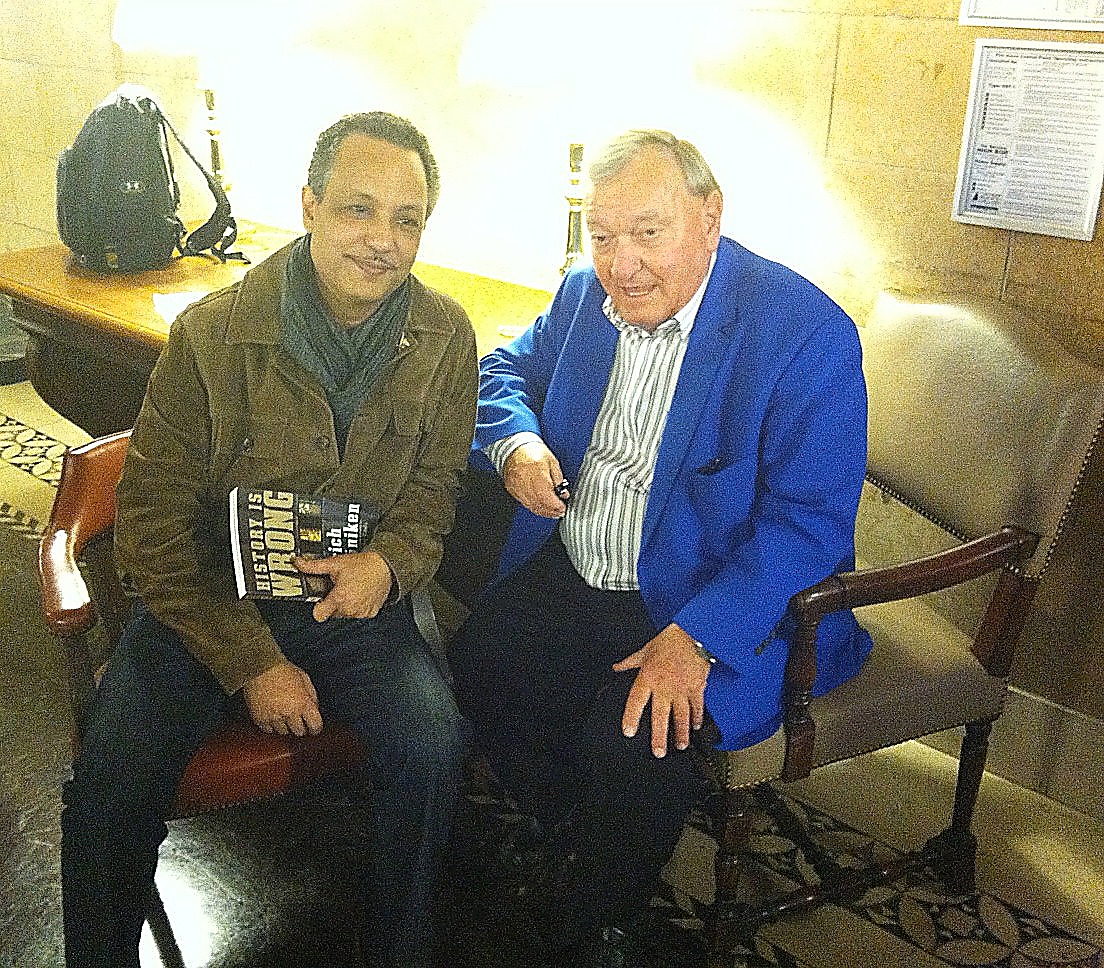
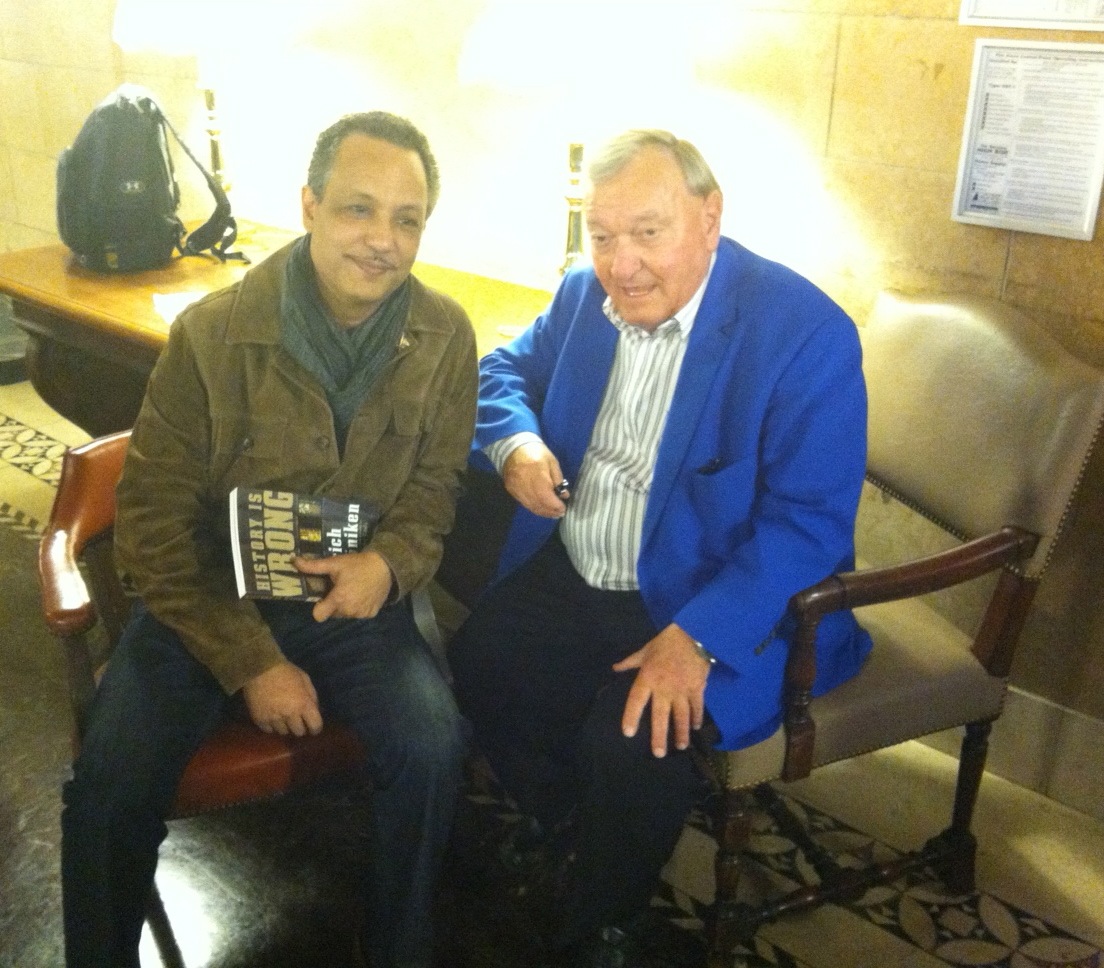
I had the privilege of meeting Erich von Däniken in person. What I found was a man who had spent sixty years asking the same question with the same intensity, genuinely convinced that the answer matters — not because of what it says about extraterrestrials, but because of what it says about us. He died in January 2026. He never received the archaeological vindication he sought. The questions he asked have not gone away.
With Erich von Däniken. A conversation about evidence, methodology, and what the official record refuses to address.
Whatever one concludes about his theories, Erich von Däniken’s cultural impact is not in question.
His books sold more than 70 million copies worldwide, according to Reuters, making him one of the best-selling non-fiction authors of the twentieth century. They were translated into more than 30 languages and remained continuously in print throughout his life. In 1970, a documentary adaptation of Chariots of the Gods? was nominated for an Academy Award. A 1973 version reached mass television audiences across Europe and North America.
His direct intellectual descendants include Giorgio Tsoukalos — who worked with von Däniken directly and later became the public face of the Ancient Aliens television series on the History Channel. That series has run for more than twenty seasons and attracted audiences of millions per episode.
He founded the Mystery Park in Interlaken, Switzerland — later renamed Jungfrau Park — as a permanent exhibition dedicated to ancient mysteries and humanity’s possible extraterrestrial connections. He also established the Archaeology, Astronautics and SETI Research Association (AAS RA), a formal body dedicated to investigating ancient astronaut claims with greater methodological rigour than his early books displayed.
None of this proves his hypothesis. All of it demonstrates that a Swiss hotel manager with a provocative question in 1968 created something that proved far more durable than his critics expected — and that durability is itself a phenomenon deserving of serious examination.
What He Left Behind
Mainstream archaeology did not meaningfully engage with von Däniken’s work for decades. The dismissal had calcified into a professional reflex: to cite him approvingly was to mark oneself as outside serious scholarship. This insulated his ideas from rigorous scrutiny, because the researchers best equipped to evaluate his evidence largely declined to do so at length. That was a mistake. Serious engagement would have produced a clearer public understanding of exactly where the evidence stops.
What genuinely changed the frame, late in his life, was the discovery of Göbekli Tepe — a 12,000-year-old temple complex in Turkey, built by hunter-gatherer communities who had not yet developed agriculture or writing. The site significantly changed scholarly understanding of social organisation and monumental construction during the Pre-Pottery Neolithic. It demonstrated that early human communities were more capable than the academic establishment had assumed. That finding is not a vindication of von Däniken’s extraterrestrial claims; it is the opposite. It shows that the question “how did they build this without help?” has a straightforward answer: they were more capable than we gave them credit for. The more interesting conclusion is that ancient humans needed no outside assistance — which makes their achievement more remarkable, not less.
The contemporary UAP disclosure movement — the acknowledgment by the Pentagon and multiple governments that unidentified objects of unknown origin have been observed in Earth’s atmosphere — does not bear directly on the ancient astronaut hypothesis. Congress has examined contemporary UAP reports and alleged government programmes, not evidence that extraterrestrials influenced ancient civilisations. The two subjects are separate. Treating them as mutually reinforcing overstates what either body of evidence actually shows.
Von Däniken died having never received the archaeological confirmation he sought. His questions have outlasted him. The evidence for his specific answers has not improved.
The UFO Times Assessment
Category
Rating
Notes
Cultural Influence
★★★★★
Founded the ancient astronaut genre as a mass cultural phenomenon; his influence on how millions of people think about ancient history is unrivalled and historically significant regardless of the validity of his conclusions
Scholarly Rigour
★★☆☆☆
Methodology is selective and presentational; factual errors documented by multiple independent critics; core approach is advocacy rather than falsifiable inquiry; classified by mainstream archaeology as pseudoarchaeology
Site Evidence
★★★☆☆
The monuments and artefacts he cited are real and genuinely impressive; the claim that they required extraterrestrial assistance is an interpretation, not an established finding; no physical evidence of extraterrestrial presence has been identified at any cited site
Historical Significance
★★★★★
More than 70 million books sold; 20+ seasons of Ancient Aliens; a formal research association; the most successful alternative history publishing phenomenon of the twentieth century; his influence on popular curiosity about ancient history is beyond dispute
Evidentiary Claims
★☆☆☆☆
His extraterrestrial hypothesis has not been supported by physical evidence in fifty years of examination; his specific factual claims have been documented as containing errors; his methodology relies substantially on argument from ignorance
Editorial Perspective
The honest assessment is this: von Däniken’s influence on popular culture is established beyond argument. The ancient sites he discussed are real, impressive, and in several cases still not fully explained. His extraterrestrial interpretation of those sites has not been demonstrated by the evidence. Mainstream archaeology classifies his conclusions as pseudoarchaeology, and that classification is based on documented methodological failures, not professional jealousy. Both things are true simultaneously. He was the man who made millions of people curious about ancient history. He was also a man whose specific answers to that history’s hardest questions did not hold up under scrutiny. The correct approach is to honour the curiosity while being clear about the evidence.
Recommended Reading
Affiliate disclosure: links below use our Amazon Associates tag (theufotimes-20). We earn a small commission on qualifying purchases at no extra cost to you. This does not influence our editorial assessments.
Chariots of the Gods? — Erich von Däniken (1968)
The book that started everything. Read it as what it is: a passionate, provocative work by an autodidact asking questions credentialed professionals had declined to ask. Its errors are real and documented. So is the scope of its ambition. Every serious reader of this subject should encounter it at least once.
The most systematic published response to von Däniken’s claims. Story goes through Chariots of the Gods? methodically, identifying specific factual errors, misquotations, and logical failures. Essential reading for any honest assessment of what von Däniken actually demonstrated.
Where von Däniken worked from physical evidence and ancient art, Sitchin worked from Sumerian texts and cuneiform tablets. Their conclusions converge. Both bodies of interpretation have been contested by specialists in the relevant fields. Read both alongside the scholarly responses; the comparison is illuminating.
UNESCO World Heritage — Lines and Geoglyphs of Nasca and Palpa UNESCO’s official designation and description, connecting the Nazca Lines to Nazca religious, ceremonial, and cultural practices. The geoglyphs are visible from surrounding elevated terrain; their ceremonial purpose is the scholarly consensus.
German Archaeological Institute — "How Old Is It? Dating Göbekli Tepe" Primary scholarly source on Göbekli Tepe’s dating and interpretation. The site demonstrates that Neolithic hunter-gatherer communities were capable of monumental construction — an argument for human capability, not for extraterrestrial assistance.
Ronald Story — The Space-Gods Revealed (1976, Harper & Row) The most thorough published catalogue of factual errors in Chariots of the Gods? Chapter-by-chapter examination of von Däniken’s claims against their cited sources.
Investigate the Sites He Cited
Von Däniken’s case rested on specific monuments and artefacts. We have investigated several of them independently, with primary sources. The evidence and the open questions are both assessed.