
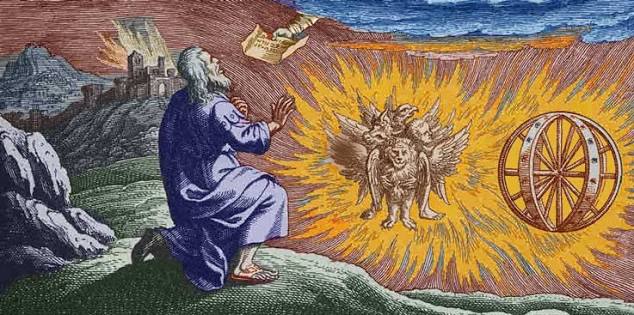
A colorized historical engraving depicting Ezekiel prostrate before the four living creatures and the great wheel surrounded by fire — with the divine throne visible above in radiant light and the burning city of Jerusalem visible in the distance at left. This scene, recorded in Ezekiel Chapter 1, has been one of the most discussed and debated passages in all of religious literature for more than 2,500 years.
■ Primary Source — Ezekiel 1:4
“I looked, and I saw a windstorm coming out of the north — an immense cloud with flashing lightning and surrounded by brilliant light. The center of the fire looked like glowing metal.”
— Ezekiel 1:4
One of the most extraordinary visions recorded in the Hebrew Bible has fascinated theologians, historians, artists, and modern researchers for more than 2,500 years.
Was it a symbolic revelation from God — a vision of divine majesty expressed in the only language available to a human observer? A profound mystical experience that later generated centuries of Jewish contemplative tradition? Or, as some twentieth-century writers proposed, the description of advanced technology witnessed by an ancient observer who lacked the vocabulary to describe what he was actually seeing?
Understanding Ezekiel’s vision begins not with speculation, but with history — with the man himself, the world that produced him, and the literary tradition in which he was writing.
At The UFO Times, our approach is consistent: primary source first, historical context second, scholarly interpretation third, and modern speculation last. That order matters. What Ezekiel actually wrote is the only foundation from which any serious discussion of his vision can proceed.
A Timeline
c. 622 BC
Birth of Ezekiel. Probably born into a priestly family in Judah during the reign of King Josiah. His priestly background profoundly shaped both the language and the concerns of his later prophecies.
597 BC
First Babylonian Deportation. Nebuchadnezzar II conquers Jerusalem. Thousands of Judah’s priests, craftsmen, and nobles — including Ezekiel — are taken into exile in Babylon. The Temple still stands; Jerusalem has not yet fallen.
593 BC
The Vision by the River Chebar. In the fifth year of King Jehoiachin’s exile, Ezekiel experiences the vision recorded in Chapter 1 of his book. He is thirty years old — the age at which a priest would have begun his Temple duties, had he been in Jerusalem.
586 BC
Destruction of Jerusalem. Nebuchadnezzar destroys Solomon’s Temple and the city of Jerusalem. A second wave of exiles arrives in Babylon. The catastrophe that Ezekiel had prophesied is confirmed. His later prophecies shift from warning to consolation.
1st Century AD
Early Christian interpretation develops. Church Fathers identify the four living creatures of Ezekiel’s vision with the four Evangelists. Ezekiel’s imagery enters the visual language of Christian art across the following centuries.
Middle Ages
Merkabah Mysticism flourishes. Jewish mystics develop elaborate contemplative traditions centred on Ezekiel’s vision of the divine chariot. Rabbinic authorities simultaneously restrict its public teaching, considering it too profound for ordinary instruction.
1974
Josef Blumrich publishes The Spaceships of Ezekiel, proposing that the vision describes an extraterrestrial spacecraft. The former NASA engineer produces engineering diagrams based on the biblical text. The book generates significant popular attention and remains influential in Ancient Astronaut circles.
Today
Ongoing scholarly, religious, and popular debate. Historians continue to study Ezekiel’s vision within its ancient Near Eastern context. The text remains canonical scripture for Jewish and Christian communities, a foundation of Jewish mystical tradition, and a recurring reference point in modern speculative literature.
Who Was Ezekiel?
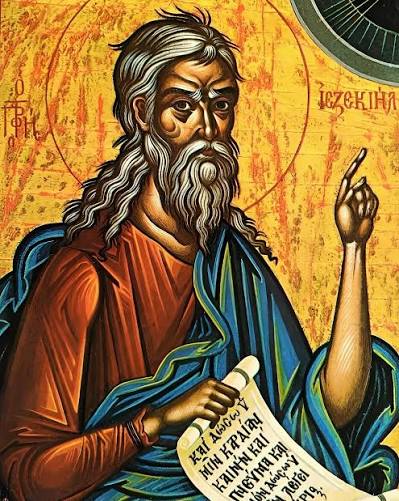
A Byzantine icon of the Prophet Ezekiel, inscribed with his name in Greek. He holds a scroll — the symbol of prophetic authority. Eastern Christian art consistently portrays Ezekiel as a figure of intense spiritual gravity, befitting the nature of his visions.
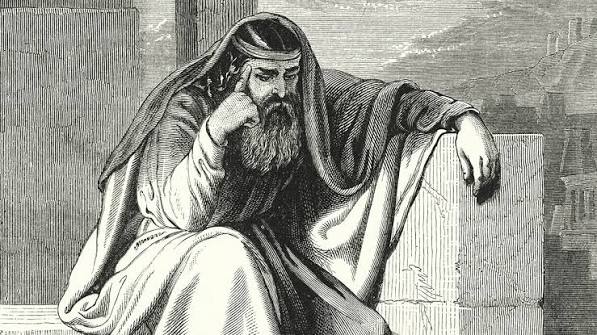
A classical engraving depicting Ezekiel seated in contemplation — the brooding exile-prophet whose words addressed a community in crisis. The ruins visible behind him evoke the destruction of Jerusalem that would later confirm his earlier prophecies.
Ezekiel was a Jewish priest and prophet who lived during one of the darkest periods in Israel’s history. Born into a priestly family around 622 BC, his entire worldview was shaped by the rhythms of Temple worship, sacrificial law, and the theology of divine presence centred in Jerusalem.
Around 597 BC, the Babylonian king Nebuchadnezzar II conquered Jerusalem and deported thousands of its inhabitants — including priests, craftsmen, and nobles — to Babylon. Ezekiel was among these exiles. He would never return to Judah.
Far from his homeland, he continued his priestly calling while delivering prophetic messages to fellow captives who struggled to understand why Jerusalem had fallen and whether God had abandoned His people. Unlike many biblical prophets who delivered their oracles in Jerusalem’s public spaces, Ezekiel spoke from exile on the banks of a Mesopotamian canal called the River Chebar — a world away from the Temple he had served.
It was there, in the fifth year of King Jehoiachin’s exile, that Ezekiel experienced the vision that would define his legacy across three millennia.
The Babylonian Exile: Why Context Is Everything
To understand Ezekiel’s vision, one must first understand its historical setting — because the vision was not delivered in a vacuum. It was addressed to a specific community, in a specific crisis, with a specific theological purpose.
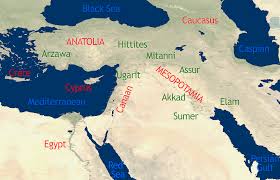
The Ancient Near East at the time of Ezekiel. Babylon lay in southern Mesopotamia; Judah was the small kingdom centered on Jerusalem in Canaan. The River Chebar — where Ezekiel received his vision — was a major canal in Babylonian territory, near the city of Nippur.
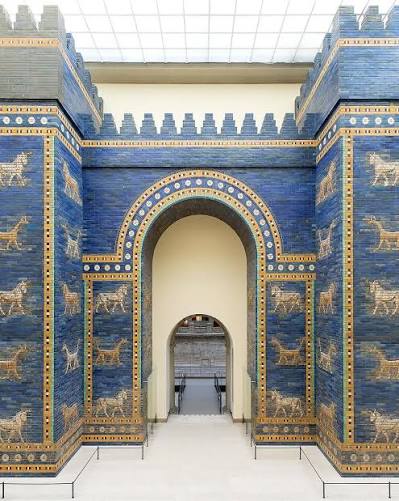
The Ishtar Gate of Babylon, reconstructed and now displayed at the Pergamon Museum in Berlin. Built under Nebuchadnezzar II — the same king who deported Ezekiel — it was one of the most magnificent structures in the ancient world. This was the empire in whose shadow Ezekiel prophesied.
The Babylonian Exile was more than a military defeat. It was a profound religious crisis — perhaps the deepest in Israel’s history. The Temple in Jerusalem, understood as the dwelling place of God on earth, had been destroyed. The Davidic monarchy had collapsed. Thousands of Israelites found themselves living in a foreign empire whose gods appeared, by the evidence of military history, to have triumphed over the God of Israel.
Questions consumed the exilic community. Had God abandoned Israel? Was the covenant irreparably broken? Could the God of a small Near Eastern kingdom communicate with His people in the heart of the Babylonian empire, thousands of kilometres from Jerusalem and the Temple?
Ezekiel’s vision answered these questions in the most dramatic way imaginable: God was not confined to Jerusalem. The divine presence was mobile. It appeared in Babylon — on foreign soil, beside a Mesopotamian canal — with a power and majesty that dwarfed anything the Temple liturgy had expressed.
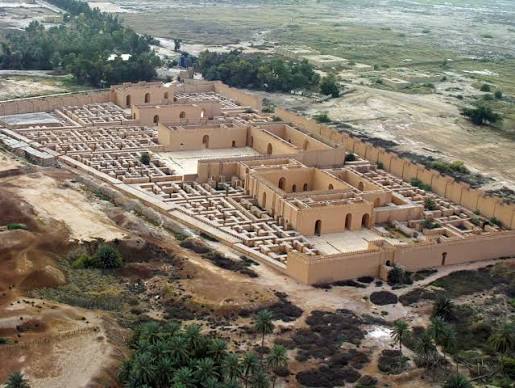
Aerial view of the Babylon archaeological site in modern Iraq. This was the city where Ezekiel and thousands of other Judean exiles lived following the deportations of 597 and 586 BC. The scale of Babylon’s urban environment — then one of the largest cities on earth — made the exiles’ religious crisis all the more acute. How could the God of a small conquered kingdom still act within the shadow of this empire?
The Vision by the River Chebar
The first chapter of the Book of Ezekiel opens with a precise date and location — a characteristic feature of prophetic literature that signals the historical seriousness of the account. It is the fourth day of the fourth month, in the fifth year of King Jehoiachin’s exile. Ezekiel is among the exiles by the River Chebar.
What he then describes has occupied biblical commentators, mystics, theologians, artists, and modern researchers ever since. Before we examine what any of them made of it, it is worth reading it on its own terms — as Ezekiel experienced it, in sequence, detail by detail.
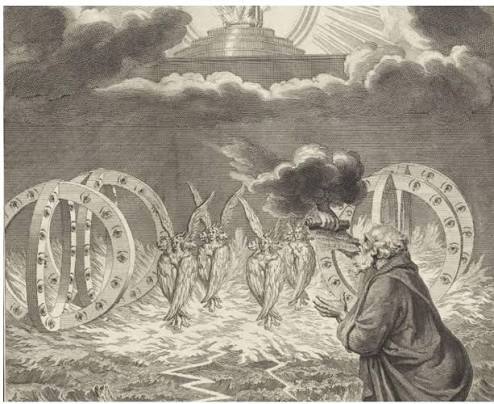
A detailed historical engraving illustrating Ezekiel’s vision: the four living creatures emerge from fire as Ezekiel looks on from the right, while the great wheels — their rims covered with eyes — dominate the centre, and the divine throne is visible above the storm in brilliant light. The visual detail here attempts to capture what the biblical text itself describes as almost impossible to convey in human language.
A violent storm approaches from the north — an immense cloud with continuous lightning erupting at its heart, surrounded on all sides by brilliant light. At the center of the fire, something gleams like molten metal.
From within the fire emerge four living creatures. Ezekiel’s first instinct is to describe their overall form as human — but that impression immediately gives way to something stranger. Each creature has four faces: a human face looking forward, a lion’s face to the right, an ox’s face to the left, and an eagle’s face at the back. Each has four wings. Beneath the wings are human hands. Their legs are straight and unbending; their feet gleam like polished bronze. The creatures move in perfect synchrony — each going straight forward, never turning, as if governed by a single will.
Between the creatures, fire moves back and forth like torches. Lightning flashes out of it. The creatures themselves dart like flashes of lightning.
■ Primary Source — Ezekiel 1:5–10, 1:16, 1:18, 1:26–28
“And in the fire was what looked like four living creatures. In appearance their form was human, but each of them had four faces and four wings… Their faces looked like this: Each of the four had the face of a human being, and on the right side each had the face of a lion, and on the left the face of an ox; each also had the face of an eagle.”
“This was the appearance and structure of the wheels: They sparkled like topaz, and all four looked alike. Each appeared to be made like a wheel intersecting a wheel.” — Ezekiel 1:16
“Their rims were high and awesome, and all four rims were full of eyes all around.” — Ezekiel 1:18
“Above the vault over their heads was what looked like a throne of lapis lazuli, and high above on the throne was a figure like that of a man. I saw that from what appeared to be his waist up he looked like glowing metal, as if full of fire, and that from there down he looked like fire; and brilliant light surrounded him. Like the appearance of a rainbow in the clouds on a rainy day, so was the radiance around him. This was the appearance of the likeness of the glory of the Lord. When I saw it, I fell facedown…” — Ezekiel 1:26–28
— Ezekiel 1:5–10, 1:16, 1:18, 1:26–28 (NIV)
Beside each of the four creatures stands a wheel on the ground. These wheels are immense — Ezekiel describes them as sparkling like topaz. Each wheel appears to contain a second wheel intersecting it at a right angle, so that the structure can move in any direction without turning. The rims of every wheel are covered with eyes, countless and unblinking, running all the way around.
The creatures and the wheels move as one. Wherever the creatures go, the wheels go with them — rising when they rise, stopping when they stop. The spirit of the creatures is in the wheels.
Above the heads of the creatures stretches a vast expanse, gleaming and awesome, like crystal or ice spread out under the sky. The sound of the creatures’ wings is like the roar of rushing waters, like the thunder of the Almighty, like the tumult of an army. When they stop, they lower their wings.
And above the expanse: a throne of lapis lazuli. And upon the throne, high above, a figure whose appearance is like that of a man — from the waist up gleaming like metal in fire, from the waist down burning like flame, surrounded on all sides by brilliant light. Like the appearance of a rainbow in the clouds after rain, so is the radiance that surrounds him.
Ezekiel falls face down.
This is the appearance of the likeness of the glory of the Lord.
That last sentence — hedged three times over — is one of the most carefully constructed phrases in prophetic literature. Ezekiel does not say he saw God. He says he saw the appearance of the likeness of the glory. Each word adds another layer of distance between the observer and what he is trying to describe. The prophet seems acutely aware, even as he writes, that human language has reached its limits — and that saying less is the only honest way to say more.
The Merkabah: The Divine Chariot
In Jewish tradition, Ezekiel’s vision became known as the Merkabah — from the Hebrew word for chariot. The term does not appear in the text itself; it was applied by later interpreters who understood the four living creatures and the great wheels as constituting a kind of divine throne-chariot, carrying the presence of God through the heavens.
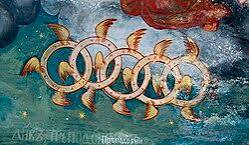
A classical engraving captioned “Ezekiel’s Vision” — one of numerous historical attempts to illustrate what Ezekiel described in Chapter 1. The great interlocking wheels dominate the foreground as the prophet stands at left, while the divine throne radiates light above. Note the caption beneath: “So I opened my mouth & he caused me to eat that roll.”
Classical Jewish commentators understood every element of the Merkabah symbolically. The four living creatures represented divine servants — angelic beings who carried the throne. The wheels symbolized the omnipresence of God, His capacity to move and act in every direction simultaneously. The many eyes represented divine knowledge and awareness, nothing escaping the sight of the divine presence. The throne affirmed God’s sovereignty over all creation.
Crucially, in this reading, Ezekiel’s vision was not primarily about the creatures or the wheels. It was about the throne and the one who occupied it. The machinery, as it were, was incidental to the message: God’s glory was present in Babylon, as fully as it had ever been present in Jerusalem.
Merkabah Mysticism

The Merkabah, or Star Tetrahedron — a geometric form associated with Merkabah mysticism in later tradition. The term evolved from Ezekiel’s chariot-vision into a broader system of Jewish contemplative practice.
The Merkabah vision gave birth to one of the earliest and most distinctive forms of Jewish mysticism. Practised from roughly the third century through the seventh century AD, Merkabah mysticism involved structured contemplative practices intended to replicate Ezekiel’s ascent to the divine throne — to “see” what the prophet had seen.
Practitioners produced elaborate texts describing the journey through seven heavenly palaces (hekhalot), each guarded by angelic gatekeepers who demanded the proper divine names and seals before allowing passage. These Hekhalot texts, as they are known to scholars, represent a sophisticated and highly developed tradition that grew directly from Ezekiel’s foundational account.
The rabbinic attitude toward this material was characteristically cautious. Ancient authorities restricted the public teaching of Ezekiel Chapter 1, considering it too profound — and potentially too dangerous — for ordinary instruction. The Mishnah records that the chapter should not be expounded before groups; it was reserved for mature scholars under careful conditions. This caution itself testifies to the enormous authority the text was understood to carry.
Jewish Interpretation
Rabbinic Judaism approached Ezekiel’s vision with great intellectual seriousness across the centuries. The dominant approach, established firmly by the medieval period, understood prophetic visions as employing imagery that transcended ordinary human language — comparisons and approximations attempting to communicate spiritual realities that no single image could adequately capture.
The great Jewish philosopher and biblical commentator Maimonides (1138–1204) devoted significant attention to Ezekiel’s vision in his Guide for the Perplexed, arguing that the four living creatures and the wheels represented Aristotelian cosmological principles translated into biblical imagery. Each element of the vision corresponded to a philosophical concept about the nature of the universe and divine governance. For Maimonides, the vision was a sophisticated philosophical communication, not a literal description of moving machinery.
Other Jewish commentators, including Rashi and Nahmanides, similarly understood the vision in terms of symbolic religious language. The creatures did not literally have four faces; the wheels did not literally contain eyes. These were images chosen to communicate theological truths about the divine nature — omnipresence, omniscience, creative power, and sovereignty over all creation.
Christian Interpretation
Christian theologians inherited Ezekiel’s vision and gave it a distinctive interpretation that would shape Western religious art for more than a millennium. The most influential reading identified the four living creatures — the human, the lion, the ox, and the eagle — with the four Gospel writers.
This interpretation, articulated clearly by Irenaeus of Lyon in the second century and subsequently standardized, saw Matthew’s Gospel represented by the human face, Mark’s by the lion, Luke’s by the ox, and John’s by the eagle. The rationale varied between commentators, but the identification became deeply embedded in Christian iconography — visible in illuminated manuscripts, cathedral sculptures, and stained glass windows across medieval Europe.
“The cherubim are a vision beyond human understanding. They signify the God who governs all things and who is over all creation.”
— Irenaeus of Lyon, Against Heresies, c. 180 AD
Other Christian thinkers saw the four creatures as representing the four Gospels’ distinct emphases on Christ’s humanity, royal power, priestly sacrifice, and divine nature. Still others interpreted them as symbols of God’s universal rule over all living things. The diversity of readings reflects both the richness of Ezekiel’s imagery and the creative flexibility of patristic biblical interpretation.
Art and Influence Through the Centuries
Few biblical passages have inspired as sustained and varied an artistic response as Ezekiel’s vision. From early Byzantine mosaics to Renaissance paintings, from Gustave Doré’s nineteenth-century engravings to twentieth-century experimental music, the imagery of the Merkabah has crossed every medium and era.
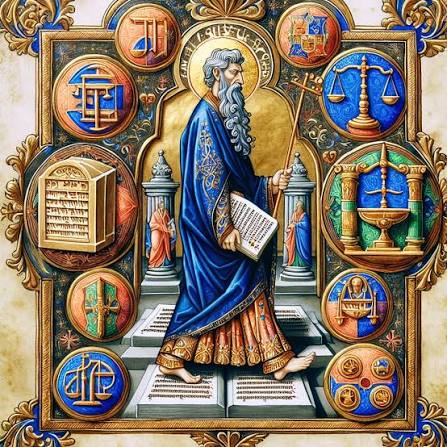
An ornate illuminated manuscript page depicting the Prophet Ezekiel surrounded by symbolic medallions representing the themes of his visions. Medieval manuscripts frequently attempted to organize Ezekiel’s complex imagery into visual systems of theological meaning.
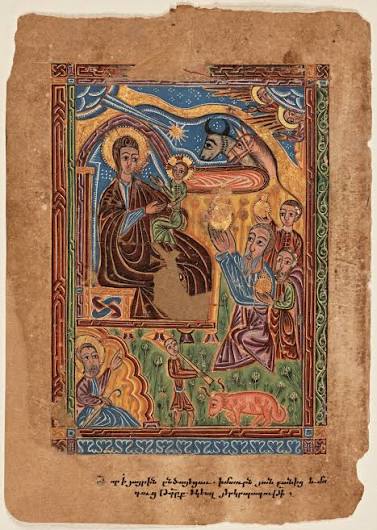
A medieval manuscript illumination depicting the divine throne and the living creatures of Ezekiel’s vision, with the prophet visible at lower left. This Armenian or Eastern Christian manuscript illustrates the remarkable spread of Ezekiel’s visual imagery across different artistic traditions.
The phrase “wheel within a wheel” has entered the Western vocabulary as a symbol of mystery, complexity, and hidden order — used far beyond its biblical context in poetry, music, and everyday speech. The vision’s imagery shaped the development of Jewish mysticism, influenced Christian theology and visual art for more than a thousand years, and continues to appear in modern cultural contexts ranging from academic theology to popular entertainment.
This cultural reach is itself historically significant. The persistence of Ezekiel’s imagery across radically different eras and traditions suggests that the vision addresses something in human experience that remains compelling across contexts — the encounter with a reality that exceeds the capacity of ordinary language to describe.
The Ancient Astronaut Reading
In the twentieth century, Ezekiel’s vision attracted the attention of writers associated with the Ancient Astronaut hypothesis. The argument, in its basic form, proposed that ancient religious texts sometimes preserve garbled or symbolic descriptions of actual encounters with advanced technology — encounters that ancient observers interpreted in the only framework available to them: supernatural experience.
Erich von Däniken discussed Ezekiel’s vision in Chariots of the Gods? (1968), suggesting that the four living creatures and their wheels might represent a landing vehicle of some kind. The argument gained its most technically detailed expression in 1974 when Josef F. Blumrich, a former NASA engineer who had worked on the Saturn V rocket, published The Spaceships of Ezekiel.
Blumrich approached the text as an engineering problem. Using the biblical description as his specification, he produced technical drawings for what he argued was a plausible spacecraft — with rotor blades (the “wings”), a central cabin (the “expanse”), and independently articulated landing pods (the “wheels”). He argued that the “eyes” covering the rims were sensor apertures, and that the fire and brilliant light were consistent with rocket propulsion.
Supporters of this interpretation point to several features of the biblical text: the storm cloud approaching from the north (consistent with an object moving through the atmosphere), the continuous lightning and brilliant light (consistent with energy emissions), the metallic descriptions (the creatures’ feet “gleaming like polished bronze”), the capacity for movement in any direction without turning, and the overwhelming noise that Ezekiel associates with the creatures’ wings (“like the roar of rushing waters”).
These interpretations remain popular in documentary media and online discussion communities, and Blumrich’s book continues to be cited as a serious engineering analysis of the biblical text.
What Do Scholars Say?
The overwhelming majority of biblical scholars, historians, and archaeologists reject the technological interpretation — not because they dismiss Ezekiel’s account, but because a detailed examination of the ancient Near Eastern literary context provides a more compelling explanation for every element of the vision.
Scholars note that virtually every feature of Ezekiel’s vision has direct parallels in ancient Near Eastern religious imagery that predates the prophet by centuries. The composite creature with multiple faces and wings appears throughout Mesopotamian and Egyptian religious art. Winged figures associated with divine thrones are well-attested in both Babylonian and Canaanite iconography. The storm-cloud approach from the north reflects an ancient Near Eastern convention for divine appearance (theophany) that appears repeatedly in the Hebrew Bible — in Isaiah, Psalms, and Nahum, among others.
The “wheel within a wheel” capable of moving in any direction without turning is, in this reading, a vivid expression of divine omnipresence — the theological claim that God’s presence is not confined to a single location or direction. The eyes covering the rims express divine omniscience. These are theological symbols, not engineering specifications.
Critically, Blumrich’s engineering analysis has been criticized by biblical scholars on textual grounds: the Hebrew terms he translates as technical components do not carry those meanings in their ancient context. The words Ezekiel uses are drawn from the standard vocabulary of ancient Near Eastern religious literature — vocabulary that his first audience would have understood within their own cultural framework without reference to any technology.
Three Interpretations Compared
| Framework | The Four Creatures | The Wheels | The Throne Figure | Basis |
|---|---|---|---|---|
| Traditional Jewish | Angelic beings carrying the divine throne; symbols of divine power over all creation | Symbol of God’s omnipresence; the ability to act in every direction simultaneously | “The appearance of the likeness of the glory of the Lord” — the divine presence in Babylon | Scripture & Tradition |
| Christian Interpretation | The four Evangelists (Matthew, Mark, Luke, John); symbols of Christ’s universal lordship | Divine providence extending through all of history and creation | A prophetic anticipation of Christ; God’s presence foreshadowing the Incarnation | Theology & Typology |
| Mainstream Scholarship | Symbolic composite beings drawn from the well-documented visual vocabulary of ancient Near Eastern religion | Theological imagery for omnipresence; parallels in other biblical theophany texts | The prophetic convention of divine appearance adapted to address the crisis of the Babylonian exile | Historical Analysis |
| Ancient Astronaut Theory | Mechanical components of an extraterrestrial spacecraft, misunderstood and described in religious language | Rotor blades, independently articulated landing gear, or propulsion mechanisms | An extraterrestrial pilot or commander in an advanced vehicle | Speculative Interpretation |
Why the Vision Still Fascinates
Ezekiel’s vision occupies a unique position in the history of religious literature. It sits at the intersection of theology, history, archaeology, literary criticism, mysticism, and modern speculative interpretation in a way that few biblical texts can match.
Part of its enduring power lies in the nature of the language itself. Ezekiel does not claim to describe what God looks like. He claims only to describe “the appearance of the likeness of the glory.” That deliberate uncertainty — that layering of hedged comparisons — leaves every subsequent reader with something to project. Ancient readers saw the heavenly throne. Medieval mystics saw a gateway to the divine. Renaissance artists saw an opportunity for visual drama. Modern engineers sometimes see technical specifications. Each reading reflects as much about its own era as about the sixth-century prophet who recorded his experience by a Mesopotamian canal.
What remains constant, across all of these readings, is the sense that Ezekiel was describing something that exceeded his capacity to describe — and that this inadequacy is itself part of the vision’s theological point. The God who appeared to a displaced priest on the banks of the River Chebar was not a God who could be easily contained in human language, in a single city, or in a Temple that armies had destroyed.
The UFO Times Assessment
| Category | Rating | Editorial Note |
|---|---|---|
| Historical Importance | ★★★★★ | Among the most significant prophetic texts of the Hebrew Bible. Its historical setting — the Babylonian exile — is exceptionally well-documented. Ezekiel is a canonical figure in Judaism, Christianity, and Islam. |
| Religious Influence | ★★★★★ | Generated the entire tradition of Merkabah mysticism. Shaped Christian iconography for more than a millennium. Directly influenced the Book of Revelation. Remains active in Jewish, Christian, and Islamic theological traditions. |
| Archaeological Context | ★★★★★ | The Babylonian exile is thoroughly confirmed by archaeology and cuneiform records. Nebuchadnezzar II’s deportations are documented in Babylonian chronicles. The River Chebar has been identified with a known Mesopotamian canal (Kabaru). Ezekiel’s historical setting is not in dispute. |
| Ancient Near Eastern Parallels | ★★★★★ | Every element of the vision — composite creatures, throne imagery, storm theophany, cosmic wheels — has well-documented parallels in Mesopotamian, Canaanite, and Egyptian religious iconography. The vision draws on a rich visual vocabulary that Ezekiel’s audience would have recognized. |
| Scientific Evidence for Technological Interpretation | ★☆☆☆☆ | No archaeological or physical evidence supports the interpretation of Ezekiel’s vision as a spacecraft encounter. Blumrich’s engineering analysis has been challenged on textual and linguistic grounds by biblical scholars. The vision text does not present itself as a technical description. |
UFO Times Evidence Assessment
- ESTABLISHED Ezekiel was a real historical figure, a Judean priest deported to Babylon c. 597 BC. The Book of Ezekiel is canonical scripture in Judaism and Christianity, and the Babylonian exile is thoroughly confirmed by archaeology and cuneiform records.
- ESTABLISHED Ezekiel’s vision directly influenced the development of Merkabah mysticism, shaped Christian iconography for more than a millennium, and influenced the Book of Revelation. Its theological and cultural impact is thoroughly documented.
- ESTABLISHED Every element of the vision — composite creatures, throne imagery, storm theophany — has well-documented parallels in ancient Near Eastern religious literature and art that predate Ezekiel by centuries.
- CREDIBLE The dominant scholarly interpretation — that the vision is a theophany expressed in the symbolic language of ancient Near Eastern religion, addressed to the specific theological crisis of the Babylonian exile — is well-supported by textual, archaeological, and historical evidence.
- SPECULATIVE That Ezekiel’s vision preserves a literal description of an actual encounter, whether supernatural or technological, beyond the literary and religious conventions of its era.
- UNSUPPORTED That the vision describes an extraterrestrial spacecraft. No archaeological evidence supports this reading. Blumrich’s engineering analysis has been challenged on linguistic grounds, and the text’s own language consistently employs the conventions of ancient religious vision rather than technical description.
Editorial Perspective
Some of history’s greatest accounts endure because they resist simple explanations. Ezekiel’s vision is one of them. Whether approached as sacred scripture, ancient literature, mystical symbolism, or a source of modern speculation, the text continues to provoke careful reading and thoughtful debate more than 2,500 years after it was first recorded.
The biblical text itself does not describe extraterrestrial visitors. It presents a prophetic experience using powerful symbolic language — language drawn from the visual and religious vocabulary of the ancient Near East — intended to communicate the sovereignty and presence of God to a community in exile. Understanding that context does not diminish the account. It makes it more remarkable: a displaced priest, far from everything he had known, producing one of the most vivid and enduring descriptions of the divine that any tradition has preserved.
When in doubt, choose credibility over drama. A mystery remains fascinating even when we admit that not all of the answers are known.
— The UFO Times Editorial Desk
Frequently Asked Questions
What did Ezekiel actually see?
According to Chapter 1 of his book, Ezekiel saw an immense storm cloud approaching from the north, from which emerged four composite living creatures with four faces each (human, lion, ox, eagle), great wheels that moved with the creatures and whose rims were covered with eyes, a crystal expanse above them, and above the expanse, a throne of lapis lazuli upon which sat a radiant figure surrounded by light. Ezekiel describes this as “the appearance of the likeness of the glory of the Lord” and falls facedown.
What is the Merkabah?
Merkabah is the Hebrew word for chariot, applied by Jewish tradition to Ezekiel’s vision. In classical Jewish interpretation, the four living creatures and the great wheels form a divine chariot-throne that carries the presence of God. Merkabah mysticism is a tradition of Jewish contemplative practice, dating roughly from the 3rd to 7th centuries AD, that sought to re-experience Ezekiel’s ascent to the divine throne through meditation and sacred texts.
What is “a wheel within a wheel”?
Ezekiel 1:16 describes the wheels he saw as each appearing to be “like a wheel intersecting a wheel.” In the traditional theological reading, the intersecting wheels symbolize the divine capacity to move in any direction simultaneously — omnipresence made visual. In Josef Blumrich’s Ancient Astronaut interpretation, it was read as a mechanical description of a rotor mechanism. Biblical scholars generally understand it as visionary symbolic imagery rather than a technical specification.
Was Ezekiel’s vision a UFO?
This claim, associated primarily with Erich von Däniken and Josef Blumrich, proposes that Ezekiel witnessed an extraterrestrial spacecraft. The argument has not been accepted by mainstream biblical scholars or historians. Every element of the vision — composite creatures, wheeled thrones, storm theophany, fire and light — has extensive parallels in ancient Near Eastern religious literature that predate Ezekiel by centuries. No archaeological evidence supports the spacecraft interpretation.
Where was the River Chebar?
The River Chebar is identified by most scholars with the Kabaru canal in southern Mesopotamia, near the ancient city of Nippur in what is now Iraq. Cuneiform documents confirm the existence of this canal and its use by Babylonian communities during the period of Ezekiel’s exile. It was one of the main waterways of the Babylonian irrigation system, flowing through an area where Jewish exiles are known to have settled.
How does Ezekiel’s vision relate to the Book of Enoch?
Both texts belong to the broad tradition of ancient Jewish visionary literature. Ezekiel’s vision of the divine throne directly influenced the heavenly journeys described in the Book of Enoch, where Enoch also ascends to witness a divine throne-room. The Merkabah imagery of Ezekiel Chapter 1 recurs in 1 Enoch, demonstrating that Ezekiel’s vision was an active and generative influence on subsequent Jewish religious imagination during the Second Temple period.
Related Investigations
Recommended Reading
The Book of Ezekiel, Chapters 1–24 — Daniel I. Block (NICOT)
The definitive English-language commentary on the first half of Ezekiel — rigorous, historically grounded, and accessible to serious non-specialist readers. Block places the vision firmly in its ancient Near Eastern context while taking the theological dimensions of the text with full seriousness. The essential starting point for anyone who wants to understand what Ezekiel was actually communicating.
View on Amazon →Ezekiel 1–20 — Walther Zimmerli (Hermeneia Series)
The classic critical commentary in the Hermeneia series — exhaustive in its treatment of the Hebrew text, the ancient versions, and the history of interpretation. Zimmerli’s analysis of the Merkabah vision is among the most thorough in any language. Essential for readers who want depth rather than accessibility.
View on Amazon →The Spaceships of Ezekiel — Josef F. Blumrich
Presented here for completeness: the most technically detailed argument for reading Ezekiel’s vision as a description of extraterrestrial spacecraft, by a former NASA engineer. Blumrich’s approach and conclusions have been disputed by biblical scholars, but understanding the argument in its own terms is worthwhile for anyone who wants to evaluate it seriously rather than simply dismiss it.
View on Amazon →Ancient Mysteries — Coming Next
Father Carlo Crespi and the Mystery of the Golden Plates
Next in the Ancient Mysteries section: the Ecuadorian priest who collected thousands of ancient metal artefacts donated by indigenous communities — many of which disappeared after his death. What were the Crespi artefacts? What do archaeologists actually know about them? And why do they remain one of the most debated collections in alternative history?
Explore Ancient Mysteries →