
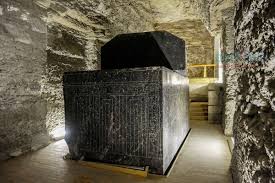
Beneath the desert plateau of Saqqara, eleven kilometres south of Cairo, runs a tunnel system that contains some of the largest carved stone objects ever produced in the ancient world.
Cut into the living rock at a depth of several metres, the Greater Vaults of the Serapeum hold twenty-four monumental hard-stone sarcophagi. The literature identifies granite and other costly stones, including basalt and diorite. The containers vary somewhat in their dimensions, surface treatment and state of preservation. Each is large enough to have served as the burial vessel for a fully grown bull — which is exactly what they were built to do.
The containers were made to receive the mummified bodies of the Apis bulls, animals that ancient Egyptians regarded as earthly embodiments of the god Ptah and, after death, as manifestations of Osiris. When French Egyptologist Auguste Mariette excavated the site beginning in November 1851, he found almost all of them empty.
The scale of the operation that produced them — quarrying, transporting, lowering and finishing stone containers of this mass in a pre-industrial society — is a genuine engineering achievement. It does not require an extraordinary explanation to be extraordinary.
A Necropolis for Sacred Bulls
The Apis bull was one of the most important sacred animals in Egyptian religion. At any given time only one living bull held the title: a specific animal selected according to a set of required physical markings, including a white triangle on the forehead, a crescent moon shape on the flank and a distinctive mark under the tongue. The bull was installed at the temple of Ptah at Memphis, where it was treated as a living deity, observed for oracular significance and maintained in conditions appropriate to a god.
When an Apis bull died, an elaborate mourning period followed. The body was mummified with the same care applied to royalty. It was then interred in a stone container within the Serapeum, accompanied by votive offerings, amulets, canopic equipment and objects bearing inscriptions that recorded the date of death, the identity of the reigning pharaoh and ritual formulas connected with the Osirian afterlife.
The cult was extraordinarily long-lived. The earliest Apis burials at Saqqara date from the reign of Amenhotep III in the Eighteenth Dynasty, roughly 1386 BC. The practice continued through the Nineteenth Dynasty under Ramesses II, through the Third Intermediate Period, and well into the Ptolemaic era, ending around 30 BC. That is more than thirteen hundred years of documented, unbroken continuity.
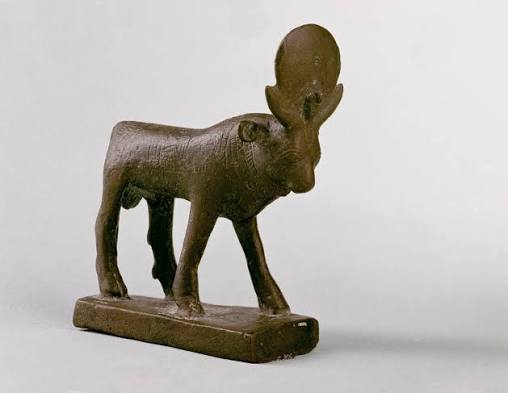
The complex at Saqqara developed across three distinct phases. The earliest Apis burials at the site were isolated tombs, with each bull interred individually in a chamber or shaft. The Lesser Vaults represent a transitional phase, associated particularly with the work of Khaemwaset, son of Ramesses II and royal administrator of the Memphis region; in these earlier galleries the bulls were interred in wooden coffins rather than the monumental hard-stone containers that characterise the final phase. The Greater Vaults, the subject of most modern investigation, represent the full development of the monumental hard-stone sarcophagus tradition and continued in use through the Ptolemaic period.
“At any given time only one living bull held the sacred title. When it died, the mourning period paralleled that for royalty. Thirteen centuries of Apis burials are documented in the Egyptian record.”
The Great Vaults
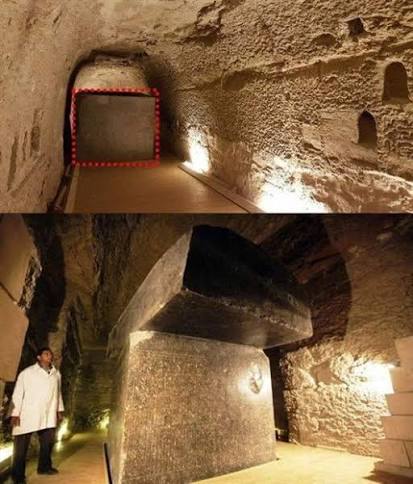
The Greater Vaults form a T-shaped system of tunnels running approximately 200 metres in total length. The main corridor, roughly 68 metres long and 5 metres wide, is lined on each side with lateral chambers. Each chamber was designed to receive a single sarcophagus. The ceilings are vaulted.
The complex was cut through the Saqqara plateau limestone by teams of workers who would have used metal tools, stone pounders and abrasive sand. The cutting quality is sufficient to have produced the smooth arched ceilings and regular chamber dimensions visible today, though the rock is softer limestone rather than the harder stone used for the sarcophagi themselves.
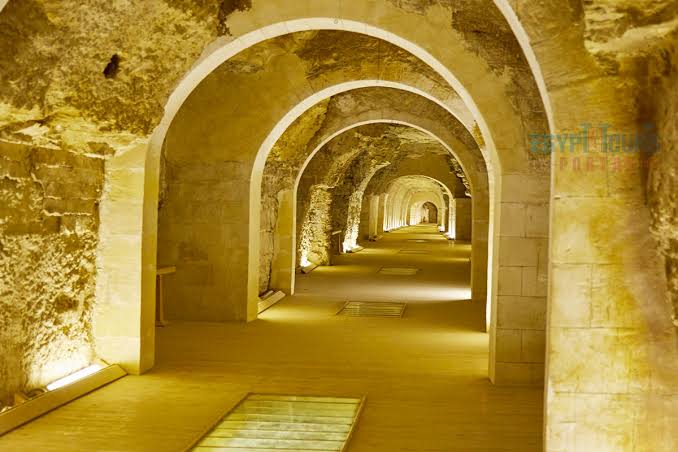
The sarcophagi themselves are a different category of achievement. Each is a monolithic container, rectangular in plan, with a flat base, four walls and a separate lid. The stone varies across the twenty-four units: the literature identifies granite and other costly hard stones, including basalt and diorite, though material attribution has not been systematically confirmed for all containers. The interior hollowing reduces the wall thickness to roughly 27–35 centimetres on each face in the best-documented examples. The lid rests in a recessed channel carved around the upper perimeter of the box.
Gallery layout: The Greater Vaults form a roughly T-shaped tunnel system, approximately 200 metres in total length. The main corridor runs approximately 68 metres and is flanked by lateral chambers opening on each side. Mariette’s original survey was published in Le Sérapéum de Memphis (1857). A plan image has been omitted from this article pending confirmation of reuse rights.
The containers bear hieroglyphic inscriptions on their exterior faces recording the name, dates and genealogy of a specific Apis bull, the reigning pharaoh at the time of burial, and the name of the officiant who oversaw the interment. These inscriptions are the primary archaeological anchor connecting the containers to the Apis cult, and they are inconsistent with the claim that the containers were produced by some earlier, unknown civilisation.
A Serious Transport Problem
The granite used for most of the Greater Vault sarcophagi almost certainly came from the Aswan quarries in Upper Egypt, approximately 900 kilometres by river from Memphis. Aswan was the source of Egypt’s prestige hard stone throughout the pharaonic period, supplying obelisks, colossal statues, temple doorways and royal sarcophagi across nearly three thousand years.
The first challenge was quarrying a block large enough to produce the finished container. The raw block, before the interior was hollowed out, would have been substantially larger than the finished product. Quarrying was accomplished using wooden wedges driven into cut channels and then saturated with water to expand, or through the use of dolerite pounders to break away rock. The traces of this technique are visible in the Aswan quarries today, most famously in the unfinished obelisk that still lies in the quarry bed.
Once freed, the block was moved to the river on wooden sledges, possibly on a track lubricated with liquid. An Egyptian wall painting from the tomb of Djehutihotep at El-Bersheh, dating from the Middle Kingdom, shows precisely this technique being used to move a colossal statue, with workers pouring liquid ahead of the sledge runners while hundreds of men haul on ropes.
The river journey from Aswan to Memphis required that the block be floated on a heavy barge or lashed between two barges. Egyptian reliefs show the transport of pairs of large obelisks on single vessels, confirming that the shipbuilding and river-navigation technology to move loads of this mass was well established.
At Memphis the block needed to travel a further eight to ten kilometres overland to reach the Saqqara plateau, rising approximately 40 metres above the Nile flood plain. Then came what may have been the most logistically demanding phase: lowering each finished or semi-finished sarcophagus into the underground galleries.
The gallery chambers are barely larger than the sarcophagi themselves. Mariette and later investigators noted that the walls of some chambers showed abrasion marks consistent with the stone being slid or levered into position. One working hypothesis involves the use of sand-filled chambers: the box is lowered onto a sand bed, and as sand is gradually removed from below, the box descends in a controlled manner. This technique is attested in other ancient engineering contexts and does not require any technology beyond what was available.
ⓘ Engineering Note
No single step of the Serapeum construction programme requires a technology that is not independently attested in the Egyptian record. The challenge lay in sustaining that programme across decades, with sufficient organisation to source, transport and finish stone containers of consistent quality, and to lower each one into a pre-cut underground chamber with little room for error.
The Precision Question
Much of the popular attention directed at the Serapeum since the 1990s has focused on claims about the surface flatness of the containers — in some versions, precision measurable in microns across surfaces more than a metre wide. This precision, the argument goes, cannot be explained by abrasive hand-finishing and must imply powered machine tools or technology from an unknown civilisation.
That claim requires careful assessment.
The measurements most frequently cited in this context originate from a 1995 visit by engineer and author Christopher Dunn. Dunn pressed a straight-edge against selected surfaces and estimated the gap. His findings were self-reported and have not been replicated in a peer-reviewed study with calibrated instruments across a representative sample of surfaces from multiple containers. The precision he describes may exist on some surfaces of some containers; it has not been systematically demonstrated across the Serapeum sarcophagi as a group.
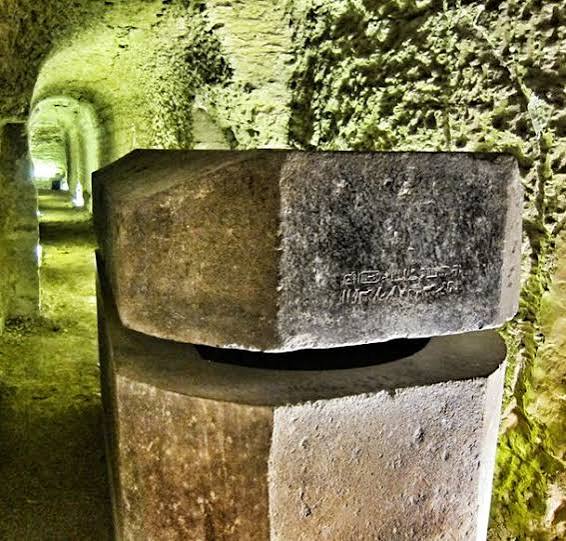
What mainstream Egyptology does acknowledge is that Egyptian craftsmen were capable of high-quality stonework. The casing stones of the Great Pyramid, the sarcophagus in the King’s Chamber, and a number of royal sarcophagi now in museum collections all demonstrate a standard of surface finishing and geometric accuracy that reflects sophisticated technique. The tools available — copper saws loaded with abrasive quartz sand, dolerite balls used as pounders, and smooth stones used for final lapping — are capable of achieving high results when used with patience and skill.
Abrasive lapping can produce extremely smooth surfaces, but establishing reliable geometric flatness requires reference control and repeated measurement — it does not occur automatically from rubbing two surfaces together. The exact procedures used for the Serapeum containers are not documented. Egyptian craftsmen working on royal stone objects had extensive experience with controlled abrasive finishing techniques, and the results at attested sites demonstrate a high level of skill.
| Claim | Status | Notes |
|---|---|---|
| The sarcophagi are large and heavy | Documented | A published calculation for one large example estimates ~37.6 tonnes (container) + 24.4 tonnes (lid) = ~62 tonnes combined. Other containers vary. None have been independently weighed; these are calculations, not measurements. |
| The containers are connected to Apis bull burials | Confirmed | Inscriptions, stelae, votive material, animal remains |
| The stone was sourced from Aswan | Most probable | Consistent with all major Egyptian monumental granite; full petrological survey across containers not published |
| Micron-level flatness across all containers | Not demonstrated | Informal measurements by a single researcher at selected surfaces; no peer-reviewed survey |
| All 24 containers are black granite | Inaccurate | The literature identifies granite and other costly stones including basalt and diorite; material attribution varies across the published record and has not been systematically confirmed for all containers |
| Power tools or machines were used | No evidence | Abrasive finishing consistent with hand techniques paralleled at other Egyptian sites |
| The containers predate dynastic Egypt | Contradicted | Inscriptions date specific containers to named pharaohs |
| Sand-displacement lowering is plausible | Reconstructed | Not directly attested at Serapeum but consistent with Egyptian engineering practice |
The more productive question is not whether the precision is “possible” — it clearly was achievable, since the containers exist — but what level of precision was actually achieved and how it compares across the full set of containers. That question remains open because the systematic, independent measurement work has not been conducted and published.
Why Were They Empty?
When Mariette entered the Greater Vaults, he found nearly all the containers with their lids displaced or removed and their interiors empty. This is the second major puzzle of the Serapeum, and the available evidence points toward a straightforward answer.
Physical evidence inside the galleries provides several clues. Mariette documented thieves’ tunnels bored through the walls and floor of the complex, indicating that ancient robbers had entered at multiple points. Several lids showed tool marks consistent with having been levered off their fittings from above. The dates of the robberies are uncertain. The disturbance occurred after the relevant burials and may represent several episodes.
Documented Apis burial material — natron, linen, bovine remains, canopic equipment and votive objects — was recovered from across the wider Serapeum complex, particularly from the earlier isolated tombs. Mariette also reported finding sealed material in portions of the complex. The original contents and subsequent history of every individual Greater Vault container cannot now be reconstructed with certainty.
“The combined inscriptions, stelae, architectural context and recovered burial material from across the Serapeum complex strongly support the funerary purpose of the Greater Vault containers — even where the specific contents of individual containers can no longer be determined.”
The combined inscriptions, stelae, architectural context and earlier Apis burials strongly support the funerary purpose of the Greater Vault containers, although the original contents and later history of every individual container cannot now be reconstructed.
Auguste Mariette and the 1851 Discovery
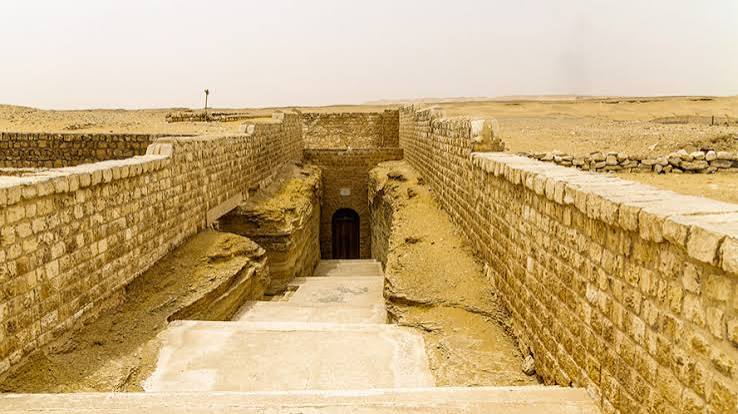
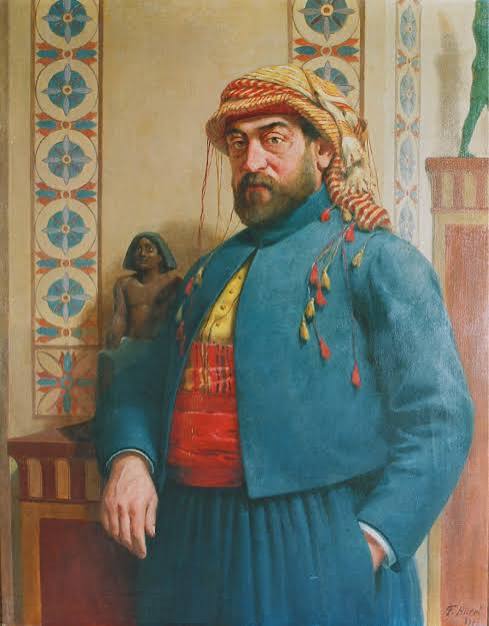
Auguste Mariette arrived in Egypt in 1850 as an agent of the Louvre Museum, nominally to collect Coptic manuscripts. Instead, he became captivated by the monuments of Saqqara.
His discovery of the Serapeum was guided by classical texts: the Greek geographer Strabo, writing in the first century BC, had described an avenue of sphinxes leading to a temple of Serapis at Memphis. Mariette found a sphinx head protruding from the sand and followed the implied line of the avenue. By November 1851 he had located the entrance to the underground complex.
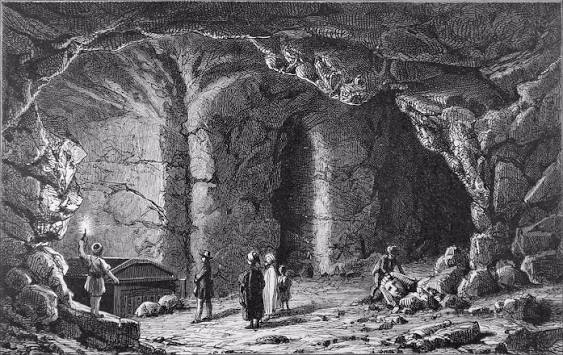
What Mariette found in the galleries was a combination of extraordinary stone monuments and largely empty chambers. He documented every visible inscription, measured the galleries, recorded the positions of the containers and the contents of the chambers that still held material, and transported a number of inscribed stelae and associated objects to the Louvre.
His publication Le Sérapéum de Memphis (1857) remains one of the foundational texts of Egyptian archaeology. Mariette later became the first director of the Egyptian Antiquities Service, an institution he helped establish to protect the country’s heritage from unregulated export and excavation.
Evidence Assessment
Confirmed by archaeology
- The Serapeum of Saqqara is an authenticated underground necropolis within the Memphis World Heritage Area.
- It was used as the burial place for Apis bulls across more than thirteen centuries of documented Egyptian history.
- The Greater Vaults contain monumental stone containers, most found empty but with residual evidence of interment.
- Inscriptions on the containers and associated stelae name specific Apis bulls, reigning pharaohs and dates of burial.
- Auguste Mariette excavated the site from 1851, documented his findings and published them in 1857.
- Physical evidence of ancient robbery is present: forced entry tunnels, displaced lids and disturbed floor deposits.
- Egyptian craftsmen demonstrably produced high-quality stone work using abrasive techniques at other well-documented sites.
Reasonably reconstructed
- Most stone sourced from the Aswan quarries, transported by river barge to Memphis.
- Overland hauling accomplished using sledges, lubrication and organised labour gangs.
- Lowering into galleries most plausibly achieved using sand-displacement or rope-and-lever systems.
- High surface quality likely achieved through abrasive techniques; the exact procedures used in the Serapeum galleries are not documented, and producing reliable geometric flatness requires reference control beyond simple abrasion.
Not demonstrated
- Micron-level flatness across all containers, confirmed by independent calibrated measurement.
- All twenty-four containers being made from the same material to uniform specifications.
- The use of any form of powered machine tool.
- Construction by a civilisation predating dynastic Egypt.
- Extraterrestrial involvement of any kind.
Frequently Asked Questions
What is the Serapeum of Saqqara?
The Serapeum of Saqqara is an underground necropolis at the ancient Egyptian site of Saqqara, near Memphis. It was used as the burial place for the sacred Apis bulls from approximately the reign of Amenhotep III (18th Dynasty, c. 1386 BC) through the Ptolemaic period, covering more than thirteen centuries of documented use.
How heavy are the Serapeum sarcophagi?
The containers and their lids weigh tens of tonnes. A historically published calculation for one large example estimated approximately 37.6 tonnes for the container and 24.4 tonnes for its lid, or about 62 tonnes combined. Other examples vary, and these figures are calculations rather than modern weighings. No comprehensive weighing has been conducted across all twenty-four containers.
Why were the sarcophagi empty when discovered?
Auguste Mariette found most containers empty when he excavated from 1851. Physical evidence — thieves’ tunnels, displaced lids, disturbed floors — indicates ancient robbery; the dates of the robberies are uncertain and the disturbance may represent several episodes. Documented Apis burial material was recovered from across the wider Serapeum complex, particularly from the earlier isolated tombs. The combined inscriptions, stelae, architectural context and earlier Apis burials strongly support the funerary purpose of the Greater Vault containers, although the original contents and later history of every individual container cannot now be reconstructed.
Were the sarcophagi machined to impossible tolerances?
No published peer-reviewed study confirms micron-level flatness across all containers. Some researchers have made this claim based on informal measurements at specific surfaces. Standard Egyptology acknowledges high craftsmanship consistent with Egypt’s documented abrasive stoneworking techniques. A comprehensive independent survey has not been conducted. The containers are impressive on any evidence-based assessment; claims about specific tolerances across all twenty-four units go beyond what has been demonstrated.
How did the ancient Egyptians move stone of this weight?
The most plausible reconstruction combines Aswan quarrying, Nile river transport on heavy barges, overland hauling on lubricated wooden sledge tracks, and controlled lowering into the galleries using levers, ramps and possibly sand-displacement. Each step is paralleled in the Egyptian archaeological record or attested in contemporary wall paintings and textual sources.
When and how was the Serapeum discovered?
French Egyptologist Auguste Mariette identified the site in November 1851, guided by the ancient geographer Strabo’s description of a sphinx-lined avenue leading to a temple of Serapis at Memphis. Spotting a sphinx head above the sand, he followed the avenue to the entrance. Systematic excavation continued through the 1860s.
What is the connection between the Apis bull and the god Serapis?
In Egyptian theology the Apis bull was associated with Ptah in life and with Osiris after death, forming the composite deity Osiris-Apis. Under the Ptolemaic ruler Ptolemy I, this figure was developed into Serapis — a syncretic deity designed to appeal to both Egyptian and Greek subjects. The name Serapeum derives from this tradition.
Sources and Further Reading
Primary and Academic Sources
- Auguste Mariette, Le Sérapéum de Memphis (Paris: Gide, 1857) — foundational excavation report; public domain
- Egyptian Ministry of Tourism and Antiquities — Serapeum of Saqqara, official monument record
- UNESCO World Heritage: Memphis and its Necropolis — the Pyramid Fields from Giza to Dahshur
- Aidan Dodson, The Canopic Equipment of the Kings of Egypt (Kegan Paul, 1994) — Apis burial context
- Musée du Louvre — Collection search: Serapeum and Saqqara objects
- Mark Lehner, The Complete Pyramids (Thames & Hudson, 1997) — Egyptian stoneworking methods
- Rosalie David, The Experience of Ancient Egypt (Routledge, 2000) — Apis cult and Memphis religion
Alternative Interpretation
- Christopher Dunn, Lost Technologies of Ancient Egypt (Inner Traditions, 2010) — presents the precision and machine-tool hypothesis; not peer-reviewed
Further Reading
Two contrasting perspectives on Egyptian stoneworking. One is mainstream scholarship; the other presents the lost-technology interpretation and is labeled accordingly. The UFO Times earns a small commission on qualifying Amazon purchases.
■ Mark Lehner
The Complete Pyramids
The standard scholarly reference on Egyptian pyramid construction, quarrying and stone transport. Essential context for understanding what Egyptian engineers were capable of — and how they did it.
View on Amazon →■ Christopher Dunn — Alternative View
Lost Technologies of Ancient Egypt
Presents the case for advanced lost technology including at the Serapeum. Dunn’s engineering background makes this a serious rather than casual alternative view, though his precision claims have not been independently replicated in peer-reviewed research.
View on Amazon →ⓘ Affiliate disclosure: The UFO Times participates in the Amazon Associates programme and earns commissions on qualifying purchases. Our editorial positions are independent of affiliate relationships.
■ The UFO Times — Ancient Mysteries
Evidence-led investigations, weekly
New ancient mystery investigations, UAP developments and our weekly briefing — direct to your inbox. Free.
Editorial Note — Our Standards
All images in this article have been selected and captioned to reflect what can be visually confirmed from the Serapeum of Saqqara. Images of uncertain provenance — including a 2009 plan image whose reuse rights could not be independently verified — were excluded. Modern field photographs are noted "photographer unattributed; original creator and licence unverified." Pre-1900 images (the Mariette portrait and 1851 engraving) are treated as public domain. The weight figures cited — approximately 37.6 tonnes for one container and 24.4 tonnes for its lid — are a historically published calculation for a single large example, not a modern weighing, and not a figure that applies uniformly to all twenty-four containers. No claim in this article asserts that the sarcophagi are uniform in material or dimensions, that their tolerances have been comprehensively measured, or that the exact stoneworking procedures are documented. The UFO Times applies the same standard to all archaeological investigations: Facts First. Mystery Second. Speculation Last.