
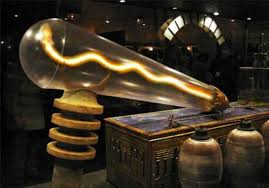
The relief carvings in the Hathor Temple at Dendera that some researchers interpret as electric light bulbs. The objects are shown resting on pillars, with a serpent inside a transparent bulb-like enclosure connected to what appears to be a cable.
In the basement crypts of the Hathor Temple at Dendera, Egypt — one of the best-preserved temples of the ancient world — there are carvings that have generated more controversy than almost any other image in archaeology.
The reliefs, carved into stone walls approximately 2,000 years ago during the Ptolemaic period, depict what many researchers describe as unmistakable electric light bulbs: elongated, teardrop-shaped objects resting on pillars, with serpents contained inside transparent enclosures and what appear to be cables connecting them to box-like bases. The resemblance to modern fluorescent lamps is striking enough that Austrian electrical engineer Walter Garn created a working replica in 1966 — a replica that, when connected to a power source, produced light.
The question is obvious. Were these carvings depicting something the ancient Egyptians actually used? And if so, how did a civilization without any known electrical infrastructure produce and power such devices — and why did the knowledge disappear entirely?
The Temple at Dendera
The Hathor Temple at Dendera is located approximately 60 kilometers north of Luxor on the west bank of the Nile. Construction of the current structure began in the late Ptolemaic period — around 54 BCE — and continued into the early Roman era. It is one of the most intact ancient Egyptian temples in existence, its carvings and painted reliefs preserved in extraordinary detail.
The temple is dedicated to Hathor, the goddess of love, beauty, music, and the sky. Its astronomical ceiling — a painted map of the night sky — is considered one of the most important ancient astronomical documents ever discovered. The zodiac of Dendera, now housed in the Louvre in Paris, is among its most famous features.
The crypts where the controversial reliefs are located are small, low-ceilinged chambers beneath the temple floor, accessible through narrow passages. They were used for storing cult objects and sacred implements. They are also almost completely dark — a detail that becomes significant when examining the light bulb hypothesis.
What the Carvings Show
The reliefs in question show several elongated oval or teardrop shapes, each resting on a pillar called a djed column — a symbol associated with Osiris and representing stability. Inside each oval shape is a serpent in a posture that suggests motion or extension. The ovals themselves are depicted with what appears to be a filament-like element inside, surrounded by a smooth, transparent-seeming enclosure.
Connecting the base of each object to a rectangular box is what researchers like Erich von Däniken and electrical engineer Peter Krassa have described as a cable or conduit. The box, they argue, could represent a power source — specifically a device resembling a Baghdad Battery, galvanic cells that produce electricity through electrochemical reaction and were found at a site near Baghdad dating to roughly the same era.
The resemblance to a modern electric discharge lamp is not a matter of interpretation. When Austrian engineer Walter Garn built a physical replica and applied current, it produced light. That is either a remarkable coincidence or something that demands explanation.
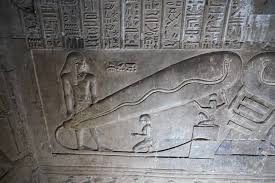
The crypts beneath the Hathor Temple at Dendera, where the controversial light bulb reliefs are carved. The chambers are almost entirely without natural light — which, proponents of the ancient electricity theory argue, raises the question of how the Egyptians illuminated these spaces to carve with such precision.
The No-Soot Problem
The Dendera carvings are not the only piece of evidence cited in the ancient electricity argument. A related and genuinely puzzling observation concerns the absence of soot.
Ancient Egyptians carved, painted, and decorated the interiors of temples and tombs with extraordinary detail and precision — much of it in spaces that receive no natural light. The standard archaeological explanation for how they illuminated these spaces is oil lamps or torches. However, researchers including Dr. Helmut Becker have noted that the interior surfaces of many Egyptian tombs and temple crypts show minimal to no soot deposits — the black residue that oil lamps and torches invariably leave on walls and ceilings.
In the Valley of the Kings, where tombs were carved and decorated in total darkness over decades, the absence of significant soot accumulation has been difficult to explain. Some Egyptologists have proposed polished bronze mirrors arranged to redirect sunlight deep into the tombs — a system that would have worked in some configurations but not in the tight turns and low chambers of the deepest crypts.
The no-soot observation does not prove the existence of electric lighting. But it does create a genuine gap in the conventional explanation that has not been fully closed.
The Baghdad Battery Connection
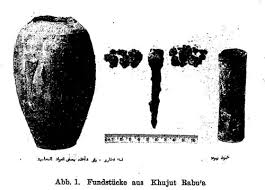
The Baghdad Battery — clay jars containing copper cylinders and iron rods discovered near Baghdad in 1938. Dating to approximately 250 BCE–224 CE, these devices produce a measurable electrical current when filled with an acidic solution. Their exact purpose remains debated by archaeologists.
In 1938, German archaeologist Wilhelm König discovered a series of clay jars near Baghdad containing copper cylinders and iron rods — an arrangement that, when filled with an acidic solution such as vinegar or lemon juice, produces a measurable electrical current. Known as the Baghdad Battery or Parthian Battery, these devices date to approximately 250 BCE–224 CE — broadly contemporaneous with the Dendera reliefs.
The existence of the Baghdad Battery is not disputed. What is disputed is its function. Mainstream archaeology suggests the jars were used for storing sacred scrolls or for electroplating — a process for applying thin coatings of metal to objects, which the ancient world demonstrably practiced. The electroplating theory has experimental support: replicas of the Baghdad Battery have been used to successfully gold-plate objects.
The ancient electricity hypothesis connects the Baghdad Battery to the Dendera reliefs as follows: if the ancient Near East possessed galvanic cells capable of producing electrical current, and if the Dendera carvings depict electrical discharge lamps, then the two pieces of evidence together suggest a more sophisticated understanding of electricity in the ancient world than mainstream science acknowledges.
The leap from electroplating to illumination is significant. Producing a sustained current sufficient for a discharge lamp requires far more power than the Baghdad Battery would generate. No ancient power source capable of running a lamp at the required voltage has been identified. This is the central weakness of the ancient electricity theory.
What Mainstream Egyptology Says
The mainstream Egyptological interpretation of the Dendera reliefs is straightforward and firmly held: the carvings depict a lotus flower giving birth to a serpent — a well-documented motif in Egyptian religious iconography representing creation and the emergence of life from the primordial waters.
The djed pillar at the base is a standard religious symbol. The serpent inside the "bulb" is a standard representation of divine energy or solar force. The cable-like element is a lotus stem. The rectangular base is an altar or offering table. Each element, Egyptologists argue, has a clear parallel in Egyptian religious art and requires no technological explanation.
Dr. Lynda Carroll and other Egyptologists have pointed out that the carvings in question are surrounded by other clearly religious imagery — gods, offerings, hieroglyphic inscriptions — and that interpreting a subset of those carvings as electrical equipment requires selectively reading some symbols as religious and others as technological, with no consistent principle for deciding which is which.
The soot argument is also contested. Studies of Egyptian tomb lighting by researchers including Egyptologist Lanny Bell have identified evidence of oil lamp use and proposed mirror systems that, while complex, would have functioned in many tomb configurations. Some researchers note that ancient Egyptians may simply have been more careful about soot management than modern experiments suggest.
Where the Honest Uncertainty Lies
The mainstream interpretation of the Dendera reliefs — lotus, serpent, religious symbolism — is plausible and consistent with the broader context of Egyptian religious art. It is the most parsimonious explanation and should be the default.
At the same time, three things remain genuinely unresolved.
First, the physical resemblance of the Dendera reliefs to electrical discharge lamps is not trivial. The specific combination of features — elongated bulb, internal filament-like element, connecting conduit, base component — appears in no other Egyptian religious motif with the same consistency. The resemblance may be coincidental, but it is specific enough to warrant examination rather than dismissal.
Second, the soot question has not been fully answered. The mirror-system explanation works in some configurations but faces real challenges in the deepest, most complex tomb sections. How Egyptians illuminated the innermost chambers of the Valley of the Kings to the level of precision their paintings demonstrate remains, strictly speaking, an open question.
Third, the existence of the Baghdad Battery establishes that the ancient world possessed at least a rudimentary understanding of electrochemistry. How widely that knowledge was applied — and in what forms — is not fully documented.
None of this proves that the ancient Egyptians had electric lighting. But it establishes that the question is not as closed as mainstream Egyptology sometimes suggests.
The Larger Question
The Dendera Light sits within a broader pattern that runs through ancient history: unexplained precision, unexplained knowledge, unexplained technology — and mainstream explanations that are plausible but incomplete.
What makes Dendera particularly compelling is not the carvings alone, but what they sit alongside. The astronomical ceiling of the same temple demonstrates knowledge of celestial mechanics sophisticated enough to map the sky with precision that was not equaled in Europe for centuries. The temple itself is constructed with an alignment precision that modern engineers find remarkable. The priests who operated it possessed astronomical, mathematical, and architectural knowledge that challenges the conventional timeline of human intellectual development.
Whether they also possessed electrical knowledge is a separate question. But the question deserves to be asked seriously — not because ancient aliens are the answer, but because the honest answer is that we do not yet know everything about what the ancient Egyptians knew.
■ The UFO Times Evidence Scale
How we rate the claims in this article.
The Dendera relief carvings exist in the Hathor Temple crypts and date to the Ptolemaic period. The Baghdad Battery exists, dates to approximately 250 BCE–224 CE, and produces measurable electrical current. The Hathor Temple's astronomical ceiling demonstrates sophisticated knowledge of celestial mechanics. Walter Garn built a physical replica of the Dendera object that produced light when connected to a power source.
The soot absence in Egyptian tombs. Reports vary across different tombs and chambers, and no comprehensive peer-reviewed survey has definitively established the absence of soot as a site-wide phenomenon requiring a non-lamp explanation.
That the Dendera reliefs depict actual electrical lamps used for illumination. That the Baghdad Battery was connected to or inspired by a broader ancient electrical knowledge system. These interpretations are possible but unproven.
That the ancient Egyptians had a functioning electrical grid or power infrastructure. No evidence for a power generation or distribution system has been found anywhere in Egypt. The Baghdad Battery produces millivolts — far below what is needed to power a discharge lamp.
Recommended Reading
Chariots of the Gods — Erich von Däniken (1968)
Von Däniken’s foundational survey of anomalous ancient technology — including his analysis of the Dendera carvings as possible depictions of electrical or plasma devices brought to ancient Egypt by an advanced civilisation.
View on Amazon →Forbidden Archaeology — Michael A. Cremo & Richard L. Thompson (1993)
The most comprehensive catalogue of archaeological evidence suppressed or ignored by mainstream science — essential for situating the Dendera anomalies within a broader pattern of officially unexplained ancient technology.
View on Amazon →The Ancient Alien Question — Philip Coppens (2011)
A measured investigation into ancient civilisations and extraterrestrial contact — Coppens treats the Dendera reliefs as part of a global pattern of anomalous technical knowledge in the ancient world.
View on Amazon →Related Articles
- The Pyramids and the Impossible Question of How
- Puma Punku: The Ruins That Mainstream Archaeology Cannot Explain
- Ancient Aliens and Archaeology: The Evidence Mainstream Science Struggles to Explain
- The Ancient Astronaut Theory: What It Claims and Why It Won't Go Away
- The Anunnaki: Gods, Aliens, or Myth?
Further Reading
From Erich von Däniken's original investigations to modern Egyptological scholarship — the books that built the Dendera debate.
Browse the UFO Times Bookstore →