
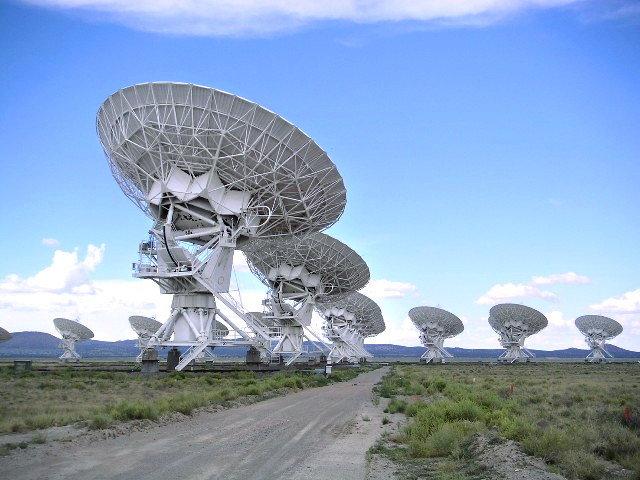
Radio telescopes like those used by Breakthrough Listen and the SETI Institute scan billions of frequency channels simultaneously, looking for a signal pattern that could not have been produced by natural astrophysical processes. The search is systematic, patient, and — unlike most UFO investigation — scientifically rigorous by design.
Somewhere on the planet right now, a bank of antennas is listening to the sky.
Not for weather. Not for aircraft. For a specific class of radio signal — narrowband, anomalous in its frequency, carrying a pattern that no known astrophysical process could produce. A signal that could only have been made by something with a mind behind it.
At the same time, in an entirely different institutional world, military aviators are filing incident reports. Sensor data is being reviewed by analysts. Congressional committees are pressing intelligence officials for answers. The subject is the same — intelligence beyond human — but the methodology is completely different, the institutions involved share almost no personnel, and the two communities rarely speak.
This is the strange fork at the centre of the modern search for non-human intelligence. Two parallel efforts, funded by entirely different sources, operating under entirely different epistemological assumptions, both aimed at the same fundamental question. One is called SETI. The other doesn't have a clean name yet, though "UAP research" is the term currently favoured in government circles.
The question worth asking in 2026 — with real UAP disclosure now a political reality rather than a fringe aspiration — is which search strategy is actually more likely to succeed. And what it would mean for each field if the other one got there first.
Why Radio Telescopes Made Sense
The case for radio as a search medium begins with physics. Radio waves travel at the speed of light and pass through interstellar dust that would block optical signals. They require relatively modest energy to produce at intensities that could cross interstellar distances. They were, as early SETI theorists argued, the logical choice for any civilisation trying to communicate across the galaxy at low cost.
The field was formally inaugurated in 1960, when Cornell astronomer Frank Drake pointed the 85-foot Green Bank Telescope in West Virginia at two nearby stars — Tau Ceti and Epsilon Eridani — and listened for eighty hours. He heard nothing anomalous. But Project Ozma, as it was called, had established something important: the search was scientifically possible, and someone was willing to try.
Drake went on to formalise the mathematics of the problem. The Drake Equation — introduced at the first SETI conference in 1961, at a table that included Carl Sagan and the young neuroscientist John Lilly — is not a calculation so much as a framework for thinking about how many communicating civilisations might exist in the galaxy. Drake's original estimate, plugging in the best guesses available in 1961, suggested ten. Later estimates, using data from Kepler and other exoplanet missions, have ranged from a handful to millions, depending on assumptions about the frequency of life-bearing planets and the longevity of technological civilisations.
The equation cannot be solved with current data. But it does something useful: it makes explicit exactly which parameters we would need to measure to arrive at an answer. That kind of rigour — specifying what you don't know and what evidence would resolve it — is precisely what the UAP field has historically struggled to provide.
Seventy-Two Seconds in Ohio
On the evening of August 15, 1977, a volunteer astronomer named Jerry Ehman was reviewing a printout of radio data collected by the Big Ear telescope at Ohio State University. His job was to scan columns of alphanumeric characters representing signal intensity. A value of 1 meant background noise. A value above 9 was represented by a letter: A for 10, B for 11, and so on.
He found a sequence that read: 6EQUJ5.
It reached a peak intensity of 30 — represented by the letter U — in a frequency band very close to 1420 MHz, the emission frequency of neutral hydrogen and one that SETI theorists had long predicted would be chosen by any advanced civilisation as a universal hailing frequency. The signal lasted seventy-two seconds — exactly as long as a signal from a fixed celestial source would take to pass through Big Ear's field of view. Then it was gone.
Ehman circled the sequence in red pen and wrote in the margin: Wow!
It has never been detected again. Dozens of follow-up observations with more powerful instruments have found nothing. No source has been identified. No natural astrophysical process has been shown to produce a narrowband signal at that frequency with that intensity pattern. The Wow! Signal remains the most credible candidate for an extraterrestrial radio transmission ever recorded — and its origin is still unknown.
The Wow! Signal is to SETI what the Tic Tac footage is to UAP research: a single, well-documented anomaly that matches what an extraterrestrial signal should look like, recorded by qualified observers, and never satisfactorily explained. Neither field knows what to do with its best case.
The Modern Search: Breakthrough Listen and the SKA
The SETI Institute was founded in 1984. Carl Sagan's 1985 novel Contact — adapted to film in 1997 with Jodie Foster — brought the idea of radio contact to mass audiences. But for most of its institutional history, SETI operated on the margins of mainstream science, dependent on private donors and occasional NASA support that was revoked in 1993 when Congress defunded the High Resolution Microwave Survey.
That changed in 2015 when Russian-Israeli billionaire Yuri Milner pledged $100 million to a project called Breakthrough Listen — the most generously funded SETI effort in history. Based at Berkeley's SETI Research Center, Breakthrough Listen was allocated significant time on two of the world's most powerful radio telescopes: the Parkes Telescope in Australia and the Green Bank Telescope in West Virginia. In 2016, FAST — the Five-hundred-metre Aperture Spherical Telescope in Guizhou, China — became the world's largest filled-aperture radio telescope, and has since been used for SETI observations as well.
The scale of the current search is genuinely unprecedented. Breakthrough Listen surveys the one million nearest stars to Earth, scanning billions of frequency channels simultaneously. Its computing infrastructure processes data volumes that would have been inconceivable to Project Ozma. Machine learning tools now flag candidate signals for human review that would previously have been buried in noise.
And within the next decade, the Square Kilometre Array — being built across South Africa and Australia, with its first phase expected to be operational in the late 2020s — will be the most sensitive radio observatory ever constructed. Its effective collecting area will be roughly a million square metres. It will be able to detect, from across the galaxy, a signal equivalent in power to an airport radar.
Whether there is anything to detect remains the open question. But the equipment available to answer it has never been more capable.
The Two Communities That Don't Talk
Here is something that should strike any serious observer as strange: the SETI community and the UAP research community are both ostensibly investigating the same fundamental question, and they have almost no institutional relationship with each other.
SETI researchers, by and large, have historically been reluctant to engage with UAP cases. The reasons are partly sociological — SETI spent decades trying to establish scientific credibility, and the UFO field's association with conspiracy theory and poor evidentiary standards made any association professionally risky. But the reasons are also methodological: SETI's search strategy rests on the assumption that any civilisation capable of interstellar communication would choose radio waves, and that we have not yet detected them because the distances involved are vast and the search is incomplete. The UAP hypothesis — that non-human craft are already operating in our atmosphere — implies a very different conclusion: that they are already here, and chose not to send a radio signal.
These two pictures of the situation are not easy to reconcile. If UAPs represent non-human craft operating in Earth's atmosphere, and have been doing so for decades, why is SETI still finding nothing? One answer: they are not using radio at all, and searching for radio signals from a species that doesn't use radio would produce exactly the kind of sustained absence SETI has observed. Another answer: the UAP hypothesis is wrong or overstated, and what we are observing in our airspace has conventional explanations that remain to be found. A third answer — the most uncomfortable one — is that both things are true simultaneously, and the universe may be inhabited by multiple types of intelligence at very different stages of development, some of whom communicate by radio and some of whom don't.
What Disclosure Changes — and What It Doesn't
In 2023, former intelligence officer David Grusch testified under oath before Congress that the United States government had recovered materials and biological remains associated with non-human craft — and that the programme tasked with managing those materials had been deliberately kept from Congressional oversight. Grusch was not speaking as a conspiracy theorist on a podcast. He was testifying formally, having gone through official inspector general channels, at personal and professional cost. Other senior figures with relevant clearances have corroborated aspects of his account without contradicting the central claims.
If Grusch's testimony is accurate — and we are careful to note that it remains unverified by independent physical evidence in the public domain — it would mean that a civilisation capable of crossing interstellar space has been operating in Earth's vicinity, and that at least some of their craft have been recovered. In that scenario, SETI's continued absence of a detectable signal becomes deeply interesting: either this civilisation never communicated by radio, or they are deliberately silent, or our radio searches have not been aimed in the right direction at the right time.
The SETI research community largely continues to operate as though the UAP developments of the past decade are not its concern. That may be the correct scientific posture — extraordinary claims require extraordinary evidence, and Grusch's testimony, whatever its ultimate accuracy, is not physical evidence available for independent analysis. But the disconnect is striking. If there is a possibility, even a modest one, that non-human intelligence has already made contact in a physical form, the assumption underlying SETI's search strategy — that we are looking for a signal from something that has not yet arrived — deserves to be explicitly examined rather than quietly maintained.
Why Radio Might Still Win
There is a serious case that radio telescope searches will produce the first confirmed evidence of non-human intelligence — and it rests not on optimism but on coverage.
The number of stars that SETI has systematically surveyed is now in the millions. The SKA, when fully operational, will extend that survey to billions of star systems. Even at conservative estimates of the prevalence of technological civilisations, the probability of detecting a leaking signal — not a deliberate broadcast, just the electromagnetic noise of an industrial civilisation — increases with every order of magnitude added to the search volume. The galaxy has been here for ten billion years. Intelligence could have arisen many times, at many distances. Most of it, by definition, is far away. Radio waves are how we reach what is far away.
The UAP phenomenon, by contrast, is inherently local. Whatever is being observed in Earth's atmosphere represents something that is already here, or recently here. That is potentially more immediately significant — but it is also, paradoxically, harder to study rigorously. A signal detected by a radio telescope can be recorded, analysed, shared internationally, and scrutinised by the full scientific community. A UAP event lasting seconds over a military base, captured by a sensor system whose specifications are classified, cannot.
The question of which approach will get to a confirmed, publicly verifiable answer first may ultimately be answered not by which civilisation is closer, but by which search method produces evidence that the scientific community can evaluate without restriction. On that criterion, SETI has a structural advantage that no amount of congressional testimony is likely to overcome in the short term.
Unless, of course, a physical object in a government warehouse can eventually be brought into that same open scientific framework. That remains the unresolved question at the centre of disclosure.
Two searches. One question. The honest position, in July 2026, is that neither has yet produced evidence sufficient to close the case — and that the most productive development would not be one field winning over the other, but both finally beginning to speak to each other with the seriousness the subject demands.
The sky is big enough for both of them.
Further Reading
Frank Drake and Dava Sobel's Is Anyone Out There? (1992) remains one of the most honest accounts of what scientific optimism about SETI actually looks like from the inside. Seth Shostak's Confessions of an Alien Hunter (2009) covers the field's evolution from Green Bank to the Allen Telescope Array. For the Fermi Paradox context that connects SETI's silence to the UAP question, see our article The Fermi Paradox in the Age of Disclosure. And for Avi Loeb's unconventional approach to the same set of questions, his expert profile is here: UFO Experts.
■ The UFO Times Editorial Principles
— The UFO Times Editorial Board · theufotimes.com · Est. 2010
Recommended Reading
The Eerie Silence: Renewing Our Search for Alien Intelligence — Paul Davies (2010)
Written to mark the 50th anniversary of SETI, Davies asks why our most powerful instruments have returned silence — and proposes radical new search strategies, including looking for signatures of technology rather than radio broadcasts.
View on Amazon →Cosmos — Carl Sagan (1980)
Sagan’s masterwork — the book that made SETI meaningful to a generation. His treatment of the Drake Equation, the Voyager message, and the statistical inevitability of other civilisations remains the essential popular science foundation for the search.
View on Amazon →Contact — Carl Sagan (1985)
Sagan’s novel — still the most scientifically plausible account of radio telescope first contact, and the work that most accurately anticipates the institutional, political, and human challenges of the moment the SKA might one day produce.
View on Amazon →