
More Files, More Questions: What the Pentagon’s Latest UAP Release Really Changes
Forty-one records. Gulf of Oman footage. FBI triangle interviews. Eight decades of files entered the public record on August 7. This edition examines what the evidence actually shows—and applies the standard that must hold regardless of how compelling the headlines are.

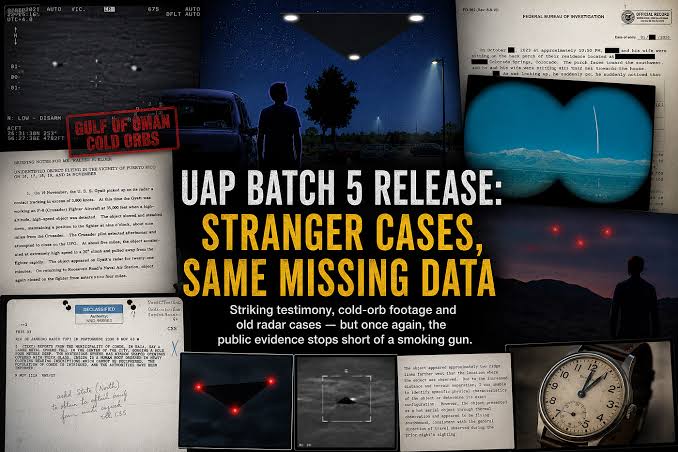
On August 7, 2026, the U.S. government released its fifth batch of UAP records through the PURSUE system. Forty-one records. Gulf of Oman sensor footage. FBI interview transcripts describing black, silent triangles. A 1953 Naval Photographic Interpretation Center film analysis. Project Sign documents from 1948. Eight decades of material released in a single morning.
Within hours, the usual cycle began.
Social media posts described the Gulf of Oman videos as proof of something extraordinary. The FBI triangle records were treated as confirmation of a specific craft. The 1953 film report became, in some corners, evidence of an advanced programme the government had concealed for seventy years.
The UFO Times is not immune to the pull of that narrative. We find these cases genuinely compelling. That is precisely why we hold them to a higher standard.
A declassification is not a disclosure. A release is not an explanation. What we have is more evidence that extraordinary things have been reported, investigated, and filed away. We do not yet have evidence of what those things are.
The Gulf of Oman Videos: Real Footage, Unresolved Questions
The videos are real. They were captured by U.S. military sensors and released through official channels. That is not in dispute.
What is in dispute is what they show.
The objects recorded appear as small, cold—infrared-dark, or “cold-orb”—returns moving across the sensor frame. The associated intelligence report describes movements that the crew considered unusual. The released clips, however, do not preserve enough range, platform, sensor and environmental data to independently validate the reported maneuvers or speed estimates.
But “difficult to explain” is not the same as “impossible to explain.”
The videos do not include altitude confirmation, radar cross-reference, simultaneous sensor data, or the platform flight parameters that would allow independent analysts to assess whether the apparent maneuvers represent genuine physical anomalies or artefacts of sensor optics, atmospheric effects, or viewing geometry.
We are not saying the objects are ordinary. We are saying the evidence available does not yet allow us to say they are extraordinary.
■ Official Footage — PURSUE Release 05
The Gulf of Oman sensor recordings are examined in our full technical analysis of Release 05, where we provide additional context on sensor type, viewing conditions, and the limits of what each clip can confirm independently.
Watch With Full Context →■ Our conclusion
Authentic government footage of unexplained sensor returns. The authentication is significant. The identification remains open. Official release does not equal official explanation.
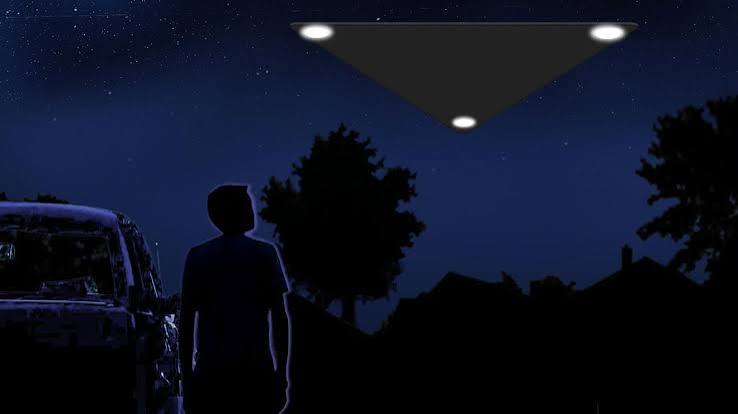 Artistic Reconstruction — Not a Photograph
This image is an artist’s reconstruction based on witness descriptions in FBI records. It is not a photograph, sensor image, or documentary record of any specific event. The UFO Times applies this label to all reconstructed imagery involving unidentified phenomena.
The FBI Triangle Records: Documented Accounts, Unresolved Observations
The released FBI documents describe interviews with multiple witnesses who reported observing large, silent, triangular aircraft—often at low altitude, often with no visible propulsion exhaust. Some estimates placed the objects at more than 300 feet across.
Those accounts are striking. The accounts are detailed and were formally documented by the FBI. The released interview summaries, however, contain no bureau conclusion verifying the witnesses’ physical estimates or identifying what they observed.
But the documents are interview summaries, not technical analyses. The FBI did not conclude that the objects represented exotic technology. The records establish that witnesses described observations they could not explain and that the FBI documented those descriptions. They do not establish the physical nature of the reported objects.
The documents do not establish the origin or nature of the objects. They preserve multiple witness descriptions of apparently triangular objects with unusual reported characteristics. Whether the separate observations shared a common cause remains unknown.
One critical caution: the triangular image circulating online and attributed to these records is an artist’s reconstruction, not a photograph or sensor image. We have applied the label “ARTISTIC RECONSTRUCTION—NOT A PHOTOGRAPH” to every use of that image in our coverage. This distinction matters more than most headlines have acknowledged.
1953 Naval Photographic Interpretation Center film analysis. The analysts examined footage from the Montana (1950) and Utah (1952) film cases. Their calculations were limited partly because object distance was assumed rather than measured. Their final determination was inconclusive. This document has been mischaracterized in some coverage as definitive evidence of a concealed programme.
Project Sign, established in 1947, was the first formal U.S. Air Force UFO investigation programme. Several later participants claimed that an internal “Estimate of the Situation” favored an interplanetary interpretation and was rejected or destroyed. No authenticated copy has entered the public record.
The 1953 Film Analysis and Project Sign: History That Cuts Both Ways
The 1953 Naval Photographic Interpretation Center film analysis and the Project Sign documents add historical depth without resolving the central question.
The analysis examined footage from the Montana (1950) and Utah (1952) film cases—two of the most-discussed UAP films of the early Cold War era. The analysts noted that object distance was assumed rather than measured, which limited the reliability of any speed or size calculations. Camera position, focal length, and the absence of a firm reference object further constrained their conclusions. Their final determination was inconclusive.
Project Sign—established in 1947 as the Air Force’s first official UFO investigation—underwent a significant internal debate. Several later participants claimed that Project Sign produced an “Estimate of the Situation” favouring an interplanetary interpretation and that senior Air Force leadership rejected or destroyed it. No authenticated copy has entered the public record, so the account remains historically important but not independently verifiable. The programme was reorganized as Project Grudge and later Project Blue Book. The investigative priorities, methods and institutional attitudes changed substantially under each successor programme. Historians continue to debate how seriously each pursued unresolved cases.
What these documents show is not quite what some have claimed: the historical record shows recurring institutional tension over how much personnel, funding and scientific attention UFO investigations should receive—not necessarily an agency that had answers it concealed.
If the later accounts are accurate, the rejection or destruction of that assessment would be historically significant. The surviving Release 05 records do not independently prove that episode. The records do not, however, prove what was in the sky. They show that the institutional response changed substantially and remains the subject of historical debate.
What the Release Actually Changes
The PURSUE release is significant. It adds to the public record. It demonstrates that the government is willing—under political and legislative pressure—to declassify material it previously held. That is worth noting.
But a declassification is not a disclosure. A release is not an explanation.
The Gulf of Oman videos remain unexplained. The triangle witnesses remain unresolved. The 1953 analysts concluded they could not conclude anything. The Project Sign suppression tells us more about institutional culture than about what was actually in the sky.
What we have is more evidence that extraordinary things have been reported, investigated, and filed away. We do not yet have evidence of what those things are.
■ The Pattern That Keeps Repeating
Each new release follows the same arc. Striking material enters the public record. Initial coverage tends toward the dramatic. Over the following days, researchers who apply stricter evidentiary standards begin identifying the limits of what the release actually shows.
The gap between headline and evidence is not a sign of a cover-up. It is a sign that the evidence is genuinely ambiguous—and that ambiguous evidence is difficult to communicate to a public that has been trained by decades of cinema, conspiracy culture and institutional opacity to expect either a full disclosure or a full denial.
We are getting neither. We are getting partial records confirming that UAP reports are real, recurring and treated as an official investigative matter—without establishing that all reports share one cause.
■ What The UFO Times Thinks
These files matter. The pattern they add to matters even more.
Across more than eight decades, United States military, intelligence, diplomatic and law-enforcement agencies have documented reports occurring across multiple decades and locations, interviewed witnesses, produced analyses that were sometimes withheld from full public view, and filed records that have now begun to emerge.
That accumulation is meaningful. It is not proof of any single explanation. But it is evidence of a sustained reporting and investigative problem involving incidents that may not all have the same explanation, and one that deserves serious scientific and journalistic attention.
We will continue to cover this story using the standard we have applied from our first edition: Facts First. Mystery Second. Speculation Last. The next release will come. When it does, we will examine it the same way.
One Archive, Four Different Types of Evidence
What each category of Release 05 material confirms—and where the public record still falls short.
| Evidence Type | Item | What It Confirms | What It Does Not Confirm |
|---|---|---|---|
| Sensor Video | Gulf of Oman cold-orb footage | Recorded returns on military sensors, released via official channels | Object identity, performance capabilities, or origin |
| Witness Docs | FBI triangle interview records | Multiple formally documented witness descriptions of triangular objects | Object origin, construction, or flight capability |
| Film Analysis | 1953 Naval Photographic Interpretation Center film analysis (Montana & Utah films) | Government awareness of the footage; the analysts’ own documented limitations | Object identity—analysts determined: inconclusive |
| Historical Programme | Project Sign (1948) | The official investigation and subsequent reorganisation are documented; the reported “Estimate of the Situation” survives only through later accounts | Extraterrestrial technology or government knowledge of object origin |
The Standard That Must Hold
Every PURSUE release will arrive with a wave of coverage that races ahead of the evidence. That is not dishonesty. It is the predictable response to genuinely compelling material in a subject where the public has been kept in the dark for decades.
Our role—and the standard we committed to in Edition No. 1—is to examine what the evidence actually shows, not what we hope it shows or fear it might show. We apply that standard to government agencies, to witnesses, to researchers, and to our own editorials.
Credible witnesses deserve to be heard. Official releases deserve scrutiny. Government agencies should release enough information for meaningful public and scientific evaluation. And extraordinary conclusions should require evidence strong enough to support them.
Facts First. Mystery Second. Speculation Last.
— The UFO Times Editorial Desk
■ Continue Your Investigation
Explore our ongoing coverage of the stories behind this week’s release:
- Pentagon UAP Files Release 05 — full editorial examination with footage →
- Government UAP files and official investigations →
- Voices of Disclosure — every major witness profile →
- Project Blue Book and the history of official UFO research →
- Military encounters and unforgettable cases →
The search for truth continues. Follow the investigation with The UFO Times.
Free Newsletter
Don’t Miss Edition No. 3
Every week: the strongest journalism, the most credible witnesses, the evidence that matters. No noise. Only what holds up.
No spam. Unsubscribe at any time.