
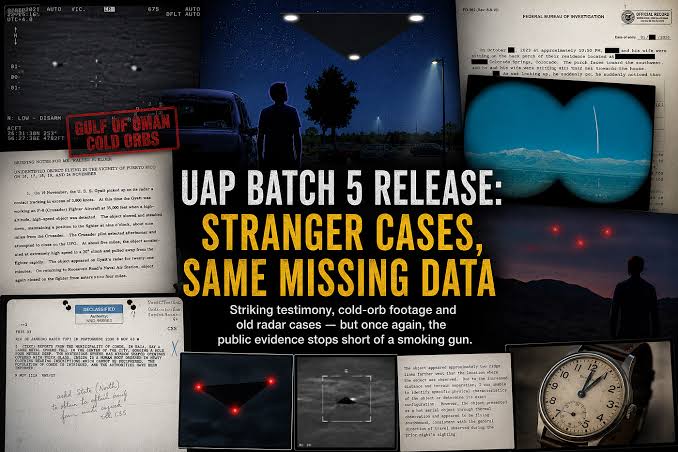
The United States Department of War published the fifth release of records under the Presidential Unsealing and Reporting System for UAP Encounters, known as PURSUE, on August 7, 2026. The official database identifies 41 records carrying the August 7 release date: 22 PDFs, 16 videos and three image files. The collection spans incidents reported from the 1940s through 2026 and includes material attributed to the Department of War, FBI, CIA, Department of State and Executive Office of the President.
Release 05 contains genuinely important material. It includes modern military sensor footage, witness interviews, historical intelligence assessments and government correspondence about reports that officials attempted to verify. But it does not provide one definitive answer to the UAP mystery.
Instead, the release demonstrates why every record must be classified according to what it actually represents. A military intelligence report is not the same as a completed scientific analysis. An interview summary is not physical evidence. An artistic reconstruction is not a photograph. An unresolved observation is not proof of an extraordinary origin. Those distinctions form the foundation of any serious examination of Release 05.
What Was Released?
The new records fall into several substantially different categories: historical government analyses of UFO photographs and reports; military infrared and electro-optical videos; intelligence reports containing observations from military personnel; FBI summaries of witness interviews; artistic renderings based on witness descriptions; diplomatic records documenting attempts to verify sensational stories; cases for which the released evidence remains inconclusive; and claims that official investigators found unsupported.
The presence of a record in PURSUE means that the material is connected to a UAP report or government inquiry. It does not mean that the government has authenticated every claim contained in that record.
The Gulf of Oman Encounter

One of the most consequential files concerns a U.S. military training exercise over the Gulf of Oman on September 8, 2021. According to an Intelligence Information Report designated DOW-UAP-D101, the crew of a U.S. Special Operations Forces AC-130 gunship observed approximately 25 instances of unidentified phenomena while conducting nighttime live-fire training.
The initial observation reportedly occurred after the aircraft deployed a water-activated flare as a mock target. When the aircraft’s electro-optical and infrared sensor returned to the flare, the crew reported seeing two objects that appeared cold in infrared. The objects were estimated to be approximately four feet in diameter and positioned between zero and 20 feet above the water. The report states that the objects remained stationary for approximately 15 seconds.
According to the crew’s account, the two objects moved rapidly away immediately before the aircraft’s 105mm cannon fired. The timing led the observers to believe that the objects had reacted to the weapon. During the remainder of the exercise, the crew reported additional cold, orb-like phenomena. Some were described as moving in coordinated formations. Others reportedly maneuvered erratically or aggressively. The crew estimated speeds ranging from approximately 250 to 1,300 miles per hour and reported seeing no visible means of propulsion.
If completely verified, these reported characteristics would be highly significant. But several limitations prevent the document from serving as conclusive evidence of extraordinary technology.
ⓘ Important Distinction
The Gulf of Oman document is an Intelligence Information Report containing collected information. It is not a finished intelligence assessment or an independent scientific validation of the crew’s estimates. The report is evidence that an extraordinary observation was recorded through official military channels. It is not proof that every initial interpretation of that observation was correct.
DOW-UAP-D101 establishes that a military crew reported these observations. It does not independently establish the objects’ actual size, distance, speed or origin. The estimates depend on the circumstances of the observation and the information available to the crew. Release 05 does not include an independent technical analysis validating every reported performance characteristic.
The Missing Gulf of Oman Data
The military crew reportedly attempted to preserve the complete electro-optical and infrared recording. According to the intelligence report, the aircraft’s digital video recorder failed and part of the desired video data became corrupted. Six associated videos — DOW-UAP-PR117 through DOW-UAP-PR122 — were included in Release 05.
These videos deserve careful analysis. However, the released footage does not preserve the entire encounter described in the intelligence report. It cannot independently demonstrate all the reported formations, accelerations or estimated speeds. A viewer may see areas of contrast moving through a sensor display. Determining the objects’ true velocity would require reliable information about range, sensor geometry, platform movement, magnification, tracking mode and environmental conditions. Without that complete information, apparent motion across a screen cannot automatically be converted into extraordinary physical performance.
▶ Examine the Official Gulf of Oman Files
Six videos associated with the September 8, 2021 Gulf of Oman report are included in Release 05. All six are available directly from the official PURSUE database and as part of the Release 05 video bundle.
Officially released footage associated with a 2021 Gulf of Oman crew report. The released footage does not independently demonstrate every movement, speed or performance characteristic described in the accompanying intelligence report.
The Gulf of Oman case therefore remains important — but unresolved.
The FBI Triangle Interviews
Release 05 also contains FBI interview records describing triangular objects reportedly observed during several separate incidents.
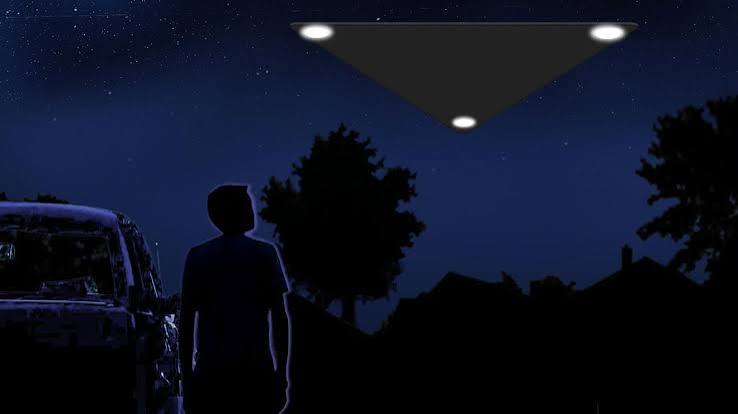
⚠ ARTISTIC RENDERING CREATED BY THE FBI IN 2026 FROM WITNESS TESTIMONY — NOT A PHOTOGRAPH
One file, FBI-UAP-D026, documents a January 2026 interview with a former Department of War employee about an observation near Colorado Springs in October 2023. The witness reported that the object appeared to pass at a relatively low elevation. It was described as a nearly perfect triangle, possibly dark gray or silver, with what appeared to be haze, ripples or visual distortion surrounding it. The witness initially perceived the object as almost translucent. A band of silvery-blue light was reportedly visible along its trailing edge.
The object was described as completely silent. The entire observation reportedly lasted approximately four seconds. The witness believed the object did not resemble conventional aircraft with which he was familiar. Nevertheless, no contemporaneous photograph, native sensor recording or physical evidence is included with the interview. The file documents the witness’s recollection. It does not establish what caused the observation.
A Second Colorado Springs Triangle
Another FBI interview, designated FBI-UAP-D030, records an October 2025 conversation concerning a separate 2023 incident near Colorado Springs. The witness described seeing a black triangular object emerge from what appeared to be a dark, distorted cloud. A red light was reportedly visible at each corner. The witness estimated that the triangle could have been as large as the parking lot where he was standing and potentially three to five stories thick. It was described as silent, surrounded by a mirage-like visual effect and capable of sudden acceleration.
These are remarkable claims. But the estimates were based on visual recollection rather than a published measurement from calibrated equipment. The FBI form also contains an explicit limitation: it represents an interview record and contains neither recommendations nor conclusions from the bureau. The existence of an FBI document does not mean that the FBI verified the object’s dimensions, speed or nature.
The Triangle Pictures Are Artistic Reconstructions
Release 05 contains images associated with several FBI interviews. These pictures may become some of the most widely shared materials from the release. They must not be mistaken for photographs of the reported objects. The accompanying descriptions state that the FBI produced the digital renderings in 2026 as visual aids based on witness accounts. They were created after the alleged events. They can help readers understand what witnesses attempted to describe. They cannot independently verify those descriptions.
A reconstruction illustrates testimony. It does not authenticate it. This is particularly important in the social-media environment, where an image can become separated from its original caption and circulated as supposed photographic evidence. Any responsible publication displaying these images should identify them prominently as artistic renderings — not bury that information in small print.
What Investigators Saw in the 1950 and 1952 Films
Another important file, DOW-UAP-D098, concerns an analysis of two historical films: one recorded in Montana in 1950 and another in Utah in 1952. The memorandum documents work conducted by the U.S. Naval Photographic Interpretation Center. Analysts attempted to evaluate photographed objects using contemporary photogrammetric techniques, including comparisons involving luminosity, apparent size and movement.
The investigators wrote that they could not identify the images as natural phenomena or commonly known human-made objects. Their analysis considered possibilities including birds, balloons, conventional aircraft, reflective surfaces and light sources. Some calculations produced apparently extreme velocities and accelerations. Taken alone, those figures sound extraordinary. But the document explains that they depended on important assumptions.
One assumption placed the objects approximately five miles from the camera. The report acknowledged that this distance was arbitrary. Changes in the assumed distance would affect the calculated size and velocity. The analysis also stated that the investigation lacked adequate equipment, funding and personnel. Its authors acknowledged that no attempt had been made to corroborate all the opinions presented and recommended additional testing. The document shows that trained analysts considered the films genuinely difficult to explain using the information and methods available to them. It does not mean that every historical calculation has been validated by modern analysis.
Project Sign and the Limits of Unexplained Reports
Release 05 also contains a collection of documents connected to Project Sign, an early U.S. Air Force effort to investigate reports of unidentified flying objects. The records demonstrate that the military did not simply ignore the reports. Investigators considered balloons, astronomical phenomena, optical effects, hallucinations, hoaxes, foreign aircraft and unconventional vehicles. They also acknowledged the possibility that some reported objects might have represented a national-security concern.
The report concluded that, in many cases, observers probably had seen something they could not classify within the limits of their experience. But that conclusion was not equivalent to confirming extraordinary aircraft. Many reports were associated with weather balloons, scientific balloons or astronomical bodies such as Venus. Other cases lacked sufficient information for a confident determination.
A smaller number remained without a reasonable everyday explanation. Yet investigators stated that they had obtained no physical evidence confirming the existence of extraordinary aircraft. They also considered the possibility of vehicles from another planet. The report concluded that tangible evidence supporting such an explanation was completely lacking. That distinction remains relevant almost eight decades later. A case can remain unexplained because the available evidence is incomplete. “Unexplained” describes the status of an investigation. It does not identify the cause.
A Reported UFO Crash in Brazil
Some of the most valuable records in Release 05 concern a story that did not withstand scrutiny. In November 1963, reporting circulated concerning an alleged crash near Conde in Bahia, Brazil. The story described a large metallic object and a deceased occupant supposedly wearing a uniform or spacesuit with strange markings. The claim attracted the attention of American officials, who sought local verification.
Records from the Executive Office of the President and Department of State document the inquiry. A subsequent diplomatic cable from the U.S. Embassy in Brazil, designated DOS-UAP-D002, reported that the story appeared to have been fabricated in Rio de Janeiro. The cable cited the absence of contemporary local reporting, contradictory newspaper accounts and a denial from the Brazilian Ministry of Aeronautics that any strange object had been present in Conde.
This case is particularly instructive. A sensational claim entered official government correspondence because officials attempted to determine whether it was true. The creation of those records did not authenticate the original story. Here, the documentary trail leads toward rejection rather than confirmation. The inclusion of the case strengthens the value of the archive because it demonstrates that PURSUE contains more than mysterious reports. It also contains evidence of investigation, contradiction and debunking.
What Release 05 Establishes
Release 05 establishes that American government agencies accumulated records concerning unusual observations across many decades. It confirms that military personnel, government employees and civilians have reported objects or phenomena they could not readily identify. It also shows that some government analysts treated these reports seriously and attempted to assess whether they represented technological or national-security concerns.
The Gulf of Oman report is especially important because it records observations attributed to a military aircrew operating an advanced sensor platform. The accompanying videos warrant methodical independent study. The historical files are equally valuable. They provide insight into how earlier investigators evaluated UFO reports, which explanations they considered and where their evidence proved inadequate. The FBI interviews preserve potentially important witness testimony, although testimony alone cannot determine the physical nature of an event. These records justify continued investigation.
What Release 05 Does Not Establish
The release does not establish that the unresolved objects were extraterrestrial spacecraft. It does not establish that they represented nonhuman intelligence. It does not validate every witness estimate of size, distance, altitude or speed. It does not transform artistic renderings into photographic evidence. It does not demonstrate that every video depicts an object exhibiting extraordinary performance. It does not eliminate conventional explanations that may become apparent through further technical analysis. Most importantly, it does not provide publicly available physical evidence that independently confirms an extraordinary origin.
Why the Evidentiary Gaps Matter
Several recurring problems appear throughout the release: missing or corrupted primary data; secondary recordings of sensor displays; digitally altered media presented as received; unverified distance and speed estimates; witness interviews conducted after an event; short observation periods; heavy redactions; artistic reconstructions easily confused with photographs; historical calculations built on uncertain assumptions; limited information about environmental and sensor conditions.
None of these limitations proves that the underlying observations were ordinary. But each limitation reduces the certainty of conclusions that can responsibly be drawn. A scientifically persuasive case would ideally include native sensor data, known range, calibrated instrumentation, environmental information, platform telemetry, independent sensors, contemporaneous witness statements and a documented chain of custody. Release 05 rarely provides that complete combination.
■ Key Takeaways
- Release 05 contains 41 records dated August 7, 2026 — 22 documents, 16 videos, 3 images. It is not the entire PURSUE database.
- The Gulf of Oman intelligence report records observations from a U.S. military AC-130 crew. It is collected information, not a finished intelligence assessment. The speed estimates attributed to the crew have not been independently validated.
- The six Gulf of Oman videos are officially released but do not preserve the complete encounter. Missing DVR data prevents independent verification of all reported maneuvers.
- The FBI triangle images are artistic renderings created in 2026 from witness testimony. They are not photographs. They must not be presented as photographic evidence.
- The 1953 film analysis is important evidence of official uncertainty, not final proof. Its velocity calculations rested on an assumed—not measured—camera-to-object distance.
- The Project Sign records confirm that early investigators found no physical evidence of extraordinary aircraft, including no evidence supporting a vehicle-from-another-planet explanation.
- The Brazil 1963 case is instructive precisely because government correspondence ultimately characterized the story as fabricated.
- The correct response to Release 05 is disciplined examination — neither automatic belief nor automatic dismissal.
The Most Responsible Conclusion
The fifth PURSUE release is meaningful. It expands the public record and gives independent researchers access to material that deserves serious examination. The Gulf of Oman report is compelling because of the number of reported observations, the military setting and the claimed behavior of the phenomena. The historical film analysis demonstrates that experienced analysts encountered imagery they could not comfortably explain. The FBI interviews preserve detailed accounts from witnesses who believed they observed unconventional triangular objects.
At the same time, the collection contains substantial evidentiary gaps. It includes reconstructions rather than photographs, incomplete footage rather than a complete sensor record and witness estimates rather than independently verified measurements. It even contains a sensational UFO crash story that government correspondence ultimately characterized as fabricated.
That mixture is not a weakness of the archive. It is the reality of UAP investigation. Some reports may eventually receive conventional explanations. Others may remain unresolved because the necessary data no longer exist. A smaller number could represent phenomena that require new investigation and better collection methods. The correct response is neither automatic belief nor automatic dismissal. It is disciplined examination.
Release 05 gives researchers more evidence to study. It does not give the public permission to claim more than that evidence demonstrates.
Facts First. Mystery Second. Speculation Last.
■ Related Coverage
- This Week at The UFO Times: What the Witnesses Saw—and What the Evidence Can Prove
- One Hundred Objects off Virginia: What AARO’s New UAP Report Actually Reveals
- Pentagon Releases Fourth Batch of UAP Files: More Transparency, More Questions
- Ryan Graves: What a 12-Year Veteran Naval Aviator Actually Told Congress
- David Fravor and the Nimitz Encounter: The Record, Examined — Voices of Disclosure
- David Grusch: The Whistleblower, the Allegations, and What Can Be Verified
- Lue Elizondo and the Birth of Modern UAP Disclosure
- Our Editorial Standards: How The UFO Times Covers UAP
■ Primary Sources
- PURSUE Database — Department of War, WAR.GOV/UFO
- Release 05 Announcement — Department of War, August 7, 2026
- DOW-UAP-D101 — Gulf of Oman Intelligence Information Report, 2021
- DOW-UAP-D098 — Film Analysis of Unidentified Objects, 1953
- DOW-UAP-D100 — Air Materiel Command Report (Project Sign), 1947–1948
- FBI-UAP-D026 — Dark Translucent Triangle Interview (FD-302)
- FBI-UAP-D030 — Large Triangle with Red Lights Interview (FD-302)
- DOS-UAP-D002 — Diplomatic Cable, Brazil, November 20, 1963
■ The UFO Times
Stay ahead of every release
New investigations, original analysis and the weekly briefing — direct to your inbox.