Eighteen years of service. Approximately five minutes of observation. An account that has remained remarkably consistent.
By The UFO Times Editorial Team · July 29, 2026
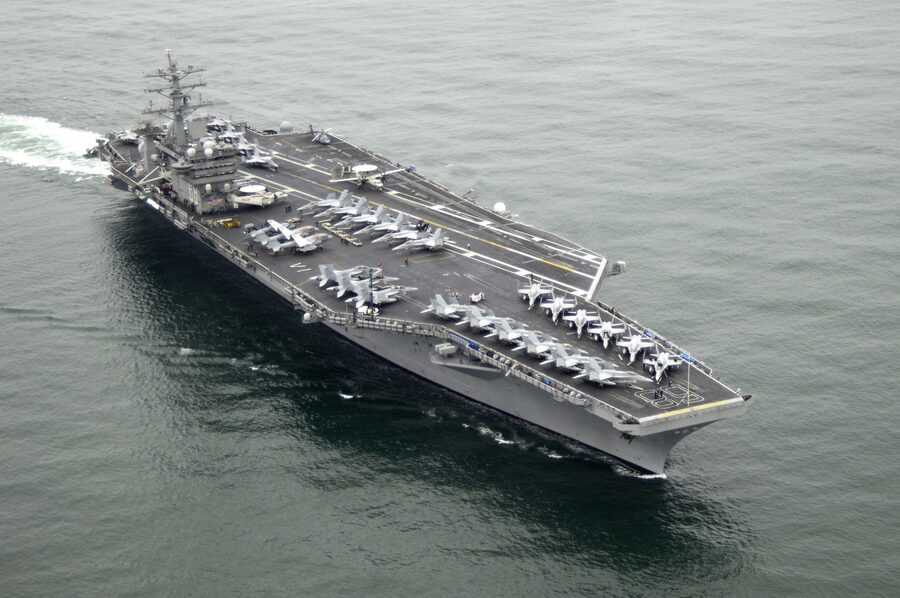
The USS Nimitz (CVN-68) carrier strike group was operating approximately 100 miles southwest of San Diego, California, on November 14, 2004, when Commander David Fravor was directed to investigate an unidentified contact. U.S. Navy / Public Domain.
On the morning of November 14, 2004, Commander David Fravor was flying a routine combat air patrol training exercise over the Pacific Ocean when his flight was redirected by the USS Princeton, an Aegis cruiser operating nearby. The Princeton had been tracking anomalous radar contacts for two weeks. No one on the ship had been able to explain them.
What Fravor encountered in the next several minutes has become the most scrutinised pilot UAP testimony in modern history — supported by fellow aircrew and associated with authenticated infrared footage recorded during a later flight. The footage was subsequently authenticated and officially released by the Department of Defense.
He has told the same story, in the same detail, without revision, for more than twenty years.
That consistency is not a minor detail. It is the core of his credibility.
The Man in the Cockpit
David Fravor retired from the United States Navy as a Commander after more than 18 years of active service. He is a graduate of the U.S. Naval Academy and a former commanding officer of the VFA-41 "Black Aces" — one of the Navy's premier F/A-18F Super Hornet strike fighter squadrons.
At the time of the 2004 encounter, he was not a junior pilot on his first deployment. He was a highly experienced combat aviator with thousands of flight hours, including missions flown during Operation Iraqi Freedom. He had spent his career operating in complex, high-stakes environments where accurate observation and measured reporting were professional requirements, not personal preferences.
This background matters because the UAP field is crowded with claims made by individuals whose qualifications are difficult to assess independently. Fravor's military record is not in dispute. His training, his rank, his operational history — all of it is publicly documented and independently verifiable.
When he describes what he saw on November 14, 2004, he is describing it as a man who had spent nearly two decades distinguishing between what he understood and what he did not.
What he encountered that morning, he did not understand.
The November 14 Encounter
The USS Princeton had been detecting unidentified objects on its advanced SPY-1 radar system for approximately two weeks before Fravor's flight. The objects were descending from altitudes above 80,000 feet, slowing to hover at around 20,000 feet, and then disappearing from the radar picture entirely. Senior Chief Kevin Day, the Princeton's air intercept controller, had been tracking them and flagging them as anomalous contacts. Nothing in his experience or training accounted for the behaviour.
On November 14, Fravor and his Weapons Systems Officer, Lieutenant Commander Jim Slaight, were directed to investigate along with a second F/A-18F crewed by Lieutenant Commander Alex Dietrich and her WSO. The four of them descended toward the area of interest approximately 100 miles southwest of San Diego.
What they saw was this:
A white, oblong object — approximately 40 feet in length, roughly the shape of a Tic-Tac candy — hovering above the ocean surface. Below it, the water was disturbed in a clearly visible circular pattern. There were no wings. No tail fins. No exhaust plume. No visible propulsion system of any kind.
The object appeared to be reacting to the aircraft below it. As Fravor began descending toward it in a spiralling approach, the object mirrored his movement — ascending to meet him, maintaining the same relative distance. When Fravor broke the spiral and turned directly toward it, the object accelerated away instantaneously. Not gradually. Instantly. It was gone.
Moments later, the Princeton's radar picked it up again at their combat air patrol point — a pre-briefed coordinate that Fravor's flight had discussed before takeoff — sixty miles away.
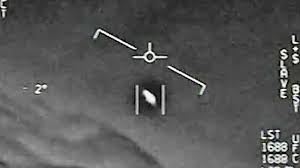
A second jet, equipped with a FLIR (Forward-Looking Infrared) pod, was subsequently scrambled. Lieutenant Chad Underwood later recorded an unidentified object associated with the same sequence of events. That footage became known as FLIR1. It was later leaked to the public, and officially declassified and released by the Pentagon in April 2020. The public record does not conclusively establish that the object in the FLIR footage is the identical object Fravor observed visually — though both are associated with the same reported incident.
A still from the FLIR1 infrared footage captured during the USS Nimitz encounter, November 2004. The Pentagon officially confirmed and released this footage in April 2020. The object displayed no wings, no exhaust plume, and no visible means of propulsion. U.S. Navy / Public Domain.
Some Princeton crew members have alleged that data or recordings were removed after the incident. Fravor's 2023 written testimony to the House Oversight Committee, however, states that tapes were never taken. Without the original records or an official investigation resolving these conflicting accounts, the fate of the radar data remains disputed.
What Fravor Actually Said
Fravor has given interviews to news organisations, appeared before Congress, and spoken at length on podcasts. His account has been consistent across all of them. The following are paraphrases reflecting positions he has expressed repeatedly in public statements; specific sources are indicated for each.
On the object's physical description:
Fravor has consistently described the object as white, smooth and oblong, with no wings, no exhaust plume, and no visible markings — and as moving in ways unlike anything he had seen in his flying career.
Fravor has said that as he descended toward the object, it moved to mirror his position — as if aware of his approach — before accelerating away when he turned directly toward it.
Fravor has said he is certain the object was not anything in his experience — not any aircraft he had trained against, tested, or encountered — and that it displayed performance characteristics beyond anything in the publicly known aerospace inventory of the time.
Fravor has been consistent in not claiming he knows what the object was. He does not identify it as extraterrestrial. He identifies it as something outside his experience and outside the publicly known aerospace inventory — no further.
That distinction is important and frequently missed in coverage of his testimony. In formal testimony, Fravor has not claimed definitive knowledge of the object's origin, although he has occasionally expressed his personal belief that it may represent something extraordinary — including a 2017 interview in which he said he believed the object was "not from this world." The difference between a personal belief and a sworn evidentiary claim matters under any serious editorial standard.
The Evidence: Four Witnesses, One Video
What separates the Fravor account from the majority of UAP testimonies is not the seniority of the observer. It is the corroboration.
Four military aircrew were present during the visual encounter: Fravor and Slaight in one aircraft, Dietrich and her WSO in the second. All four have confirmed the substance of what they saw, though their descriptions of their personal reactions vary. Lieutenant Commander Alex Dietrich has spoken publicly about the incident, describing the object as "clean" — no markings, no exhaust, no wings — and acknowledging that it moved in ways she could not explain.
The Princeton's radar operators tracked the object before, during, and after the encounter. Senior Chief Kevin Day has described in detail the anomalous radar track that preceded Fravor's flight — objects descending from extreme altitude, decelerating to hover, then disappearing. That behaviour, if the radar data is accurate, describes performance characteristics that no publicly known aircraft of that era could replicate.
The FLIR video captured by Chad Underwood shows an object that maintains a stable infrared signature while accelerating out of the camera's field of view. Pentagon officials confirmed the footage's authenticity in 2020 and stated that it was captured by U.S. Navy personnel.
The combination — four visual witnesses, radar corroboration from a separate platform, and authenticated infrared footage — makes the Nimitz encounter among the most evidentially supported pilot UAP cases in the public record. There are cases with more dramatic claims. Few modern military UAP cases combine testimony, multiple witnesses and authenticated imagery as prominently as the Nimitz encounter.
Evidence at a Glance
Evidence
Status
Fravor's eyewitness account
ESTABLISHED Consistent across 20+ years of public statements
Three corroborating witnesses (Slaight, Dietrich, WSO)
ESTABLISHED All four aircrew confirm the core account
FLIR1 infrared video (Pentagon-confirmed)
ESTABLISHED Officially released and authenticated by DoD, April 2020
USS Princeton radar data (SPY-1)
CREDIBLE Described by crew; raw data has not been publicly released and its ultimate disposition is disputed
Princeton radar tapes "taken" after incident
DISPUTED Some crew members allege removal; Fravor's 2023 sworn statement says tapes were never taken. Conflicting accounts; unresolved
Object of non-human origin
UNSUPPORTED Not claimed by Fravor; no publicly verifiable evidence
Why It Took Thirteen Years
The encounter happened in November 2004. The public did not hear about it until December 2017 — when the New York Times published an investigation into AATIP, the Pentagon's secret Advanced Aerospace Threat Identification Program. Fravor was one of the named witnesses. The FLIR1 video accompanied the story.
In the intervening thirteen years, Fravor did not go silent by accident. He described the encounter to Navy colleagues and mentioned it when asked, but there was no institutional pathway for bringing it to public attention. The UAP reporting culture within the military actively discouraged disclosure. Pilots who reported anomalous aerial contacts risked professional consequences and peer ridicule. The system created incentives to say nothing.
It was the existence of AATIP — and the reporters who discovered it — that created the conditions in which Fravor's account could finally reach a public audience.
This context matters because it is part of the evidence. If an experienced commanding officer with a spotless record spent thirteen years mentioning this encounter only quietly, in private, without seeking publicity or financial gain, that is relevant to assessing his motivations. The behaviour is consistent with someone who witnessed something they cannot explain and did not know what to do with that knowledge.
It is not consistent with fabrication.
Where Things Stand Today
Since going public in 2017, Fravor has testified before Congress, participated in public hearings, and spoken extensively with journalists and researchers. He is not a fringe figure. He has been taken seriously by the institutions that have examined UAP evidence, including the Senate Armed Services Committee and the House Oversight Committee.
The Department of Defense's acknowledgement of the FLIR footage in 2020 was significant. The Pentagon's statement confirmed that the video was shot by U.S. Navy personnel and that the object in the footage remained "unidentified." That word — officially applied by the DoD to an object encountered by a senior naval officer and captured on authenticated footage — carries weight that should not be underestimated.
Fravor continues to maintain that what he saw cannot be explained by anything in the publicly known aerospace inventory. He has said he would welcome a full investigation with access to the radar data from the Princeton — data whose ultimate fate, as noted above, remains a matter of conflicting accounts among crew members.
That data has not been released.
What Has Not Happened
In the interests of accuracy, this profile records not only what has been established but what has not.
The full Princeton radar data has never been publicly released. The individuals alleged to have removed recordings from the ship have not been identified or named in any official investigation. No government body has publicly provided a conventional explanation for what Fravor and his crew observed. No government body has confirmed it was extraterrestrial.
The FLIR footage, while authenticated, shows an infrared return. It does not, by itself, confirm any particular origin for the object. Image analysts have offered differing interpretations of what the footage shows, including the possibility of camera artefact effects in the final moments when the object appears to accelerate. Fravor disputes those interpretations based on his direct visual observation.
None of this undermines the core of his account. What it establishes is the boundary between what is documented and what remains open. That boundary matters. Fravor himself does not cross it. He describes what he saw. He does not claim to know what it was.
The UFO Times Assessment
Category
Rating
Notes
Influence
★★★★☆
The NYT story built on his account helped shift UAP from fringe subject to congressional agenda; influence is principally evidential rather than political
Credibility
★★★★★
18 years military service, commanding officer, account corroborated by three independent witnesses, consistent over 20+ years without revision
Public Evidence
★★★★☆
Pentagon-authenticated FLIR video, four corroborating witnesses, radar descriptions from Princeton crew; raw radar data not publicly released
Scientific Value
★★★☆☆
Eyewitness account from a highly trained observer; the encounter produced authenticated video but no instrument data from his aircraft; radar data from Princeton not yet publicly available
Historical Significance
★★★★★
The Nimitz encounter is the pivotal UAP case of the modern era — the case that, more than any other, moved the subject from speculation into institutional acknowledgment
Editorial Perspective
Commander David Fravor occupies a unique position in this series. He is not a whistleblower making extraordinary claims about classified programmes. He is not a politician using UAP as a lever for oversight battles. He is a highly credible witness who saw something he cannot identify, said so plainly, and has not embellished that account in twenty years. The Nimitz encounter's significance rests not on what Fravor has claimed, but on what has been officially confirmed: that a U.S. Navy commanding officer and three fellow aircrew encountered an object that the Pentagon itself describes as unidentified. That is the documented record. Everything beyond it remains, appropriately, an open question.
Recommended Reading
UFOs: Generals, Pilots and Government Officials Go on the Record — Leslie Kean (2010)
The book that established the evidentiary benchmark Fravor's account now exemplifies — rigorous testimony from credible military and government observers, assessed against the available evidence. Kean's methodology is the standard by which UAP reporting should be judged.
Skinwalkers at the Pentagon — James Lacatski, Colm Kelleher & George Knapp (2021)
The inside account of AATIP — the Pentagon programme that formally investigated the Nimitz encounter. Written by three of the people closest to the programme, it provides essential context for understanding why Fravor's account received serious institutional attention and what came of that attention.
A scholar of religion examines how the UAP phenomenon functions in contemporary culture — why encounters like Fravor's become focal points, how belief and evidence interact, and what it means that credible people are having experiences that existing frameworks cannot accommodate.
Fravor and Dietrich — CBS 60 Minutes Interview CBS News / 60 Minutes, May 16, 2021. The most extensive television interview with both Fravor and Lieutenant Commander Alex Dietrich on the 2004 encounter.
Voices of Disclosure profiles the individuals who have significantly shaped the modern UAP conversation. Our goal is to help readers understand who is driving the discussion, what their contributions are, and how much of the evidence supporting their claims is publicly verifiable. Inclusion in this series does not imply endorsement of every claim made by the individual profiled.