
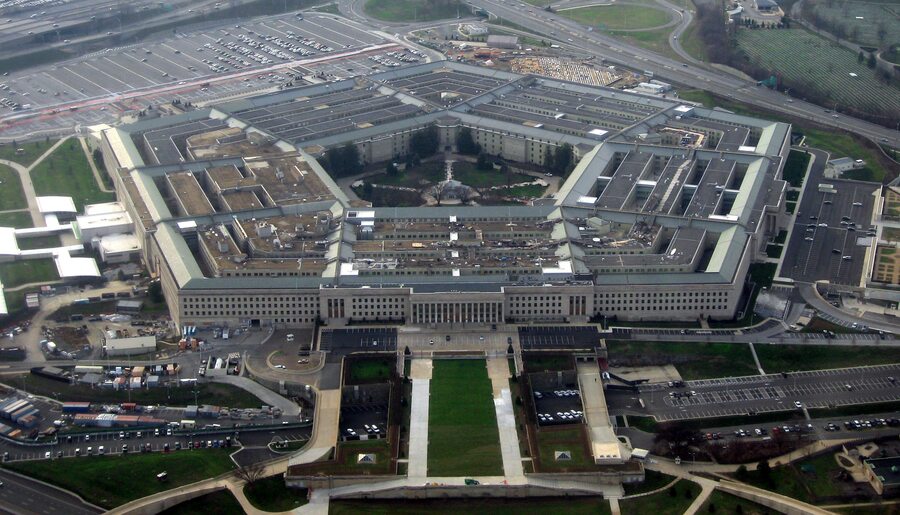
The Pentagon, Arlington, Virginia. In July 2022, the Department of Defense formally established the All-domain Anomaly Resolution Office — AARO — within its walls. It was the first permanent, congressionally mandated office in American history dedicated to investigating UAP.
By the summer of 2022, Congress had done something remarkable. Through a combination of intelligence authorization riders, National Defense Authorization Act provisions, and bipartisan pressure applied over two years, it had forced the most powerful military in the world to create an office whose explicit purpose was to investigate UFOs.
Not informally. Not in a classified annex that could be defunded and buried. Permanently. In statute. With a director confirmed by the Secretary of Defense, a mandate to report to Congress, and a legal obligation to establish a system for receiving reports from military and intelligence personnel — reports that, for decades, those same personnel had been discouraged or actively prohibited from making.
The office was called the All-domain Anomaly Resolution Office — AARO. It stood up officially on July 15, 2022.
How it got there — and what happened after — is the story of Part III.
Before AARO: A Graveyard of Half-Measures
To understand what AARO represented, you need to understand everything that came before it — and why none of it worked.
Project Sign (1948), Project Grudge (1948–1951), Project Blue Book (1952–1969): the Air Force ran all three, and all three shared a common feature. They were not designed to find answers. They were designed to manage public perception. When Blue Book was dissolved in 1969 following the Condon Report's dismissal of UFO phenomena as scientifically unworthy of study, the official position became: there is no program because there is nothing to study.
That position held, publicly, for nearly five decades.
Privately, the story was different. The Advanced Aerospace Weapon System Applications Program — AAWSAP — ran from 2007 to 2012 under a classified contract managed by the Defense Intelligence Agency. Its successor, the Advanced Aerospace Threat Identification Program — AATIP — continued through at least 2012 and possibly longer. Both were funded at the initiative of Senator Harry Reid, a Nevada Democrat who had been briefed on UAP incidents involving military assets and concluded that the subject warranted serious investigation.
Neither AAWSAP nor AATIP had any public existence until 2017, when the New York Times and Politico published their joint investigation revealing both programs' existence, Luis Elizondo's role in AATIP, and the existence of videos — FLIR1, Gimbal, GoFast — showing encounters between Navy aircraft and unidentified objects displaying extraordinary flight characteristics.
The 2017 revelation created a pressure that the Pentagon could not fully contain. The question "what are you doing about this?" now had a public audience. What followed was a sequence of institutional half-measures, each creating enough bureaucratic architecture to claim action while retaining enough flexibility to avoid accountability.
The UAP Task Force: A Floor, Not a Ceiling
In August 2020, the Deputy Secretary of Defense established the UAP Task Force — UAPTF — within the Office of the Under Secretary of Defense for Intelligence and Security. Its mandate was to detect, analyze, and catalog UAP that could potentially pose a threat to U.S. national security.
The Task Force was a meaningful step in one sense: it was the first official acknowledgment since Blue Book's dissolution that UAP were a legitimate national security concern. But it had fundamental structural problems. It was not established by Congress. It had no independent subpoena power. It had no formal mechanism to compel reporting from the intelligence community's other agencies. And its classification level meant that whatever it found would not be shared with the public or even, in most cases, with Congress.
The Rubio Amendment — which we examined in Part II — had mandated the UAPTF's creation and required the Director of National Intelligence to produce a report within 180 days. That report, delivered to Congress in June 2021 and partially released to the public, acknowledged 144 UAP incidents, could not explain 143 of them, and noted that the data quality was insufficient to reach any definitive conclusions.
The 2021 ODNI report was simultaneously a breakthrough and a disappointment. A breakthrough because it was the first official document to admit that UAP were real, unexplained, and potentially threatening. A disappointment because it raised the bar for what "unexplained" meant — and then said almost nothing about what lay behind it.
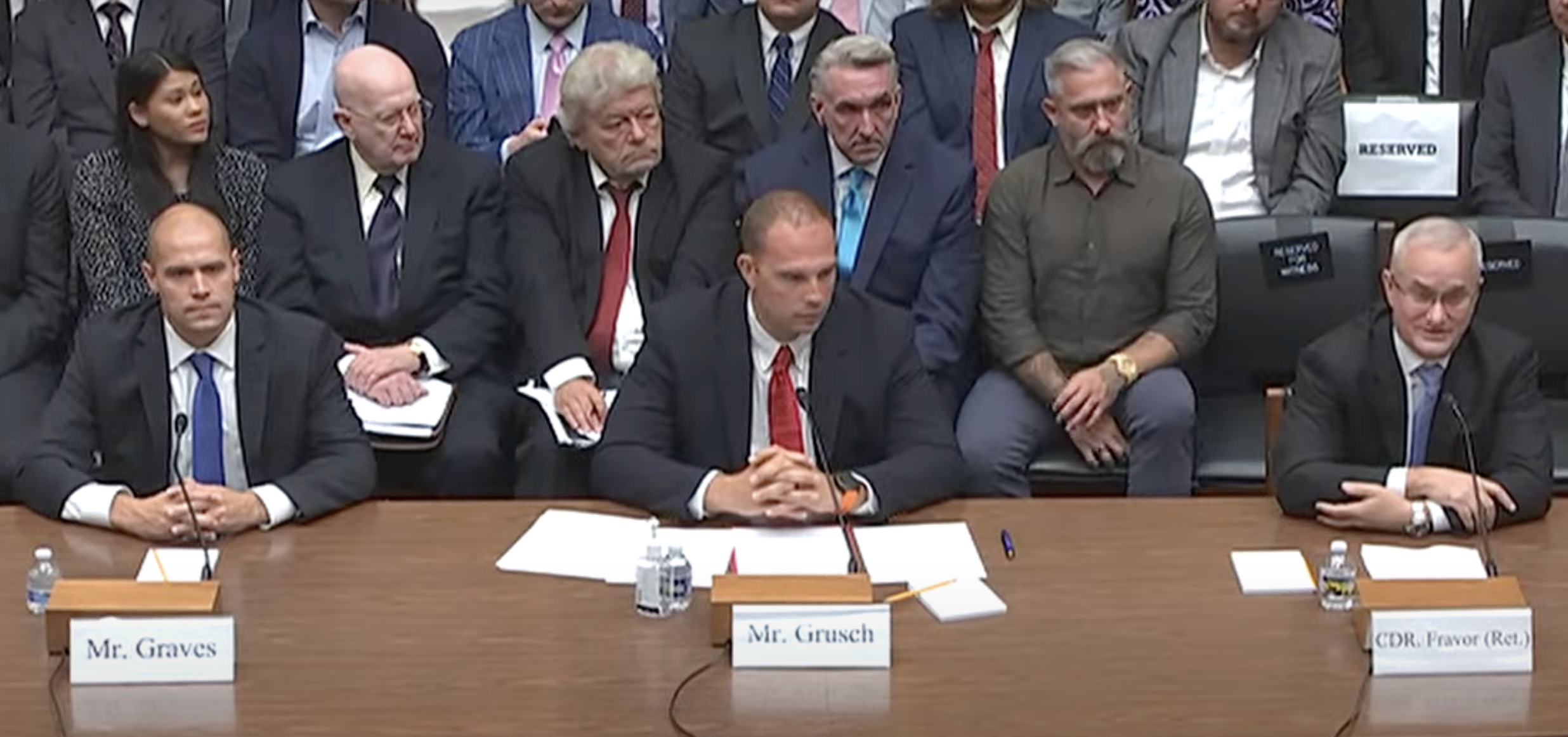
The July 26, 2023 congressional UAP hearing — the most significant public testimony on UFOs in the history of the United States Congress. David Grusch testified under oath that the U.S. government possesses non-human craft and biological materials. His testimony came months after AARO's first director, Sean Kirkpatrick, had publicly questioned the evidence for exactly this claim.
Building AARO: The 2022 NDAA
The National Defense Authorization Act for Fiscal Year 2022 — passed in December 2021 — contained the legislative architecture that would replace the UAPTF with something more permanent. Section 1683 directed the Secretary of Defense to establish, within 180 days, a "Unidentified Aerial Phenomena Joint Program Office" — language that was subsequently modified to produce AARO.
The key differences between AARO and its predecessors were structural. AARO was established in statute, not by executive memorandum, meaning it could not simply be dissolved by a future administration without Congressional action. It was given a broader mandate — "all-domain" meant it covered not just aerial phenomena but also transmedium and underwater anomalies. It was required to report to both the Secretary of Defense and, critically, to Congress. And the 2022 NDAA included provisions for a secure reporting mechanism — a way for military and intelligence personnel to come forward with UAP information without fear of retaliation.
Sean Kirkpatrick, a physicist and career intelligence officer, was appointed AARO's first director. He came with substantial credentials: a PhD in physics from the University of Tennessee, experience at the DIA and DARPA, and a reputation for rigorous analytical thinking. His appointment signaled that the Pentagon was serious about bringing scientific credibility to the enterprise.
That credibility became the center of controversy almost immediately.
AARO's First Year: Data, Skepticism, and Friction
In AARO's first year of operation, Kirkpatrick was publicly consistent: the available evidence did not support claims of extraterrestrial craft or government possession of non-human technology. He testified before Congress in April 2023 that AARO had found no credible evidence supporting these claims, and that of the several hundred cases in its database, the overwhelming majority had mundane explanations — balloons, drones, sensor artifacts, atmospheric phenomena.
That testimony came three months before David Grusch, a former senior intelligence official and AARO detailee, went public with his claims that the U.S. government not only possessed non-human craft and biological materials but had maintained a decades-long, multi-contractor retrieval and reverse-engineering program — a program specifically designed to be hidden from Congressional oversight through a misuse of special access program authorities.
The contrast was stark. AARO's director was telling Congress there was nothing to see. A former AARO detailee was telling Congress — and two investigative journalists, and the Intelligence Community Inspector General, who found his claims "credible and urgent" — that there was everything to see.
This was not a simple disagreement about data. It was a disagreement about whether AARO had access to the data that would settle the question. Grusch's core claim was that the most sensitive UAP programs were specifically excluded from AARO's access — that the office had been given a mandate to investigate UAP while being denied access to the compartmented programs that would answer the most important questions.
AARO operates under the authority of the U.S. Department of Defense. Critics argue this is precisely the problem: an office designed to investigate potential government programs is housed within, funded by, and accountable to the government it is supposed to be investigating.
The Access Problem
The question of access sits at the center of every serious critique of AARO — and it is a question with no easy answer.
If Grusch and other whistleblowers are correct that the most sensitive UAP programs are classified at a level that AARO's personnel cannot reach, then AARO's public conclusions — "no credible evidence of non-human technology" — are meaningless. They reflect not the absence of evidence but the absence of access. An office that cannot see the relevant programs cannot be expected to find what those programs contain.
The 2022 NDAA attempted to address this by establishing a mechanism for UAP-related whistleblowers to report to Congress directly. The Intelligence Authorization Act of 2023 went further, establishing that UAP whistleblowers could come forward through the Inspector General of the Intelligence Community without fear of retaliation, and that their disclosures would be protected as protected disclosures under existing whistleblower statutes.
But the fundamental structural problem remained: AARO is a creature of the Pentagon. It is funded by the Pentagon. Its director was appointed by and reported to the Secretary of Defense. Asking AARO to investigate whether the Pentagon was hiding UAP programs from Congress was, critics argued, structurally indistinguishable from asking the police department to investigate itself.
This critique intensified in March 2024 when AARO published its Historical Record Report — a review of UAP programs going back to 1945. The report concluded that it had found no credible evidence of any U.S. government program involving the possession or reverse-engineering of extraterrestrial technology, and dismissed the claims of whistleblowers like Grusch as based on misidentification, rumor, and the misclassification of legitimate programs.
Congressional reaction was not uniformly positive. Members of the House Oversight Committee who had heard testimony from Grusch and other witnesses publicly questioned whether AARO had the access it needed to reach those conclusions. Senator Kirsten Gillibrand, who had been one of AARO's strongest legislative champions, stated publicly that she had concerns about the completeness of the records AARO had reviewed.
Kirkpatrick's Exit — and What It Means
Sean Kirkpatrick announced his departure as AARO director in December 2023, having served approximately 18 months. In a co-authored paper released shortly after his departure — written with Avi Loeb, the Harvard astronomer who had conducted his own UAP investigation — Kirkpatrick discussed UAP in a broader scientific context that suggested his views were more nuanced than his Congressional testimony had implied.
His departure left AARO without a permanent director during a period when the office's credibility was under sustained challenge from members of Congress on both sides of the aisle. The leadership vacuum coincided with a period of maximum legislative pressure: the UAP Disclosure Act had passed the Senate in 2023 and was awaiting House action, and multiple whistleblowers were in various stages of coming forward through Inspector General channels.
Whether Kirkpatrick left because he had accomplished what he set out to do, or because he concluded the mission was structurally impossible, or for reasons entirely unrelated to the UAP question, is not publicly known. What is known is that the office he led — the most serious institutional attempt in American history to investigate UAP — had, by the end of his tenure, generated more controversy than resolution.
The Honest Assessment
AARO was a significant institutional development. For the first time in American history, the U.S. military had a permanent, congressionally mandated office whose explicit purpose was to investigate UAP — not deny them, not manage public relations around them, but investigate them. That matters, regardless of what the office has or has not found.
At the same time, the structural critiques of AARO are serious and have not been answered. An office that cannot access the most sensitive UAP-related programs cannot reach meaningful conclusions about those programs. An office accountable primarily to the institution it is supposed to investigate faces an inherent conflict that no amount of stated independence can fully resolve.
The question of whether AARO is a genuine investigative body or a sophisticated mechanism for managing the disclosure problem — keeping it institutional, keeping it controlled, and ensuring that whatever emerges emerges on the Pentagon's timeline and in the Pentagon's framing — is not one that can be answered by examining AARO's public statements. It can only be answered by what Congress does next.
That brings us to Part IV: the whistleblowers — the men and women who decided that waiting for AARO to find the truth was not something they were willing to do.
■ The UFO Times Evidence Scale
How we rate the key claims in this article.
AARO was established by DoD on July 15, 2022, pursuant to the FY2022 NDAA. Sean Kirkpatrick served as its first director and departed in December 2023. AARO's 2024 Historical Record Report found no confirmed evidence of extraterrestrial technology. David Grusch served as an AARO detailee before becoming a whistleblower. The ICIG found Grusch's claims "credible and urgent."
Grusch's specific claims about the existence and content of crash retrieval programs. Senator Gillibrand's public concerns about the completeness of AARO's records review. Claims that compartmented programs are structured specifically to exclude AARO oversight.
That AARO was deliberately designed to provide the appearance of investigation without the substance. That Kirkpatrick's departure was connected to frustration with the structural access problem. These are possible interpretations of ambiguous evidence, not established facts.
That AARO's negative findings definitively prove no government UAP programs exist. Absence of evidence in a system with restricted access is not evidence of absence. Neither AARO's conclusions nor its critics' counter-claims can be accepted as definitive without full access to the relevant programs.
Continue the Series
Recommended Reading
Skinwalkers at the Pentagon — James T. Lacatski, Colm Kelleher & George Knapp (2021)
The classified AAWSAP programme that preceded AATIP and AARO — written by the programme’s first director. Essential context for understanding how the modern UAP infrastructure came to exist inside the Pentagon.
View on Amazon →UFOs and the National Security State — Richard Dolan (2002)
The most comprehensive historical account of the U.S. government’s classified engagement with UAP — from 1941 through the Cold War. Volume 1 of the definitive academic treatment of the national security dimension.
View on Amazon →A.D. After Disclosure — Richard Dolan & Bryce Zabel (2012)
What happens after a government body like AARO makes a historic acknowledgement? Dolan and Zabel map the likely political, institutional, and cultural aftermath — still the most serious treatment of the post-disclosure world.
View on Amazon →Related Articles
- David Grusch: The Intelligence Official Who Testified Under Oath
- AARO: What the Pentagon's UAP Office Has — and Hasn't — Found
- Congress to White House: Grant Immunity and Whistleblowers Will Reveal Locations of Craft
- Luis Elizondo and the AATIP Revelation
- The Full History of Congressional UAP Hearings
Further Reading
The books that track the disclosure arc from AATIP to AARO — investigative journalism, insider accounts, and the political history of UAP in Washington.
Browse the UFO Times Bookstore →