
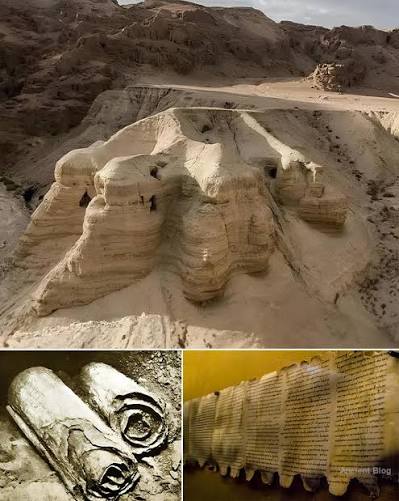
The entrance to Qumran Cave 4, cut into the marl terrace above the Dead Sea. This single cave yielded fragments of approximately 575 different manuscripts — the largest and most diverse cache among the eleven caves excavated between 1947 and 1956. The cave was discovered by archaeologists in 1952, five years after the initial Bedouin discovery.
■ Primary Source — The Great Isaiah Scroll (1QIsa¹), c. 125 BC
“For a child will be born to us, a son will be given to us; and the government will rest on His shoulders; and His name will be called Wonderful Counselor, Mighty God, Eternal Father, Prince of Peace.”
— Isaiah 9:6, as preserved in the Great Isaiah Scroll (1QIsa¹) — the oldest complete copy of any biblical book, dated to approximately 125 BC and discovered in Cave 1 at Qumran in 1947. Its text closely matches the Hebrew Bible manuscripts copied more than a thousand years later.
One of the most significant archaeological discoveries of the twentieth century began with an act of carelessness. A young Bedouin shepherd threw a stone into a cave he had never entered, and heard pottery break.
What tumbled out of those tall clay jars — leather scrolls wrapped in linen, sealed for nearly two thousand years — would transform the study of the Hebrew Bible, reveal a lost world of Second Temple Judaism, and provide the earliest surviving manuscript evidence for some of the most important religious texts ever written.
The Dead Sea Scrolls are not a single document. They are a library — nearly 900 manuscripts and tens of thousands of additional fragments, composed and copied across several centuries, hidden in eleven caves in the Judean desert and left undisturbed from roughly the first century AD until the mid-twentieth century.
At The UFO Times, we cover the Dead Sea Scrolls here because they are directly relevant to two subjects we investigate with care: the Book of Enoch (whose earliest surviving manuscripts were found among the Scrolls) and the broader question of how ancient texts have been transmitted, interpreted, and sometimes misrepresented across the centuries. Our approach is the same as always: primary source first, archaeological context second, scholarly interpretation third, and speculation last.
A Timeline
3rd century BC
Earliest Scrolls composed. The oldest manuscripts among the Dead Sea Scrolls — portions of Deuteronomy, Samuel, and the Aramaic texts later associated with the Book of Enoch — are written. These predate the community at Qumran by generations.
c. 150 BC – 68 AD
Qumran active. The settlement at Qumran is occupied. Manuscripts are copied, studied, and collected. The community produces its own distinctive texts, including the Community Rule, the War Scroll, and the Thanksgiving Hymns.
c. 125 BC
Great Isaiah Scroll copied. The complete Isaiah manuscript (1QIsa¹), now housed in the Israel Museum’s Shrine of the Book, is written by a single scribe. It will remain undisturbed in Cave 1 for more than two thousand years.
68 AD
Qumran destroyed. Roman legions advancing through Judea during the First Jewish Revolt attack and destroy the Qumran settlement. The community, or refugees carrying their most precious manuscripts, hides the scrolls in caves throughout the surrounding cliffs. None return to retrieve them.
Spring 1947
Cave 1 discovered. Muhammad edh-Dhib, a young Bedouin shepherd of the Ta’amireh tribe, throws a stone into a cave and hears pottery break. He and a companion enter the cave and find seven intact scrolls in tall clay jars. The Dead Sea Scrolls have been found.
1949–1956
Eleven caves excavated. Archaeologists and Bedouin searchers systematically explore the Qumran cliffs. Ten additional caves yield manuscripts and fragments. Cave 4 alone produces fragments of approximately 575 different manuscripts — the most significant single cache of the entire discovery.
1991
Full scholarly access granted. After decades during which access to unpublished scroll fragments was restricted to a small team, the Huntington Library releases photographs of all the scrolls. The Israel Antiquities Authority subsequently makes the full collection available to researchers worldwide. The era of restricted access is over.
Today
Global digital archive. The Leon Levy Dead Sea Scrolls Digital Library, operated by the Israel Antiquities Authority in partnership with Google, makes high-resolution images of thousands of scroll fragments freely available online. Scholars continue to identify and publish new material. The Scrolls remain one of the most intensively studied manuscript collections in history.
A Chance Discovery
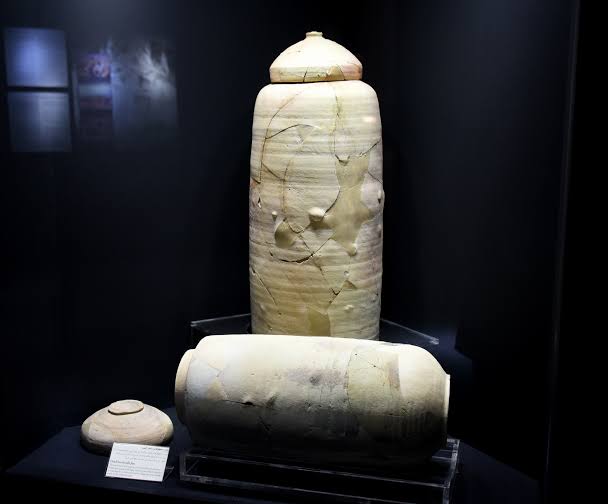
Tall clay storage jars of the type used to preserve the Dead Sea Scrolls. The manuscripts were wrapped in linen cloth, sealed inside these jars, and concealed in the caves of the Judean desert — where the dry climate preserved them for nearly two thousand years.
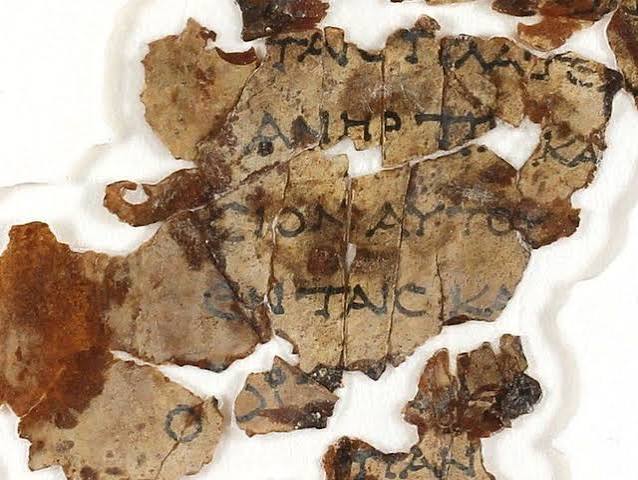
Fragments of Dead Sea Scrolls under study. Most of the material recovered from the Qumran caves is fragmentary rather than intact — tens of thousands of pieces that scholars have spent decades piecing together, identifying, and publishing.
The traditional account of the discovery places it in the spring of 1947. Muhammad edh-Dhib, a young Bedouin shepherd of the Ta’amireh tribe, was searching for a lost goat in the cliffs northwest of the Dead Sea. He threw a stone into a cave opening in the marl terrace and heard the unmistakable crack of breaking pottery.
When he entered the cave, he found several tall clay jars — some intact, some broken. Inside were leather scrolls wrapped in linen cloth, remarkably well-preserved by the extreme dryness of the Judean desert climate. He and a companion took several scrolls and brought them to Bethlehem, where they passed through the hands of antiquities dealers before scholars understood what they had found.
The seven scrolls from Cave 1 eventually came to the attention of Eleazar Sukenik, a Hebrew University archaeologist, and later of John Trever and William Brownlee of the American Schools of Oriental Research. When Sukenik identified them as genuinely ancient, the scholarly world was electrified.
What followed was one of the great archaeological hunts of the modern era. Between 1949 and 1956, teams of archaeologists and Bedouin searchers systematically scoured the cliffs around Qumran. They found eleven caves containing manuscripts — ranging from the seven nearly intact scrolls of Cave 1 to the enormous trove of tens of thousands of fragments in Cave 4.
■ Did You Know?
- The Great Isaiah Scroll is more than 1,000 years older than the oldest complete Hebrew Isaiah manuscript previously known to scholars — yet its text differs only minimally from later copies.
- Fragments of the Book of Enoch were found among the Scrolls, confirming that this text was already circulating widely among Jewish communities centuries before the birth of Jesus.
- Cave 4 alone yielded fragments of approximately 575 different manuscripts — including portions of every book of the Hebrew Bible except Esther.
- The Scrolls were written in three languages: Hebrew, Aramaic, and Greek, reflecting the multilingual reality of Jewish life during the Second Temple period.
What Are the Dead Sea Scrolls?
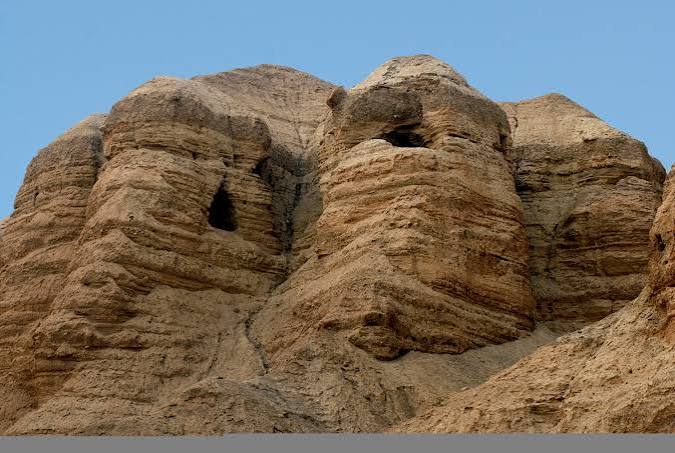
The Qumran cliffs in the Judean desert. The eleven caves that yielded manuscripts are distributed across this dramatic landscape, carved into limestone and marl terrace above the Dead Sea. The region’s extreme dryness — one of the driest places on earth — was responsible for the remarkable preservation of organic materials including leather scrolls and linen wrappings across two millennia.
The Dead Sea Scrolls are not a single collection assembled by one community for one purpose. They are a library in the broadest sense — a diverse accumulation of manuscripts that reflects the religious life of multiple Jewish communities across several centuries.
The approximately 900 manuscripts and tens of thousands of additional fragments include three broad categories of material.
The first and most celebrated category is biblical manuscripts — copies of books from the Hebrew Bible. Every book of the Hebrew Bible except Esther is represented at Qumran. Some, like the Isaiah scroll from Cave 1, are virtually complete. Others survive as fragments of a few lines. Together they constitute the oldest surviving manuscript evidence for the text of the Hebrew Bible, pushing the known textual history back more than a thousand years beyond the medieval manuscripts that scholars had previously relied upon.
The second category is apocryphal and pseudepigraphical writings — texts that were known from other traditions (like the Book of Enoch, known from the Ethiopian church) or entirely unknown before 1947. These documents reveal the breadth and diversity of Jewish religious thought during the Second Temple period in ways that no previously known source had made possible.
The third category is sectarian texts — documents that appear to have been produced by or for the specific community at Qumran. These include the Community Rule (a handbook of conduct for community life), the War Scroll (a visionary account of a final battle between the Sons of Light and the Sons of Darkness), the Thanksgiving Hymns, and numerous biblical commentaries (pesharim) that interpreted prophetic texts as applying to the community’s own situation.
The manuscripts date from approximately the third century BC to the first century AD — spanning a period of roughly 300 years and encompassing some of the most turbulent events in the history of ancient Judaism, including the Maccabean revolt, the Roman conquest of Judea, and the destruction of Jerusalem.
Qumran: A Community by the Dead Sea
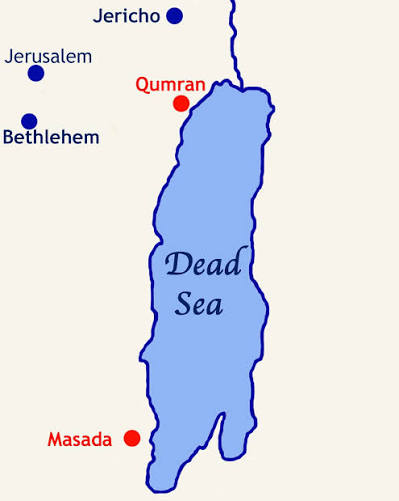
Map of the Qumran region and the Dead Sea, showing the settlement’s position in the Judean desert. Qumran sits on a marl terrace approximately 1.5 km from the northwest shore of the Dead Sea, and about 30 km from Jerusalem. The red dot marks the approximate location of the Qumran settlement; the caves containing the manuscripts were discovered in the cliffs immediately above and around it.
The discovery of the scrolls prompted systematic archaeological excavation of the nearby ruined settlement of Qumran, carried out primarily by Dominican priest Roland de Vaux and his team during the 1950s.
The settlement showed evidence of sustained occupation from roughly the second century BC through 68 AD, when it was destroyed — almost certainly by Roman forces during the First Jewish Revolt. Finds included an elaborate water system, numerous cisterns, a scriptorium with inkwells, pottery kilns, and communal dining areas.
The proximity of the settlement to the caves containing the manuscripts makes a connection almost certain. But the exact nature of that connection — who these people were, who produced which manuscripts, and why they hid their library in the cliffs — remains one of the most debated questions in biblical archaeology.
The dominant scholarly hypothesis, developed from the 1950s onward, identified the Qumran community with the Essenes — a Jewish religious movement described by ancient writers including Josephus, Philo of Alexandria, and Pliny the Elder. The Essenes were known for their communal way of life, strict ritual purity practices, celibacy (at least among some members), rejection of the Jerusalem Temple establishment, and intense study of scripture.
The parallels between the Essene descriptions in ancient literature and what the sectarian scrolls reveal about the Qumran community are substantial. But the hypothesis has also attracted significant criticism. Some scholars argue that the community was a different Jewish group entirely — perhaps Sadducees, or priests displaced from Jerusalem. Others suggest that Qumran was not a religious community at all but a commercial outpost or fortified site, and that the scrolls were brought there from Jerusalem before the Roman siege.
The debate remains unresolved. What is not in dispute is the archaeological reality: a community lived at Qumran, handled manuscripts intensively, and either produced or gathered one of the most significant libraries of the ancient world before their settlement was violently destroyed.
“The Essenes practice a way of life taught to them by no one man, nor introduced among them through a Greek school of thought, but imposed by them on themselves and introduced by their forefathers, who were remarkable for their virtue.”
— Josephus, Jewish Antiquities, c. 93 AD
What Was Found: The Key Manuscripts
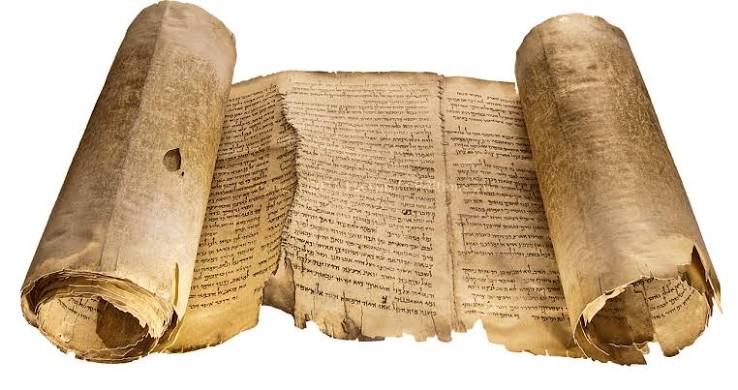
A collection of Dead Sea Scroll fragments. Most of the material from the Qumran caves survived in this state — thousands of small pieces that scholars have spent decades identifying, cataloguing, and assembling into reconstructed texts. The fragments come from leather (animal skin), papyrus, and in one case, copper.
Among the most celebrated individual discoveries from the Qumran caves:
The Great Isaiah Scroll (1QIsa¹), found in Cave 1, is a nearly complete copy of the entire Book of Isaiah, written on seventeen sheets of leather sewn together to form a scroll more than seven metres long. Dated to approximately 125 BC, it is the oldest complete copy of any biblical book ever recovered. Scholars were astonished to find that, despite being more than a thousand years older than the previously known Isaiah manuscripts, its text differed only minimally from them — testament to the remarkable care with which Jewish scribes transmitted the biblical text across the centuries.
The Community Rule (1QS), also from Cave 1, is the handbook of the Qumran community — describing initiation rites, rules of conduct, disciplinary procedures, and the theological framework that distinguished the community from the broader Jewish world. It refers to the community as the “Sons of Light” engaged in a cosmic struggle with the “Sons of Darkness.”
The War Scroll (1QM) describes a forty-year eschatological war between the Sons of Light and the Sons of Darkness, combining military logistics with apocalyptic theology. It includes detailed instructions on battle formations, the conduct of priests during warfare, and the trumpets and standards to be used in the final conflict.
The Copper Scroll (3Q15), unique among all the finds, is inscribed on sheets of copper rather than leather or papyrus. It contains a list of approximately sixty locations where treasures of gold and silver are said to be buried. Whether this represents an actual treasure, a symbolic document, or something else entirely has been debated by scholars for decades. No treasure has been found.
The Temple Scroll (11Q19), the longest of the Dead Sea Scrolls at more than eight metres, presents an idealized blueprint for the Temple and its rituals, written as if in the voice of God giving instructions to Moses — a striking example of the community’s conviction that their own interpretations carried divine authority.
The Book of Enoch Among the Scrolls
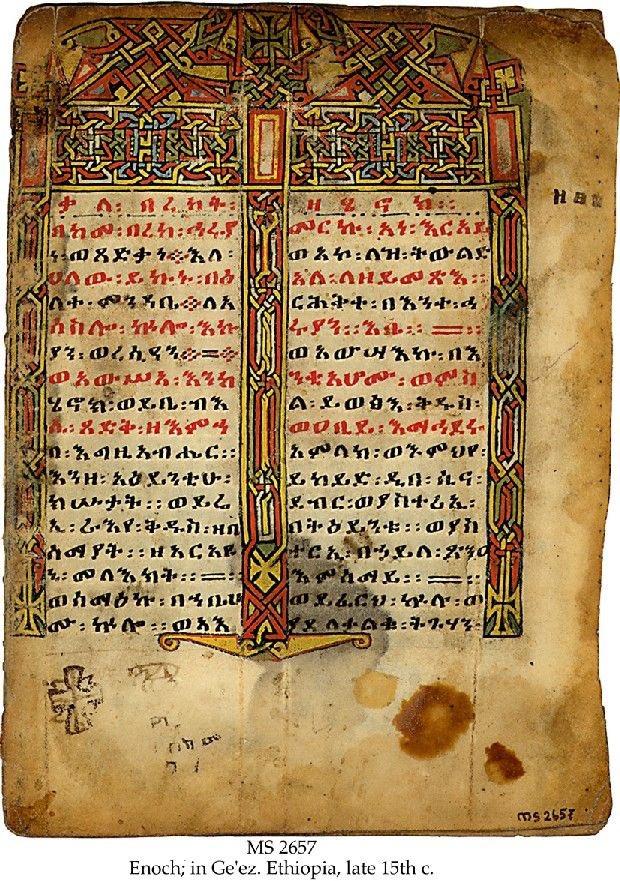
An Ethiopian Ge’ez illuminated manuscript of the Book of Enoch. Before 1947, this tradition preserved the only known complete versions of 1 Enoch. The Dead Sea Scrolls established that the text was circulating in Aramaic centuries earlier.
For readers of The UFO Times, one discovery among the Scrolls demands particular attention.
Fragments of the Book of Enoch — specifically of its earliest section, the Book of the Watchers — were found among the manuscripts from Cave 4 at Qumran. Multiple Aramaic fragments, now designated 4QEn¹ through 4QEn&sup6;, preserve portions of 1 Enoch in what was evidently its original Aramaic form.
Before 1947, many scholars had assumed that 1 Enoch was a relatively late composition, preserved primarily because the Ethiopian Orthodox Church had adopted it as part of its biblical canon. The Qumran fragments demolished that assumption. They established beyond reasonable doubt that the Book of Enoch was already circulating as an important religious text in Jewish communities during the Second and First centuries BC — centuries before the birth of Jesus.
This discovery had two significant consequences. First, it confirmed that the Ethiopian tradition had genuinely preserved an ancient text rather than a medieval composition. Second, it demonstrated that Enochic literature formed a meaningful part of the religious landscape from which both early Christianity and rabbinic Judaism later emerged.
■ Primary Source — 1 Enoch 1:9 (as preserved in Qumran Fragment 4QEn¹)
“Behold, he comes with ten thousands of his holy ones, to execute judgement upon all, and to destroy all the wicked, and to convict all flesh of all the works of their wickedness which they have committed, and of all the hard things which ungodly sinners have spoken against him.”
— 1 Enoch 1:9, preserved in Aramaic among the Dead Sea Scrolls, and later quoted directly in the New Testament letter of Jude (Jude 1:14–15). This demonstrates that Enochic literature was known to early Christian writers as authoritative or at least familiar scripture.
Why the Scrolls Changed Biblical Scholarship
The impact of the Dead Sea Scrolls on biblical scholarship cannot be overstated. In a field where primary sources are rare and almost every text is known only through copies of copies made centuries after the originals, the appearance of manuscripts more than two thousand years old was nothing less than a revolution.
Before 1947, the oldest complete Hebrew manuscripts of the Old Testament dated to the tenth century AD — the period of the Masoretes, the Jewish scribes who standardized the biblical text and added the vowel markings that modern readers depend on. Scholars knew that the biblical text had a long history before these manuscripts were copied, but they had no direct evidence of what it looked like in earlier periods.
The Dead Sea Scrolls pushed that horizon back by more than a millennium. And what they revealed was both confirming and complicating.
On one hand, the Great Isaiah Scroll demonstrated that major portions of the biblical text had been transmitted with remarkable accuracy across more than a thousand years of manuscript copying. The differences between the Qumran Isaiah and the Masoretic text are real but overwhelmingly minor — spelling variations, occasional word differences, a few longer or shorter passages. The essential content is the same.
On the other hand, the Scrolls also revealed that during the Second Temple period, multiple slightly different versions of some biblical books coexisted. The text of the Hebrew Bible had not yet been fully standardized. Different communities used different versions of the same scriptures. This diversity, which the Scrolls preserved in manuscript form for the first time, reshaped scholarly understanding of how the biblical text developed.
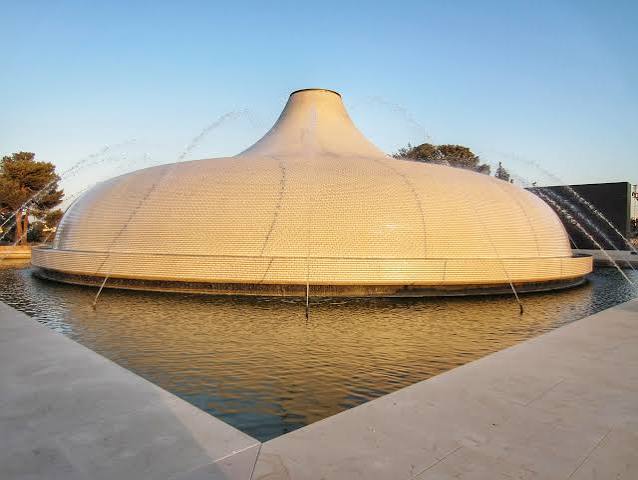
The Shrine of the Book at the Israel Museum in Jerusalem, purpose-built to house and display the Dead Sea Scrolls. The distinctive white dome echoes the shape of the lids of the clay jars in which the scrolls were found. The Great Isaiah Scroll is displayed in a circular case at the building’s centre. The structure opened in 1965 and has become one of the most visited museum wings in the world.
Did the Scrolls Contain Hidden Secrets?
Few archaeological discoveries have generated as many conspiracy theories, and for a partially understandable reason. Access to the unpublished Dead Sea Scroll fragments was restricted for decades after their discovery to a relatively small team of scholars, most of them Christian clerics. The publication process moved slowly. By the 1980s, frustration had turned to suspicion: what was being hidden, and why?
The speculation that followed was dramatic and wide-ranging. Claims circulated that the Scrolls contained hidden gospels that contradicted the New Testament, evidence of a historical Jesus that the Church was suppressing, proof that early Christianity had appropriated Essene teachings without acknowledgment, evidence of extraterrestrial contact, and confirmation of secret knowledge that mainstream scholars and religious institutions were determined to bury.
These claims were not supported by evidence, but they persisted because the controlled access to the manuscripts gave them oxygen.
The answer came in 1991, not through a scholarly decision but through a unilateral act by the Huntington Library in California, which possessed photographs of all the unpublished scroll fragments and released them to the world’s researchers. The Israel Antiquities Authority subsequently made the entire collection available. Publication of the remaining unpublished material accelerated rapidly through the following decade.
What emerged was not a suppressed gospel, a hidden history, or a record of extraterrestrial contact. What emerged was exactly what archaeologists had expected: more texts from the Second Temple period — commentaries, legal discussions, liturgical fragments, calendars, and additional copies of known biblical texts. Important and scholarly illuminating. Not secretly revolutionary in the way the conspiracy theories had required.
Ancient Astronaut Theory and the Scrolls
Some proponents of Ancient Astronaut Theory have pointed to texts found among the Dead Sea Scrolls — particularly the Book of Enoch fragments and the War Scroll — as evidence that ancient peoples were describing real encounters with extraterrestrial beings in the symbolic language available to them.
The Book of the Watchers, whose earliest surviving manuscripts are the Qumran Enoch fragments, describes divine beings called the Watchers who descend from the heavens and interact with human women, producing giant offspring called the Nephilim. The War Scroll’s depiction of angelic armies descending to participate in an eschatological battle, combined with its elaborate specifications of standards and formations, has also attracted speculative readings.
The Ancient Astronaut interpretation proposes that these texts preserve, in mythologized form, actual encounters with advanced extraterrestrial technology — beings who arrived from elsewhere and whose activities were recorded in the only framework available to ancient observers: supernatural religious narrative.
This interpretation faces the same fundamental challenge it faces everywhere it is applied: the texts themselves never describe extraterrestrial civilizations in any recognizable sense. They do not describe spacecraft, advanced propulsion, or technological processes. They describe beings within the well-established symbolic vocabulary of ancient Jewish apocalyptic literature — a genre with clear conventions, demonstrable literary antecedents, and a sophisticated theological purpose.
The discovery of these texts among the Dead Sea Scrolls demonstrates that the Book of Enoch is genuinely ancient. It does not establish that the events it describes are literally historical rather than visionary and symbolic.
Claims and Evidence: A Summary
| Claim | Evidence Assessment | Status |
|---|---|---|
| The Dead Sea Scrolls are the oldest surviving biblical manuscripts | Confirmed by radiocarbon dating and palaeographic analysis. The Great Isaiah Scroll (c. 125 BC) is over 1,000 years older than the previously known complete Hebrew Isaiah manuscripts. | CONFIRMED |
| Fragments of the Book of Enoch were found at Qumran | Confirmed. Multiple Aramaic Enoch fragments (4QEn¹–&sup6;) were recovered from Cave 4 and have been extensively published and studied. | CONFIRMED |
| The Scrolls contain hidden gospels or knowledge suppressed by the Church | No credible evidence. The full collection has been published and is available to scholars worldwide. No hidden gospels or documents contradicting the New Testament have been found. | UNSUPPORTED |
| The Scrolls record extraterrestrial contact or advanced technology | No credible archaeological evidence. The apocalyptic imagery in the Scrolls is consistent with well-documented conventions of Second Temple Jewish visionary literature and requires no extraterrestrial explanation. | UNSUPPORTED |
| The Vatican suppressed access to the Scrolls | Not supported by historical evidence. Access was controlled by an international team of scholars, not the Vatican. Delays were primarily caused by the volume of material and limited scholarly resources, not institutional suppression. | UNSUPPORTED |
Why the Dead Sea Scrolls Still Matter
The Dead Sea Scrolls illuminate the centuries immediately surrounding the birth of two world religions. They show us the Jewish world from which both rabbinic Judaism and early Christianity emerged — a world more diverse, more contested, and more intellectually rich than either tradition’s own later self-accounts had preserved.
They demonstrate that “the Bible” was not a fixed, agreed text during this period — that multiple versions of the same books coexisted, that communities had different canons, and that texts we now think of as peripheral (like 1 Enoch) were read, studied, and treated as authoritative by significant Jewish communities centuries before the birth of Jesus.
They provide the earliest surviving physical evidence for the transmission of the Hebrew Bible, and that evidence tells a story of extraordinary fidelity alongside ordinary textual variation — scribes who took their work seriously, who corrected their errors, who understood themselves to be the guardians of something irreplaceable.
And they are a reminder that the Judean desert, for all its harshness, is an archive. The same conditions that made life difficult for the people of Qumran made it possible for their manuscripts to survive. What else the desert still holds remains unknown.
The UFO Times Assessment
| Category | Rating | Editorial Note |
|---|---|---|
| Historical Importance | ★★★★★ | Among the most significant manuscript discoveries in history. Transformed the study of the Hebrew Bible, Second Temple Judaism, and the origins of Christianity. No serious scholar disputes their extraordinary importance. |
| Archaeological Evidence | ★★★★★ | The manuscripts’ authenticity and dating are confirmed by radiocarbon analysis, palaeography, and archaeological context. The Qumran settlement is thoroughly excavated and documented. |
| Biblical Manuscript Evidence | ★★★★★ | Every book of the Hebrew Bible except Esther is represented. The manuscripts demonstrate both the remarkable fidelity of scribal transmission and the textual diversity of the pre-standardization period. |
| Book of Enoch Connection | ★★★★★ | The Qumran Enoch fragments are the oldest surviving manuscripts of 1 Enoch. They confirm the text’s antiquity and its circulation as important literature in pre-Christian Jewish communities. |
| Evidence for Hidden or Suppressed Knowledge | ★☆☆☆☆ | No credible evidence. The full collection is published and publicly available. The conspiracy theories that flourished during the period of restricted access have not been substantiated by any of the published material. |
UFO Times Evidence Assessment
- ESTABLISHED The Dead Sea Scrolls are genuine ancient manuscripts, confirmed by radiocarbon dating and palaeography. Their discovery is among the most important archaeological events of the twentieth century.
- ESTABLISHED The Great Isaiah Scroll is the oldest complete copy of any biblical book ever recovered, more than 1,000 years older than previously known manuscripts. Its text is remarkably consistent with the later Masoretic tradition.
- ESTABLISHED Aramaic fragments of the Book of Enoch were found among the Qumran manuscripts, confirming the text’s antiquity and its circulation in pre-Christian Jewish communities.
- CREDIBLE The Qumran community was probably associated with the Essenes or a closely related Jewish movement, though the identification remains debated among scholars. The community was destroyed by Roman forces in 68 AD.
- SPECULATIVE That the Copper Scroll records an actual buried treasure, or that any specific treasure it describes has survived and can be located.
- UNSUPPORTED That the Scrolls contain suppressed gospels, evidence of extraterrestrial contact, or hidden knowledge deliberately concealed by scholarly or religious institutions. The full collection is published and available.
Editorial Perspective
The Dead Sea Scrolls remind us that history is more often rewritten through discovery than through speculation. A collection of fragile manuscripts hidden for nearly two thousand years reshaped modern scholarship, confirmed the antiquity of important religious texts, and revealed a richer picture of the ancient world than historians had previously imagined.
For readers of The UFO Times, the Scrolls illustrate a principle we return to often: genuine archaeological discoveries frequently prove more fascinating than the legends that later surround them. The real story of the Dead Sea Scrolls — what they actually contain, what they actually reveal about the biblical world and the communities that produced them — is more intellectually interesting than any theory about hidden gospels or extraterrestrial knowledge.
The greatest revelations, in archaeology as in other fields, are those supported by evidence. The challenge is always the same: to distinguish carefully between documented history, informed interpretation, and imaginative speculation. That distinction is at the heart of every investigation we publish.
— The UFO Times Editorial Desk
Frequently Asked Questions
Who discovered the Dead Sea Scrolls?
The first discovery is credited to Muhammad edh-Dhib, a young Bedouin shepherd of the Ta’amireh tribe, who threw a stone into a cave above the Dead Sea in the spring of 1947 and heard pottery break. He and a companion entered the cave and found seven intact scrolls in clay jars. The scrolls subsequently passed through antiquities dealers before scholars identified their importance. Systematic archaeological excavation of the site and surrounding caves continued from 1949 through 1956.
How old are the Dead Sea Scrolls?
The manuscripts date from approximately the third century BC to the first century AD — a range of about 300 years. The oldest are fragments of Deuteronomy and Samuel copied in the third century BC. The Great Isaiah Scroll dates to approximately 125 BC. Many of the community’s own texts were composed and copied during the second and first centuries BC. The most recent manuscripts date to just before the destruction of Qumran in 68 AD.
Who wrote the Dead Sea Scrolls?
Not all the Scrolls were written by the same community. The biblical manuscripts and many apocryphal texts were produced elsewhere and collected at Qumran. The sectarian texts — the Community Rule, the War Scroll, the Thanksgiving Hymns — were produced by or for the Qumran community itself. Most scholars associate the community with the Essenes, a Jewish religious movement known from ancient historical sources, though this identification is debated.
Were the Dead Sea Scrolls suppressed?
Access to unpublished fragments was restricted for several decades after their discovery, controlled by a small international team of scholars. This delay — caused by the volume of material, the complexity of the work, and institutional inertia — generated significant controversy and conspiracy theories. In 1991, the Huntington Library released photographs of all unpublished fragments, and the Israel Antiquities Authority subsequently made the entire collection available. All the major texts have now been published. No hidden gospels or suppressed secrets have emerged from the unpublished material.
Did the Dead Sea Scrolls contain the Book of Enoch?
Yes. Multiple Aramaic fragments of the Book of Enoch — specifically of the Book of the Watchers (1 Enoch 1–36) and other sections — were recovered from Cave 4 at Qumran. These are designated 4QEn¹ through 4QEn&sup6; and represent the oldest surviving manuscript evidence for this text. Their discovery confirmed that the Book of Enoch was widely read in Jewish communities during the Second Temple period, centuries before the birth of Jesus.
Where are the Dead Sea Scrolls today?
The majority of the Dead Sea Scrolls are held by the Israel Antiquities Authority and displayed at the Shrine of the Book in the Israel Museum, Jerusalem. Some fragments are held by other institutions, including the Jordan Museum in Amman. High-resolution images of the entire collection are available through the Leon Levy Dead Sea Scrolls Digital Library, operated by the Israel Antiquities Authority. A substantial number of scroll fragments sold on the antiquities market in recent decades have been identified as forgeries, including fragments acquired by the Museum of the Bible in Washington, D.C.
Related Investigations
Recommended Reading
The Complete Dead Sea Scrolls in English — Geza Vermes
The standard one-volume English translation of the Dead Sea Scrolls, by the scholar who did more than anyone to make them accessible to general readers. Vermes’s translations are accurate, his introductions clear, and his editorial judgment consistently sound. The essential starting point for anyone approaching the Scrolls for the first time.
View on Amazon →Reclaiming the Dead Sea Scrolls — Lawrence H. Schiffman
A rigorous and deeply learned examination of the Scrolls within their Jewish context by one of the leading scholars in the field. Schiffman makes the case that the Scrolls are fundamentally a Jewish document, illuminating the world of Second Temple Judaism rather than proto-Christianity. Invaluable for understanding what the Scrolls tell us — and what they don’t.
View on Amazon →The Dead Sea Scrolls Today — James C. VanderKam
An exceptionally clear and authoritative overview of the Scrolls — their discovery, contents, historical context, and significance — by one of the foremost scholars in the field. VanderKam is particularly strong on the apocryphal and pseudepigraphical texts, including the Book of Enoch fragments. Consistently reliable and accessible without sacrificing scholarly depth.
View on Amazon →Ancient Mysteries — Coming Next
Father Carlo Crespi and the Mystery of the Golden Plates
Next in the Ancient Mysteries section: the Ecuadorian priest who collected thousands of ancient metal artefacts donated by indigenous communities — many of which disappeared after his death. What were the Crespi artefacts? What do archaeologists actually know about them?
Explore Ancient Mysteries →