
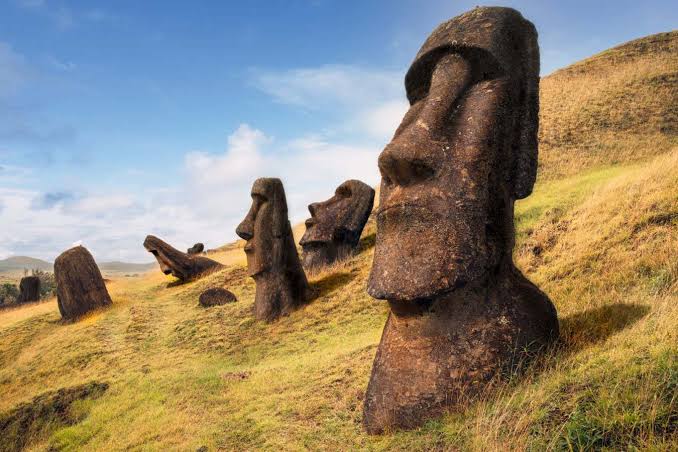
Easter Island — Rapa Nui — sits in the South Pacific, 2,300 miles from the coast of Chile. It is one of the most remote inhabited places on Earth. Sometime between 1000 and 1600 CE, the people who lived there carved nearly 900 stone statues from the volcanic rock of a single quarry, and moved them — somehow — across the island's rugged terrain to platforms on the coast. How they did it remains a genuine archaeological mystery.
Rapa Nui — Easter Island — is the most remote inhabited place on Earth. It sits alone in the South Pacific, 2,300 miles from the coast of Chile and 1,300 miles from the nearest other island. It is 63 square miles of volcanic rock. Its closest neighbors are a scattering of uninhabited atolls.
On this island, a civilization we call the Rapa Nui carved nearly 900 massive stone statues — the Moai — from the volcanic tuff of a single quarry called Rano Raraku, and then transported them to ceremonial platforms called ahu distributed around the island's coast. The statues range from around 6 feet to 33 feet in height. The largest completed and transported Moai stands 33 feet tall and weighs approximately 82 tons. The largest ever carved — found abandoned at the quarry, apparently mid-construction — would have been 69 feet tall and weighed around 270 tons.
They did this with no wheels. No draft animals. On an island that, by the time European explorers arrived in 1722, had been almost entirely deforested — and where the trees that remained were far too small to serve as rollers for multi-ton stone figures.
When early European explorers asked the Rapa Nui how the statues had been moved, the answer was consistent and immediate: the Moai had walked.
The Engineering Problem
To appreciate how genuinely difficult the Moai transport problem is, consider what we know about the island at the time of construction.
Pollen analysis of lake sediment cores from Easter Island shows that when the Rapa Nui first arrived — around 800–1200 CE — the island was densely forested, including with the Easter Island palm (Paschalococos disperta), which grew up to 65 feet tall. By the time the Dutch explorer Jacob Roggeveen arrived in 1722, the island was almost completely bare. The deforestation was total and catastrophic, and the Rapa Nui civilization had apparently collapsed in the centuries before European contact — population declining from a peak of perhaps 15,000 to around 2,000–3,000.
This creates an interesting sequencing problem. The most likely explanation for how the Moai were moved — felled trees used as rollers or sledges — requires trees. But the archaeological and pollen evidence suggests that by the time the Moai-building period reached its peak, the trees were already being depleted. The largest and most ambitious statues appear to have been carved at approximately the same time as the deforestation was accelerating.
The numbers are also daunting. Over 900 statues. The average Moai weighs around 14 tons. The heaviest successfully transported weighed 82 tons. The average distance from the Rano Raraku quarry to the coastal ahu platforms is about 11 miles — across terrain that includes hills, gullies, and volcanic rock outcroppings. Using conventional estimates of labor requirements for moving heavy stones, the total effort represented by the Moai transport has been calculated as requiring millions of person-hours of sustained work.
The "Walking" Theory — And Why Science Took It Seriously
For decades, the conventional explanation was that the statues were laid horizontal and rolled on logs. Thor Heyerdahl demonstrated this with a small group of islanders in 1955. Other researchers have proposed sledges of woven grass, or the construction of roads using stone paving.
But the oral tradition of the Rapa Nui — maintained consistently and independently by multiple family lineages — insists that the Moai walked upright, rocking from foot to foot, guided by ropes. This sounded like mythology until 2012, when archaeologists Carl Lipo and Terry Hunt conducted an experiment that changed the conversation.
Using a 5-ton replica Moai, a team of 18 people, and three ropes — two controlling the statue from the sides, one attached to the front to prevent it from falling forward — they demonstrated that the statue could be "walked" upright in exactly the manner the oral tradition describes. It moved at approximately 100 metres per minute. The method required only ropes and coordination, no logs, no sleds, no large labor pools. The distinctive road network found across Easter Island, with its slightly curved edges and raised centre, turns out to be perfectly designed for this rocking-walking method — the curvature allows the statue's base to rotate side to side as it moves.
"The oral traditions were right. The Moai walked. The road network was built for exactly this purpose. We had been wrong for 60 years." — Archaeologist Carl Lipo, University of Binghamton, 2012
The walking theory also explains something that previously puzzled researchers: why so many unfinished Moai were found along the roads, tipped over and abandoned mid-journey. If the statues were being walked upright, a loss of rope coordination could send one toppling — and a fallen 14-ton statue cannot easily be righted on rough terrain. The abandoned statues mark the sites of failed transport attempts, not quarrying waste.
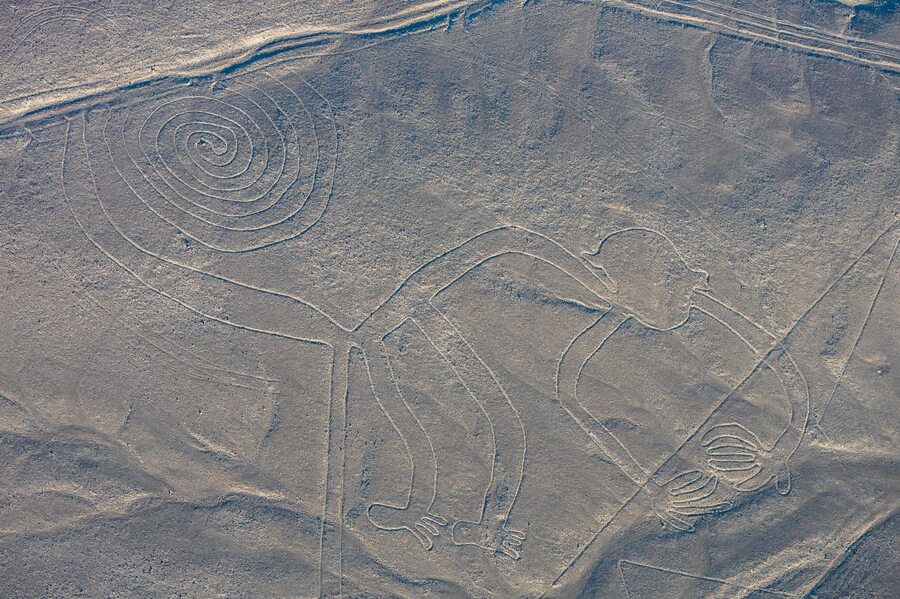
The Nazca Lines of Peru — another ancient monument complex that has long challenged conventional explanations. Like the Moai, the Nazca Lines demonstrate that ancient peoples were capable of sustained, organized, large-scale engineering projects whose full scope and purpose remain incompletely understood. Both sites have been associated with the ancient astronaut theory.
What the Hats Tell Us
The Moai mystery has a second layer that the walking debate tends to overshadow: the pukao.
Many of the Moai were topped with massive red stone cylinders — hats, essentially — carved from a different type of volcanic rock found at a quarry called Puna Pau on the opposite side of the island from Rano Raraku. The pukao weigh up to 12 tons each. They were placed on top of statues that themselves stood up to 33 feet tall.
If walking the Moai upright resolves the transport question for the statues, it raises an immediate new question for the hats: how do you lift a 12-ton stone cylinder to the top of a 33-foot statue that cannot be laid down without destroying it? No experiment has successfully demonstrated this. The engineering required — some kind of ramp or crane system — would have left archaeological evidence that has not been found.
This is the part of the Easter Island story that remains genuinely unresolved, even after the 2012 breakthrough.
The Collapse: What Really Happened
The popular narrative of Easter Island's collapse — immortalized in Jared Diamond's Collapse — is one of ecological self-destruction: the Rapa Nui cut down all their trees to move their statues, destroyed their island's ecosystem, and their civilization fell as a result. It is a satisfying moral fable about the dangers of environmental destruction.
It is also, according to more recent research, probably wrong.
Studies published in the 2010s and 2020s have significantly revised the picture. The deforestation of Easter Island appears to have been largely driven by the Pacific rat (Rattus exulans), which the Rapa Nui brought with them in their canoes and which devastated the palm's ability to regenerate by eating the seeds. Climate analysis suggests the island experienced severe droughts in the centuries before European contact. And most significantly: the population collapse appears to have been driven primarily by European contact — specifically, Peruvian slave raiders who in 1862 kidnapped an estimated 1,500 Rapa Nui (including virtually the entire chiefly class and all the holders of the Rongorongo writing tradition), and the epidemic diseases that followed European settlement.
The Rapa Nui did not destroy themselves. They were largely destroyed by outsiders — a quieter but more accurate version of their story.
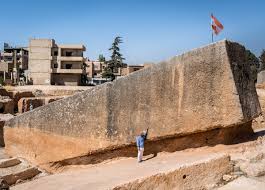
The megaliths of Baalbek, Lebanon — some of the largest stones ever quarried and moved in human history. Like the Moai, the Baalbek stones demonstrate that ancient peoples regularly accomplished feats of engineering that our conventional understanding of their technology struggles to fully account for. The question is not whether they could do it — they demonstrably did — but how.
The Ancient Astronaut Interpretation
The ancient astronaut reading of Easter Island focuses on several elements that remain unexplained even after the 2012 walking demonstration: the pukao placement problem, the sheer scale and ambition of the project relative to the island's resources, the existence of the Rongorongo script (one of only a handful of writing systems to have been independently invented, and one that has never been fully deciphered), and the oral traditions that speak of the Moai's powers as connected to divine beings called mana.
Von Däniken and others have suggested that the Moai themselves — with their elongated heads, large ears, and forward-facing posture — represent not the Rapa Nui people but the beings they were depicting: the gods or visitors who came from the sky and whose power the statues were meant to channel or commemorate.
The counterargument is that elongated heads and large ears are common in Polynesian art across many islands, and that the Moai's features are culturally explained. The ancient astronaut reading requires a specific interpretation of ambiguous artistic evidence.
The Honest Assessment
Easter Island's central mystery — the Moai's transport — has been substantially resolved by the 2012 walking experiment. The oral tradition was accurate. The road network was purpose-built. The method required no lost technology, no extraterrestrial assistance: only ropes, coordination, and remarkable organizational capacity.
What remains genuinely unexplained is the pukao placement, the full purpose of the ahu platform system, and what the Rongorongo script says. These are real archaeological gaps, not manufactured mysteries.
What Easter Island ultimately demonstrates — like Puma Punku, like the Great Pyramid, like Baalbek — is that ancient peoples were capable of sustained, large-scale organizational and engineering achievement that we consistently underestimate. The lesson of the walking Moai is not that aliens helped. It is that the Rapa Nui were more ingenious than we gave them credit for — and that the oral traditions we dismissed as myth sometimes turn out to be accurate engineering memory.
UFO Times Evidence Assessment
- ESTABLISHED Nearly 900 Moai were carved and transported across Easter Island. The 2012 walking experiment demonstrated that upright rocking transport using ropes is physically feasible and consistent with the island's road network.
- ESTABLISHED The Rapa Nui civilization's collapse was primarily caused by European slave raiding and epidemic disease, not ecological self-destruction as previously believed.
- CREDIBLE The pukao placement problem remains unresolved. How 12-ton stone hats were lifted to the tops of standing statues has not been experimentally demonstrated.
- SPECULATIVE That the Moai represent beings other than the Rapa Nui ancestors, or that their construction involved outside assistance. Possible but not supported by current evidence.
- UNSUPPORTED Any specific claim about extraterrestrial involvement in the Moai's construction or transport.
Related Investigations
Recommended Reading
Fingerprints of the Gods — Graham Hancock (1995)
Hancock’s landmark investigation into pre-Ice Age civilisations includes an analysis of Easter Island and the Moai as possible remnants of a global culture with engineering capabilities our conventional timeline cannot explain.
View on Amazon →Chariots of the Gods — Erich von Däniken (1968)
Von Däniken’s treatment of Easter Island as a possible ancient landing site — examining the Moai, the Rongorongo script, and the island’s isolation as evidence for extraterrestrial intervention.
View on Amazon →The Ancient Alien Question — Philip Coppens (2011)
A sober reanalysis of ancient anomalies including the Easter Island statues — examining the engineering challenges, the oral traditions, and the physical evidence that mainstream archaeology has struggled to explain.
View on Amazon →Go Deeper
Essential Reading on Easter Island
Terry Hunt and Carl Lipo's The Statues That Walked is the definitive account of the walking transport discovery and the revised understanding of the island's collapse. Jared Diamond's Collapse provides the older ecological destruction narrative — valuable context even where its conclusions have been revised.
Browse the Bookstore →