■ Evidence Status
Confirmed
Weathering and erosion are visible on the Sphinx enclosure walls
Confirmed
North Africa experienced significantly wetter climate before ~3000 BCE (African Humid Period)
Disputed
Whether the dominant erosion mechanism is rainfall, groundwater, salt crystallization or limestone variability
Not Established
Sphinx construction before 5000 BCE
No Evidence
Direct inscription naming the Sphinx’s builder on the monument itself
Not Established
Evidence of an advanced civilization at Giza before 5000 BCE
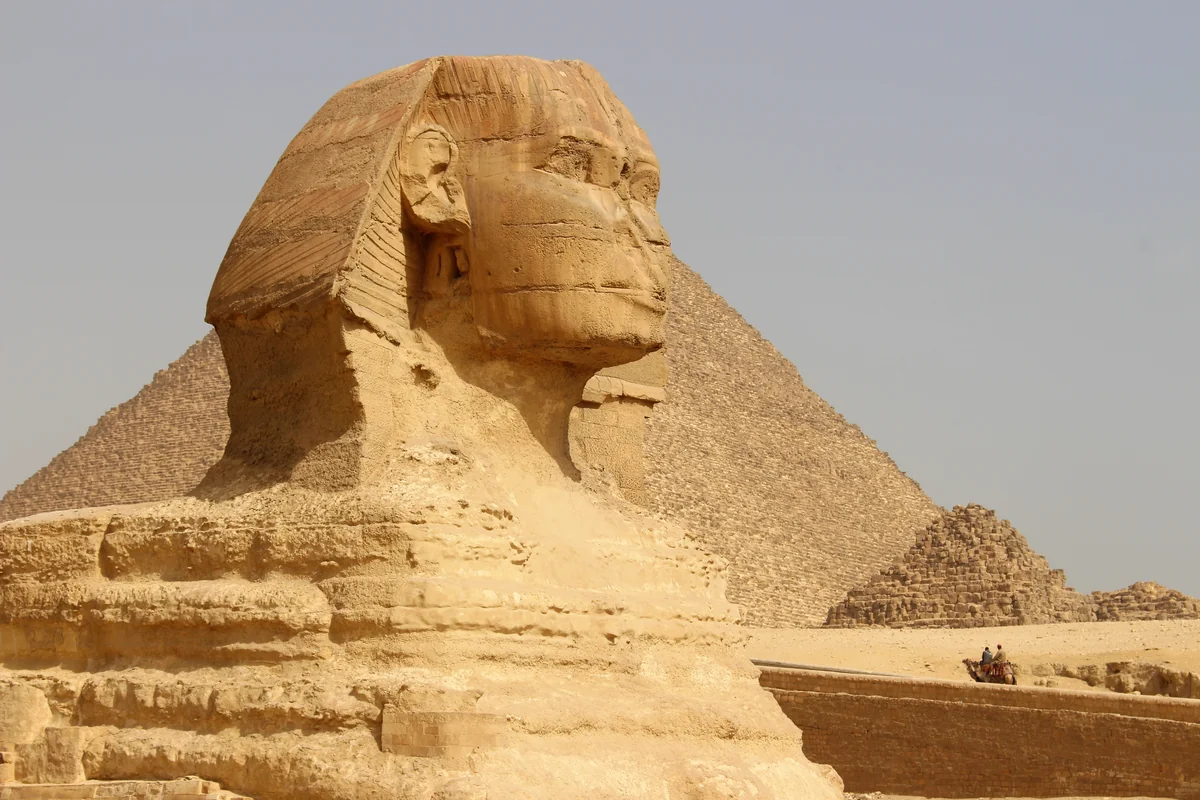
The Great Sphinx of Giza is one of the world’s largest and most famous sculptures carved from a single body of bedrock. For most of the twentieth century, Egyptologists placed its construction at approximately 2500 BCE, during the Fourth Dynasty of the Old Kingdom, attributing it to the Pharaoh Khafre. Earlier writers had questioned the conventional chronology—including Schwaller de Lubicz—but John Anthony West brought the challenge to an international mass audience and sought geological support for it, transforming a fringe observation into a sustained research argument.
What he noticed was the pattern of weathering on the limestone walls surrounding the monument. In his reading, and later in the geological analysis of Robert Schoch, those patterns looked like the work of water—specifically, of rainfall running down exposed rock over an extended period. If they were right, the Sphinx had to be far older than 2500 BCE, because Egypt had not seen that kind of sustained rainfall since long before the pharaohs.
West spent much of his career on this argument. He did not resolve it. Neither did Schoch, nor the geologists who pushed back against them. Decades on, the Sphinx water-erosion hypothesis remains a minority interpretation that has prompted responses from geologists, conservation specialists and Egyptologists. It has not been accepted by the mainstream archaeological or geological consensus, but the specific mechanisms and rates of weathering continue to be debated.
Who Was John Anthony West?
John Anthony West was born in New York in 1932. He was not an academic. He held no university degree in Egyptology, archaeology or geology, and he did not seek to misrepresent his credentials. He described himself as an author, lecturer, independent researcher and a guide to Egypt—a country he visited repeatedly over several decades.
His central intellectual commitment was to the idea that ancient Egypt represented a form of knowledge—a “sacred science”—far more sophisticated and far older than mainstream scholarship acknowledged. He articulated this most fully in his 1979 book Serpent in the Sky: The High Wisdom of Ancient Egypt (revised 1993), which drew extensively on the work of French philosopher and symbolist R.A. Schwaller de Lubicz.
West was a gifted communicator. His Traveler’s Key to Ancient Egypt became a respected practical guide, and his 1993 documentary Mystery of the Sphinx—narrated by Charlton Heston and featuring Schoch’s geological testimony—brought the erosion controversy to millions of viewers. In 1994, West received a News and Documentary Emmy Award for Outstanding Individual Achievement in a Craft: Researchers for his work on the program; the documentary was also nominated in a program category. He died in 2018 at the age of 85.
The Idea West Inherited: Schwaller de Lubicz
R.A. Schwaller de Lubicz (1891–1961) was a French philosopher, mathematician and practitioner of esoteric traditions who spent approximately fifteen years studying the Temple of Luxor (Karnak). His monumental work The Temple of Man (1957) argued that ancient Egyptian temples encoded a profound understanding of proportion, cosmology and the human body, and that this knowledge predated the civilization that built those temples.
During his years at Karnak, Schwaller reportedly noticed that the body of the Sphinx showed weathering he believed was inconsistent with desert wind erosion. He mentioned this briefly but did not pursue a formal geological investigation. West read Schwaller carefully and recognized that if the observation could be substantiated by a qualified geologist, it would provide physical evidence for his larger argument: that Egyptian civilization had deep prehistoric roots beyond what dynastic archaeology recorded.
This is what ultimately led West to Robert Schoch.
Robert Schoch and the Geological Examination
Robert Schoch is a geologist and associate professor of Natural Sciences and Mathematics at Boston University’s College of General Studies. West contacted him in the late 1980s and persuaded him to visit Egypt and examine the Sphinx enclosure as a geologist—not as an Egyptologist, not as an advocate for any theory, but as someone trained to read rock.
Schoch first visited Giza in 1990. What he saw in the enclosure walls troubled him in ways he had not expected. The weathering on the limestone was predominantly vertical—deep, undulating grooves running downward through the rock. To Schoch, this was morphologically different from the horizontal weathering patterns that wind-driven sand produces, which typically undercut softer lower layers while leaving harder upper layers more intact.
Vertical, rounded erosion channels of the type Schoch observed are characteristic, in other geological contexts, of rainfall and water runoff. Rain falling on exposed limestone flows downward, dissolving and eroding the rock along its path. The harder layers are not spared; the whole face weathers as water sheets down it.
Schoch presented his analysis at the 1992 annual meeting of the Geological Society of America. His conclusion: the erosion visible on the Sphinx enclosure walls was consistent with prolonged, heavy precipitation—the kind of rainfall that Egypt had not seen since the end of the African Humid Period, generally dated to approximately 3000–5000 BCE. If the Sphinx body had been exposed long enough to accumulate that weathering, it was carved during or before that wetter era—significantly earlier than Khafre’s reign.
The Counterarguments: What the Mainstream Says
The geological and archaeological response to Schoch’s argument was not silent. Several credible counterarguments have been advanced, and they deserve careful consideration.
Limestone variability. The enclosure walls are not uniform limestone. They are cut from the Mokkatam Formation, a sequence of layers with significantly different compositions, hardness and solubility. Softer, more porous layers weather faster under any mechanism—wind, water or chemical dissolution. Critics argue that the apparent vertical channels could result from differential erosion of alternating hard and soft layers, driven by mechanisms other than rainfall.
Salt crystallization and groundwater. K. Lal Gauri, J.J. Sinai and J.K. Bandyopadhyay, in a 1995 paper in Geoarchaeology, proposed that subsurface moisture, capillary water rising through the limestone, and the crystallization of soluble salts could produce weathering patterns similar to those Schoch attributed to rainfall. In their analysis, the Nile floodplain’s seasonal groundwater fluctuations provided sufficient moisture to drive this process across historical timescales, without requiring rainfall at the volume Schoch envisioned. The paper argued that the conventional dating of the Sphinx was therefore consistent with the observed erosion.
Atmospheric moisture and dew. Others have noted that desert environments are not entirely moisture-free. Overnight dew and condensation cycles can introduce limited but consistent moisture to exposed stone surfaces over centuries, contributing to chemical weathering that does not require open-sky rainfall events.
The enclosure’s orientation and drainage. The Sphinx enclosure faces east and is partially sheltered. Its floor slopes, and rain—when it occurred—would have pooled and drained along specific paths. Some geologists argue this localized drainage could account for pronounced erosion in certain zones without requiring overall rainfall intensity much greater than what the archaeological record suggests for the early dynastic period.
The head and the Inventory Stele. The Sphinx’s head shows far less severe erosion than its body—a point both sides address. West and Schoch note that the head has been re-carved, reducing its weathered surface. Critics argue this is speculative. A stele known as the Inventory Stele, discovered by Auguste Mariette in the nineteenth century and dated to the Twenty-sixth Dynasty, describes Khufu ordering restoration of a pre-existing Sphinx—but most Egyptologists regard it as a later pious invention rather than a reliable historical record of an earlier Sphinx.
Absence of corroborating evidence. Mainstream Egyptologists, including Mark Lehner of the Ancient Egypt Research Associates and Zahi Hawass, point to the absence of any archaeological site in Egypt datable to the period West and Schoch proposed (10,500 BCE or earlier) that exhibits the organizational complexity necessary to quarry and carve a statue of the Sphinx’s scale. No tools, settlements, administrative infrastructure or monuments from that era have been found in the Giza area.
Colin Reader’s Intermediate Hypothesis
Not every geologist who examined the controversy lined up neatly with either side. Colin Reader, a British geologist, published a careful geomorphological study of the Giza necropolis in the journal Archaeometry in 2001. He agreed with Schoch that water erosion had played a significant role in shaping the enclosure walls. Where he differed was on the timescale.
Reader argued that the erosion pattern was consistent with a period of several hundred years of greater-than-present rainfall, rather than the multi-millennium exposure Schoch’s earlier dating implied. He proposed that the Sphinx predated Khafre—perhaps by 500 to 1,000 years—placing its construction in the Early Dynastic or late Predynastic period, roughly 3000 to 3500 BCE. This still revised the conventional narrative, but it did not require positing an unknown civilization thousands of years before the pharaohs.
Reader’s paper is notable for its methodological care and its willingness to accept part of the erosion argument without embracing the most dramatic conclusions. It has received less popular attention than the West–Schoch hypothesis, partly because a 500-year revision of the Sphinx’s age is a less compelling headline than 8,000 years.
Timeline
c. 8000–3000 BCE
African Humid Period. North Africa experiences significantly greater rainfall than today. The Sahara supports vegetation, lakes and human habitation. The period ends gradually, with increasing aridification from approximately 5500 BCE.
c. 2500 BCE
Conventional date for construction of the Great Sphinx of Giza, attributed to Pharaoh Khafre of the Fourth Dynasty. The Sphinx enclosure, causeway and valley temple form a single architectural complex with Khafre’s pyramid.
1957
R.A. Schwaller de Lubicz publishes The Temple of Man, noting briefly that the Sphinx body appears to show rain-erosion patterns inconsistent with the dynastic period.
1979 (revised 1993)
John Anthony West publishes Serpent in the Sky, making the extended case for Egypt as the repository of a prehistoric sacred science. He takes up Schwaller’s Sphinx observation as a central piece of evidence.
1990
West brings Robert Schoch to Giza for the first geological field examination of the Sphinx enclosure walls. Schoch concludes that the erosion is consistent with prolonged rainfall.
1992
Schoch presents his findings at the Geological Society of America annual meeting. His paper receives significant attention and pushback from geologists and Egyptologists. West and Schoch debate Egyptologist Zahi Hawass and geologist James Harrell, who disputes the rainfall interpretation.
1993
Mystery of the Sphinx, narrated by Charlton Heston, airs on NBC. In 1994, West receives a News and Documentary Emmy Award for Outstanding Individual Achievement in a Craft: Researchers; the documentary is also nominated in a programme category. The film brings the erosion controversy to a mass audience for the first time.
1995
Gauri, Sinai and Bandyopadhyay publish their Geoarchaeology paper proposing subsurface moisture and salt crystallization as alternative explanations for the Sphinx enclosure weathering, consistent with a conventional dynastic date.
2001
Colin Reader publishes his geomorphological study in Archaeometry, proposing that the Sphinx predates Khafre by several hundred years—an intermediate position accepting water erosion but not the deep-prehistory dating.
2000s–2010s
Schoch continues his research. He expands his arguments to include seismic data suggesting a subsurface cavity beneath the front left paw area, and to connect the Sphinx’s possible antiquity to the discovery of Göbekli Tepe, which demonstrated complex construction circa 9600 BCE in Anatolia.
2018
John Anthony West dies on February 6, 2018, at the age of 85. The geological dispute he helped initiate remains unresolved.
Key Claims and Their Status
| Claim | Source | Status |
|---|---|---|
| The Sphinx enclosure shows pronounced weathering | All parties | Confirmed |
| The enclosure weathering pattern is primarily due to rainfall | Schoch (1992+) | Disputed |
| Salt crystallization and groundwater can produce similar patterns | Gauri et al. (1995) | Plausible, debated |
| The Sphinx slightly predates Khafre by centuries | Reader (2001) | Possible; not established |
| The Sphinx was carved before 5000 BCE | Schoch / West | Not established |
| The Sphinx was carved c. 10,500 BCE by a lost civilization | West (extended argument) | No supporting evidence |
| Khafre built the Sphinx c. 2500 BCE | Mainstream Egyptology | Supported by indirect evidence; no direct inscription |
Four Interpretations Compared
Mainstream Egyptology
Sphinx built c. 2500 BCE by Khafre. Weathering is explained by wind, sand, chemical decay and localized moisture. The monument fits structurally within Khafre’s pyramid complex. No archaeological evidence for an earlier builder.
West–Schoch
Weathering is the product of prolonged precipitation. The Sphinx was carved no later than 5000 BCE; Schoch’s early estimates suggested 7000–5000 BCE. West placed this in the context of a prehistoric sacred civilization predating dynastic Egypt.
Colin Reader
Water erosion is real and significant, but implies a more modest revision. The Sphinx was likely built several hundred years before Khafre, in the Early Dynastic or late Predynastic period. A prehistoric lost civilization is not required.
Gauri et al.
Subsurface moisture, salt crystallization and limestone variability adequately explain the erosion within a conventional dynastic timeframe. Rainfall-only interpretation overstates one mechanism while ignoring others.
What West Got Right
He identified a genuine anomaly. The weathering question on the Sphinx enclosure is real. It has been examined by multiple geologists since Schoch’s 1992 presentation, and no consensus mechanism has fully satisfied all parties. Even Reader’s conservative hypothesis accepts that water erosion played a significant role—and Reader concludes the Sphinx predates Khafre.
He brought a qualified scientist to the problem. West’s decision to engage Robert Schoch rather than simply make his own geological claims was methodologically sound. Whatever one thinks of Schoch’s conclusions, his analysis was conducted in the field, presented to a geological society, and published in a form open to peer critique. That is how science is supposed to work.
He did not fabricate evidence. The erosion patterns West pointed to exist. His interpretation of them is disputed; the features themselves are not. This distinguishes the Sphinx argument from many archaeological mysteries that rest on misidentified, misrepresented or invented data.
He raised the bar for the conventional explanation. The mainstream Egyptological position that the Sphinx was built entirely by Khafre circa 2500 BCE was never as thoroughly established by direct evidence as its confident assertion implied. West’s challenge forced more careful scrutiny of exactly what the Khafre attribution rested on. That scrutiny was useful—and the answers, while supporting a conventional dating, are more nuanced than they were before the controversy.
Where West Went Beyond the Evidence
The leap to a lost civilization. Schoch’s geological argument, at its most defensible, establishes that the Sphinx body may have been exposed to significant rainfall—which is more consistent with a pre-3000 BCE carving than a 2500 BCE one. It does not identify who carved it, what civilization they belonged to, or what knowledge system they possessed. West’s argument that this implied a sophisticated prehistoric civilization encoding sacred science was a separate claim that rested on different and far thinner evidence.
The date of 10,500 BCE. West and some of his collaborators—notably Graham Hancock, whose work on a lost civilization he influenced—pointed to astronomical alignments, particularly the Orion correlation proposed by Robert Bauval, to anchor the Sphinx’s construction to approximately 10,500 BCE, when the constellation Leo rose directly in front of the lion-shaped monument at the vernal equinox. This is a poetic argument. It is not a geological or archaeological one, and it cannot substitute for physical evidence of a civilization operating at Giza in 10,500 BCE. No such evidence has been found.
The sacred-science framework. West inherited from Schwaller de Lubicz a comprehensive mystical interpretation of Egyptian civilization that regarded its symbols, temples and monuments as encoding universal wisdom. This interpretive framework shaped what West saw when he looked at the evidence. Whether that framework is valid is a philosophical and spiritual question, not an empirical one—and West sometimes conflated the two.
The absence does not imply presence. West argued that the lack of pre-dynastic monumental archaeology in Egypt was itself evidence of a civilization lost to catastrophe—not evidence against one. This reasoning is difficult to falsify and therefore difficult to evaluate scientifically. Absence of evidence is not necessarily evidence of absence; but it is also not evidence of presence.
The discovery of Göbekli Tepe in southeastern Turkey, with its complex carved pillars dated to approximately 9600 BCE, has strengthened the broader case that humans were capable of sophisticated construction earlier than previously assumed. West and Schoch have both cited it as supporting context. It does not, however, demonstrate that a civilization capable of carving the Sphinx existed in Egypt at the same time. Graham Hancock’s subsequent work developing the lost civilization thesis has kept these questions in public conversation, building directly on West’s foundation.
■ The UFO Times Assessment
John Anthony West identified a genuine geological anomaly and pursued it with intellectual seriousness. His decision to engage a qualified geologist gave the argument empirical grounding that distinguishes it from most alternative-archaeology claims. The erosion question is real and, decades later, not definitively settled. What West could not demonstrate—and what the evidence does not support—is that the pattern of erosion establishes a specific date, a specific civilization, or a specific knowledge system. The gap between “this looks like it was exposed to a lot of rainfall” and “this was built by a prehistoric civilization encoding sacred science” is not crossed by geology. It is crossed by inference—and inference is not evidence. The Sphinx water-erosion argument deserves continued investigation. The lost-civilization conclusions West drew from it remain, for now, speculation.
John Anthony West’s Core Work
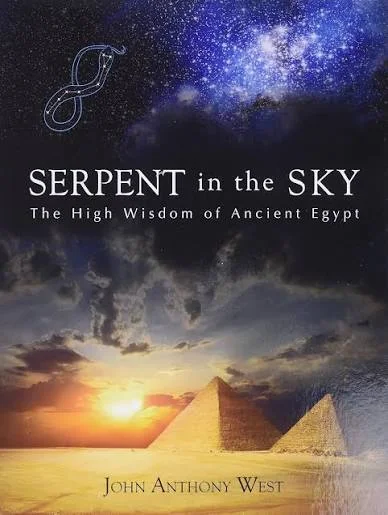
Serpent in the Sky: The High Wisdom of Ancient Egypt, first published in 1979 and revised in 1993, is West’s most sustained argument for Schwaller de Lubicz’s vision of Egyptian civilization as a repository of prehistoric sacred science. It covers hieroglyphic symbolism, temple architecture, mathematics, medicine and astronomy, reading all of them as elements of a unified, deeply ancient knowledge system. It is the book that drew the Sphinx water-erosion observation into West’s broader interpretive framework, and it remains the primary document for understanding what he actually argued.
Whether you find his framework persuasive or not, Serpent in the Sky is a serious work of intellectual engagement with Egyptian civilization, not a popular sensationalist text. It repays careful reading alongside the academic literature it challenges.
West’s Central Argument
Serpent in the Sky — John Anthony West
The definitive statement of West’s argument that Egyptian civilization was built on a far older sacred science. Essential reading for understanding what the Sphinx water-erosion argument was actually in service of.
View on Amazon →The Lost Civilization Case
Fingerprints of the Gods — Graham Hancock
Hancock builds directly on West’s Sphinx argument to develop the broader case for a lost prehistoric civilization. The book that brought the water-erosion hypothesis to its widest audience and anchored it within the larger alternative-archaeology framework.
View on Amazon →The Archaeological Standard
The Complete Temples of Ancient Egypt — Richard H. Wilkinson
The definitive illustrated guide to Egyptian sacred architecture from the mainstream archaeological perspective. Indispensable context for evaluating both West’s claims about Egyptian sacred science and the Sphinx’s place in the Fourth Dynasty building programme.
View on Amazon →ⓘ Affiliate disclosure: As an Amazon Associate, The UFO Times may earn from qualifying purchases, at no additional cost to you. Our editorial positions are independent of affiliate relationships.
Frequently Asked Questions
Sources and Further Reading
Institutional Archaeological Research (Mainstream)
- Ancient Egypt Research Associates — The Great Sphinx Project
- American Research Center in Egypt — Sphinx Mapping Project
- Robert Schoch — The Sphinx: A Summary of His Geological Argument
- Robert Schoch — Tribute and references concerning John Anthony West
- Reader, C.D. (2001). A geomorphological study of the Giza Necropolis, with implications for the development of the site. Archaeometry, 43(1), 149–165.
- Gauri, K.L., Sinai, J.J. & Bandyopadhyay, J.K. (1995). Geologic weathering and its implications on the age of the Sphinx. Geoarchaeology, 10(2), 119–133.
Overview Sources
- Smithsonian Magazine — Uncovering the Secrets of the Sphinx
- Harvard Digital Giza — Digital library including Reader’s geomorphological study and related Giza bibliography
- Boston University — Robert Schoch official faculty profile
- Lehner, M. (1997). The Complete Pyramids. Thames & Hudson. — The standard archaeological treatment of the Giza complex and Sphinx attribution.
Minority Interpretation — West’s Own Work (and Schoch)
- West, J.A. (1979, rev. 1993). Serpent in the Sky: The High Wisdom of Ancient Egypt. Quest Books.
- West, J.A. (1985). The Traveler’s Key to Ancient Egypt. Alfred A. Knopf.
- Mystery of the Sphinx (1993). Documentary, dir. Bill Cote. Narrated by Charlton Heston. NBC.
Related Investigations
UFO Experts
Graham Hancock and the Lost Civilization Hypothesis
UFO Experts
Robert Schoch: The Geologist Behind the Sphinx Controversy
Investigation
The Great Pyramid: What New Analysis Has Found
Ancient Mysteries
Göbekli Tepe: The Temple That Rewrote History
Ancient Mysteries
Atlantis: Myth, Metaphor or Lost History?
Analysis
Ancient Aliens and Archaeology: What the Evidence Actually Shows
■ The UFO Times — Ancient Mysteries
New investigations, every week.
Evidence-led ancient mysteries, prehistoric archaeology and the cases that mainstream coverage gets wrong.
Editorial Note — Our Standards
Editorial note: The geological formations discussed in this article are real, but their causes, rates of development and chronological significance remain disputed among specialists. The Fourth Dynasty attribution remains the dominant archaeological conclusion. The water-erosion hypothesis is a minority interpretation; it has not been accepted by the mainstream Egyptological or geological consensus. The UFO Times distinguishes documented evidence from minority interpretation and speculation: Facts First. Mystery Second. Speculation Last.