
The Hypogeum of Malta: What Happened to Its Mysterious Elongated Skulls?
Beneath Paola, Malta, a 6,000-year-old underground sanctuary holds a vast quantity of prehistoric human bone — and a handful of long-headed skulls that have fuelled decades of extraterrestrial speculation. We examine what was actually found, what the original publication says, and what the claims rest on.
By Rachid Echahly · August 20, 2026 · Ancient Mysteries / Archaeology
■ Evidence Snapshot
Confirmed
- The Hypogeum is a prehistoric underground funerary complex near Paola, Malta.
- It was used approximately between 4000 and 2500 BCE during the Maltese Neolithic period.
- Human bones, pottery, ornaments and figurines were recovered during excavation.
- Eleven measurable skulls were documented in the 1912 publication by Zammit, Peet and Bradley.
- Some of those skulls were classified as dolichocephalic — longer than wide — a natural human anatomical variation.
- The skulls remain in Heritage Malta’s collection; they were placed on public display in December 2020 for the first time since 1995.
- Peer-reviewed acoustic research has documented unusual resonance properties in the Oracle Chamber, with primary resonances measured at approximately 41, 72 and 76 Hz (Till, Antiquity, 2017).
Not Established
- That the skulls are nonhuman or from an extraterrestrial species.
- That thousands of elongated skulls were discovered (the 1912 publication documents 11 measurable examples).
- That the skulls lack normal cranial sutures (this claim has no primary source in the Malta literature).
- That the skulls disappeared or were permanently concealed from the public.
- That acoustic effects at any frequency altered consciousness or DNA.
- That the Hypogeum was built by a vanished advanced civilisation beyond Neolithic Malta.
A Prehistoric Sanctuary Cut from Rock
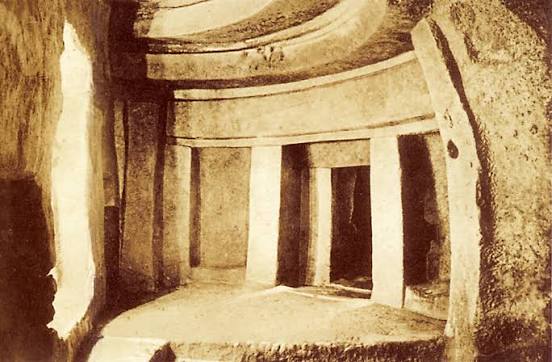
The Ħal Saflieni Hypogeum — the name derives from Greek, meaning “underground chamber” — is unlike anything else in European prehistory. Carved over at least fifteen centuries from the soft globigerina limestone beneath the town of Paola in southern Malta, it descends through three levels to a depth of roughly ten metres. Its chambers, niches, and passages were shaped with stone tools alone, and their walls bear traces of the red ochre spiral paintings that also decorate Malta’s above-ground megalithic temples.
The site was used primarily as a communal burial place. The excavated deposits contained a vast quantity of commingled human bone. UNESCO describes the Hypogeum as having originally contained the remains of approximately 7,000 individuals. This is an archaeological estimate, not a count of 7,000 separately identified skeletons.
On current dating, the complex was in use during the Maltese Neolithic — approximately 4000 to 2500 BCE — encompassing the Ġgantija phase, the Saflieni phase, and the Tarxien phase that represents the height of Malta’s prehistoric temple civilisation. UNESCO inscribed the Ħal Saflieni Hypogeum as a World Heritage Site in 1980. It remains one of the best-preserved prehistoric underground monuments in the world.
What makes the Hypogeum particularly unusual — even by the standards of prehistoric Europe — is the architectural sophistication of its principal chambers. The second level contains spaces that reproduce, in carved stone, the corbelled ceilings, trilithon doorways, and horizontal beam details found in Malta’s above-ground temples. These features were not structural necessities underground; they appear to have been deliberate aesthetic and symbolic choices, suggesting that the people who built this complex understood architectural space in ways we can observe but not fully interpret.
The Discovery and Excavation
In 1902, workers drilling a cistern for a new housing development in Paola broke through the roof of an underground chamber. The discovery was initially kept quiet by the property owner. Word eventually reached the colonial authorities, and formal excavation began in 1903 under the direction of Father Emmanuel Magri, a Jesuit priest with archaeological training.
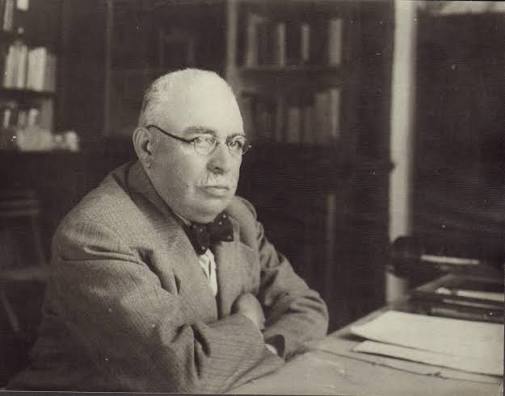
Following Magri’s death in Tunisia in 1907 — and the loss of his excavation notes — Themistocles Zammit assumed responsibility for the work. Zammit, then director of the Malta Museum and the island’s first professionally trained archaeologist, continued the investigation methodically until 1911, recording the architecture, documenting the find contexts, and cataloguing the human remains and associated objects. The loss of Magri’s notes means that the documentation for the earliest phase of excavation is incomplete.
What Was Found Inside
The vast quantity of commingled human bone recovered from the three levels indicates that the Hypogeum served a funerary function over many generations — likely for a sizeable community and possibly for people of specific social status, given the architectural elaboration of the principal chambers. The site’s scale as a communal burial ground is established by the archaeological record; the precise count of individuals cannot be recovered from commingled, disarticulated remains.
Associated finds included pottery in styles consistent with the Saflieni and Tarxien phases, bone and shell ornaments, small animal figurines, and at least one object that has become one of Malta’s most recognisable prehistoric artefacts: the Sleeping Lady. This small terracotta figure, dated to around 3000 BCE, depicts a reclining form on what appears to be a couch or bed. The pose has been interpreted as representing ritual sleep, incubation dreaming, or death — practices associated with healing sanctuaries in the ancient Mediterranean. Its precise findspot within the Hypogeum was not recorded in detail by the early excavators, limiting interpretive conclusions. It is now housed at the National Museum of Archaeology in Valletta.
The Hypogeum’s walls retain traces of red ochre decoration, most prominently spirals and honeycomb patterns. Red ochre decoration is a recurring feature of Maltese prehistoric sites and may carry symbolic significance related to blood, fertility, or ritual. In the Hypogeum context, where the dead were interred, the meaning is uncertain. The decoration is damaged and fragmentary, and its original extent is not fully known.
The Skulls: What the 1912 Publication Actually Says
In 1912, Temi Zammit, Eric T. Peet and R.N. Bradley published The Small Objects and the Human Skulls Found in the Hal-Saflieni Prehistoric Hypogeum at Casal Paula, Malta. The text is available via the University of Malta’s Open Access Repository at um.edu.mt/library/oar/handle/123456789/9125. This is the primary documentary source for what was actually observed about the skulls recovered from the Hypogeum.
The 1912 publication examined 11 measurable skulls from the site and included individual cranial measurements. However, the surviving published record does not support claims that an entire population possessed extraordinarily elongated skulls. Dolichocephaly is a natural classification of skull proportions and does not establish an unusual species, nonhuman origin or extraterrestrial connection.
What the 1912 publication does not describe: skulls lacking cranial sutures, skulls of nonhuman proportions, skulls whose volume exceeds the human range, skulls attributed to an extraterrestrial population, or thousands of skulls with unusual morphology. These descriptions appear in internet sources and alternative history videos, not in the original documentation.
Anatomising the Claims
The most widely circulated claims about the Hypogeum skulls can be assessed directly against the primary sources.
Claim: Thousands of elongated skulls were discovered. The 1912 publication examined 11 measurable skulls. The broader skeletal deposit was not the subject of a comprehensive cranial morphology study, and no subsequent peer-reviewed analysis has reported a figure of “thousands” of elongated skulls. The characterisation of the entire assemblage as composed of elongated skulls has no documented basis.
Claim: The skulls lack a parietal plate or cranial sutures. Absent cranial sutures — specifically the absence of the sagittal or coronal sutures — would be a genuine anatomical anomaly. This claim does not appear in the 1912 Zammit, Peet and Bradley publication, nor in any subsequent peer-reviewed anatomical study of the Hypogeum material. The claim is consistently associated in internet sources with the Paracas skulls from Peru — a different archaeological collection on a different continent — and appears to have been applied to the Malta material without a traceable primary source.
Claim: The skulls disappeared or were removed from public view. Heritage Malta has stated that the skulls were held in its reserve collection and had not been publicly exhibited since 1995. The institution opened the exhibition Alien Headaches? The Hypogeum Skulls Enigma in December 2020, and the display continued into 2021. The skulls did not disappear; they were in institutional storage between public exhibitions, which is standard archival practice for fragile archaeological material.
Claim: The skulls are extraterrestrial or represent a separate nonhuman species. No physical anthropologist, anatomist, or archaeologist who has examined the Hypogeum skeletal material has described the remains as nonhuman. The dolichocephalic skulls documented in 1912 are within the range of natural human anatomical variation. The extraterrestrial interpretation does not derive from the excavation literature or from subsequent scientific analysis of the material.
The Oracle Chamber: Sound, Resonance and What the Research Found
Among the Hypogeum’s chambers, the Oracle Room on the second level has attracted particular scientific interest for a reason that is real, documented, and genuinely unusual: its acoustic properties.
The most rigorous peer-reviewed investigation of the Hypogeum’s acoustics was conducted by Rupert Till of the University of Huddersfield and published in Antiquity in 2017 (DOI: 10.15184/aqy.2016.258). Till’s systematic measurements identified primary resonances in the Oracle Chamber at approximately 41, 72 and 76 Hz — frequencies in the lower end of the acoustic range.
The Oracle Room also features a small aperture cut into the wall. Whether this aperture was intentionally positioned for acoustic effect, or whether it served another function, cannot be determined from the physical evidence alone.
The acoustic resonances documented by Till are a real and scientifically measurable property of the chamber. Whether they were intentionally designed, whether prehistoric users perceived them as significant, and whether they influenced ritual behaviour are separate questions that the acoustic data alone cannot answer.
What acoustic research does not establish: that the builders consciously engineered the Oracle Room as an acoustic instrument, that the resonances were intended to alter consciousness, that any acoustic frequency at this site has genetic or DNA-level effects on those present, or that the properties require an explanation beyond the natural behaviour of the limestone in which the chamber is carved. These are interpretations imposed on the acoustic data, not conclusions that follow from it.
What the Evidence Actually Supports
The Ħal Saflieni Hypogeum is one of the most remarkable prehistoric monuments in the world. Its construction — carried out over many generations with stone, bone, and antler tools in a soft but demanding limestone — required significant organisational capacity, architectural knowledge, and sustained communal investment. The people who built it were not primitive. They were the same prehistoric culture that constructed the Ġgantija temples on Gozo—part of a group UNESCO ranks among the earliest free-standing stone buildings in the world—and the Tarxien temples of Malta, with their elaborate spiral carvings and altar niches.
The Hypogeum is consistent, in every documented feature, with the funerary and ritual practices of Malta’s Neolithic temple builders. The dolichocephalic skulls fall within the natural range of human anatomical variation. The acoustic properties of the Oracle Chamber are real and peer-reviewed, but they do not require a supernatural or extraterrestrial explanation. The Sleeping Lady is a sophisticated and moving object, but she is consistent in material, style, and context with other Neolithic Maltese figurines.
The Hypogeum’s real mystery is not extraterrestrial. It is the mystery of a sophisticated civilisation that flourished on a small island for over a thousand years, built monuments of remarkable technical and aesthetic accomplishment, and then — around 2500 BCE, for reasons that remain unclear — appears to have collapsed or disappeared. The people who used the Hypogeum left no written records. What they believed, how they organised themselves, and why their civilisation ended are questions the archaeology raises but cannot fully answer.
That is a genuine and profound historical mystery. It does not require skulls without sutures or alien architects to be worth taking seriously.
Evidence Assessment
| Claim | Status | Evidence Note |
|---|---|---|
| Hypogeum is a prehistoric funerary complex | Confirmed | Excavation, radiocarbon dating, UNESCO documentation |
| 11 measurable skulls documented in the 1912 publication | Confirmed | Zammit, Peet & Bradley (1912); text available via University of Malta OAR |
| Some skulls classified as dolichocephalic | Confirmed | Within normal human anatomical variation; common in ancient Mediterranean populations |
| Skulls held in Heritage Malta’s collection | Confirmed | Heritage Malta; December 2020 exhibition “Alien Headaches? The Hypogeum Skulls Enigma” |
| Oracle Chamber has documented acoustic resonances (approx. 41, 72, 76 Hz) | Confirmed | Till, Antiquity (2017), DOI: 10.15184/aqy.2016.258 |
| Thousands of elongated skulls were found | Not Supported | 1912 publication documents 11 measurable skulls; no peer-reviewed study reports thousands |
| Skulls lack cranial sutures | Not Supported | Absent from 1912 publication and all subsequent Malta-specific anatomical literature; claim derives from Paracas material |
| Skulls disappeared or were permanently concealed | Not Supported | Skulls were in reserve collection 1995–2020; publicly exhibited December 2020 by Heritage Malta |
| Skulls are nonhuman or extraterrestrial | Not Supported | No anatomical or scientific study of the material has described nonhuman characteristics |
| Oracle Chamber acoustics were intentionally engineered | Unresolved | Resonances are documented; builder intent cannot be established from physical evidence alone |
■ Related Investigations on The UFO Times
- The Serapeum of Saqqara: Egypt’s Giant Stone Sarcophagi — another ancient construction whose precision has generated extraterrestrial claims
- The Ancient Astronaut Theory: Origins and Evidence — the broader framework into which the Hypogeum claims fit
- Ancient Aliens and Archaeology: What the Experts Say — how archaeologists assess the ancient-alien hypothesis
- Göbekli Tepe: The 12,000-Year-Old Temple — another prehistoric construction that has challenged established chronologies
- Father Carlo Crespi and the Metallic Library — an artefact mystery with similar provenance difficulties
Frequently Asked Questions
Sources and Further Reading
Primary and Official Sources
- Zammit, T., Peet, E.T., & Bradley, R.N. (1912). The Small Objects and the Human Skulls Found in the Hal-Saflieni Prehistoric Hypogeum at Casal Paula, Malta. Available: um.edu.mt/library/oar/handle/123456789/9125
- Heritage Malta — Ħal Saflieni Hypogeum official site page
- Heritage Malta — “The Hypogeum Skulls on Display at the National Museum of Archaeology” (December 2020 exhibition announcement)
- UNESCO World Heritage Centre — Ħal Saflieni Hypogeum (Site No. 130)
- Till, R. (2017). An archaeoacoustic study of the Ħal Saflieni Hypogeum on Malta. Antiquity, 91, 74–89. DOI: 10.15184/aqy.2016.258
Alternative and Contextual Sources
- Hancock, G. (1995). Fingerprints of the Gods. — the foundational alternative-civilisation hypothesis that contextualises claims about Maltese prehistory
- Feder, K. (2013). Frauds, Myths, and Mysteries: Science and Pseudoscience in Archaeology. — the standard archaeological assessment of claims of this type
Further Reading
Mainstream Archaeology
Frauds, Myths, and Mysteries — Kenneth Feder
The most readable academic assessment of archaeological mystery claims. Feder applies consistent scientific method to separate verifiable evidence from speculation — directly applicable to the Hypogeum skull narrative.
View on Amazon →Alternative Interpretation
Fingerprints of the Gods — Graham Hancock (1995)
The foundational text for the lost advanced civilisation hypothesis. Malta’s prehistoric temples are among the sites Hancock discusses in building his argument. Understanding his framework is essential context for assessing the alternative claims about the Hypogeum.
View on Amazon →Alternative Interpretation
America Before — Graham Hancock (2019)
Hancock’s updated argument for a pre-Ice Age civilisation, incorporating more recent archaeological discoveries. His treatment of prehistoric sacred sites and their acoustic and astronomical properties is directly relevant to the Hypogeum debate.
View on Amazon →ⓘ Affiliate disclosure: The UFO Times participates in the Amazon Associates programme and earns commissions on qualifying purchases. Our editorial positions are independent of affiliate relationships.
■ The UFO Times — Ancient Mysteries
New investigations, every week.
Evidence-led ancient mysteries, prehistoric archaeology and the cases that mainstream coverage gets wrong.
Editorial Note — Our Standards
Two images are used in this article, both verified as public domain: an early twentieth-century interior photograph from Wikimedia Commons, and a pre-1935 portrait described as Themistocles Zammit. Eight additional images were removed because their creators, reuse rights, or connection to the Ħal Saflieni Hypogeum could not be independently established. The 1912 skull publication (Zammit, Peet and Bradley) is cited by its correct title and is available via the University of Malta Open Access Repository. Acoustic frequencies cited follow Till’s peer-reviewed Antiquity 2017 study, not earlier unpublished or non-peer-reviewed reports. The human-remains figure follows the UNESCO World Heritage documentation for Site No. 130, which describes approximately 7,000 individuals as an archaeological estimate, not a count of separately identified skeletons. The UFO Times applies the same standard to all archaeological investigations: Facts First. Mystery Second. Speculation Last.