
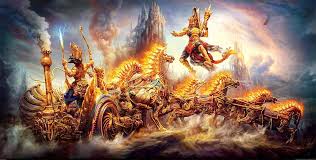
The Mahabharata, one of the two great Sanskrit epics of ancient India, contains hundreds of references to flying vehicles called Vimanas — along with descriptions of aerial battles, divine weapons, and technologies that bear an unsettling resemblance to modern warfare. Written between roughly 400 BCE and 400 CE, the texts record traditions that may be far older.
Consider the following passage, taken from the Ramayana — one of the oldest surviving epic poems in human history, composed in Sanskrit and dated by most scholars to somewhere between the 5th and 1st centuries BCE, though the oral traditions it records are almost certainly older:
"The Pushpaka Vimana that resembles the Sun and belongs to my brother was brought by the powerful Ravana; that aerial and excellent car going everywhere at will... that car resembling a bright cloud in the sky... and the King got in, and the excellent car at the command of the Raghira, rose up into the higher atmosphere."
The word "Vimana" — from the Sanskrit for "having been measured out" or "traversing" — appears hundreds of times in ancient Indian literature. It refers, depending on context, to a palace, a temple tower, or — most intriguingly — a flying vehicle. The descriptions are not vague. They are specific, consistent, and technical enough that in the 20th century, aeronautical engineers took them seriously enough to analyze them.
Whether those analyses vindicated or debunked the ancient accounts depends very much on which account you read — and which texts you take as primary sources.
What the Texts Actually Say
The Vimana references in ancient Indian literature are not clustered in a single obscure text. They appear across a remarkable range of sources spanning thousands of years.
In the Rigveda — among the oldest religious texts in the world, dating to roughly 1500–1200 BCE — there are references to a three-wheeled, three-seated vehicle that travels through the sky at the command of the Ashvins, divine twin physicians associated with the dawn. The vehicle is described as moving swifter than the mind, carrying the gods between heaven and earth.
In the Ramayana, the Pushpaka Vimana — originally created by the divine architect Vishwakarma, stolen by the demon king Ravana, and subsequently used by the hero Rama after Ravana's defeat — is described in considerable detail. It can fly in any direction at will. It adjusts its size depending on how many passengers it carries. Its interior is beautifully appointed. It moves silently through the sky at great speed. When Rama uses it to fly from Lanka back to his kingdom of Ayodhya, he is able to observe the landscape below him — rivers, mountains, and the site of the great battle — from the air.
In the Mahabharata — the longer of the two great Sanskrit epics, comprising roughly 100,000 verses — the Vimana references multiply dramatically. There are aerial chariots of the gods, flying palaces used by kings, and detailed accounts of aerial warfare. The Kaurava king Duryodhana is described as observing his troops from a Vimana. Divine beings travel between worlds in them. Arjuna, the great warrior hero, is taken to the heavens aboard a Vimana to receive divine weapons.
And then there are the weapons.
The Weapons That Disturb Nuclear Physicists
No discussion of Vimanas can avoid the weapons described in the same texts — because the weapons are, if anything, more troubling than the flying machines.
The Mahabharata describes a weapon called the Brahmastra in terms that have struck multiple readers, including scientists, as uncomfortably familiar. Here is one passage, describing the aftermath of a Brahmastra's use:
"A single projectile charged with all the power of the Universe... An incandescent column of smoke and fire, as brilliant as ten thousand suns, rose in all its splendour... it was an unknown weapon, an iron thunderbolt, a gigantic messenger of death which reduced to ashes an entire race. The corpses were so burned as to be unrecognizable. Their hair and nails fell out. Pottery broke without cause. Birds whitened... After a few hours, all foodstuffs were infected."
The symptoms described — hair loss, nail loss, food contamination, mass burning, the characteristic mushroom-shaped column of fire — are a precise match for the effects of a nuclear weapon and the radiation sickness that follows. Robert Oppenheimer, who led the Manhattan Project and watched the first atomic bomb test at Trinity, New Mexico, was reportedly asked whether this was the first nuclear explosion in history. His answer, often quoted, was: "In modern times, yes."
Oppenheimer was a student of Sanskrit. He was familiar with the Mahabharata. Whatever he meant by that answer, he did not dismiss the comparison as absurd.
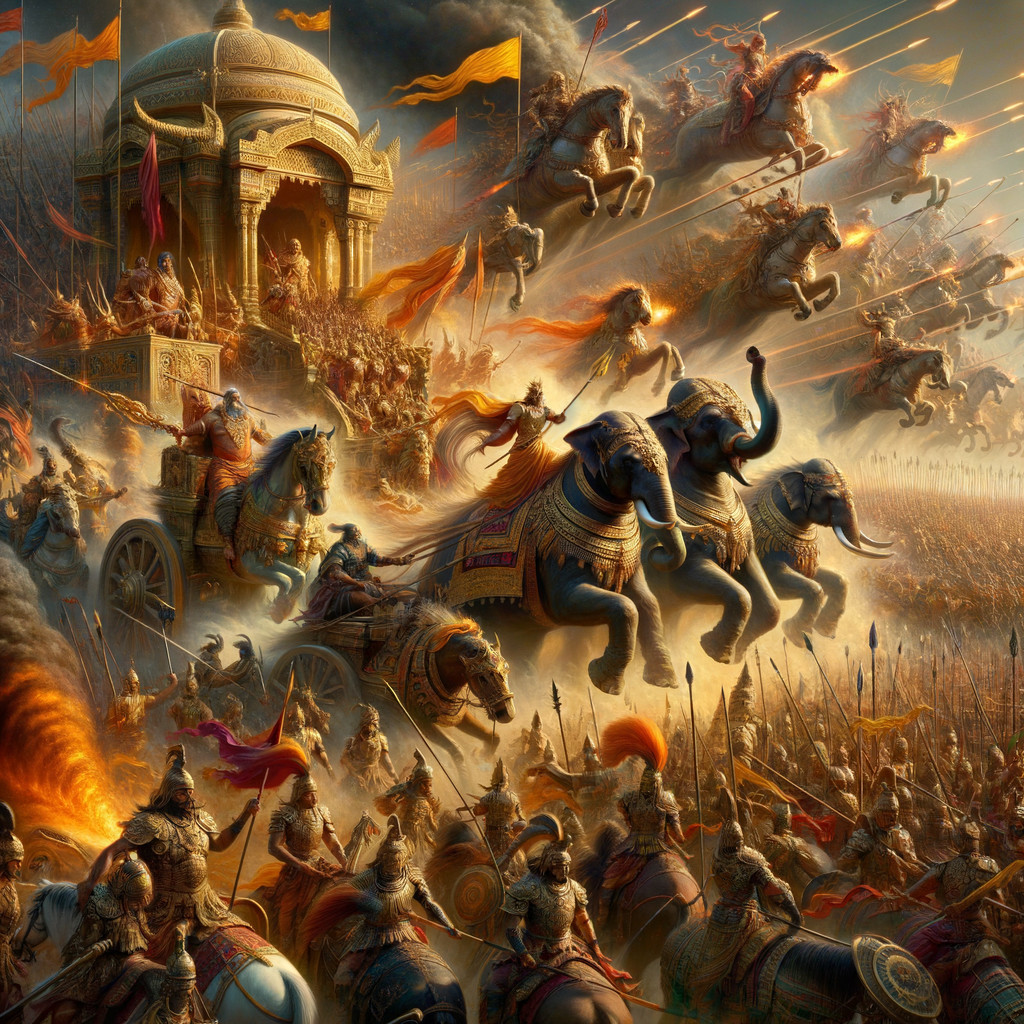
The Kurukshetra War as depicted in traditional Indian art. The Mahabharata's descriptions of the battle include references to aerial combatants, divine weapons of mass destruction, and flying vehicles launching attacks from the sky. Multiple nuclear physicists have noted the similarity between the Brahmastra's described effects and those of a nuclear detonation.
The Vaimanika Shastra: The Most Specific — and Most Problematic — Source
If the Ramayana and Mahabharata provide tantalizing but interpretable descriptions of flying vehicles, the Vaimanika Shastra provides something entirely different: a technical manual.
The Vaimanika Shastra — "Science of Aeronautics" — describes different types of Vimanas, their construction materials, propulsion systems, navigational instruments, and the clothing pilots should wear at different altitudes. It names specific metals and alloys from which the craft should be built. It describes instruments for detecting storms, weapons systems, and methods of making the craft invisible.
It is, on its face, a remarkable document. There is, however, a significant problem with using it as evidence of ancient technology: it was written in the early 20th century.
The Vaimanika Shastra was dictated between 1904 and 1923 by Pandit Subbaraya Shastry, a Sanskrit scholar in Bangalore, who claimed to be channeling the work through psychic contact with the ancient sage Bharadvaja. It was transcribed, illustrated, and eventually published. Its most enthusiastic proponents treat it as a rediscovery of authentic ancient knowledge. Its critics note that it was produced by a single individual over a 19-year period in the early 20th century, that no manuscript predating Shastry's dictation has ever been found, and that its technical descriptions cannot be independently verified as ancient.
In 1974, a team of aeronautical engineers and scientists at the Indian Institute of Science in Bangalore conducted a formal analysis of the aircraft designs described in the Vaimanika Shastra. Their conclusion was unambiguous: the designs were aerodynamically unsound. None of the craft described could fly. Several were structurally incoherent. The report stated that the Vaimanika Shastra "cannot be," in the authors' words, a document of aeronautical knowledge — ancient or otherwise.
This does not resolve the question of Vimanas in the Ramayana and Mahabharata, which predate Shastry by two millennia. But it does mean that the Vaimanika Shastra — often cited as the primary technical evidence for ancient Indian aviation — cannot bear the evidentiary weight placed on it.
The Kailasa Temple: A Different Kind of Evidence
Those who argue for advanced ancient Indian technology often point to a structure that requires no textual interpretation at all: the Kailasa Temple at Ellora, in Maharashtra.
The Kailasa Temple is not built — it is carved. The entire structure, comprising a main tower 32 meters high, a massive courtyard, subsidiary shrines, and elaborate sculpted elephants supporting the whole complex, was excavated top-down from a single basalt cliff. An estimated 400,000 tons of rock were removed to create it. The precision of the carving, executed from the top downward — meaning no mistakes could be corrected once made — has baffled engineers who have studied it.
The temple is attributed to the 8th century CE Rashtrakuta king Dantidurga, though some researchers argue the sophistication of the engineering points to knowledge and techniques that the historical record does not account for. It is, like Puma Punku and the Great Pyramid, a structure that makes you ask: how exactly did they do this?
The Kailasa Temple at Ellora, Maharashtra. The entire structure — 32 meters high, including a massive courtyard, subsidiary shrines, and sculpted elephants — was carved from a single basalt cliff, working from the top down. An estimated 400,000 tons of rock were removed with a precision that modern engineers find difficult to fully explain. It is the largest monolithic structure ever excavated in human history.
The Ancient Astronaut Interpretation
The ancient astronaut reading of the Vimanas is straightforward: the flying vehicles described in Sanskrit texts were real craft — either belonging to an advanced human civilization now lost to history, or to extraterrestrial visitors whom the ancient Indians interpreted as gods.
The strongest version of this argument rests not on the Vaimanika Shastra but on the internal consistency of the ancient texts. The Vimana descriptions in the Rigveda, the Ramayana, and the Mahabharata were composed across many centuries, by different authors, in different regions. Yet the descriptions share common features: vehicles that fly under intelligent control, that carry multiple passengers, that can travel vast distances, and that are associated with beings of superhuman power. If these were purely mythological constructs, why are they so consistent? Why do they include details — the ability to observe the landscape from above, the adjustment of size for cargo — that would be meaningless in a world without flight?
The weapons argument adds another layer. The Brahmastra's described effects — the blinding flash, the column of fire, the radiation sickness symptoms — are not the kind of destruction that ancient people would have imagined from conventional warfare. Swords, arrows, and siege engines do not cause hair loss or food contamination. The descriptions suggest a first-hand account of something no ancient poet should have been able to imagine.
Giorgio Tsoukalos, one of the most prominent voices in the ancient astronaut field, has argued that the Vimanas represent not myth but memory — cultural transmission of actual experiences with technology that the civilization that produced them could not explain in modern terms, and so described in the religious and poetic language available to them.
What Mainstream Scholars Say
The mainstream scholarly position on Vimanas is that they are mythological — literary devices representing divine power, not technical descriptions of real aircraft.
In this reading, the Pushpaka Vimana is not a flying machine but a metaphor for divine sovereignty: Ravana possesses it because he has stolen divine power; Rama takes it because he has restored righteous order to the cosmos. The flying vehicle is a symbol of cosmic authority, not a vehicle in any literal sense.
The Brahmastra, in this interpretation, is a divine weapon granted by the god Brahma — a literary hyperbole conveying the absolute destructive power of a divine being, not a technical description of a nuclear device. Ancient authors describing the wrath of gods routinely used catastrophic imagery. The comparison to nuclear weapons, scholars argue, reflects modern readers' tendency to interpret ancient texts through the lens of contemporary knowledge.
On the internal consistency argument, scholars note that mythological traditions frequently share common features across large geographic and temporal ranges without implying a common factual origin. Dragon myths appear independently on multiple continents. Flood myths appear in cultures with no known contact. Consistency in mythology reflects the consistency of the human imagination, not necessarily a shared historical experience.
The Vaimanika Shastra, mainstream scholars largely agree, is a 20th century document and should be evaluated as such.
Where the Honest Uncertainty Lies
Both positions — the ancient astronaut reading and the mainstream scholarly one — rest on assumptions that are worth examining.
The mainstream view assumes that ancient people could not have had firsthand experience of flight or advanced weaponry, and therefore that any description of such things must be symbolic or imaginary. This is a reasonable prior — but it is a prior, not a proof. If an advanced civilization did exist in the ancient world, or if extraterrestrial contact did occur, the mainstream assumption would be wrong by definition.
The ancient astronaut view assumes that consistency across texts implies a common factual origin, and that the nuclear parallels are too specific to be coincidental. These are also reasonable observations — but they stop short of proof. Imaginative consistency across a literary tradition does not require a historical basis, and the nuclear weapon comparison, while striking, requires interpreting ancient poetic language through a very specific modern lens.
What can be said with confidence: the Vimana tradition is one of the most detailed and internally consistent descriptions of technology in any ancient literature. The texts describe aircraft with a specificity — directional control, passenger capacity, aerial observation capability — that goes well beyond what mythological purposes would seem to require. The weapons descriptions contain details that remain unexplained by any conventional interpretation of ancient Indian warfare.
And the Kailasa Temple stands — 400,000 tons of rock removed, carved from the top down, in a single basalt cliff — as physical evidence that ancient Indian civilization possessed engineering capabilities that we still struggle to fully account for.
None of this proves that ancient India had aircraft. But it does suggest that the question deserves more serious attention than it typically receives.
UFO Times Evidence Assessment
- ESTABLISHED Vimana descriptions appear consistently across multiple ancient Sanskrit texts spanning thousands of years. The Vaimanika Shastra is a 20th century document, not an ancient one.
- ESTABLISHED The Kailasa Temple at Ellora is a genuine engineering marvel. 400,000 tons of rock were removed from a single cliff with extraordinary precision, top-down.
- CREDIBLE The Brahmastra descriptions in the Mahabharata contain details — radiation sickness symptoms, blinding flash, food contamination — that are not easily explained by conventional ancient warfare imagery.
- SPECULATIVE That the Vimana descriptions reflect real aircraft, whether belonging to an advanced ancient civilization or extraterrestrial visitors. Consistent with the texts, but not proven by them.
- UNSUPPORTED Any specific claim about Vimana propulsion, materials, or technology. The Vaimanika Shastra's technical specifications have been shown by engineers to be aerodynamically unsound.
Related Investigations
Recommended Reading
Chariots of the Gods — Erich von Däniken (1968)
Von Däniken’s foundational treatment of ancient Sanskrit texts as possible accounts of extraterrestrial technology — the book that brought Vimana literature to the attention of the modern world.
View on Amazon →The 12th Planet — Zecharia Sitchin (1976)
Sitchin’s analysis of Mesopotamian and Indian ancient texts proposes that flying craft described in scripture were literal accounts of Anunnaki aerospace technology — placing the Vimana tradition within a global pattern of ancient aviation evidence.
View on Amazon →Forbidden Archaeology — Michael A. Cremo & Richard L. Thompson (1993)
Cremo and Thompson’s survey of suppressed historical evidence — including ancient texts and artefacts that suggest technological capabilities far beyond what mainstream history assigns to ancient Indian civilisation.
View on Amazon →Go Deeper
Essential Reading on Ancient Technology
Erich von Däniken's Chariots of the Gods first brought Vimanas to a Western audience in 1968. David Childress's Vimana Aircraft of Ancient India & Atlantis provides the most comprehensive treatment of the primary texts. Our bookstore has both — along with the full range of essential ancient mysteries reading.
Browse the Bookstore →