
Ancient Aliens and Archaeology: The Evidence Mainstream Science Struggles to Explain
Across six continents and five millennia, the archaeological record contains structures, artefacts, and engineering achievements that our best current understanding of ancient human capability cannot comfortably explain. This is not a fringe position. It is the quiet acknowledgement of professional archaeologists who, when pressed, will concede that the gap between what ancient peoples are supposed to have been capable of and what they demonstrably achieved is wider than textbooks suggest. The ancient aliens hypothesis — that non-human intelligence provided technological or intellectual assistance to early human civilisations — is one attempt to bridge that gap. It is not the only one. But it is the one that the evidence keeps returning to.
This is a rigorous examination of the strongest archaeological cases: the sites that have generated the most serious debate, the anomalies that remain formally unresolved, and the honest limits of what the current evidence does and does not support.
Göbekli Tepe: The Discovery That Changed Everything
In 1994, German archaeologist Klaus Schmidt began excavating a hill in southeastern Turkey that local farmers had long avoided because it was strewn with flint. What he found beneath that hill demolished one of the foundational assumptions of human prehistory.
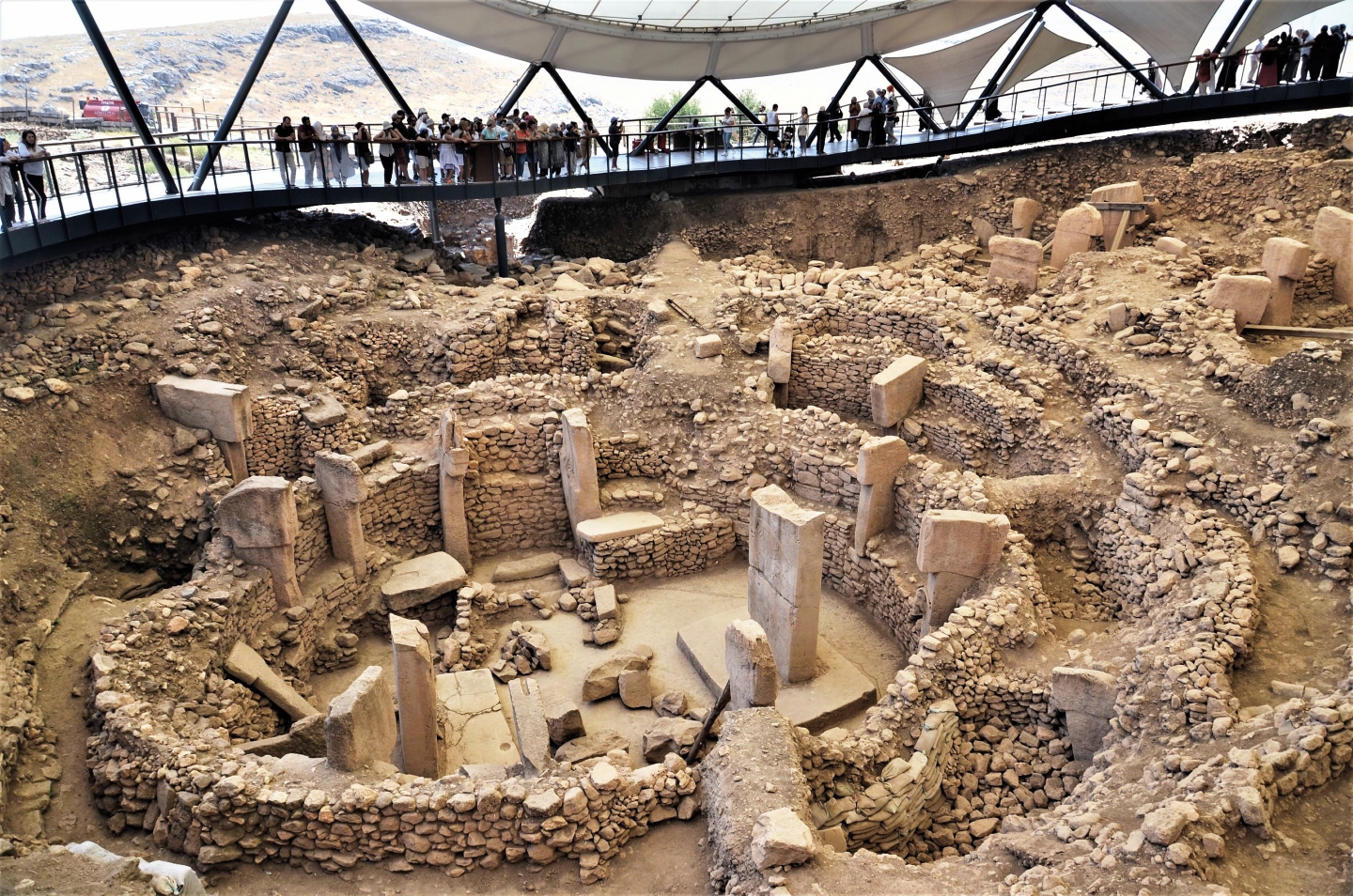
Göbekli Tepe — “Potbelly Hill” in Turkish — is a series of circular stone enclosures containing T-shaped limestone pillars up to six metres tall and weighing up to 20 tonnes. The pillars are decorated with carved reliefs of animals: foxes, scorpions, lions, vultures, snakes, and abstract symbols. The entire complex was built approximately 12,000 years ago — roughly 6,000 years before Stonehenge, 7,000 years before the Egyptian pyramids, and at a time when, according to the standard archaeological model, human beings were nomadic hunter-gatherers who had not yet invented agriculture, the wheel, or settled community life.

This creates an archaeological paradox that has not been resolved. The standard model holds that complex architecture follows settled civilisation: you need agriculture first, then surplus food, then specialist labour, then monumental construction. Göbekli Tepe inverts that sequence entirely. The site required the coordinated effort of hundreds of people, the quarrying and transport of multi-tonne stones, and sustained artistic and engineering skill — all produced by people who, by the received model, should not yet have been capable of it.
More provocatively: someone buried it. Göbekli Tepe was deliberately and systematically filled in — around 8,000 BCE — with stone rubble and soil. It was not abandoned. It was intentionally concealed, in a process that itself required enormous organised effort. Why? Nobody knows. The answer has never been found in the archaeological record, and the question has not been convincingly answered by the academic consensus.
The ancient aliens interpretation of Göbekli Tepe is straightforward: a site of this complexity, built at this date, by people of this technological level, suggests outside assistance or knowledge that pre-dates our current understanding of human development. The conventional interpretation — that we simply underestimated the capability of Neolithic hunter-gatherers — raises more questions than it answers, because it requires us to explain not just Göbekli Tepe but why no comparable sites from the same period have been found.
→ Read our full investigation into Göbekli Tepe
Puma Punku: The Precision That Defies the Bronze Age
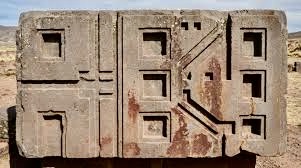
At 3,825 metres above sea level in the Bolivian Andes, the site of Puma Punku contains what many engineers and archaeologists regard as the most precisely worked stone in the ancient world. The blocks — primarily red sandstone and grey andesite, some weighing over 130 tonnes — feature right angles, perfectly flat surfaces, and interlocking H-shaped grooves cut to tolerances measured in fractions of a millimetre. Many of the cuts appear to have been made with a tool capable of consistent straight-line cutting at extreme precision — a capability not attributed to any pre-Columbian culture in the region.
The andesite used at Puma Punku is one of the hardest stones available, rating 7 on the Mohs scale. The culture responsible for the site — Tiwanaku — had no iron tools. They had bronze, bone, and stone. The technology required to achieve the observed cuts in andesite using only those materials has never been experimentally replicated to the satisfaction of engineers who have studied the site in detail. The blocks were also transported from quarries between 10 and 90 kilometres away, across terrain that includes Lake Titicaca — meaning either enormous rafts or organised land transport of multi-tonne stones in the absence of wheeled vehicles.
The conventional explanation attributes the stonework to sustained skilled labour and lost techniques. It is possible. It is not demonstrated. The ancient aliens interpretation — that the precision reflects tool technology beyond what Tiwanaku culture is known to have possessed — cannot be dismissed on current evidence.
→ Read our full investigation into Puma Punku
Baalbek: The Largest Stones Ever Moved by Human Hands
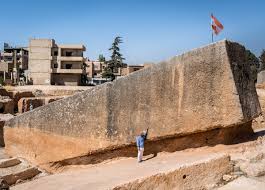
In the Bekaa Valley of Lebanon, the Roman temple complex of Baalbek sits on a foundation platform that contains the largest dressed stone blocks ever incorporated into any structure in human history. The trilithon — three individual limestone blocks forming part of the western retaining wall — weighs approximately 800 tonnes each. They were quarried over a kilometre away, transported to the site, and raised to a height of approximately eight metres with millimetre precision.
In the quarry itself, an unfinished block known as the “Stone of the Pregnant Woman” weighs an estimated 1,000 tonnes. A second unfinished stone discovered nearby in 2014 weighs approximately 1,650 tonnes — the largest known quarried stone on Earth. It was never moved. The Romans, who built the temple complex on top of the existing platform, did not move stones of this size anywhere else in their empire. Their own engineering records contain no technique that could account for the trilithon blocks.
The question of who built the original platform — the one the Romans built on top of — is genuinely unresolved. The Romans inherited it. Pre-Roman occupation of the site is documented but the construction date of the megalithic platform itself has never been established with certainty. The ancient aliens hypothesis holds that the platform predates any known civilisation with the demonstrated capability to build it. This is, as of 2026, an archaeologically open question.
The Great Pyramid: Numbers That Still Defy Explanation
The Great Pyramid of Giza is the most studied structure in human history and the only one of the Seven Wonders of the Ancient World still standing. It contains approximately 2.3 million stone blocks averaging 2.5 tonnes each, with some granite blocks in the King’s Chamber weighing up to 80 tonnes. The base covers 53,000 square metres. The four sides align with true north, south, east, and west to within fractions of a degree of arc — an astronomical precision that modern GPS surveying has confirmed repeatedly.
The engineering problem is not that the pyramid was built. It is the rate at which it was built. Current Egyptological consensus attributes the Great Pyramid to Pharaoh Khufu, with a construction timeline of approximately 20 years. Simple arithmetic — 2.3 million blocks in 20 years, working 365 days a year, 10 hours a day — requires placing one block every 4.5 minutes, continuously, for two decades. This calculation has never been satisfactorily answered by experimental archaeology. The largest modern stone-moving experiment, conducted with hundreds of workers and modern equipment, achieved rates far below what the 20-year timeline demands.
There are also astronomical relationships embedded in the pyramid’s dimensions that have generated sustained academic controversy. The ratio of the pyramid’s perimeter to its height approximates the value of 2π to four decimal places — a mathematical relationship that would require its builders to have understood the concept of pi, for which no other evidence exists in the historical record until Greek mathematicians formalised it over two thousand years later. Whether this is intentional encoding, coincidence, or a consequence of a different measurement system is actively debated by mathematicians and Egyptologists.
→ Read our investigation into the pyramids and the engineering problem
The Nazca Lines: Artwork Designed to Be Seen From the Air
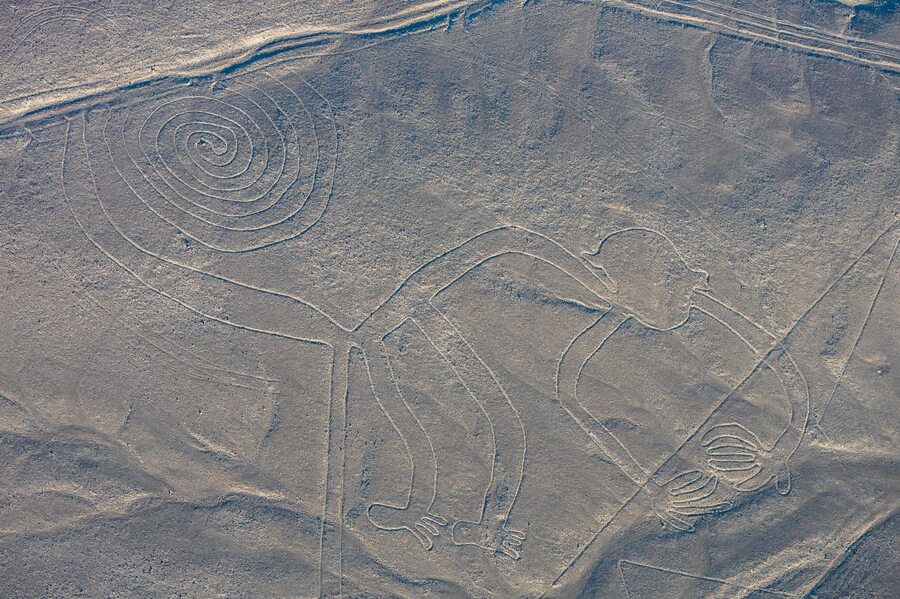
Etched into the coastal desert of southern Peru between approximately 500 BCE and 500 CE, the Nazca Lines comprise hundreds of geometric shapes, straight lines extending for kilometres, and figurative geoglyphs — hummingbirds, spiders, monkeys, fish, condors, and humanoid figures — some spanning over 300 metres. The lines were created by removing the reddish surface stones to reveal the lighter ground beneath. They have survived for two millennia because the Nazca plateau is one of the driest and most wind-free environments on Earth.
The central problem is one of perspective. The figurative geoglyphs are only coherent from altitude. At ground level, they are simply lines in the desert. The Nazca people had no known aircraft. The conventional explanation — that the figures were created using simple surveying techniques with wooden stakes and cords — has been partially demonstrated experimentally, but the demonstration addresses the mechanical question of how the lines were drawn, not the design question of why figures were created at a scale only appreciable from the sky.
Maria Reiche, the German mathematician who dedicated her life to studying the lines from the 1940s until her death in 1998, believed they represented an astronomical calendar. Subsequent analysis has partially supported and partially undermined this interpretation. The astronomer Gerald Hawkins found fewer astronomical alignments than Reiche believed; other researchers have found more. The purpose of the Nazca Lines remains, formally, unknown — and that is the position of the academic consensus, not a fringe claim.
→ Read our full investigation into the Nazca Lines
The Kailasa Temple: Carved Downward from a Single Rock
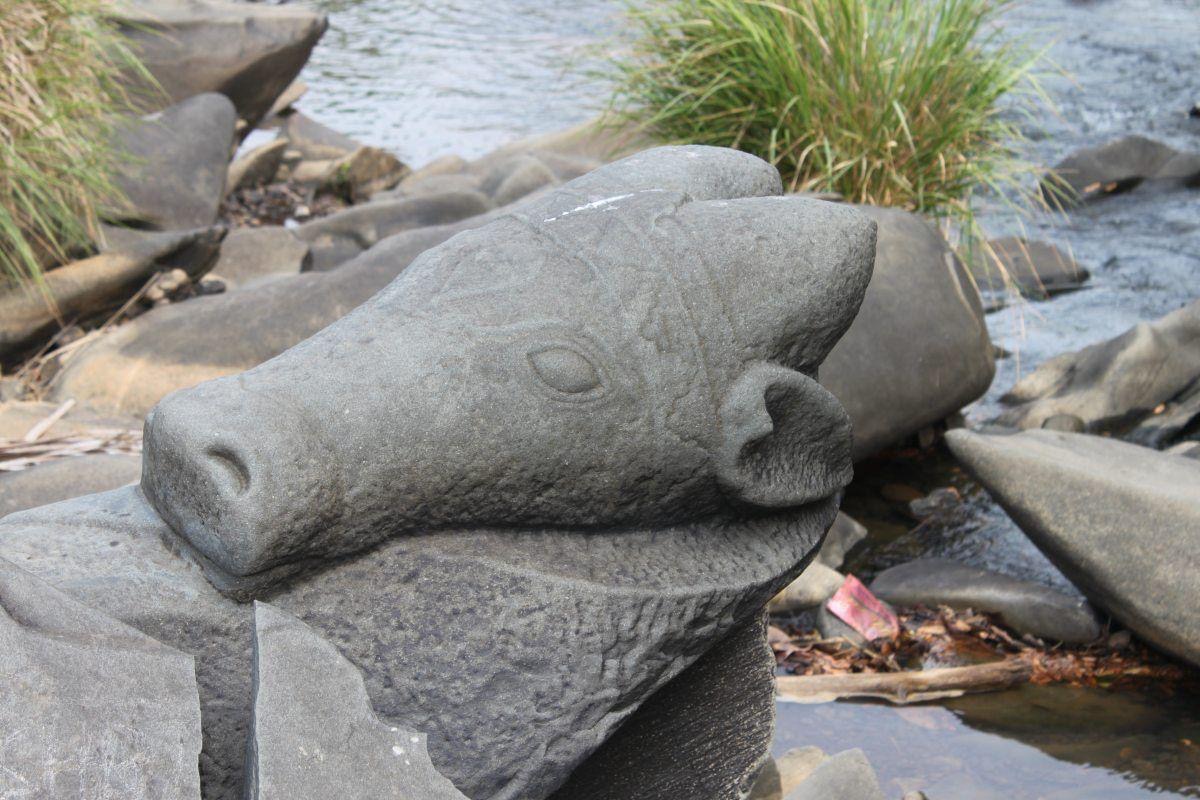
The Kailasa Temple at Ellora in Maharashtra, India, is the largest monolithic structure in the world — carved not by adding material but by removing it. The entire temple, including its multiple levels, ornate towers, carved elephants, and detailed friezes, was excavated downward from a single basalt cliff face. An estimated 200,000 tonnes of rock were removed in the process.
The Hindu inscription attributes its construction to the 8th-century ruler Krishna I of the Rashtrakuta dynasty. What the inscription does not explain is the logistics. The construction required removing rock from the top down, which means workers could not see the full structure they were creating as they carved it. The precision of the finished result — a structurally coherent, architecturally sophisticated temple complex — implies master planning of a kind that archaeologists have not been able to reconstruct from period tools and techniques. One 16th-century account claims that the temple’s own builder, upon seeing it completed, said: “It is impossible that I built this.”
Whether that anecdote is historical or legendary, the engineering challenge it gestures at is real. The Kailasa Temple remains one of the most technically demanding construction achievements of the ancient world, and the methods by which it was achieved have not been definitively established.
The Cross-Cultural Pattern: What It Means
The sites above are separated by thousands of kilometres and thousands of years. Göbekli Tepe is in Turkey; Puma Punku is in Bolivia; Baalbek is in Lebanon; the Great Pyramid is in Egypt; the Nazca Lines are in Peru; Kailasa is in India. The cultures that built them had no documented contact with each other. Their languages, religions, and social structures were entirely different.
And yet the pattern of anomalies is consistent: precision stonework beyond demonstrated tool capability; transport of masses that should have been impossible; astronomical alignments requiring sophisticated mathematical knowledge; construction timelines that the available labour force cannot account for; and, in several cases, a deliberate orientation toward the sky — upward-facing geoglyphs, astronomical alignments, temple axes tracking celestial events — that implies a relationship with the heavens that goes beyond religious metaphor.
The conventional archaeological position is that each anomaly has a local explanation that we have not yet fully recovered. Lost techniques, misunderstood timelines, overestimated difficulty. This may be correct. What it requires, however, is that we accept multiple independent instances of lost knowledge, each at a different site, each in a different culture, each producing a similar class of anomaly. That accumulation of independent coincidences is precisely what the ancient aliens hypothesis was formulated to address.
What the Ancient Aliens Hypothesis Actually Claims
It is worth being precise about what the ancient aliens hypothesis does and does not claim, because popular presentations of it — driven largely by the television series of the same name — have attached it to claims that are much weaker than the core argument.
The core argument is this: the archaeological record contains achievements that exceed the demonstrated technological capabilities of the cultures that produced them, and the simplest explanation for this gap is that those cultures received assistance or knowledge from an intelligence operating beyond their own developmental level. That intelligence could be extraterrestrial — beings from another planet who visited Earth and assisted early humans. It could also be, as Jacques Vallée and others have argued, a non-human intelligence of a different kind: something that has interacted with human civilisation across deep time in ways we do not fully understand.
What the hypothesis does not require is the specific claims that populate cable television: that individual monuments were built by aliens using levitation, that every ancient civilisation worshipped the same extraterrestrial beings, or that mainstream archaeologists are engaged in a deliberate cover-up. Those are elaborations, not the core argument — and they are largely unsupported by evidence. The core argument stands on the engineering anomalies themselves, which are real, documented, and unresolved.
What Mainstream Archaeology Says — Honestly
Professional archaeologists, when speaking frankly rather than defensively, acknowledge the anomalies described above. The argument within the discipline is not whether the anomalies exist but what they mean.
The mainstream position is methodological: in the absence of positive evidence for extraterrestrial involvement, the working hypothesis should be human agency using techniques we have not yet recovered. This is a reasonable scientific principle. It is not, however, a disproof of the alternative. Absence of evidence for extraterrestrial involvement is not evidence of absence — particularly given that the most classified programmes of the United States government have, as of 2023, produced sworn Congressional testimony claiming the recovery of non-human materials from crash sites. If that testimony is accurate, it changes the prior probability that non-human intelligence has interacted with Earth significantly enough to affect how we should evaluate ancient engineering anomalies.
The position that seems most defensible, given the full weight of current evidence, is this: the ancient aliens hypothesis is not confirmed, but it is not irrational. The engineering anomalies are real. The cross-cultural pattern is genuine. The gap between what ancient peoples are known to have been capable of and what they demonstrably achieved is wider than conventional accounts acknowledge. Whether that gap was bridged by lost human techniques, by a lost civilisation that pre-dates the accepted record, or by external intelligence is a question that the evidence currently leaves open.
Recommended Reading
View on Amazon →
View on Amazon →
View on Amazon →
View on Amazon →
Related Articles
- → Göbekli Tepe: The Site That Rewrote Human History
- → Puma Punku: The Precision Stone That Defies Explanation
- → The Nazca Lines: Artwork for the Gods
- → The Pyramids: Engineering Impossibility or Lost Knowledge?
- → Chariots of the Gods: The Book That Started It All
- → Graham Hancock: The Case for a Lost Civilisation
- → Robert Bauval and the Orion Correlation Theory
- → Zecharia Sitchin: The Anunnaki Hypothesis